
Welcome to your Friday edition of the Best of Bylines newsletter, bringing you a standout article from one of our 10 UK national and regional publications – and this is no ordinary start to the weekend.
This is the day Andy Burnham becomes leader of the Labour Party and, as a result, Prime Minister of the United Kingdom. In his latest speeches, he has said social care will be a key priority for his new government. But how will the country’s significant disabled population fit into his social and economic policies?
This insightful article from James Waterson of North East Bylines asks why cutting disability social security is often presented as an easy way to save taxpayers’ money. Whilst it may sound simple, the picture appears much more complex when you examine what happens after the benefits money disappears. Drawing on examples from the Tees Valley, James reveals the impact of such policy changes on individuals and the wider economy.
Andy Burnham has previously championed an “inclusive growth” model in which disability, health and employment are treated as central issues rather than peripheral costs. And a decade of austerity has shown that cutting public spending doesn’t automatically make costs vanish.
Before we go any further, it’s worth asking why we rarely hear the phrase “social security” anymore. Over time, it has largely been replaced by the word “benefits“ – a subtle but important shift in language.
Social security describes a system that we all contribute to and may rely on at different points in our lives. By contrast, “benefits” has increasingly come to imply a one-way handout rather than a shared safety net.
Reclaiming the language of social security means reclaiming its original purpose: providing security when people face circumstances beyond their control.
That distinction matters because social security for disabled people is often misunderstood. It is not a reward for being unable to work, or a financial bonus. It exists to help meet the unavoidable extra costs of disability, from mobility aids and specialist equipment to accessible transport, higher energy bills and personal care. For many people, it is the difference between participating in society and being excluded from it.
This reflects the social model of disability, which recognises that people are disabled not simply by their medical conditions but by the barriers society creates.
Those barriers can include inaccessible transport, unsuitable housing, workplaces that fail to make reasonable adjustments, or the extra costs that accompany living with a disability.
Social security for disabled people helps remove some of those barriers, enabling people to work, study, care for their families and participate in their communities. It is not about paying people to be disabled; it is about reducing the economic disadvantages that disability too often brings.
And that support doesn’t disappear into a savings account. It is spent on groceries, heating, taxis, pharmacy bills and other everyday essentials. That spending supports local businesses, keeps people in work and circulates through communities. Economists call this the multiplier effect.
You don’t have to look far to see why this matters. The Tees Valley is still rebuilding after decades of deindustrialisation. Steelworks, shipyards and heavy industry may have declined, but local businesses still depend on customers walking through the door.
Today, around 74,000 working-age people in the Tees Valley are disabled, almost one in five adults of working age, a higher proportion than the England average.
They are employees, parents, carers, volunteers, business owners and customers. When disability support is cut, it’s not just disabled households that feel the impact. It’s a café losing regular customers, a taxi firm getting fewer bookings and a corner shop seeing less money through the till.
Another persistent myth is that social security for disabled people discourages people from working.
The government says it wants to boost economic growth by helping more people move from welfare into employment, but its current approach appears to assume that reducing financial support will push people into jobs.
In reality, without tackling structural barriers such as inaccessible transport, inadequate workplace adjustments and the extra costs of disability, cutting support is more likely to push people into poverty than into work as evidenced in the austerity years.
Disability social security is not paid because someone is unemployed; it is paid because living with a disability costs more. A wheelchair does not become cheaper because you have a job, nor do the costs of running medical equipment, paying for accessible transport or buying assistive technology simply disappear. For many disabled people, social security is what makes employment possible, not what prevents it.
To be fair to policymakers, the pressure on public finances is real. The cost of disability social security has risen significantly in recent years (most likely induced by the mass disabling event of Covid-19) and it makes an obvious target for a Treasury desperate to balance the books and reduce the national deficit.
However, cutting disability social security might reduce spending on one government spreadsheet, but it can increase costs almost everywhere else.
People without adequate support are more likely to need NHS treatment, social care, housing assistance and mental health services. Family members may reduce their own working hours to provide unpaid care. Any short-term savings can quickly be swallowed by higher costs elsewhere.
This is not efficient. It’s moving the bill from one department to another.
Unbiased. Independent. Honest. A community that champions everyday citizens and unheard voices. We don’t have oligarch owners, corporate controllers or political paymasters – we have a community of 2,500 volunteer writers and editors, and over 350,000 readers. Help power Britain’s biggest citizen journalism movement. Become a member of our Friends of Bylines Network scheme today.
Become a Friend of Bylines Network
Then there’s another part of the story that’s often overlooked: the Purple Pound. This is the spending power of disabled people and their households.
While the UK spends tens of billions annually on disability social security, this must be weighed against the economic engine that is the Purple Pound. When you subtract the support that enables disabled people to spend, you shrink that multi-billion-pound market, ultimately costing the Treasury more in lost tax revenue than it saves on welfare.
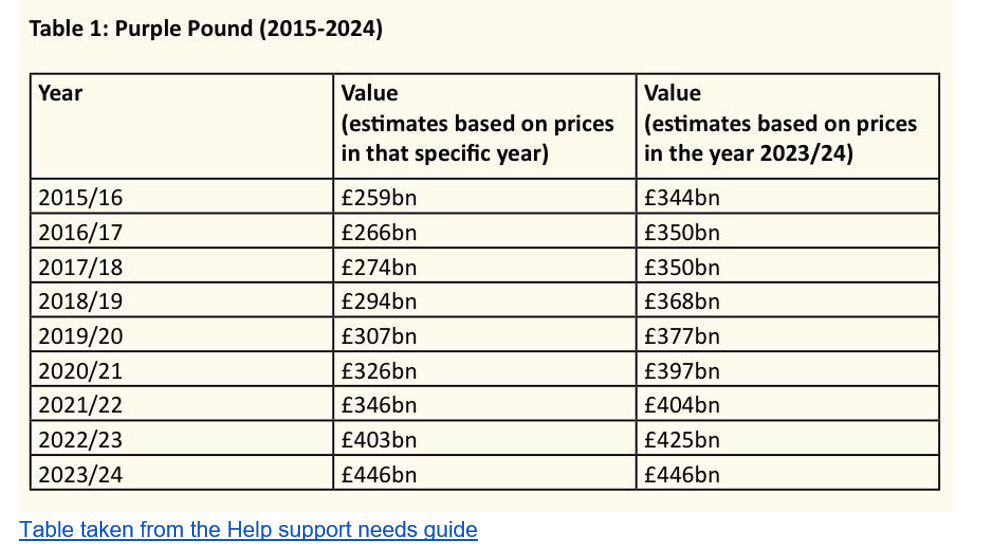
Estimates of the Purple Pound vary depending on how it is measured. Most place it in the region of £274 billionbut research by the University of Bristol puts it at £446 billiona year in the UK. Even looking at the more conservative figure, this represents around one fifth of all consumer spending, rising significantly when the spending of families and carers are then also included. It reflects both the scale of disabled consumers and their wider economic influence.
What was once described as “£1 in every £10” is now widely understood to be £1 in every £5 using the conservative estimate.
Businesses know this, which is why more companies are investing in accessible shops, step-free entrances, captioned content, inclusive customer service and accessible websites.
They’re not doing it out of charity. They’re doing it because disabled customers spend money like everyone else, and if one business isn’t accessible, another one will be.
Accessibility isn’t just good ethics; it’s good business.
Economic growth depends on making the best use of people’s skills and talents. Disabled people work across every sector of the economy, while many others volunteer, care for relatives and contribute to their communities in ways that don’t always appear in GDP statistics.
Reducing disability support risks fewer people staying in work, lower consumer spending, reduced tax revenues and greater pressure on already stretched public services.
In other words, cutting disability social security doesn’t simply affect disabled people, it affects employers, local businesses, public services and the wider economy.
The debate shouldn’t be about whether disabled people “cost” the economy. The evidence concludes the opposite.
For example, the Organisation for Economic Co-operation and Development (OECD) suggests that exclusion reduces growth, while inclusion increases participation, productivity and demand. You can read more about the Productivity-Inclusiveness Nexus here.
Supporting disabled people enables them to participate, spend, work and contribute. The Purple Pound exists because disabled people are an important part of Britain’s economy, not a burden on it.
If the government is serious about economic growth, cutting the spending power of one of the country’s largest consumer groups seems a curious place to start.
As of today, Andy Burnham is the new leader of the Labour Party and the UK Prime Minister. It’s worth bearing in mind that he has increasingly argued for an “inclusive growth” model in which disability, health and employment are treated as central economic issues rather than peripheral costs.
As he arrives in Downing Street, his previous political messaging stands out. He has been clearer on this issue than much of the national debate: you do not grow an economy by sidelining the people who need support to participate in it.
If Britain is serious about growth, productivity and public finances, it will eventually have to settle whether policy treats disabled people as a cost to be contained or as contributors to be enabled. Right now, too much of Westminster still behaves as if it cannot decide.
Read James’ recent story about the Tees Valley Combined Authority’s finance chief, Jo Moore, who moved from reassuring councillors she was staying to quitting her role amid secret talks to write off airport and other debts, as revealed in the minutes of its latest Audit and Governance Committee.
Comments
Nothing yet. Say the first thing.
Sign in to join the conversation.