
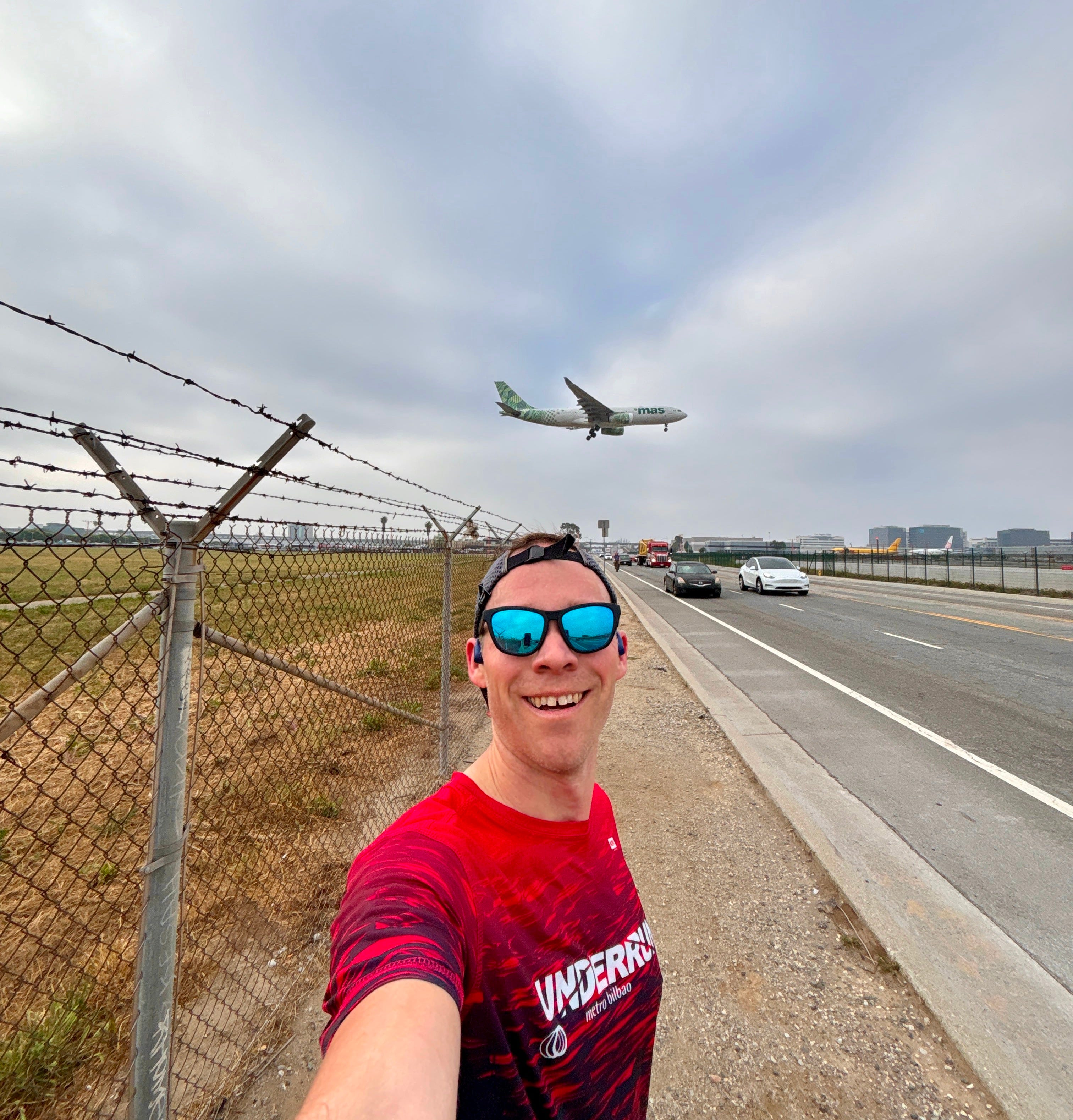
With the first hint of dawn peeking through the marine layer, I set out for a run. A run that would take me, not along one of the many wonderfully wild urban trails of the Los Angeles Basin, but around a locale that looms large in the minds of Angelenos: LAX. The airport is not that large, less than 11 miles around, given its logistical and cultural importance. And those 11-ish miles are surprisingly accessible. I covered the airport’s four-ish mile northern perimeter along a low-traffic, tree-line arterial. Then, after a jog around some closed off dunes, down to the Pacific Ocean path. It was a gray morning with departing flights disappearing in cloud as they flew overhead. By mile seven, I was following Imperial Highway, not the most inspiring urban street but at least there was a bike lane, and through the rolling El Segundo hills. Miles nine and 10 were, by far, the least picturesque. Freeways. Traffic. Lengthy street crossings with long waits. And, along on Aviation Boulevard directly under the flight path to runways 25L and 25R, no sidewalk at all. It was a good a run.
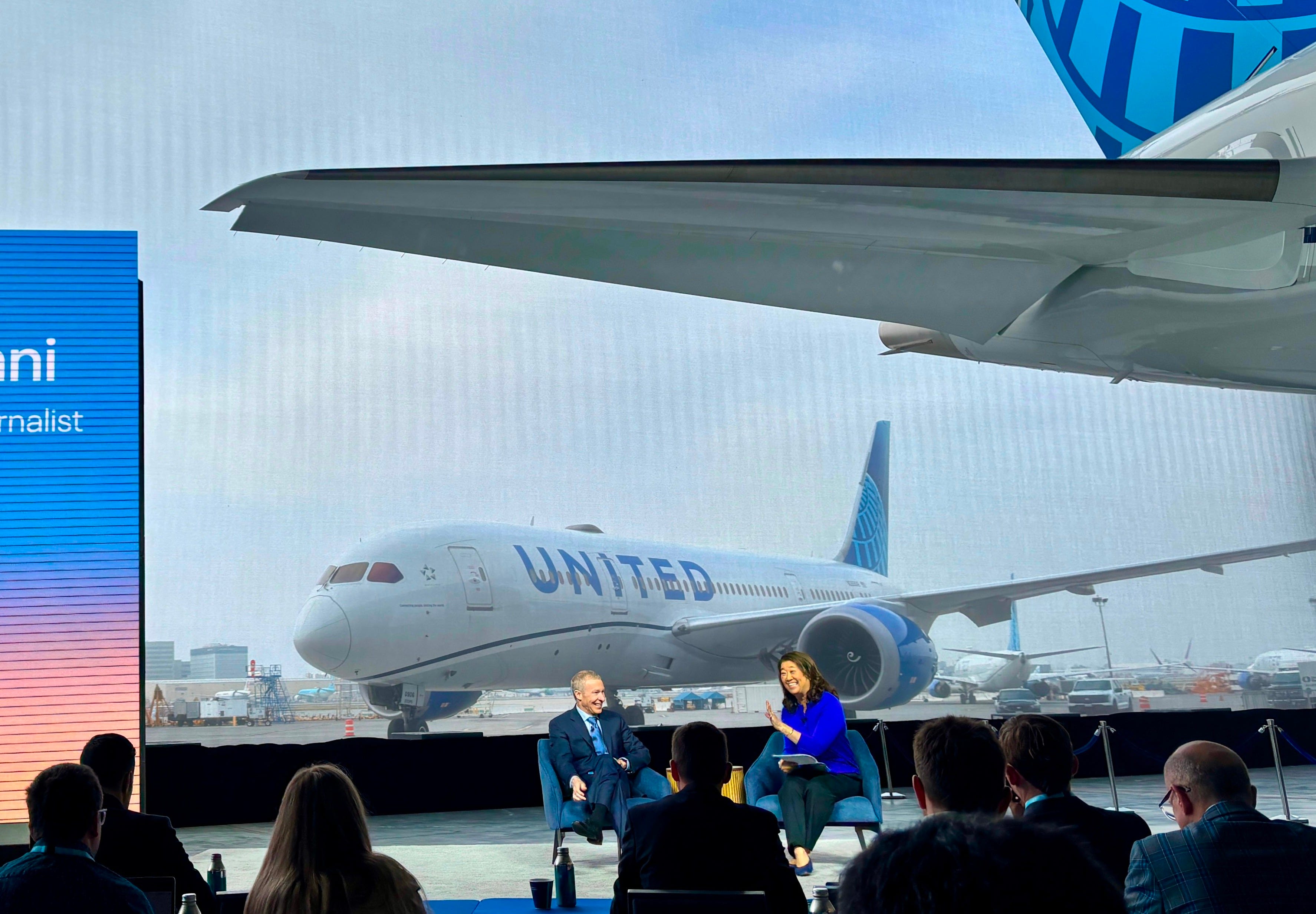
At United’s media extravaganza in Los Angeles last week, the airline doubled down on premium with four new posh layouts: the Boeing 787-9 Premium, A321neo “Coastliner,” A321XLR and CRJ450, the latter being a modified CRJ200 with nine fewer seats. “We have realized that the demand for premium was much higher than we ever knew … it’s like we’re finally creating supply to meet the demand for premium,” United CEO Scott Kirby told the assembled crowd. Time will tell if he’s right. (FlightGlobal, TPG)
Kirby wasn’t so bullish on eVTOLs at busy airports. “With everything in the airspace, the tragedy that happened in DC with the helicopter, I don’t think we need more rotor aircraft operating in crowded airspace,” he said. eVTOL developers have long pitched transport to and from airports, think JFK to Manhattan or the Embarcadero to SFO, as one of their primary use cases. Talk about a buzz kill. (FlightGlobal)
What’s in a brand? I sat down with Hawaiian CEO Diana Birkett Rakow to talk about how the airline’s retains that “je ne sais quoi” that makes it so strong as part of Alaska Airlines. Hint: it’s more than just paint on a plane. (TPG)
American Airlines and the Miami airport unveiled a $1 billion expansion to the western end of Concourse D (aka, the North Terminal) with a new three-story, 17-gate stinger replacing a single holdroom serving the same number of ground-level gates. The renderings look nice but, as I understand it, the project is not even at 30% design and subject to change. That said, anything is an improvement over the bleak D60 waiting area today. (TPG)
Plus, RTX’s tech suite for U.S. air traffic control; airlines cut flights as fuel prices skyrocket; heads to Sin City; American, Southwest and JetBlue are dropping cities; Frontier, however, is still growing; the FAA caps flights at O’Hare; preclearance at Billy Bishop; Bom dia, New York; WestJet cuts 16 U.S. routes; and Breeze adds 17 routes. (FlightGlobal, Travel+Leisure, TPG)
How the Iran war further shrank “the world’s passable skies.”
Accessibility is critical for airlines and that includes understanding and addressing the challenges of Deaf fliers, USA Today’s Zach Wichter wrote in a recent column. One reader even wrote him to say that airlines often provide them with a wheelchair — a wheelchair! — because she is Deaf 🤦🏻♂️ Not OK. (My mother-in-law is Deaf and these challenges are something she’s dealt with.)
Some airports have struggled with TSA queues during the latest partial government shutdown. While it is tough to design for such a unique scenario, architects told Fast Company that terminals can, and do, include flexibility to accommodate massive queues when needed in space that otherwise “blend into the landside space.” Art is another great form of distraction.
Boeing certified higher maximum takeoff weight variants of the 787-9 and -10 that provides for nearly 500 miles in additional range. That’s good news for airlines like Air New Zealand that are eager to stretch their Dreamliner legs a little further — or maybe just reduce weight restrictions on existing routes.
I’m all for United’s new headphone requirement but, as a parent of small children, I worry about the edge cases. I explained my reservations to Chris Dong in Afar.
Spirit wants to be a premium, big city Allegiant. That was before oil prices soared.
The numbers don’t lie: compared to other travel items — like hotels and ski lift tickets — airfares, “despite how it feels, they have been moving down more than up.”
United’s high-density Boeing 777s certainly aren’t my favorite plane but I will miss them when they’re gone. There’s something about a domestic widebody that is 🤌
Los Angeles Metro demonstrated how to get people excited about transit with a merch drop.
The Interborough Express to LaGuardia? Say more, and maybe after a direct transit connection to Manhattan.
The Beltline is a must-visit every time I’m in Atlanta. I love running the trail through the new, and reused, development and neighborhoods that it has spawned over the past decade or two. Diana Lind wrote an excellent piece on how every city should celebrate this pedestrian-oriented development.
The housing crisis in many major metros is one of the biggest challenges facing my generation (Millennials) and those after us. That’s why I am all for developments like Sen̓áḵw where a First Nations tribe, exempted from Vancouver’s planning rules, was able to build a beautiful, high-density development just minutes from downtown.
Below: The bridge between the terminal and Concourse A at the Denver airport is open again (yay!) for departing travelers.
No posts
Comments
Nothing yet. Say the first thing.
Sign in to join the conversation.