
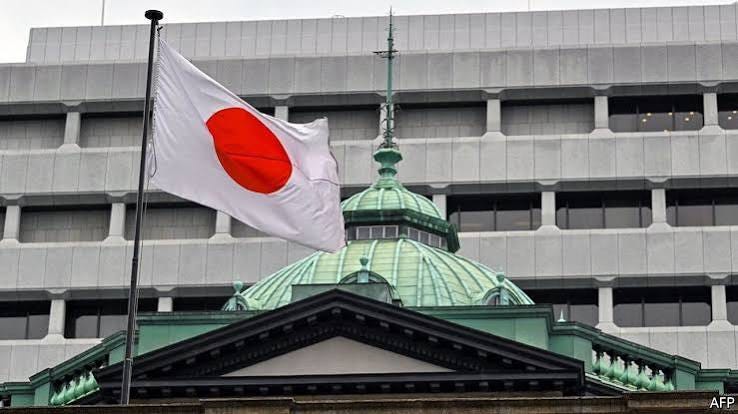
Last Friday, the U.S. Treasury did something it hadn’t done in 28 years; it stepped into currency markets to buy Japanese yen.
Passing the Torch Newsletter is a reader-supported publication. To receive new posts and support my work, consider becoming a free or paid subscriber.
By Monday, both governments had confirmed it. Treasury Secretary Scott Bessent posted that Friday’s coordinated action was meant to counter “disorderly” yen moves and that the U.S. “will not hesitate” to do it again. Days earlier, at a Camp David press event, photographers had captured a to-do list on Bessent’s notepad reading: “Buy Japanese Yen (JPY) $5–10 bil.” Given how carefully these events are staged, most observers read that as a deliberate leak.
It worked for now. The yen ripped from ¥163.73 per dollar, its weakest level in roughly 40 years, to ¥157.57 in a single session.
The official justification is “friendship”. President Trump told reporters the U.S. was sending a signal of goodwill because Japan asked for help. But peel back one layer and this is a story about foreign investment in United States treasuries.
Why Japan Was Out of Time
Japan’s problem comes down to one number: the gap between U.S. and Japanese interest rates.
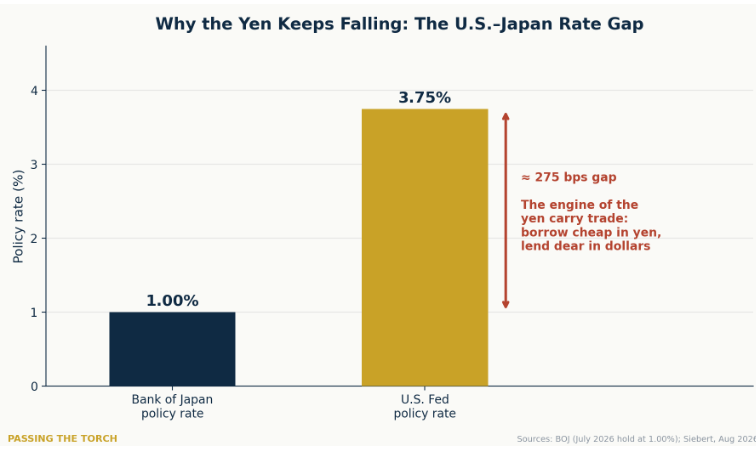
The Bank of Japan held its policy rate at 1.00% at the end of July, its highest level since 1995, but still miles below the U.S. Fed’s roughly 3.75%. That ~275 basis point gap is the engine of the global yen carry trade: investors borrow cheaply in yen, convert to dollars, and collect the higher yield on U.S. assets. Every one of those trades involves selling yen. As long as the gap stays wide, gravity pulls the currency down.
And 2026 kept making it worse. Elevated oil prices from the Middle East conflict hit Japan, a country that imports nearly all its energy, directly through the exchange rate: a weaker yen makes every barrel and every bushel more expensive in local terms, which feeds inflation, which pressures the BOJ to hike, which pushes Japanese government bond yields to levels not seen in three decades. The 10-year JGB touched a 30-year high above 2.8% in July; the 30-year has traded above 3.7%. Meanwhile, Prime Minister Takaichi’s government is leaning into fiscal stimulus to offset the oil shock, adding more inflationary pressure and more bond supply. It’s a doom loop: weak yen → imported inflation → higher yields → fiscal strain → weaker yen.
Tokyo tried to break the loop alone. Earlier this year, Japan’s Ministry of Finance spent an estimated ¥6–7 trillion on solo interventions. The yen kept sliding anyway. When the currency lurched to ¥163.73 last Thursday in what officials described as a disorderly, accelerating sell-off, Japan needed something that money can’t buy: credibility. Specifically, American credibility.
That’s what makes joint intervention categorically different from solo intervention. When Japan acts alone, traders bet against a finite war chest. When the U.S. Treasury, the issuer of the currency on the other side of the trade, publicly joins in and promises more, traders are suddenly fighting both governments at once. The last time Washington and Tokyo jointly bought yen was 1998, during the Asian financial crisis. That means that what the Yen is currently experiencing is at that scale.
Why America Actually Cares
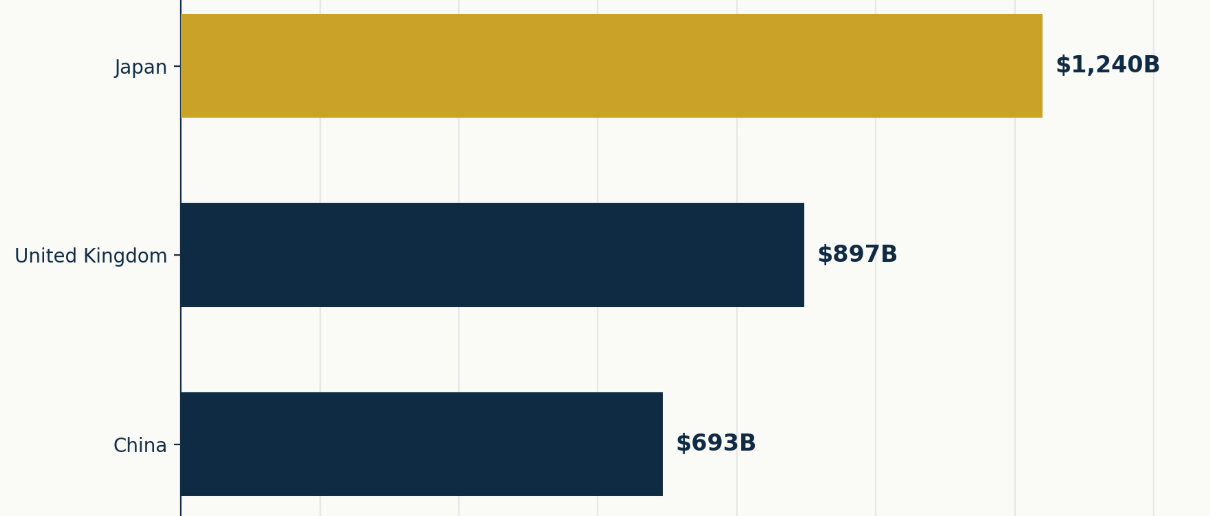
Here’s the part the “goodwill” framing skips over: Japan is the United States’ largest foreign creditor. As of the most recent Treasury TIC data, Japanese investors hold about $1.24 trillion in U.S. Treasuries — more than the U.K. ($897B) and far more than China ($693B).
How does a country defend its currency? It sells dollars and buys its own currency. And where does Japan keep its dollars? Overwhelmingly in U.S. Treasury securities.
So every yen of Japanese currency defense carried an implicit threat: to raise the dollars, Tokyo might have to dump Treasuries into the open market. And this is the worst possible moment for that. U.S. long-term borrowing costs are already strained — the Treasury sold 30-year bonds at a 5% yield this spring for the first time since 2007, and a string of auctions drew unusually weak demand. Japanese institutions had already sold roughly $29.6 billion of Treasuries and other U.S. bonds in Q1 2026, the largest quarterly net sale since 2022, as rising yields at home pulled money back to Japan.
A forced, large-scale MOF liquidation on top of that repatriation trend could have spiked yields across the curve and Treasury yields aren’t just some number, they have material impact on a litany of business operations. They set the floor for mortgage rates, corporate borrowing costs, and the interest bill on America’s own deficit. There’s also the carry trade itself: if the BOJ were forced to fight yen weakness purely with aggressive rate hikes, it could trigger a rapid unwind of trillions in yen-funded positions globally.
In other words: the U.S. didn’t intervene to rescue Japan from a weak yen. It intervened to rescue itself from what Japan might have to do about a weak yen.
The FIMA Firewall
Two interesting pieces about the style of intervention the United States conducted:
Piece one: the U.S. sold euros, not dollars. The New York Fed, acting for the Treasury’s Exchange Stabilization Fund, reportedly funded its yen purchases by selling euros from U.S. reserves — meaning Washington was technically strengthening the yen against the euro, and letting cross-rates transmit the effect to the dollar. Why the indirection? Selling dollars outright would look like the U.S. deliberately weakening its own currency, which isn’t a great move for the world’s reserve currency. Not everyone loves this design: Robin Brooks at the Peterson Institute warned that going through euros could muddy the signal, and former Treasury official Mark Sobel argued the whole exercise is unwise unless Japan tackles the underlying rate gap (an increasingly impossible task, I might add), quipping that the ESF “isn’t a hedge fund.”
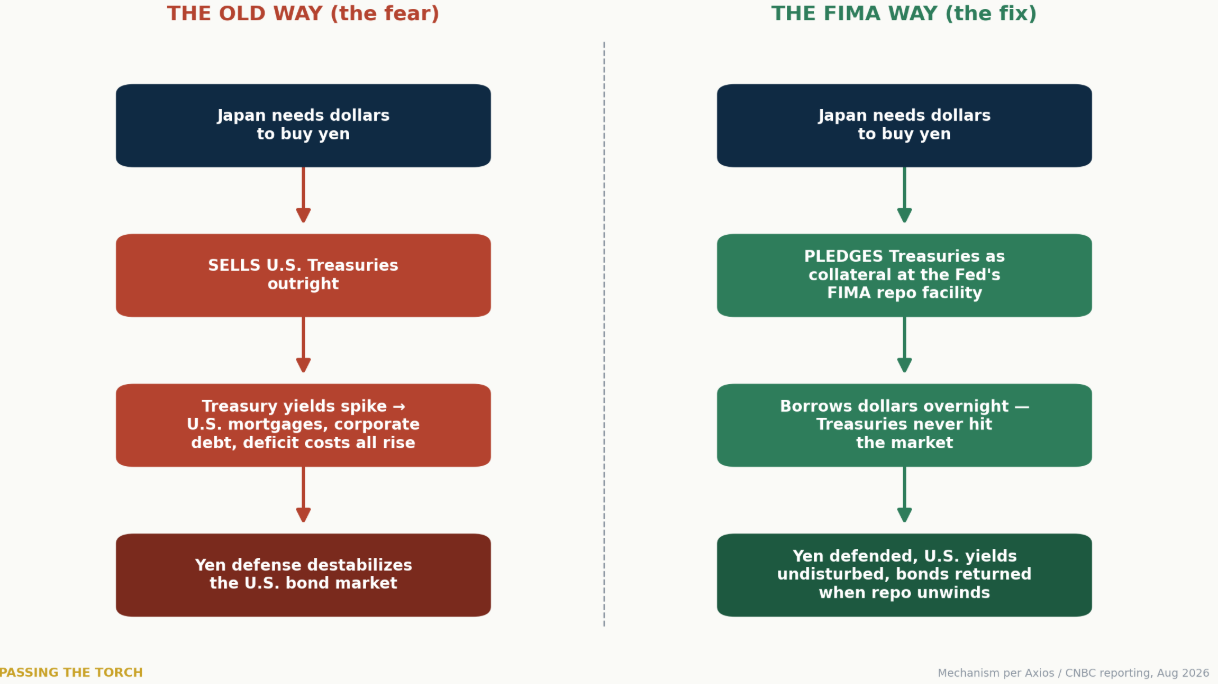
Piece two — the important one: the FIMA repo facility. The Fed operates a lending window for foreign central banks called the Foreign and International Monetary Authorities (FIMA) Repo Facility. The mechanics matter, so let’s walk through them:
Japan holds its dollar reserves largely as U.S. Treasury securities.
Under the old playbook, funding a yen defense meant selling those Treasuries for cash, thus pushing yields up in the process.
Under FIMA, Japan instead pledges those Treasuries to the Fed as collateral and borrows dollars against them, repo-style.
Japan gets the cash to buy yen. The Treasuries never touch the open market. When the repo unwinds, Japan gets its bonds back.
Japan’s Finance Ministry confirmed on Monday that it plans to use FIMA for future interventions and that announcement may matter more than the intervention itself. As State Street’s Masahiko Loo put it, advertising FIMA access tells markets that Japan can raise dollar liquidity without selling Treasuries, defusing the exact fear that made intervention dangerous for U.S. funding markets. The signal, in his words, “may be bigger than the intervention itself.” (This is a trend in the era of Bessent — using signaling techniques to make markets do the work for you. He understands, as someone who sat in the translator seat for decades, how to do the Cha Cha Slide).
The single biggest constraint on Japanese currency defense — “we can’t sell Treasuries without blowing up our ally’s bond market and our own portfolio” — is gone. In principle, Japan can now defend the yen indefinitely, at scale, with zero forced selling pressure on U.S. debt. The U.S. built a firewall between its largest creditor’s currency crisis and its own borrowing costs, using plumbing that already existed.
What This Means Going Forward
Intervention buys time but doesn’t change fundamentals. As ING’s analysts note, interventions create inflection points but can’t overturn the rate differential that’s driving yen weakness in the first place. Until the Fed cuts meaningfully or the BOJ hikes meaningfully, the 275bp gap remains, and the carry trade remains profitable. Watch the Fed’s cut timeline (markets have pushed it toward 2027) and the BOJ’s next moves.
The ESF is becoming an active policy tool. This is the second time in under a year Bessent has deployed the Exchange Stabilization Fund abroad — first stabilizing Argentina’s peso before its midterms (Argentina drew $2.5B and repaid in full), now the yen. ING’s strategists call it a “notable departure” from two decades of U.S. passivity on foreign exchange. Whatever you think of the policy, the precedent is set: the U.S. Treasury is back in the currency-intervention business.
The tell to watch: Treasury auctions and the 30-year JGB. If the firewall holds, U.S. long-end auctions should stabilize even as Japan intervenes. If Japanese yields keep climbing and repatriation accelerates anyway — FIMA solves the intervention channel of Treasury selling, but not the private investor channel — the underlying problem resurfaces.
Thanks for reading and as always, stay curious folks!
For sponsorship inquiries, or general questions, please contact us at: jaspergny@gmail.com
—J&E
Passing the Torch Newsletter is a reader-supported publication. To receive new posts and support my work, consider becoming a free or paid subscriber.
Comments
Nothing yet. Say the first thing.
Sign in to join the conversation.