

Here is the number that should be in every long-term capital markets assumption deck and is in none of them: the top 1% of American households now holds roughly 31% of all U.S. household net worth, while the entire bottom half of the country holds under 3%. That gap has continued to compound through one of the longest, and greatest, asset price booms this country has ever seen. Thanks to this article, you’ll probably never be able to look at a price chart going up and to the right again without a nagging feeling of disquietude.
Markets have treated this as a social statistic. It’s not just that. It’s a political inevitability with real market consequences, and the outputs are already visible: a DSA-backed mayor governing the financial capital of the world, avowed democratic socialists as some of the most-followed politicians in the country, and — critically — symmetric populism, because the right’s version (tariffs, industrial policy, pressure on the Fed, taxing endowments) is just as hostile to the pre-2016 asset-owner consensus as the left’s (wealth taxes, buyback restrictions, rent regulation). The debate in American politics is no longer whether to redistribute; it’s which direction and through which pipe.
The last forty years of U.S. asset returns rested on a specific policy regime: falling corporate tax rates, labor’s declining bargaining power pushing corporate profits to record shares of GDP, shareholder-primacy governance, an independent inflation-targeting Fed, and capital treated more gently than labor by the tax code. Every one of those pillars is now contested by an ascendant political coalition on at least one side of the aisle and usually both.
Run the transmission mechanisms:
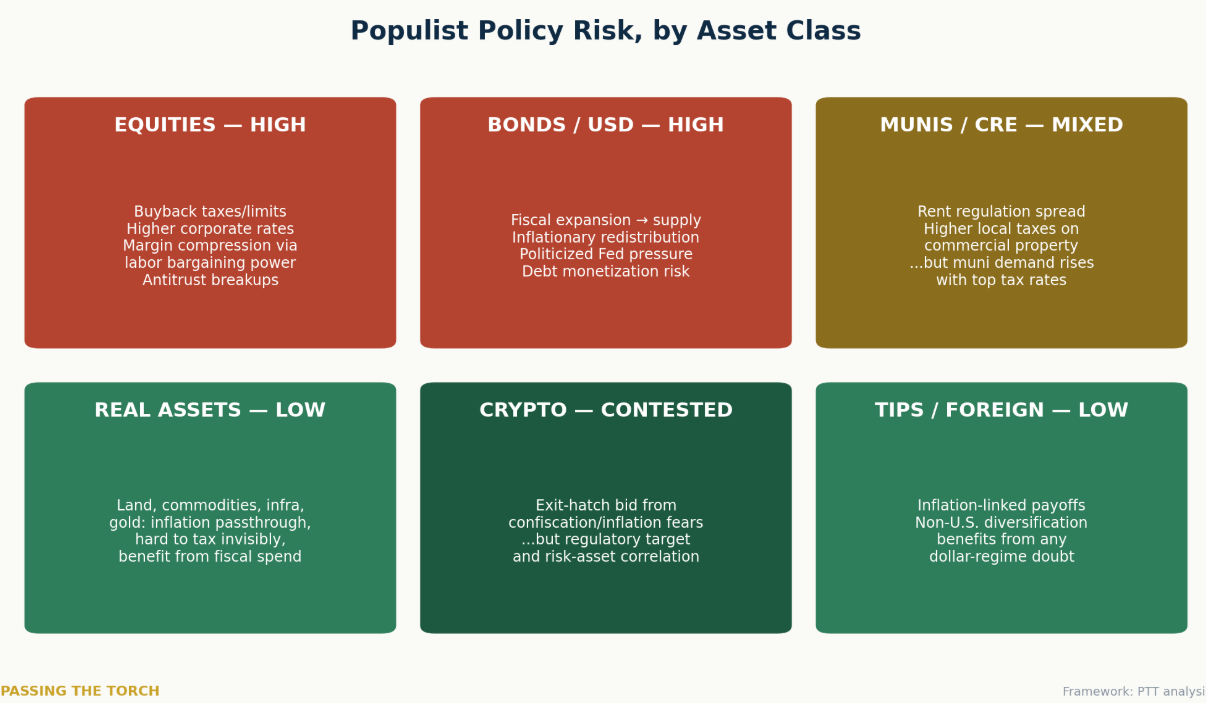
Equities. The S&P’s margin story is substantially a labor-share story. Corporate profits near record shares of GDP are the mirror image of wages at depressed shares. Any durable rebalancing, via minimum wage escalation, sectoral bargaining, buyback taxes, or simply tight labor markets that politicians refuse to cool, compresses margins structurally. Multiples were built on the assumption the pendulum never swings back.
Bonds and the dollar. Populism of both flavors is fiscally expansionary and institutionally corrosive to central bank independence. The historical pattern is consistent: when redistribution can’t get through the tax code, it comes through inflation — the one wealth tax that requires no legislation. Long-duration nominal claims are the natural victim. The term premium’s return since 2025 is arguably the first tremor.
The exceptions. Real assets — land, commodities, infrastructure, gold — hold value through inflationary redistribution, are difficult to tax invisibly, and benefit directly from fiscal spending booms. Crypto is more contested: it carries a genuine “exit hatch” bid from anyone hedging currency debasement or capital controls, but it trades like a leveraged risk asset in every liquidity drawdown and sits squarely in regulators’ sights. Call it a convex hedge.
Honesty requires the counter-case, and it’s real. First, markets have priced political risk badly in both directions before — the 2016 “Trump crash” lasted three hours. Second, the American system has historically metabolized populist energy into modest reform rather than regime change: the New Deal era, frequently cited as precedent, was followed by the greatest equity bull market in history. Third, demographics cut against confiscatory outcomes — the largest generation in history is retiring into asset ownership via 401(k)s, making the median voter more of a shareholder every year. And fourth, if AI-driven productivity gains are real, the pie may grow fast enough to fund redistribution and returns simultaneously like the 1950s.
The bear rejoinder: every one of those stabilizers assumes the bottom 50% keeps accepting a 2.5% share of the pie. There is a very strong Marxian historiographical argument to make that this will not continue. Alas, the man, Marx, said this in the 19th century and nobody really paid much attention in the West.
Thanks for reading and as always, stay curious folks!
Comments
Nothing yet. Say the first thing.
Sign in to join the conversation.