
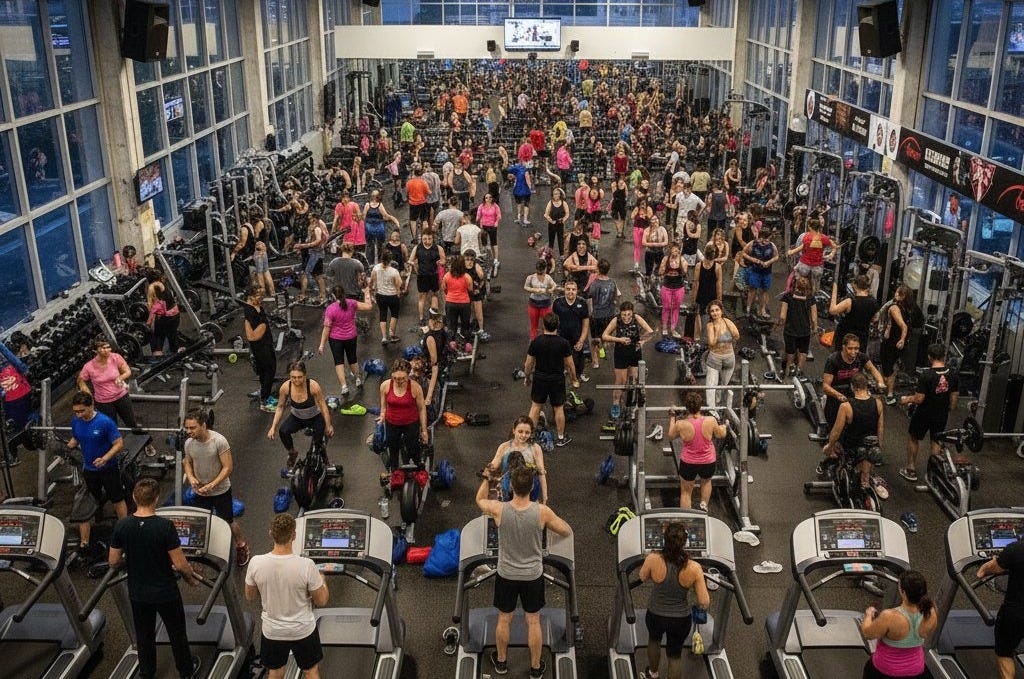
Exercise is seasonal, governed by New Year’s resolutions in January, a bulking impulse in the cold months, a frantic cut toward a summer body in spring, an outdoor phase in high summer, and a smaller return to the treadmill in September. If the behavior follows a calendar, the reasoning continues, then the products attached to it -- protein and creatine, memberships and dumbbells, running shoes and heart-rate straps -- ought to follow the same one. It is a satisfying and simple thesis, and the useful thing about a satisfying and simple thesis is that it can be checked against the numbers. When you do check it, the first half holds up handsomely and the second half turns out to be considerably stranger than the intuition assumes.
Let’s start with the behavior, because that part, well, behaves. Gym demand is one of the most legibly seasonal consumer patterns in the economy. Roughly 12% of all new memberships are signed in January alone, and at the budget chains where the effect is most concentrated the surge is startling: Bloomberg Second Measure found that Planet Fitness took on 79% more new customers in January than in an average month. Search behavior is the same, with gym-related queries climbing about 21% in the first weeks of the year and several million Americans typing “gym near me.”
The rest of the year fills in the shape anyone could predict. Attendance settles through the spring, sags by roughly 15% across the May-to-August stretch as people decamp to the outdoors and the beach and the excuse of a vacation, and then rebounds 10-15% in September and October when routines reassemble and the light starts to fail. Even the bodybuilding subculture’s vocab shows up in the aggregate data. Interest in “bulking” reliably thickens in the fall, and interest in “cutting” sharpens in spring, when the calendar to visible abs runs out. The search curve dips in October, rushes in January, and dips again in April, which is the summer-body cycle rendered as a line chart.
Gen Z is slowly changing this timeline. The cohort that turned self-optimization into a personality has produced the “winter arc,” a TikTok discipline whose organizing slogan is that October the first is the new January the first. The idea is to spend the last three months of the year waking before dawn, training five or six days a week, and generally becoming the finished person everyone else only resolves to become on New Year’s Eve. Whatever one makes of the 5am cold plunges, the economic content is very real: a meaningful slice of young consumers now front-runs the resolution by a full quarter, which spreads the demand impulse across a wider window and steals thunder from January while handing it to the fall. While this phenomenon currently belongs practically only to Gen Z, it is likely to become the new norm as they age.
Here is where the satisfying and simple intuition doesn’t seem so simple, and where the analysis gets interesting. The products do not share a single season, because they are not bought for a single reason. If you sort the fitness economy by why a purchase happens rather than by when someone exercises, it would separates into three regimes, each keeping its own time.
The first regime is aspiration. Gym memberships, the impulse tub of protein, the app subscription bought at 11pm on January the second -- these are purchases of intent, and they peak hard in January and, to a lesser degree, in June. They are the most seasonal category in the entire complex precisely because they are sold on hope, and hope has a season.
The second regime is the gift, and it follows the retail calendar rather than the fitness one. The largest revenue quarter for athletic apparel and durable equipment falls in the winter holidays rather than in January, because a great deal of this merchandise is bought by one person for another. Lululemon’s single biggest quarter is the holiday period, with recent guidance in the neighborhood of three and a half billion dollars. Garmin’s fitness segment has posted quarterly wearables growth above 40% in the fourth quarter on holiday demand, and Peloton openly describes the post-holiday first quarter as its seasonally weak one for equipment. The consequence is a paradox: the treadmill, the smartwatch and the seventy-dollar leggings sell in December, at the very moment when actual attendance is sliding toward its winter lull. The object is purchased in the season of giving and, if it is used at all, is used in the season of resolving. The demand for the product and the demand for the activity are, in these categories, roughly a month out of phase.
The third regime is habit, and it is the least seasonal of all, which surprises people who assume supplements ride the January wave hardest. Protein and creatine increasingly behave like staples rather than like resolutions, purchased on a monthly cadence by people for whom the gym is a fixture. More striking, the secular trend in these categories now swamps whatever seasonality remains. Creatine searches did not peak in the resolution window at all; monohydrate interest topped out in July of 2025 and ran up roughly 57% yoy, carried by a mainstreaming wave -- women, older adults, the protein-obsessed graduates of the GLP-1 era -- that has nothing to do with the month.
Hit reply to this email with the one name here whose seasonality the street is misreading. Aspiration (PLNT), gift (LULU, GRMN, PTON), or habit (the supplement shelf) -- which is the mispriced calendar, long or short, and why? Every reply lands in my inbox, and I’ll answer every single one, so shoot!
Stefano DellaVigna and Ulrike Malmendier’s 2006 study, bluntly titled “Paying Not to Go to the Gym,” found that members on monthly contracts attended the gym so rarely that most would have spent less buying single-visit passes -- a monument to human ego and overconfidence about one’s future self. The low-cost gym model is built directly on top of that overconfidence. Selling a ten-dollar membership to the January cohort is a wonderful business specifically because roughly 30% of them have melted away by March and half are gone within six months, converting a crowd of hopeful sign-ups into a stream of dues from people who no longer come. The seasonality of demand and the seasonality of use run in opposite directions, and the profit lives in that gap between them.
That divergence is where I would place my bets for the decade ahead. The January peak, as a share of the whole, will keep eroding, because Gen Z is dissolving the resolution into a year-round identity and pulling its own effort forward into the autumn; expect gyms and retailers to migrate marketing dollars out of the crowded New Year window and into a manufactured “reset” season around September and October. Supplements will finish their journey from resolution to routine and become as seasonally flat as toothpaste, with the bulk-and-cut cycle surviving only as vocabulary among enthusiasts. And the gifting calendar for wearables and equipment will hold its December dominance even as the behavior calendar smooths out, which means the strange month-long lag between when a fitness product sells and when a body actually uses it is likely to widen rather than close. The satisfying and simple thesis was right that fitness is seasonal. But its error was assuming the body and the shopping cart keep the same time.
Tell me where I’m wrong in this article. Reply and make the case. I answer every single reply this email/article gets, personally, and the sharpest counterargument gets a comped paid sub to our writing!
See ya, folks. Stay curious!
—J&E
Comments
Nothing yet. Say the first thing.
Sign in to join the conversation.