
All of this was pulled from the Byblos live feed - 1,400+ VC firms, 60,000+ newsletters, one place.
See what else came in today at byblos.digital →
Ask what’s happening in Bitcoin right now and you’ll get a price. Down about 25% this year, from roughly $87,500 in January to the mid-$60,000s. Spot ETF assets have fallen to around $81 billion, down about 30% since January. Strategy’s enterprise mNAV closed below 1.0 for the first time on 26 June, at 0.99 — the market now values the largest corporate holder at less than the bitcoin it holds.
This story is accurate, and it is the least interesting thing in the data.
How to get started:
🟣 Sign up over here and get a free 7-day trial of all features
🟣 Attend a 1:1 setup call with us
🟣 Receive free exclusive briefs from the 1,400+ VC database and use the app freely
Over the same period a basket of Bitcoin mining stocks rose more than 50%. TeraWulf gained over 70%. The companies built to produce bitcoin outperformed bitcoin by roughly seventy percentage points.
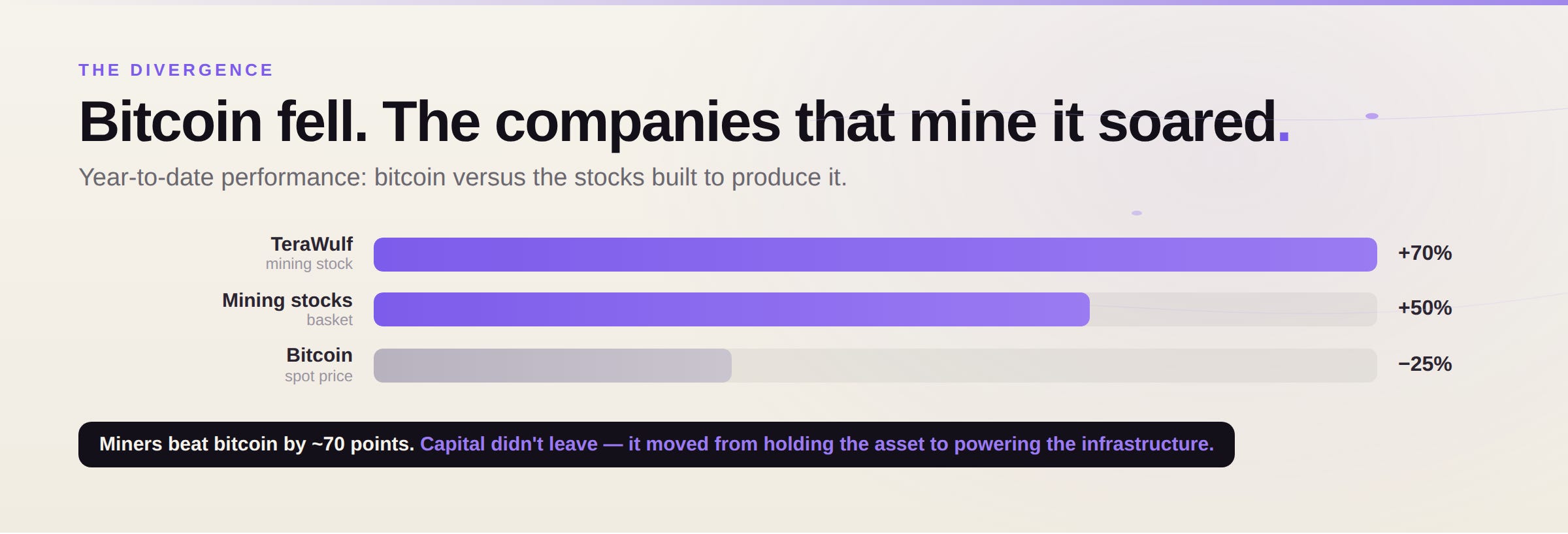
Capital did not leave the Bitcoin economy this year. It moved from holding the asset to powering the infrastructure around it — and our corpus shows the rotation happening in three independent places at once.
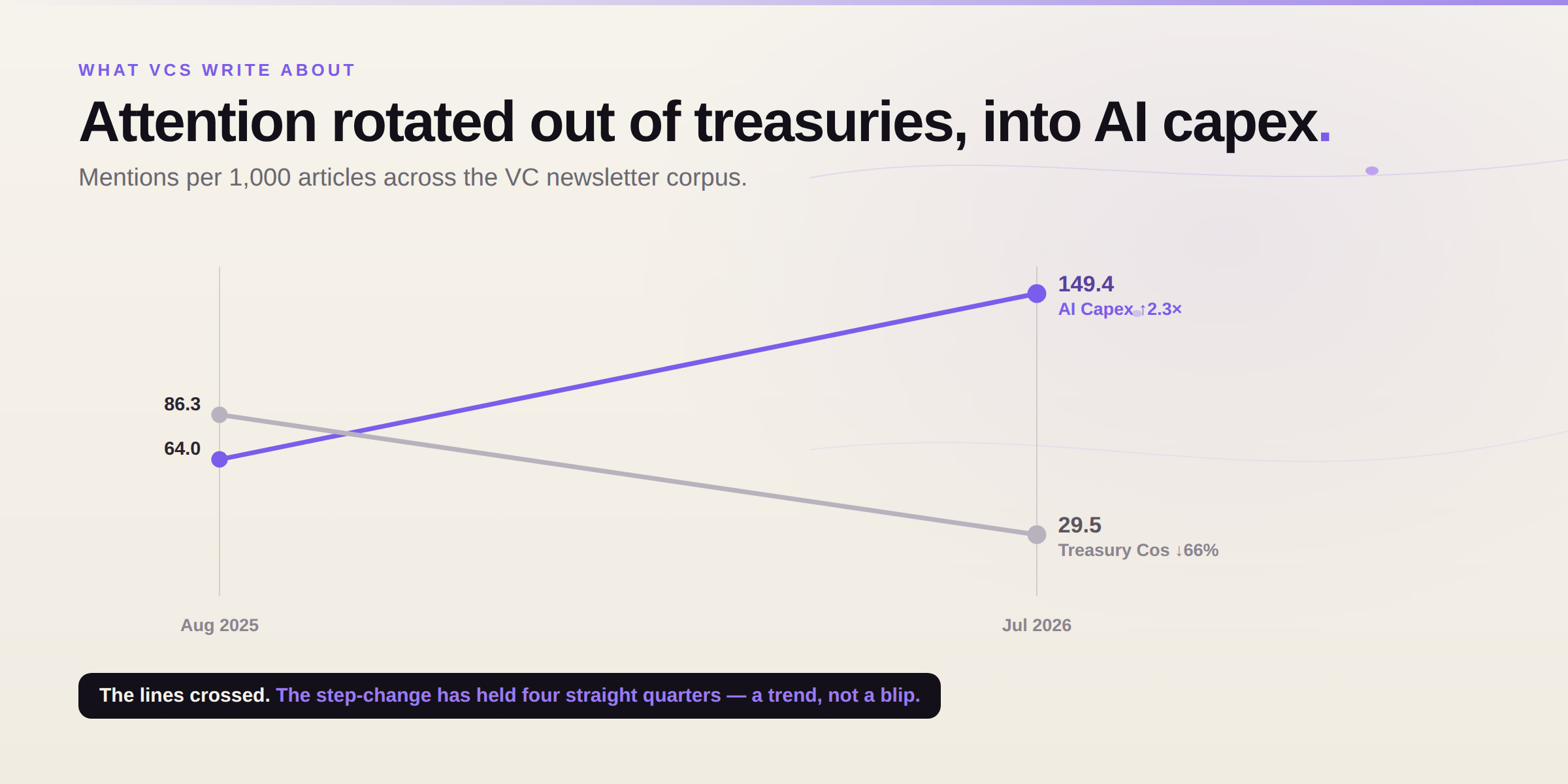
First, in what VCs write about. Across the email and RSS substrate of our corpus, Bitcoin Treasury Companies fell from 86.3 mentions per 1,000 articles in August 2025 to 29.5 by July 2026 — down 66%. AI Capex went from 64.0 to 149.4 over the same window, up 2.3×. Bullish sentiment on treasury companies dropped from 50.6% to 30.3% while bearish quadrupled from 3.1% to 13.6%, and that step-change has now held for four consecutive quarters.
Second, in what they say is causing it. Three unconnected publications named the same mechanism within two weeks of each other. Apollo Crypto attributed treasury stress to capital rotation into AI trades. CoinShares described investor rotation away from BTC-holding companies toward AI and mining. Jordi Visser, via Gate Ventures, put it plainly: capital is rotating to AI stocks.
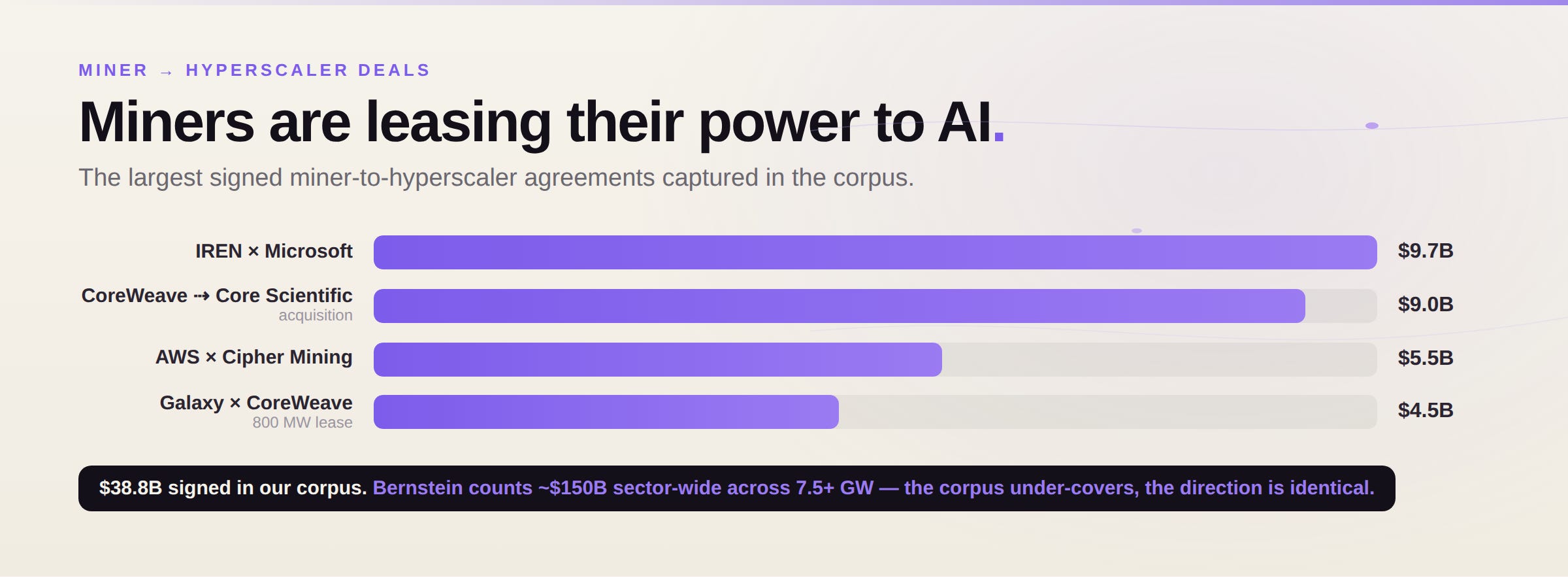
Third, and most concretely, in the deals. Deduplicating every miner-to-hyperscaler transaction in our corpus produces roughly $38.8 billion in signed agreements — IREN × Microsoft at $9.7B, CoreWeave’s $9B acquisition of Core Scientific, Hut 8 × Google, AWS × Cipher Mining at $5.5B, Galaxy Digital’s 800MW CoreWeave lease at $4.5B. Bernstein, working from public filings rather than newsletters, puts the sector-wide figure near $150 billion across 7.5+ gigawatts.
A quick note on method, because it matters. Raw mention counts are close to worthless here — a single funding round appears in up to fourteen newsletters, and Bitcoin itself functions as a tablestakes asset the way gold does. Nobody writes “we bought gold.” They write about the mine, the refinery, the ETF, the jurisdiction. Counting the word “bitcoin” measures the weather. Counting deals, instruments, and dollars measures the climate. Everything below is the second kind.
Miners have never raised venture capital.
We pulled every miner financing event in our corpus back to 2022. Riot, Marathon, Bitfarms, CleanSpark, HIVE, IREN, TeraWulf, Core Scientific — fifteen financings, roughly $6 billion, and not a single venture round. Convertible notes, senior notes, share offerings, bitcoin-backed credit lines.
This is worth stating clearly because it is easy to misread: the absence of VC in Bitcoin mining is a structural default. It’s not like a unique 2026 sign.
The insight is what happens when a miner stops mining.
CoreWeave started as an Ethereum mining operation. Crusoe started as flared-gas Bitcoin mining. Both repositioned as AI compute companies, and the capital markets available to them changed completely. CoreWeave: $221M, then $371M, then $3.5B led by NVIDIA and Blackstone, then a $7B Series C. Crusoe: $102M seed, $600M Series D, and a $1.375B Series E in January led by Mubadala alongside Founders Fund and Bain Capital Ventures.
Identical assets. Identical engineering. A different category label, and a different asset class of investor.
And some of this pivot is being funded by selling bitcoin at a loss.
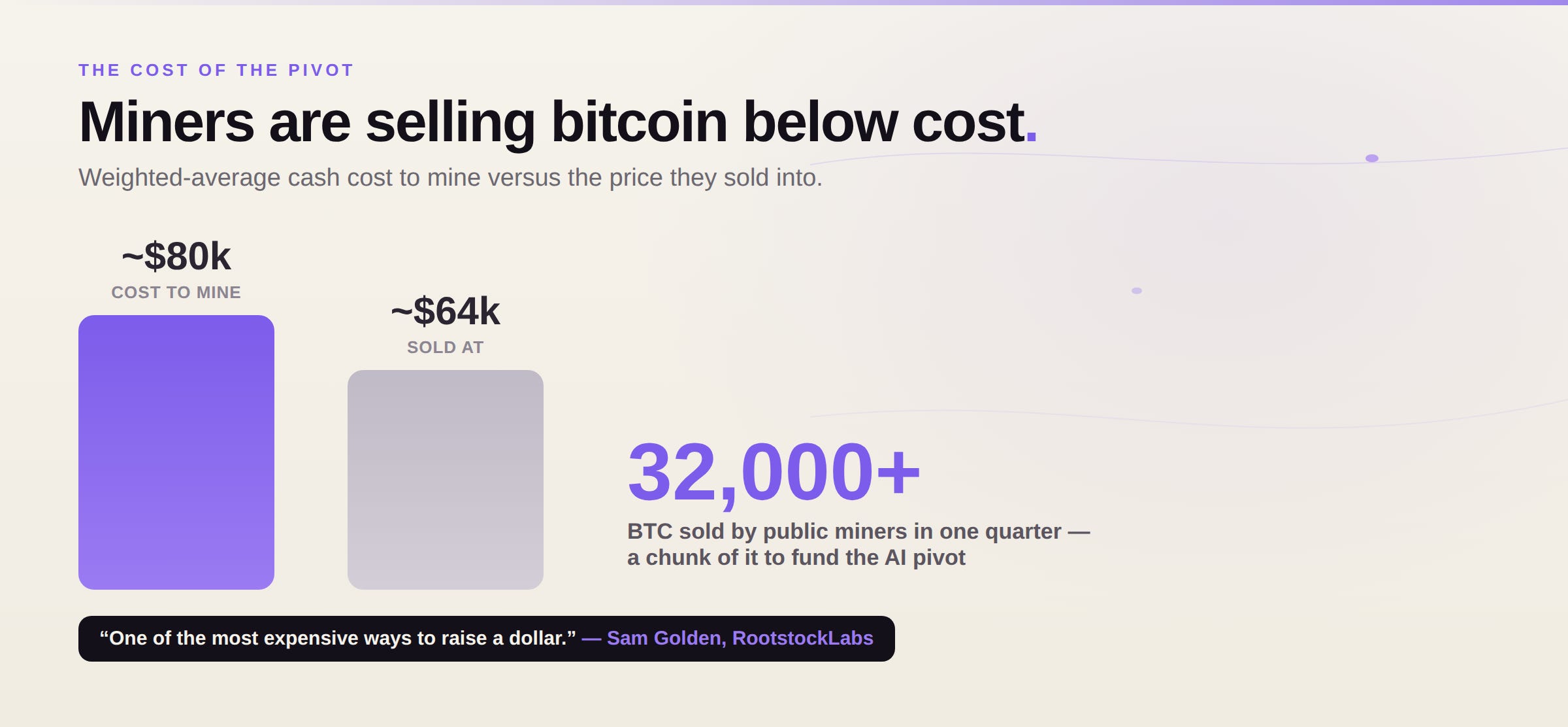
Public miners sold a record 32,000+ BTC in the first quarter of 2026. RootstockLabs’ Sam Golden documented the economics: weighted-average cash cost to mine near $80,000, hashprice compressed to $28–30 per PH/s/day, market price around $64,000. A subset of that selling went specifically to fund AI compute buildouts. Golden’s verdict on the trade — “one of the most expensive ways to raise a dollar” — is the most honest sentence written about this transition.
Core Scientific liquidated 1,992 BTC, about $175M, in March to fund its own.
So the rotation is not metaphorical. Bitcoin is being converted into AI data centres, coin by coin, frequently below cost.
The treasury companies are the other side of the same trade.
NYDIG’s Greg Cipolaro frames Strategy precisely: 847,363 BTC worth $52.4B plus $2.55B cash against $22.2B of debt and preferred claims — roughly $32.7B of surplus NAV. Solvency is not the issue. The issue is that the flywheel requires MSTR above 1.0× mNAV and STRC near $100 to function; STRC has been trading around $90 after touching $74. His conclusion: “a market-access problem, not a solvency problem”.
When that mechanism stalls, the behaviour inverts. Strategy authorised up to $1.25B in bitcoin sales to fund dividends and buybacks. Empery Digital sold half its treasury for $87.1M. BitMine pivoted to ETH staking, which now generates $45.7M quarterly — 98% of its revenue. Metaplanet bought a securities firm. Roughly 1.16 million BTC sits on corporate balance sheets earning nothing, and Cosimo Digital’s Rob Frasca argues the persistent discount isn’t sentiment at all: “It is a structural flaw.” Without a redemption path, no arbitrage can close the gap.
Go premium. $10.99/month or $109/year, with a 7-day free trial. You get the full intelligence layer:
Exclusive research from our database of 1,400 investors and 60,000 newsletters
Weekly briefs on where capital is actually moving
Direct 1:1 access to us
Comments
Nothing yet. Say the first thing.
Sign in to join the conversation.