
In 1955, only about one in fifteen American women admitted to coloring their hair. The practice carried a stigma rooted in decades of cultural judgment: hair dye was associated with actresses, showgirls, and women of questionable reputation. For the average homemaker in postwar America, walking into a drugstore to buy a box of hair color felt like a confession. The product existed. The desire existed. But the permission to use it did not.
That permission came from an unlikely source: a Brooklyn-born copywriter named Shirley Polykoff, and seven words that would reshape an entire industry.
When the advertising agency Foote, Cone & Belding won the Clairol account in 1955, they handed it to Polykoff — a junior copywriter and the only woman on the creative staff. Clairol had just launched Miss Clairol Hair Color Bath, the first product that could lighten, tint, condition, and shampoo hair in a single step at home. The technology was revolutionary. The marketing problem was not.
The challenge was never about the product’s quality. It was about the wall of shame standing between the product and its customer. Women wanted to look younger, cover gray, or simply change their look — but they didn’t want to be caught doing it. Any campaign that screamed “dye your hair!” would only reinforce the stigma. Polykoff needed to do something far more difficult: she needed to make the act of coloring your hair invisible.
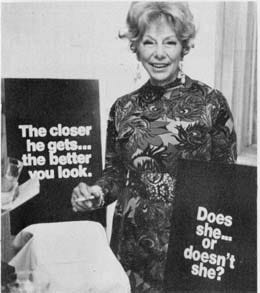
The inspiration was personal. When Polykoff first met her future mother-in-law, the older woman pulled her son aside and asked a pointed question about the true color of his girlfriend’s hair. That moment of scrutiny — the quiet suspicion, the social stakes of being “found out” — became the emotional engine of the entire campaign.
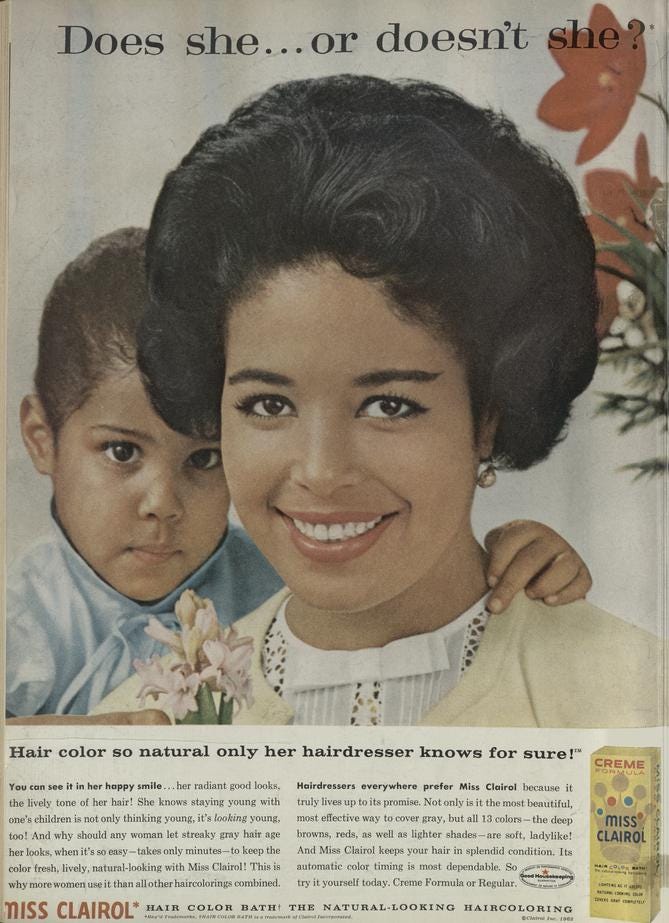
“Does she… or doesn’t she? Hair color so natural only her hairdresser knows for sure.”
The line was genius on multiple levels. It acknowledged the secrecy women already felt, then turned that secrecy into an asset. It didn’t ask women to be bold about hair dye. It promised them they’d never have to be. The subtext was clear: if the product is this good, nobody will ever know.
The ads paired this headline with photographs of wholesome, PTA-ready mothers alongside their children — a deliberate visual strategy. Polykoff placed these women in family magazines like Life, not in fashion or beauty publications. The message wasn’t aimed at glamour seekers. It was aimed at every woman who had ever thought about it and talked herself out of it.
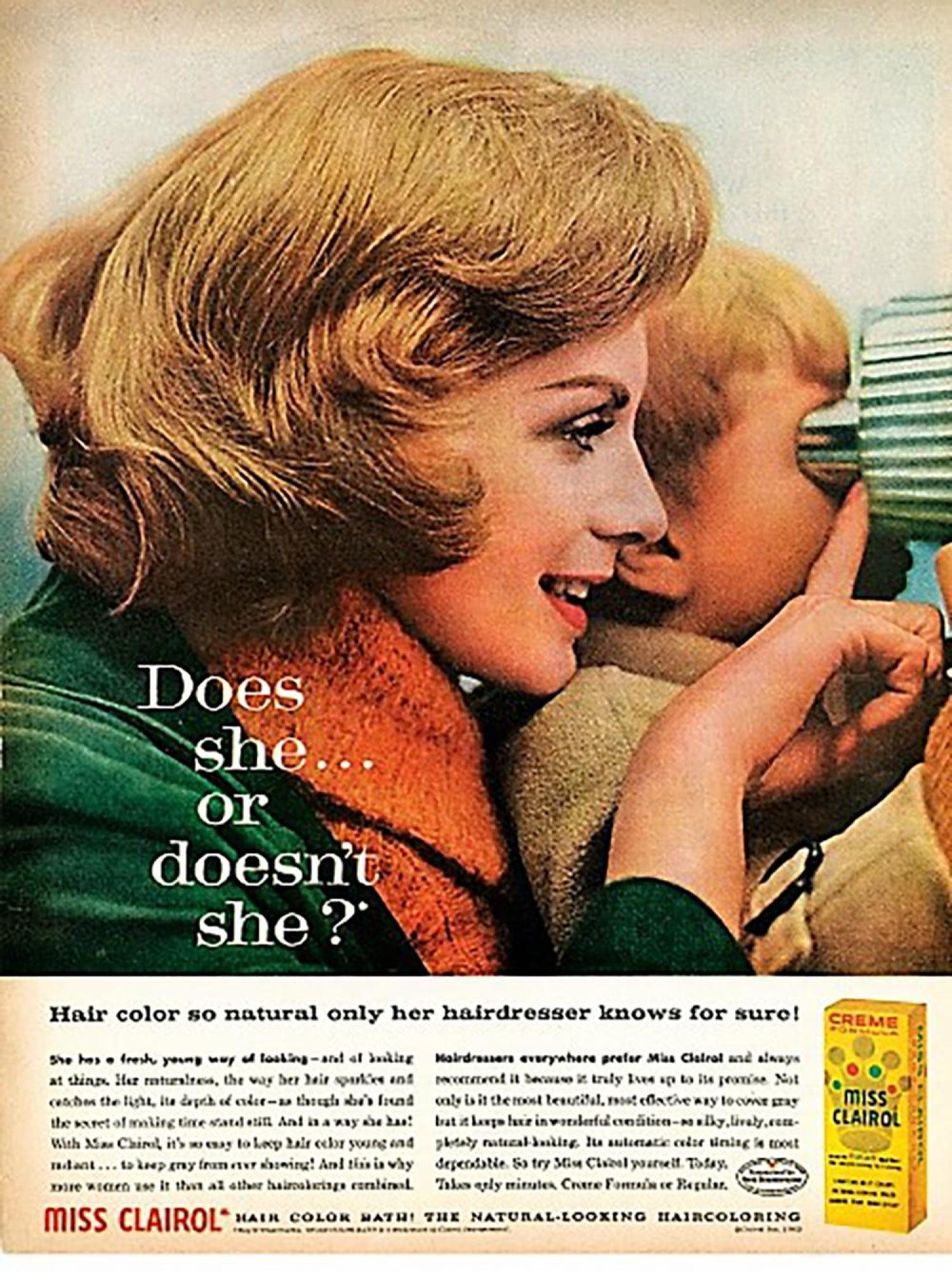
The campaign almost didn’t run. Life magazine’s all-male editorial board initially rejected the ad, reading the headline as a sexual double entendre. Polykoff pushed back, reportedly polling the magazine’s female staff, who saw nothing provocative about it. The ad ran. And the results were staggering.
Industry-wide hair color sales surged from roughly $25 million to over $200 million annually. The ratio of American women coloring their hair swung from one in fifteen to nearly one in two within a decade. The shift was so widespread that several U.S. states stopped requiring women to list their hair color on driver’s licenses, since the information had become unreliable. Polykoff went on to create follow-up campaigns for Clairol that became equally iconic — “Is it true blondes have more fun?” and “If I’ve only one life, let me live it as a blonde!” — each one building on the permission the original campaign had created.
By 1961, Polykoff was the highest-paid employee at Foote, Cone & Belding — then the seventh-largest ad agency in the world. She became the firm’s first female board member and, in 1980, the first living woman inducted into the National Advertising Hall of Fame.
Clairol’s campaign didn’t succeed because it educated women about a better product. It succeeded because it solved an emotional problem. The barrier to purchase wasn’t awareness or price — it was shame. Polykoff understood that you don’t overcome stigma by arguing against it. You overcome it by making the stigmatized behavior feel normal, safe, and undetectable. Here’s what business owners can take from this:
They identified the emotional barrier, not just the practical one. Your customer might already want what you sell. The real question is: what’s stopping them from buying it? If the answer is embarrassment, judgment, or fear of being “found out,” your marketing needs to address that feeling before anything else.
They normalized, not evangelized. Clairol never told women they should dye their hair. They showed women who already did — and made it look like the most natural thing in the world. If your product solves a problem people don’t want to admit they have, show the solution as something everyone quietly does, not something bold or brave.
They used customer’s language, not their own. Polykoff’s headline worked because it echoed the exact words women were already whispering. The best copy doesn’t come from brainstorming sessions — it comes from listening to how your audience actually talks about the problem when they think nobody’s paying attention.
They put themselves where trust already lives. Polykoff ran the ads in Life magazine alongside family content — not in beauty magazines where ads were expected and easily dismissed. Place your message in contexts where your audience already feels safe, and your credibility borrows from the environment.
They gave permission, not just a product. Sometimes the most powerful thing your marketing can do is tell your customer: it’s okay. It’s okay to want this. It’s okay to buy this. Nobody has to know. That emotional green light can be worth more than any feature list or discount code.
Clairol’s campaign didn’t succeed because it educated women about a better product. It succeeded because it solved an emotional problem. The barrier to purchase wasn’t awareness or price — it was shame. Polykoff’s insight was that you don’t overcome stigma by arguing against it. You overcome it by making the stigmatized behavior feel normal, safe, and undetectable.
This framework applies far beyond hair dye. Every market has its version of the stigma barrier: the financial product people are embarrassed to need, the health solution they don’t want to be seen buying, the service that implies they can’t do something on their own. The brands that unlock those markets are rarely the ones with the loudest message. They’re the ones that whisper the right thing at the right moment — giving their customers not just a product, but permission to use it.
Polykoff herself put it best. In her 1975 memoir, she reflected that the best advertising doesn’t come from cleverness or wit. It comes from deeply understanding what your audience already feels but cannot say out loud — and then saying it for them.

But How Did You Do It? is powered by Kajabi, the most robust all-in-one platform.
Claim your 30-day free trial and start creating, selling, and growing.
Thanks for reading But How Did You Do It? This post is public so feel free to share it.
No posts
Comments
Nothing yet. Say the first thing.
Sign in to join the conversation.