
The weird thing Liquid Death did wasn’t the skull. It wasn’t the tallboy. It wasn’t even the tagline “murder your thirst.” The weird thing was deciding, before a single can existed, that water should be sold like a Monster Energy drink to people who go to hardcore shows — and then spending $1,500 on a fake commercial to prove it. Most beverage startups lead with formulation. Liquid Death led with a joke, filmed the joke, and used the joke as the pitch deck. That order of operations is the entire lesson.
Charitable translation: most founders build the product and hope the marketing saves them. Mike Cessario built the marketing and let it tell him whether the product was worth making.
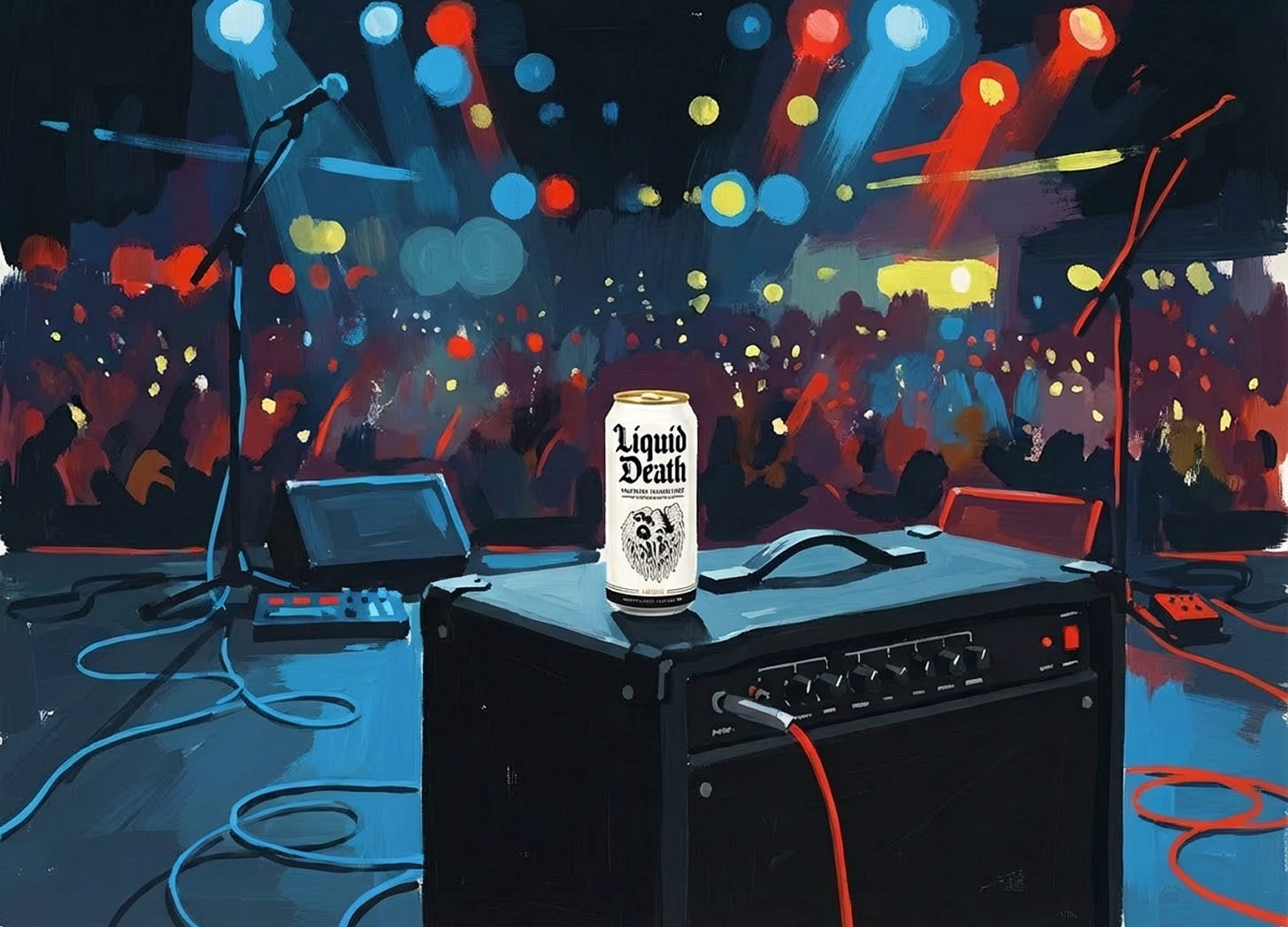
Your formulation probably doesn’t matter as much as you want it to. What you’re selling is the story the customer tells themselves while holding it.
In 2017, when Cessario filed the trademark, bottled water was the biggest and most boring category in beverage. Aquafina, Dasani, Smartwater, Fiji — the entire shelf was blue-and-silver minimalism selling “purity,” “hydration,” and glacier photography. Meanwhile the energy drink aisle next door was a knife fight. Monster, Rockstar, and Red Bull had spent a decade buying motocross, action sports, and metal festivals, wrapping their cans in skulls and claws and Gothic type. Those brands understood something the water category refused to: young people don’t buy beverages, they buy identity tokens they can hold in their hand on camera.
Cessario had watched this mismatch up close. He’d grown up in the Philadelphia punk and hardcore scene, gone into advertising, and worked as a creative director on campaigns for Netflix shows like Stranger Things and Narcos before starting the company. The founding anecdote, which he’s repeated in dozens of interviews, traces back to a Warped Tour around 2008 or 2009 — he noticed bands drinking water out of Monster cans on stage because water cans looked uncool. The bottled water category had ceded the one thing energy drinks had figured out: that packaging is media. Everyone in CPG knew challenger brands were having moments in kombucha, hard seltzer, and cold brew. Nobody thought the moment could happen in still water, because still water was where branding went to die.
Here’s what Cessario actually did. In 2018, before any product existed, he hired a small crew and shot a low-budget ad for roughly $1,500 featuring a “professional actor” being waterboarded with a can of Liquid Death mountain water. He posted it to a Facebook page built around a 3D rendering of the can. The video pulled around three million views within a few months. The page racked up more than 100,000 likes — more than Aquafina had accumulated in its entire history on the platform, according to CNBC’s reporting. Beverage distributors and retailers including a 7-Eleven buyer reached out asking who to talk to about stocking it. None of it existed yet.
That traction became the pitch. Science Inc. led a $1.6 million seed round in January 2019, and Liquid Death began selling cans direct-to-consumer on Amazon and its own site the same month. The product was plain mountain water sourced from the Alps, packaged in a 16.9 oz recyclable aluminum tallboy with a melting skull and the line “murder your thirst.” In February 2020, Whole Foods put it on shelves nationally, where Eater later reported it became the fastest-selling water brand in the chain. Sparkling launched the same year. Flavored sparkling — Mango Chainsaw, Severed Lime, Convicted Melon, Berry It Alive — followed. Revenue climbed from roughly $2.8 million in 2019 to $45 million in 2021 to $263 million in retail sales by 2023. In March 2024, a $67 million funding round valued the company at $1.4 billion. The marketing budget, relative to the valuation, stayed tiny. The company’s own estimate is that it’s generated billions of earned impressions from stunts — coffin-shaped coolers, a death metal album made from its own hate comments, selling 180,000 people’s souls as a promotion.
The mechanic is category borrowing. You take the visual, tonal, and ritual cues of a category with high cultural energy (energy drinks, craft beer, metal merch) and apply them to a category with none (still water). You’re not inventing a new aesthetic; you’re arbitraging an existing one into a shelf where it doesn’t belong. The shock of the mismatch does the advertising for free. A shopper walking past two hundred blue-and-silver water bottles doesn’t see them anymore. A matte black tallboy with a melting skull, they see.
The clearest parallel is Dollar Shave Club in 2012. Michael Dubin spent about $4,500 on a single YouTube video — “Our Blades Are F*ing Great” — that pulled millions of views in 48 hours and functioned as both the launch ad and the investor pitch. The razor itself was a commodity. The joke, the delivery, and the bravado were the product. Unilever bought the company for a reported $1 billion four years later. Same playbook: borrow the tone of stand-up comedy and bro YouTube into a category (men’s grooming) that had been selling “precision engineering” for forty years. In both cases, the founder understood that in a commoditized category, the brand isn’t a layer on top of the product — the brand IS the product, and the liquid or the blade inside is the excuse.
The ugly truth most CPG founders resist: your formulation probably doesn’t matter as much as you want it to. What you’re selling is the story the customer tells themselves while holding it.
But How Did They Do It?
2017: Cessario trademarked “Liquid Death” while still working in advertising.
2018: Produced a ~$1,500 video ad — a waterboarding sketch — before any product existed. Built a Facebook page around a 3D can render.
Early 2018–2019: Video reached ~3 million views in four months. Facebook page passed 100,000 likes, surpassing Aquafina’s lifetime total on the platform.
Jan 2019: Raised $1.6M seed round led by Science Inc. Began selling on Amazon and DTC the same month.
Feb 2020: Launched in Whole Foods nationally. Reported as the fastest-selling water on the chain’s shelves.
2020: Released “Greatest Hates,” a death metal album with lyrics pulled from real online hate comments about the brand.
2021: Revenue hit $45 million. Series C led by Live Nation made Liquid Death the exclusive water at 120+ music festivals and venues.
2023: $263 million in retail sales.
March 2024: $67M raise at a $1.4 billion valuation.
How You Can Do This
Picture a freelance designer in New York who’s been quietly doing brand identity for wellness startups for three years. Her portfolio is competent and completely invisible. Every other designer in her niche uses the same soft serif, the same sage green, the same “we help mission-driven founders tell their story” bio. She gets referrals, not inbound.
The Liquid Death move isn’t to rebrand herself as edgy. It’s to pick one category adjacent to hers that has cultural energy she can legally borrow, and make a single piece of work that lives in that tonal register before she has a single client to show for it. So she spends a weekend making a fake case study: a full brand identity for an imaginary hot sauce company, shot on her phone, with copywriting that sounds like it belongs on a wrestling T-shirt. She posts it to LinkedIn and Instagram with a one-line caption: “Wellness brands keep asking me to make them look calm. Here’s what happens when nobody’s watching.” That’s the $1,500 waterboarding video. It costs her a weekend and zero dollars. The point isn’t that she wants hot sauce clients. The point is that the fake project proves, visibly and in public, that she can operate in a register her current portfolio hides. Wellness founders who see it don’t hire her to do hot sauce work — they hire her because she suddenly looks like a designer with range, and range is the thing they were quietly worried she didn’t have. The fake project becomes the real pitch deck.
The discipline is the part people skip. Cessario didn’t film the waterboarding sketch and then also build a normal water company. He filmed it, watched the numbers, and let the response tell him the business was real. You make the thing, you put it in public, and you let the flinch or the silence decide what you do next.
Most people are one weird, specific, public piece of work away from being a different kind of business. The ones who never make it are the ones waiting until they have permission.

But How Did You Do It? is powered by Kajabi, the most robust all-in-one platform.
Claim your 30-day free trial and start creating, selling, and growing.
Thanks for reading But How Did You Do It? This post is public so feel free to share it.
Liquid Death CEO Mike Cessario: We chose ‘the dumbest possible name’ for water — CNBC
CEO on the spot: nine questions with Liquid Death’s Mike Cessario — Raconteur
Origin Stories: Liquid Death CEO Mike Cessario — Damn Good Brands
From Punk Rocker to CEO: How Mike Cessario Built Liquid Death — Entrepreneur
No posts
Comments
Nothing yet. Say the first thing.
Sign in to join the conversation.