
The wildest thing about the most emotional ad campaign in American history is that the client almost killed it. AT&T’s leadership wanted a different tagline — something patriotic and safe called “Keep in Touch, America.” A creative director at N.W. Ayer had to physically fight to get “Reach Out and Touch Someone” into a test at all. When the test finally ran, the emotional version won two to one, and the “safe” option disappeared into the footnotes of advertising history.
That’s the part that sticks. Not the jingle. Not the tears. The fact that the campaign people can still sing forty-seven years later only exists because one person refused to let a meeting bury it.
In 1979, a long-distance phone call was a small financial event. Rates were set by the FCC, AT&T had a near-total monopoly on American phone lines, and calling your mother two states away cost real money by the minute. Most households rationed long-distance calls the way people now ration airline miles — holidays, emergencies, the occasional birthday.
The advertising landscape was just as constrained. There was no cable. No internet. A TV spot on The Tonight Show with Johnny Carson could reach an audience that modern marketers would need a Super Bowl slot to touch. Utility companies, and make no mistake, that’s how AT&T was perceived, advertised on reliability, price, and coverage maps. Feelings were for soft drinks and perfume.
AT&T also had a problem the public didn’t fully understand yet. The federal antitrust case that would eventually break up Ma Bell into seven regional “Baby Bells” was already in motion. The company wasn’t just trying to sell more minutes. They were trying to become likeable before a judge decided their fate. Softening a monopoly’s public image inside a regulated industry on three TV networks is not a marketing brief most people would want. It’s the one Ayer got.
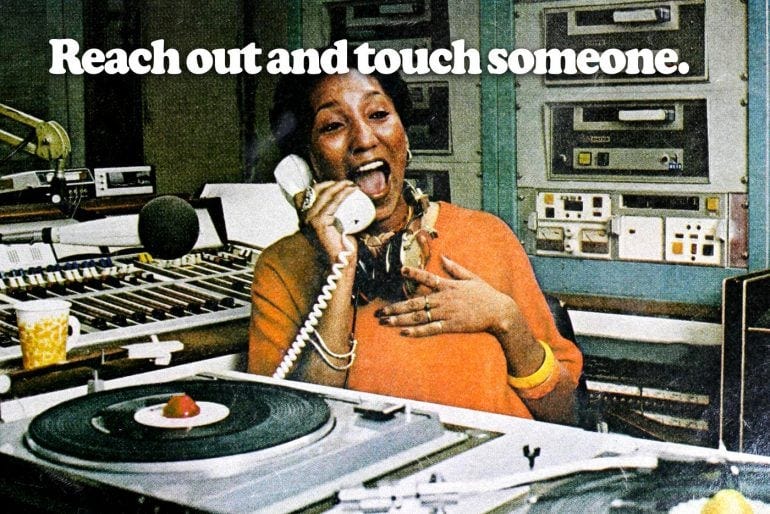
The line itself wasn’t new. “Reach Out and Touch Someone” had appeared in AT&T print ads as early as 1971, reportedly inspired by Marshall McLuhan — the Canadian media theorist behind “the medium is the message” and “the global village.” It sat dormant for almost a decade before creative director Keith at N.W. Ayer pushed to put it on television in 1979.
The spots were produced by Stanley Lomas. The music — the jingle people can still hum — was composed by David Lucas. The first commercial debuted on The Tonight Show with Johnny Carson. The format barely varied: a soldier calling home. A grandmother hearing her grandchild’s voice for the first time. Two old friends picking up after years of silence. Slow pacing. Warm light. A quiet swell of strings. No product shot of a phone until the very end, if at all.
AT&T reportedly spent around $100 million on the campaign between 1979 and roughly 1983. Long-distance call volume jumped by billions of minutes over the run. One spot — “Joey Called” — landed on Entertainment Weekly‘s 1997 list of the 50 best commercials of all time. The jingle became one of the most recognised pieces of audio branding of the twentieth century, right alongside “I’d Like to Teach the World to Sing.”
Then, in 1984, the government broke AT&T up anyway. The campaign didn’t save the company from antitrust. It saved the brand from being remembered as the villain.
The mechanic is simpler than most case studies want to admit: AT&T stopped selling the product and started selling the moment the product made possible. A long-distance call became a proxy for love at a distance. The phone was invisible. The feeling was the ad.
Name the move and it’s easy to spot elsewhere. De Beers did the same thing in 1947 with “A Diamond Is Forever” — they weren’t selling a compressed carbon rock, they were selling the idea that the size of the stone equaled the weight of the commitment. Suddenly a diamond wasn’t jewelry, it was a unit of measurement for love. Within a generation, an entire ritual existed that hadn’t existed before. AT&T ran the same play on a shorter timeline with a product people already owned.
Three things made it land. First, the emotional target was universal. Soldiers, grandparents, old friends — not a niche. Everyone in the country could cast themselves into one of those scenes without effort. Second, the jingle. David Lucas built something so singable it became infrastructure. People didn’t recall the ad, they performed it. Third, the timing. A regulated monopoly about to be broken up had every reason to look human, fast, and this campaign gave the public a reason to feel something other than resentment.
There’s also a quieter lesson tucked in here about internal politics. The emotional version almost lost to the safer one. The creative director’s real job that year wasn’t writing the line — it was protecting it. Most bad marketing isn’t bad because someone couldn’t think of the good version. It’s bad because the good version got killed in a conference room.
But How Did They Do It?
Reused a 1971 print tagline and put it on television eight years later.
Anchored every spot in a universal human moment: soldier, grandparent, old friend.
Built the jingle with composer David Lucas so the audio carried the memory.
Debuted the first commercial on The Tonight Show with Johnny Carson for maximum reach.
Spent roughly $100 million between 1979 and 1983.
Fought internally to test “Reach Out and Touch Someone” against the preferred “Keep in Touch, America.”
Let the test results win instead of leadership preference — emotional version preferred two to one.
Kept the phone itself mostly off-screen. The feeling was the product.
How You Can Do This
Picture a freelance web designer called Maya. She’s been selling her services the way almost everyone sells freelance services: a list of deliverables, a price, a timeline. Five-page website, custom design, mobile responsive, two rounds of revisions, $4,800. Her proposals look like everyone else’s proposals. Her conversion rate is fine. Not good, fine.
She runs the AT&T move on her own offer. She stops selling the website and starts selling the moment the website makes possible — the first time an inbound lead says “I found you online and you looked real.”
Concretely, here’s what changes. The homepage headline on Maya’s own site moves from “Custom websites for small businesses” to something like “The version of your business you’re actually proud to send to people.” Her proposal template opens with a short paragraph about what the client will feel the week after launch, not a scope of work. Her case studies lead with the client’s face and a quote about how it changed the way they introduce their business at parties — not a before-and-after screenshot. The deliverables list still exists, it just moves to page three where it belongs.
She doesn’t raise her prices. She doesn’t change her process. She reframes the outcome, and suddenly she’s not competing on pixels anymore. She’s competing on a feeling nobody else in her inbox is naming out loud.
The hardest part of this move isn’t the rewrite. It’s sitting with the discomfort that your actual product is softer and more embarrassing than the clean, technical version you’ve been selling. Most people flinch and go back to the feature list. The ones who don’t, get remembered.

But How Did You Do It? is powered by Kajabi, the most robust all-in-one platform.
Claim your 30-day free trial and start creating, selling, and growing.
Thanks for reading But How Did You Do It? This post is public so feel free to share it.
No posts
Comments
Nothing yet. Say the first thing.
Sign in to join the conversation.