
In 1971, a broke copywriter in Ohio sat down and wrote 361 words about family crests. That one letter eventually got mailed around 600 million times and built a company that sold for tens of millions of dollars. The weird part isn’t the numbers. The weird part is that Gary Halbert’s letter was designed, from the first word, to not look like marketing at all. It was written to look like a note from somebody’s neighbor who had stumbled onto something interesting at the library.
That was the whole trick. Everybody else in direct mail was trying to out-shout the mailbox. Halbert went the other direction and tried to disappear into it.
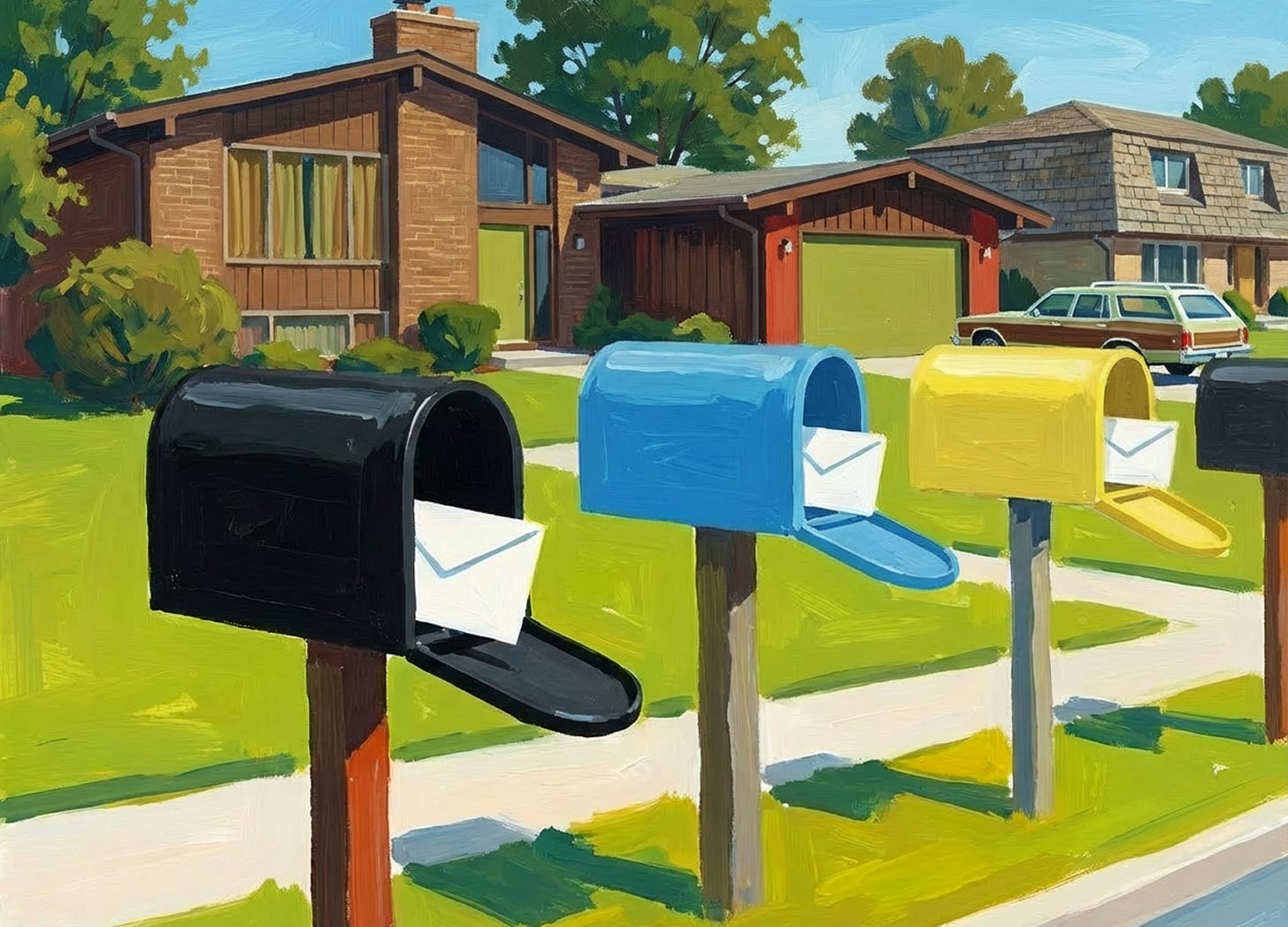
In the early 1970s, direct mail was a shouting match. Envelopes came screaming in teasers, starbursts, fake urgency stamps, windowed plastic, “OPEN IMMEDIATELY” across the front. The category had been trained by Madison Avenue and the big mail-order houses to equate attention with volume. If you weren’t yelling, you weren’t selling.
The prospect had been trained too. People stood over the wastebasket sorting mail into two piles — bills and personal on one side, promotional junk on the other. Halbert later gave this a name, the A-pile and B-pile, but the behavior existed long before the label. Any envelope that looked like an ad had roughly a second to survive. Most didn’t.
Meanwhile, genealogy was having a quiet moment. Americans were a few years out from the 1976 bicentennial, heritage was becoming a dinner-table topic, and the category of “family history” products — crests, name reports, framed parchment — was being worked by small-time operators selling through newspaper classifieds and postcards. Nobody was doing it at national scale. Nobody was doing it with a real letter.
The hardest part of any campaign isn’t the pitch. It’s the envelope.
Halbert was, by his own telling, broke. He needed a hit. The idea came from a newspaper story about a woman who sketched coats of arms and mailed postcards to people in the phone book with matching surnames. He kept the product and threw out the delivery.
What he built instead was a plain white envelope, hand-addressed, single first-class stamp, no return address treatment, no teaser copy. Inside was one page, around 361 words, signed by Nancy L. Halbert — his then-wife. The letter opened by addressing the recipient by surname (”Dear Mr. Macdonald”) and told a small story: she and her husband had been researching a friend’s family name and discovered a report on the Macdonald coat of arms going back more than seven centuries. She described what the report contained — the crest, the motto, the meaning of the name, famous bearers — printed on parchment-like paper, suitable for framing. Two dollars for one, a dollar each for additional copies sent to the same address. Checks payable to Nancy.
Halbert pulled surnames from phone books and mailed the same letter, swapped for each target name, to every matching household he could reach. At peak, the operation was processing around 20,000 orders a day. He famously needed a bank in Ohio to dedicate a floor to his deposits. The letter ran, in various forms, for roughly three decades. Halberts Inc., the company it built, was eventually sold in a deal reported in the tens of millions. The letter is widely cited as one of the most-mailed sales letters in history.
The mechanic here is camouflage marketing — deliberately disguising a commercial message as a non-commercial one so it survives the filter the audience uses to screen out commercial messages. The value isn’t in the offer. The value is in getting the envelope opened in the first place.
The parallel is the advertorial. In 1936, a copywriter named Gene Schwartz and the generation that followed him built entire categories off ads that looked exactly like editorial — same typeface as the newspaper, same column width, same byline format, with a small “advertisement” label nobody read. The classic example is the long-running Wall Street Journal “Two Young Men” letter, which ran for decades and sold subscriptions by looking like a thoughtful essay rather than a pitch. Same trick, different century: borrow the visual grammar of the thing people actually want to read, and the ad gets read instead of tossed.
Camouflage only works when the payoff matches the disguise. If Halbert’s letter had opened with a coupon code, the entire setup would have collapsed the moment the envelope came open. The product had to feel like the kind of thing a library-dwelling stranger would actually want to tell you about. A family crest, printed on parchment, tied to your name — that fit. A timeshare would not have.
But How Did They Do It?
Picked a product with genuine personal relevance — something tied to the recipient’s own name, which almost nothing else in the mailbox could claim.
Pulled target lists from phone books, filtered by surnames that had documented heraldic records.
Used a plain white envelope, hand-addressed, single stamp, no return-address branding, no teaser copy.
Wrote the letter in the voice of a wife helping her husband with a hobby project, not a company selling a product.
Opened with the recipient’s surname in the salutation and repeated it throughout the body.
Kept the letter to one page and roughly 361 words.
Priced the offer at two dollars — low enough to be an impulse, high enough to fund the mailing cost.
Made checks payable to Nancy L. Halbert personally, reinforcing the “real person” frame all the way through the transaction.
Mailed the same core letter, swapped for each surname, at massive scale for years.
How You Can Do This
Picture a freelance brand designer in a mid-size city who wants more local restaurant clients. The usual playbook is a cold email blast with a subject line like “Quick question about your branding” and a portfolio link. It lands in spam, or it lands in the inbox next to eleven other cold emails that say the same thing. Camouflage marketing says: stop trying to out-shout the other eleven. Disappear into the pile the owner actually reads.
What the owner actually reads is handwritten mail from neighbors, notes from regulars, and anything that mentions the restaurant by name in a way that sounds like it came from a human. So the designer buys a stack of plain cream cards. On each card, hand-addressed, they write three or four sentences: they ate at the restaurant last Tuesday, the tagliatelle was the best thing they’d had all month, and they noticed the menu PDF on the website was a scanned image that looked rough on their phone — they redesigned the first page for fun, it’s at a short link on the back of the card, no pitch, no follow-up unless the owner writes back. Signed with a first name.
That card is not a sales letter. It reads like a regular saying something nice and being slightly useful. The redesigned menu page is the coat of arms — a small, specific, personal artifact that proves the sender actually paid attention. The link is the two-dollar offer: low-friction, curiosity-driven, no commitment. Out of fifty cards mailed to restaurants inside a ten-mile radius, the designer might hear back from four or five. One becomes a full rebrand. The economics work because the cost per card is a stamp and fifteen minutes, and the response rate is what it is precisely because the card doesn’t look like the other cold outreach the owner already trained themselves to ignore.
The lesson Halbert keeps teaching, fifty-plus years later, is that the hardest part of any campaign isn’t the pitch. It’s the envelope.

But How Did You Do It? is powered by Kajabi, the most robust all-in-one platform.
Claim your 30-day free trial and start creating, selling, and growing.
Thanks for reading But How Did You Do It? This post is public so feel free to share it.
No posts
Comments
Nothing yet. Say the first thing.
Sign in to join the conversation.