
While the UK government’s announcement to restrict social media platforms for under 16s is a national story, it has thrown up all sorts of universally-relevant dimensions, which I’ve attempted to outline here.
I’m not going to rehash the details or get into how this restriction will (or won’t) work in practice. Instead I’ve focused on how this could signify the beginnings of some seismic tectonic shifts in our market, why a restriction has happened, the arguments around it, and what could come next: which if I’m right, could have major implications for the global streaming and connected TV market.
Before then, a quick note (and this is impossible to write without sounding like either a sycophant or self-possessed): I’ve spent pretty much all my career at the edge where the internet meets TV. I once had a boss who said ‘it is all about the work’, which is a sentiment that has stuck, because sitting half way between the glory of television and the thrill of the internet is a place where it is quite easy to lose your head. As a result, I’ve long gravitated towards those who manage to keep their heads by sticking close to the work, remaining enthused about our industry while also avoiding cynicism. I don’t think there’s been a single presentation for producers in the last 5+ years where I haven’t punted Entertainment Strategy Guy as the person to read if you want to understand our industry. Indeed, it was his newsletter that made me think perhaps I could have a go at this lark. That’s all preamble to say I’m delighted to be included in his annual blogroll of recommended newsletters, especially considering the following:
My criteria is deceptively simple: write great stuff, publish regularly, and be kind (which is easier said than done).
And hello to all those new subscribers who have come thanks to his recommendation, and I hope this newsletter is useful to you. I try to not be like anything else out there (after all, why bother?), and the purpose is to offer a unique take to those in the content industries - especially producers - to help you make informed decisions about the future. If you want to chat or would like me to come and talk to your teams about any of the themes I discuss here, then please do get in touch.

Heading to this year’s Edinburgh TV Festival?
The Festival returns from 25–28 August, bringing together the biggest names in TV and the brightest emerging voices for four days of unmissable conversations, industry insight and unrivalled networking. From headline keynotes to curated sessions and networking events, the Festival is the place to connect, collaborate and shape the future of television.
Business of TV subscribers can secure 20% off Festival passes in the month of June using the code B20DIS26. Buy your Passes here.
A few months ago, I wrote a post wondering whether we are entering a new era, where the run that big tech had enjoyed over the previous 20+ years was coming to an end, thanks to industry-wide external forces.
I also made a rash prediction that 2026 could be the year that the the inexorable growth of YouTube might start to stutter, noting:
…there is also the growing concern from parents and educators about the impact of online platforms on kids - in part the content, but also a general worry about the zombification of childhood. Considering YouTube’s audience heavily skews towards kids, this could have a longer term impact on usage, even if it is only a minority of families who implement a ban on their offspring. This theme is explored in more detail here by Ian Whittaker A generational decline in online viewing.
And so here we are; is this social media ban for under 16s the distant sound of seismic shifts starting? After all, the bans in the UK and Australia don’t appear to be isolated, with countries across the world exploring what options they too are going to put in place.
Within this context, it is hardly surprising that the announcement of this ban has not been welcomed by the social platforms. Indeed, for TV and streamers, the predicted shift in ad spend conversely could be good news, as Helenor Gilmour of Beano Brain notes:
There is certainly going to be a period of readjustment… Netflix, Amazon Prime Video and Disney+ have ad tiers now, and kids are all over those platforms. We will see a big shift [in ad spend] moving in that direction, they will be big winners and soak up quite a bit of the YouTube revenue.
Traditional TV will also benefit around big family-friendly event shows such as I’m A Celebrity and Britain’s Got Talent.
However, this shouldn’t be seen as all things are rosy for TV and streaming. As outlined by Emma Scott, chair of NSPCC, ex BBC, Freeview and Beano Studios:
The first is a content problem we’ve lived with for some time. Over the last decade we’ve steadily allowed the market for British content aimed at older children and young people to shrink. Commercial broadcasters have stepped away, the BBC continues to play an important role for pre-schoolers, but it cannot carry the whole ecosystem on its own. The result is that there simply isn’t enough ambitious, originated British content being made for 8 to 16-year-olds.
The second is a navigation problem. Even if yesterday’s changes pan out as intended, young people will still need help navigating a parallel world of content, culture and learning - without the wrapper of social/YouTube and in a void where they rejected traditional broadcasting a long time ago. They’ll still be asking what to watch, what to listen to, what to read, what to play and who to trust.
You might recall after the court case loss into the faulty design of YouTube and Meta, YouTube/Google made the following statement:
This case misunderstands YouTube, which is a responsibly built streaming platform, not a social media site.
And this week, there were similar ‘YouTube is different’ sentiments appearing post the announcement of the ban. As an example, Jordan Schwarzenberger, CEO of Sidemen management company, Arcade Media, was quoted in Deadline saying:
The bit I have always disputed is YouTube has always been lumped in with this in a way that’s totally at odds with the way the platform works.
….
YouTube should not be included in the ban because it is not social media. It’s an intentionality platform based on play-listing and curation – a well-curated search engine and a tool of immense educational value for young people.
It is hardly a surprise that this ban could be met with dismay by creators who depend on YouTube to reach teen audiences. This sentiment has also been echoed previously within the kids TV production market, who can look to YouTube as the sole place where some money can be made online, no matter how limited it is in comparison to non-kids content.
However, that doesn’t negate the issues that exist with user generated content and social platforms, and why this positioning of YouTube as something other than a social platform doesn’t stand up to much scrutiny - but it is interesting to see how long this line is pursued.
After all, social media covers a whole range of tech that enables the creation, sharing and aggregation of content in all its forms amongst communities and networks.
YouTube’s central premise is that anyone (‘broadcast yourself!’) can upload video content to their platform, for others to watch, like or comment on. Ergo, it is a social video platform, in all its splendour.
That is the whole proposition not only to the world, but specifically to those in the creative sectors, where you too can broadcast yourself and bypass those pesky gatekeepers. However, YouTube is a gatekeeper itself, as it patrols its platform for copyright infringement, illegal material and other videos that break its terms. Indeed, it has been demonetising and deleting all sorts of AI and slop channels of late, which has caused some consternation amongst certain creators, for example:
While YouTube has spent decades building quite extraordinary tech to reduce the dodgy content on its platform, as long as anyone can upload anything, a volume of this type of content will remain. Especially when you add in the financial incentives, which are the most appealing of all the social platforms.
While the content moderation policies and technology of all the platforms have evolved over time, the fundamental issue remains: as anyone can upload anything, the questions are how good are the systems, and what percentage of dodgy material getting through are we comfortable with? Is it 5%? 20%? 50%? For many parents, they’ve decided the answer is zero, which no user generated platform can achieve, which is why parenting groups and chats are being flooded with messages of relief at the announcement of this ban.
What is interesting is how the focus in the quote above is on YouTube as an ‘intentionality platform’ (meaning I think that you have to proactively browse and click on something to watch it, rather than be served a constant stream of autoplaying video).
This sidesteps all sorts of issues, one of which is how important the Shorts business is to YouTube. This is YouTube’s competitor to TikTok and Reels, and YouTube itself says it has 200bn Shorts views each and every day, which is 20+ each for every man, woman and child on the planet. They don’t explain how those views are distributed - either by age, demographic or territory. However, if you log in on a mobile, you get a far heavier Shorts experience than you do on a desktop.
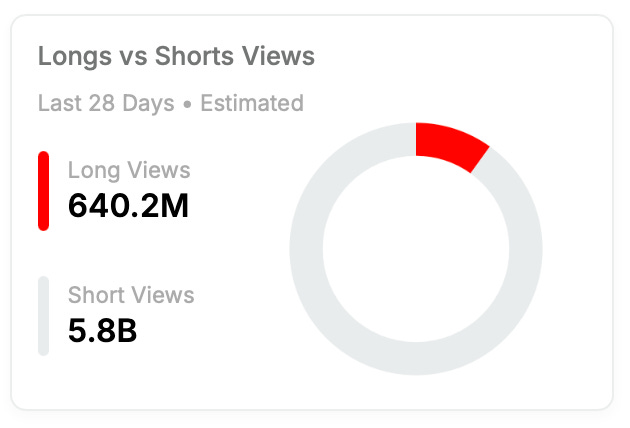
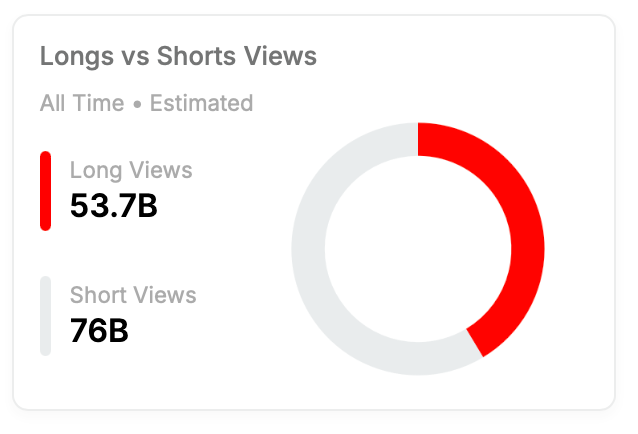
For those creators popular with under 16s, you can browse here on MrBeast’s View Stats website to see what percentage of their views are Shorts. Here is MrBeast’s own split - you can see how for years, his long form views made up more of a percentage of his overall views, and how in the last 28 days, over 90% are Shorts (in the grey):
Or here are Sidemen’s breakdown over the last 28 days, and then all time:
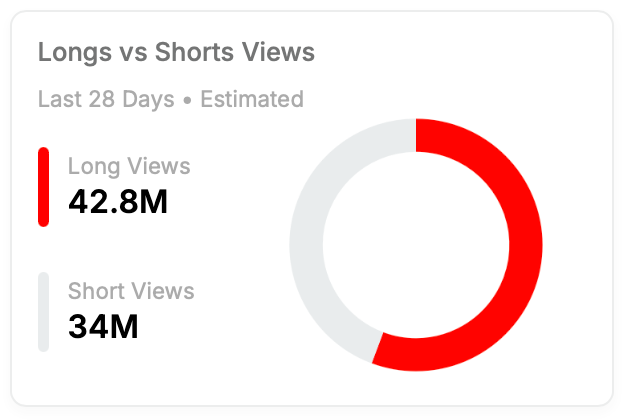
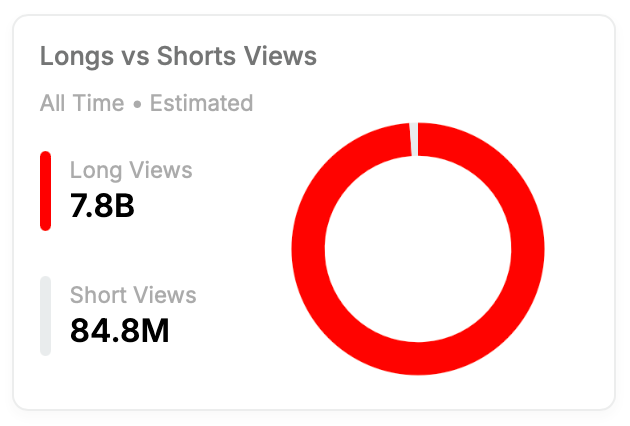
So while YouTube has created functionality to restrict Shorts if desired, the takeaway is generally speaking, YouTube Shorts = TikTok = Reels, and so should be treated the same from a child protection perspective.
It is also interesting to note how people’s perceptions of what is appropriate for teen audiences is heavily influenced by their own experience of YouTube. So I’ve seen a raft of comments from people where they are watching all sorts of wonderful old BBC documentaries, and assuming that this reflects the same experience for teens.
The whole point is your experience on the platform is personalised by all sorts of data YouTube has about you such as your age, demographics, what device you are using, and what you’ve watched previously. To put it crudely and simply, if you watch BBC documentaries, you’ll get more of that. If you are watching dodgy content, you’ll get more of that instead. And so all of us need to understand that our own individual feeds on YouTube are bespoke to us, and therefore, the content pool on the platform really matters. Just because you aren’t seeing it, doesn’t mean it isn’t there and doesn’t mean it isn’t being served to others.
YouTube said it was a ‘vital resource for young people’ and that a ban risked pushing children towards ‘anonymous, less safe services’. Google cited research they commissioned from Livity that 95% of UK teens surveyed had said watching videos helps with school work.
And here in lies the challenge with user generated social video platforms. Of course, there are many great educational creators and channels on social video platforms. However, there also is a whole host of inaccurate and gross slop too. I previously outlined the example of the Viking sacking of Lindisfarne in 793, where I stopped counting at 100 near identical videos, all with similar revolting thumbnails of an event that never happened (I just checked, many of these are still there on YouTube, albeit with tiny views so I wonder if many have been demonetised rather than deleted).
In the spirit of the Scotland fans having a blast in Boston at the World Cup, can I use a Glaswegian phrase used to poke fun at those from Edinburgh? Where they’d say ‘aw fur coat, nae knickers’.
On the one hand is the gloss of creators, acres of high quality TV shows and all sorts of partnerships like Coachella. However, on the other is the unsavoury and unsuitable for kids content (and no, this isn’t just limited Shorts).
There is a tension at the heart of YouTube where it is fighting two battles simultaneously. It is says it is a responsible platform, just like a streamer. Except, they are not regulated or measured the same as the streamers, broadcasters and so on. So Netflix, Disney+ et al are regulated in the UK by Ofcom, and YouTube isn’t.
Simultaneously, it is in a pitch battle with Reels and TikTok for attention and advertising income. Remembering that Meta made more advertising money around Reels (they claimed last year they are on an annual run rate of $50bn) than YouTube did last year ($40bn).
This fight of the scroll on one side, the curated streamer on the other is why I wrote this piece below:
The question being, will this tension become unsustainable at some point, or can YouTube sail on, confident in the knowledge it is in a category of one.
Now think of the CTV OS battleground for the living room, which I wrote about earlier in the week:
In CTV environments, it is fairly easy to block apps. While VPN access is possible, it is a right faff to set up (especially if at router level they are blocked). So in the living room at least, the regulated streamers in theory win, as parents may block the YouTube/Instagram for TV/Twitch apps. Considering the huge play YouTube has made for a slice of the TV ad market, you can see how being excluded from the living room would be undesirable for the company.
Put all this together and it isn’t hard to imagine YouTube launching a standalone curated streamer that is regulated same as Netflix and Amazon Prime Video, with humans making the decisions on what channels to allow onto the service.
There still would be many 1,000s of channels, all from a heady mix of rights holders, creators, music labels, movie studios, production companies and more, and thus enabling the company to build parental and brand trust. To be allowed onto this premium service, perhaps YouTube would hold channel owners responsible for meeting specific content and commercial standards.
What would be left beyond the gates of this service, out there on the Wild West YouTube, would be those zillions of channels that don’t pass a regulatory standard.
This two tier approach might go down exceptionally badly with those creators left out. However, this might create the very incentive needed for some channels to up their editorial and compliance game….
What do you think? Is this possible, or will YouTube stay as is?
One company that is notable by its absence on the social media ban list, but is a source of frustration for parents, is Spotify and podcasts in particular (which therefore is an issue for YouTube and Apple too).
I’ve written about this issue in the past, but to summarise: Spotify used to be just music, and therefore its child-protection involved relying on the explicit label put on music with swearing in it, familiar from the old world of CDs and tapes (plus it has a Spotify Kids standalone app, for under 13s).
Spotify’s parents’ guide reflects the aged 13 cliff edge that is common to many of the platforms. To summarise, up until 13, as well as the dedicated kids app there are managed accounts where podcasts and audiobooks are unavailable, alongside other tools for parents. After 13 however, then the world of podcasts and audiobooks are available to teens, and here the platform relies on whether the creator has flagged issues with their podcast, a level of machine learning, as well as whether users report individual podcasts for inappropriateness. So while a user can say they aren’t interested in a particular artist or creator, this again leaves it up to the kid to proactively manage their feed.
Many parents complain that the podcasts and audiobooks their teens are being served are inappropriate for a whole range of reasons: acres of f’ing and blinding, porn, adult content, violent themes and so on.
There is a philosophical world view of many working in the internet, which was foundational back in the 1990s and 2000s and is why the internet is as it is.
That is, the internet should (must?) be free and open, unrestricted and unregulated.
You can sense this philosophical position in a Times interview with YouTube co-founder Chad Hurley, back in 2008 and where already there were problems with the volumes and nature of what was being uploaded. I can’t find the original interview, but here is Wired’s reporting of what he said:
I’m not sure it is our job to solve the world’s problems … I’m not trying to hide from responsibility but we also have to respect freedom of speech.
I have two small children as well; we have clear policies and clear guidelines, and we have given tools to the community so they can flag or notify inappropriate content.
In another interview with the New York Times in 2006, Chad said:
There’s not really any safe places on the Internet.
The culture that founded social platforms was based on openness and any form of regulation is by definition, a bad thing. This world view - especially blended with the vast sums of money being made - has long created a situation that could be summarised that inappropriate content on a platform is bad, but a) possibly preferable to the regulated alternative where free speech is restricted and b) tech can solve the inappropriate content problem.
That’s not to say this is the only philosophical world view that was present during the gestation of the internet. I was reminded of another this week, where the idea that it was wrong - almost immoral - to expect people to pay for online journalism. This mindset is another crucial pillar for why we have the internet we do.
There has been a shift over time of the bar of what is considered acceptable for kids and teens. So before, broadcasters and programme makers had a strong sense of child development phases, and therefore were aware of what content was appropriate for what age group, which is why things like the watershed exist, let alone the efforts going into the programmes themselves, plus support provided when airing difficult issues.
Now, after the age of 13, much of the conversation appears to assume the problem is violence and porn, while the messy middle of complex themes doesn’t get much of a look in.
(As an aside, I’ve been ChatGPT to create these types of diagrams of late - with varying degrees of success, but frankly a huge time saver!).
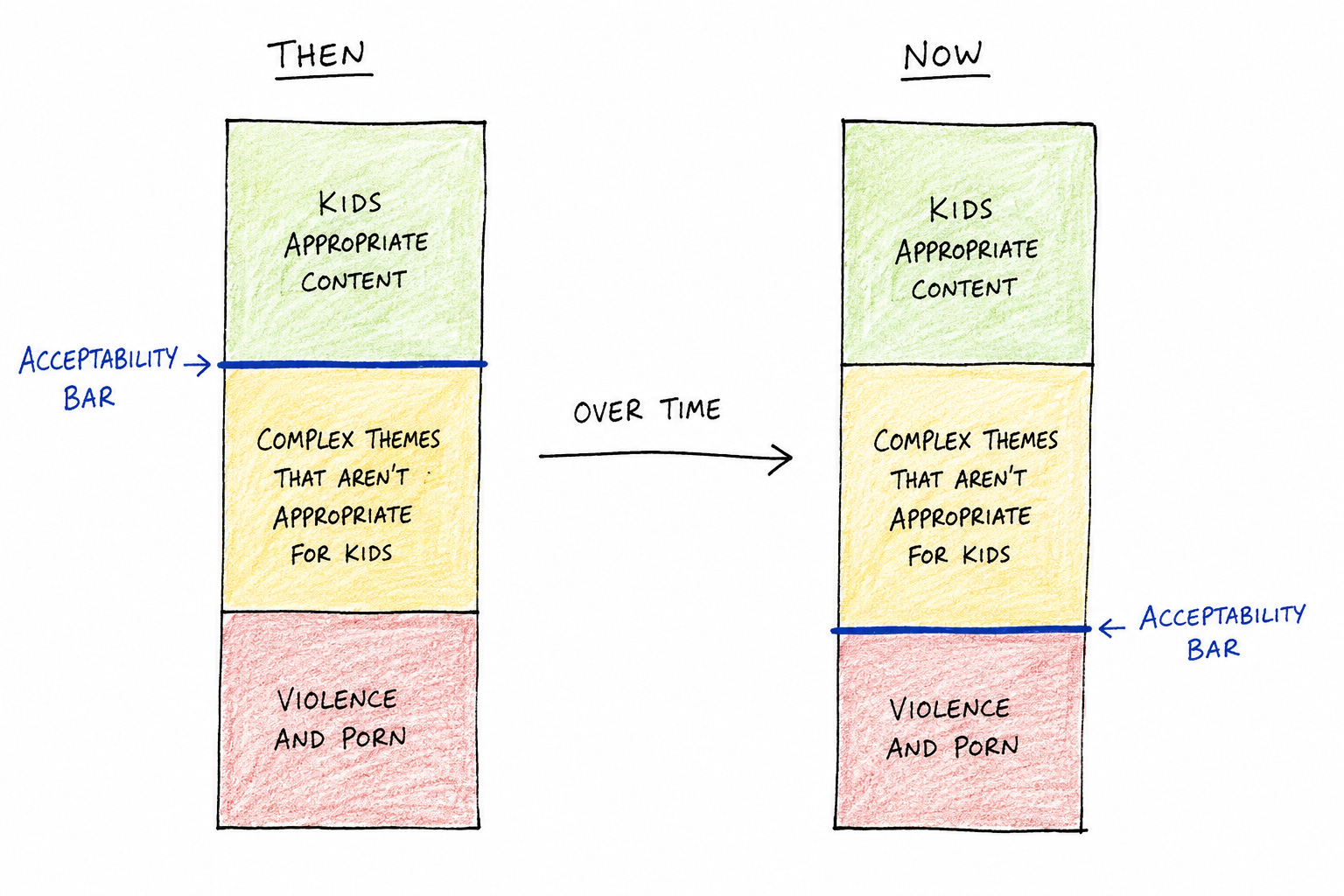
Of course, there are many excellent creators out there making age appropriate teen content. The whole point however, is that the current set-up means it is left up to the skills, care and competence of each individual creator to make these judgements, while in both the broadcast/streamer ecosystem, the platforms have this responsibility.
And individual creators are not universally appropriate or inappropriate. Indeed, watch some popular-with-teens creators - especially the live streamers - and it is remarkable how 90% will be totally fine, 10% is very much not.
So parents need to watch 100% with their kids, unlike (say) the BBC or Netflix where the parental controls mean they don’t have to helicopter over every millisecond their kid is watching or listening to, as they can have the confidence the company has made sure everything is age rating compliant.
There is a sentiment where people use the number of Australian kids reportedly circumventing the ban, with dare I say a little triumphalism? However, I think instead a longer term view is important. A point I’ve made previously is how it appears that parents of younger children are taking a far more restrictive position than those parents did in the first wave of smart phones and social platforms.
I wonder if generations of parenting styles are shrinking. So observationally, my parenting cohort (age 7 and 9) are far more restrictive and totalitarian around devices and media use than parents with kids even five years older. It is as if my current cohort have looked at the experiences of older kids - and the flood of research data that has since come in about the impact of tech and social media on young brains - and come to the conclusion that a hard no is not only possible, but indeed, perhaps essential. They also appear to have got fed up with waiting for someone (the platforms? The government?) to do something, so instead have taken matters into their own hands. Worth noting there is definitely a class element at play here too.
And then again, I wonder if the parents of kids who are currently babies will be even more hardline?
In other words, I wonder if the ‘no point banning/kids will get around it’ crew are reflecting their time and experience as parents and the world has now moved on? Or indeed, are they just speaking from experience of parenting teens while my group have yet to have that pleasure, and therefore are living in blissful ignorance?
Then thinking about the kids themselves. The social media ban has been a lively conversation in schools, and (again, risk of generalising from my own experiences) the primary school kids have understood this is because the government and parents don’t think the platforms are good for kids brains, and that there is content there that is unsuitable for them.
So over time, this stops being something that is taken away from kids (or something to be circumvented), and instead becomes something they never had.
Scott Deutrom of Progressive People made the following point below:
There will, of course, be kids who navigate around the ban and reach the very content the legislation is designed to protect them from. A plethora of evasive mechanics will no doubt circulate among those determined not to be restricted.
The evidence backs the scepticism - in Australia, where a similar ban is already in force, seven in ten children who had social media accounts before the ban still have them, but here’s the thing: if this only serves to protect ‘some’ UK kids from forming addictive and potentially destructive habits, it’s still legislation worth championing.
…I suspect a ban that protects even half our kids today will reset the baseline for what we collectively accept as normal tomorrow.
Indeed for some, they think this is just the start. In the Deadline article above, Alex Segal, MD of InterTalent who represents talent such as Grace Dent and Ross Kemp, (and also writes the newsletter Dealmakers), made the comment that this was ‘an important day’ and ‘an incredible step in the right direction of safeguarding children that should have been in place years ago.’
He went on to say that further protections might be needed, for example ‘YouTube either has to add age warnings like you get at the movies or you have to submit identification to be able to watch content.’
For those without young kids, you might not have had the joyful experience of trying to use the available child protection tools. If this is you, then I have nothing but envy.
It is hard to express in words how frustrating the existing parental control tools are, both on particular platforms, but also most importantly, how they interact with each other and between app and device settings. Patchy, glitchy, inconsistent, where each platform has taken its own approach, which ranges from hard to use but gives enough of a bandaid to protect kids, through to downright useless, where gaping holes means a parent’s only choice is to ban their kids entirely.
I remember going to a presentation years ago from the founder of the kids marketing agency Super Awesome, where he made the point that many of the founders of social platforms were young men without kids, so as a result, child safety often ended up far from their minds when managing and establishing their companies. As they grew up, got married and had kids, it is notable how many have commented publicly on their own approach to limiting screens and social for their own children: Steve Jobs, Bill Gates, Google CEO Sundar Pichai, YouTube’s Neal Mohan, Evan Spiegel of Snap. All have said a variation on the theme around limiting screen time.
Hours a week are spent by parents worrying about this issue - watching videos or reading forums on which particular restrictions to put in, talking to fellow parents as they feel their way in the dark, only to realise (often too late) they’ve left gaping holes in their armour. This often is at router or app/platform level, rather than a kid’s individual device. In other words, parents don’t realise without restrictions on their router, then it is fairly easy to bypass whatever device limitations have been put in place. And at an app/platform level, there often is a conversation that runs along the heart-sinking lines of ‘oh no, I thought that app was fine! My kid loves it!’.
Not to be all Gen X about it, making playlists by pressing record on a cassette as your favourite song came on the radio was superior to the experience of trying to create a safe way for a kid to discover new music. Which is mad considering our advanced technology capabilities and the volume of amazing content out there.
In this debate around social media bans, it is notable how the conversation centres around parents and governments, with little frustration directed at the platforms for their failings in this area.
On a similar theme, Omar Oakes said (his whole post is very much worth reading):
Every proposed solution for ‘dealing with social’ media – the ban, the Online Safety Act, safety by design principles – is a request. Not a demand with real consequences, but a meek request to very large, very rich, and very legally resourced American companies.
“Oh please will you start behaving now?”
You can’t open a restaurant in this country without passing a health and safety inspection. You don’t get a fine afterwards if your kitchen turns out to be contaminated.
I spoke to someone recently who interacts regularly with the senior leadership of many of the big tech companies, and there was a general shoulder shrug that the companies will do anything about this area unless forced by governments or the courts, unless of course there are financial upsides to do so. And in part, this is understandable, as they are answerable to their shareholders. However, this is especially depressing considering the importance these companies have in society, and their vast technical capabilities.
I do wonder if there is a strong reputational argument for big tech themselves to properly take control of this situation? While the response from the platforms to the ban was along the lines of emphasising that safer, curated online environments can be built using tech and tools, it is frustrating that a) the tools they have created aren’t better than they are and b) that they haven’t built a robust universal solution years ago.
I also wonder if the drip drip drip of parental distrust will start to be seen somewhere on balance sheets. Remember that concept of the ‘trust thermocline’ - as outlined by John Bull on Twitter several years ago. You can read his whole explanation here, but in a nutshell, it is the idea that users suddenly bulk abandon a product or service and it isn’t clear what caused this mass rejection. But actually, what has happened is people have swallowed their frustrations, all the while building a perhaps subconscious sense of being taken for granted, until suddenly, they say ‘no more’. And once trust and the associated habits are gone, well, they are very hard to get back. As John explains:
Users and readers will stick to what they know, and use, well beyond the point where they START to lose trust in it. And you won’t see that. But they’ll only MOVE when they hit the Trust Thermocline. The point where their lack of trust in the product to meet their needs, and the emotional investment they’d made in it, have finally been outweighed by the physical and emotional effort required to abandon it.
A summit could be called next week between all the companies - Apple, Microsoft, Google, YouTube, X, Meta, Spotify, Snap, TikTok, Roblox - where they agree to do what they should (and could) have done years ago: create an industry-wide, global standard for child protection tools. Put their best engineers and policy people on it. Age appropriate content environments are there for the taking. This can’t just be left to broadcasters, networks and streamers.
Could I be cheeky and suggest that if any company drags their heels or waters down the approach, then their CEO should be forced to sit through endless hours of live demonstrations by parents having an excruciating time trying to use the current tools and systems that are meant to block dodgy content for kids?
Thanks for reading Business of TV! This post is public so feel free to share it.
Comments
Nothing yet. Say the first thing.
Sign in to join the conversation.