
This week, I thought I’d write about the furore around the profits of the mega global juggernaut that is Bluey.
And while Bluey is a kids title, the story has many lessons for the wider content and creative markets, which I’ll go on to talk about.
Become a paid subscriber, and you’ll receive two posts a week to help you understand the age of internet disruption and what it means for TV and movie producers
For those who haven’t followed this story: there has been something of a storm in Australia over the last months around the mega global IP Bluey, and how little of the profits of this juggernaut have flowed back to the Australia’s public service broadcaster, the ABC.
To summarise the tale so far. The show was dreamt up by creator Joe Brumm, who approached the Brisbane-based company Ludo Studio to develop the idea. The ABC is reported to have put in $20k for a pilot episode, which then led to the BBC and the ABC co-commissioning the show. The exact financing mix hasn’t been made public, but as is common for kids shows, the production was reportedly financed via a mix of these co-commissioning budgets, Ludo making a contribution, production financing, screen agency funding and various tax credits and other incentive schemes.
Ludo Studio’s control of the IP and international rights meant they put the global master licensing merchandise and distribution rights out to tender, which was won by BBC Studios, while Disney acquired the global broadcast and streaming rights (with the ABC in Australia retaining the domestic rights). In turn, BBC Studios awarded other master licence agreements, such as toys to Australian company Moose Toys.
Critics say that the ABC ‘lost out’ on a share of the billions that Bluey makes per year, and that somehow this was caused either by the BBC unfairly swooping in and taking the rights, or a cockup by the then ABC heads for not insisting on acquiring rights as part of the original deal.
Just this week, the new CEO of the ABC says that while the BBC is better placed to exploit the international rights “The risk in terms of the total budget of the ABC was not a huge sum of money. I think it was something like $2 million on the first season.”
In many ways, this story is a perfect media furore for a smaller country being frustrated by larger players in the market. Indeed, many of the arguments are also an illustration of hindsight being 20/20. As of Understory said on LinkedIn:
Oh, look. Yet another round of hot takes arguing that the Australian Broadcasting Corporation “left billions on the table” by not pushing harder on the original Bluey rights deal. This time, the particular armchair commissioner went further: the ABC didn’t even try, because they lack risk appetite.
..
Neat line. Pure rage bait. Notably, it came from someone who hasn’t worked in television production, let alone children’s programming, where the economics, timelines, and regulatory layers are an entirely different proposition.
..
If we’re going to hold onto the next Bluey, Australia needs a creative industries system funded to match the realities of the modern media market and ecosystem.
..
Risk appetite and risk capacity are two different, albeit related, things.
There are two longer reads worth your time on this subject.
Firstly, ’s post below, where she outlines what is required to launch and manage a global kids brand; how BBC Studios was best placed to do what they did (so indeed, well done to Ludo for selecting them in the tender process, and to the BBC Studios’ team for launching and managing the brand). Finally she highlights how the ABC isn’t set up in this manner, as its remit is heavily focus on prioritising Australian content for Australians. She gives the example geo-blocking and global platforms like YouTube:
But the thing is, keeping it in your ecosystem involves thinking outside your ecosystem. Not outsourcing internationally means behaving internationally. Something that organically falls foul of the PSB remit. To this day, the Bluey YouTube channel remains geo-blocked out of Australia.

And secondly, has written a very long post detailing the history of kids TV in Australia, the ABC’s forays into commercial activity, and why in his opinion the attempt to ensure more of the next Bluey’s revenues flow back to the ABC are misguided.

I could quote his piece at length - and it is one of those articles that is worth sitting down to read in full - but just to pick out two really important points.
He talks about Australia’s size, which is important to understand within the context of Bluey and managing global IP:
People like to watch what they know and most people unfortunately aren’t Australian. The US and UK have the audiences and the buyers at home. They can pay for their shows there, then sell them abroad for a fraction of what it costs countries like us to make our own.
…
Small and distinct cultures like ours get trampled on screen if no one props them up.
He also highlights the difference between commissioning and investment, the importance of encouraging creatives to take a risk, and why trying to take a slice of the action could have reduced Ludo’s leverage with bigger players:
Michael Carrington, the man who commissioned Bluey for the ABC, called it “a bit of public broadcasting courage”. Classic Carrington, giving Ludo everything the ABC was there to give, with whatever it had left. The courage to get behind a bloke from Brisbane without a hope in hell and let him tell his Australian stories the way he wanted. Lots more came together to make Bluey, but lose any of that and Bluey doesn’t exist.
Take away the freedom and you’re concreting over the ground where crazy shit grows.
He also makes a similar point to Emily about the contradiction at the heart of the ABC’s strategy around digital distribution, where geoblocking to Australia doesn’t help build a global brand:
The ABC was also precious about keeping its shows to itself in Australia. Whatever audience Bluey built at home couldn’t seed an audience on YouTube, where any kids’ franchise has to be these days. Geo-restricting a whole country doesn’t do you any favours with the algorithm.
(Joe is also writing a book on Bluey, which he is releasing on his Substack over the coming months.)
To build on what they have written, I thought I’d add a few additional dimensions - the first of which might not be immediately apparent to non-Australians.
Growing creative sectors in other parts of a country
While both Joe and Emily highlight how Australia is a relatively small country, this doesn’t quite make clear what upstream fish Joe Brumm and Ludo Studio are - and the reason I often feature him in seminars as inspiration for producers, especially those not based in places like London which are centres of production, finance and commissioning.
Joe and Ludo originated and made Bluey in Brisbane, Queensland, a part of the country that historically was not perceived as being one of the cultural or creative centres of Australia. This is a subject that I’m very familiar with, having grown up in Adelaide in South Australia (‘Oh, Adelaide. I’ve never been there’ is not an uncommon response from anyone enquiring about my accent). Melbourne and Sydney have always been the big cities, and places like Queensland and South Australia were not considered part of the metropolitan creative landscape (although worth mentioning that C’mon Kids by the Nine Network was produced in Adelaide).
This has changed hugely since I was a kid - for Adelaide, in no small part to the Adelaide Fringe Festival, especially over the last decade thanks to the epic work by Heather Croall (who many in the UK factual scene will know from Sheffield Doc Fest).
As for Queensland (‘Hollywood on the Gold Coast’), Bluey has played a key role in helping to build a thriving industry, with all sorts of creative businesses establishing international reputations. To give just a couple of examples: the new Bluey game is being made in Queensland; Cosmic Dino Studio is attracting animators from across the world; scripted titles like Two Years Later has been set and shot there, and is due out on Paramount+ next month; and Kevin Costner is currently filming his latest project on the Gold Coast, Amazon MGM Studios’ Honeymoon with Harry.
Of course, there are all sorts of tax and financial incentives and other support available thanks to organisations like Screen Australia and Screen Queensland, and it would be wrong to suggest that this success is solely down to Bluey.
However, the point is that while the ABC might not have seen their bank accounts overflow with merchandising and licensing money because of Bluey, they instead have arguably helped to create something meaningful and sustainable, which also aligns with their public service remit: a thriving creative ecosystem in a state where previously it was much smaller and less globally competitive.
Tensions between in house and independent production
Here perhaps we can see that familiar tension between in house and out of house production. For organisations like Channel 4, which was established as a publisher not a producer, working with a myriad of independent production companies is a routine part of the job, and one that is woven into the very fabric of the institution. Where growing businesses and seeing them succeed is something to be strived for and celebrated.
However, for PSB broadcasters which historically had large in-house production divisions, the process of reducing in house production and moving to outside production companies has been a much more difficult and challenging cultural shift. So here it isn’t hard to imagine that the fostering of a vibrant independent production sector in Queensland might not have had people rushing to get out the bunting.
How deal mechanics can encourage or stifle entrepreneurs
This leads on to my next point, which is about attitude to risk, and the fundamental understanding of the balancing act required to encourage innovation versus be a dead hand on entrepreneurialism. You can see this woven through Joe Hicks’ post, where the very idea of the ABC taking rights on an unproven project by an untested talent is just as likely to have ended up killing the project stone dead, or alternatively, weakening the producer’s cards in a negotiation.
For many commissioning or funding organisations, the temptation to hold onto rights is strong. This is why in the UK Pact negotiated the terms of trade back in 2003, so rights could be returned to producers who then had the necessary financial incentives to go out and see what they could make of them. I wrote the following two posts on this subject:
Even so, the desire to warehouse rights, or the urge to take too big of a share of future earnings is hard to tame; and it takes wise leadership to curtail that instinct in themselves and others. As one senior commercial affairs person taught me many years ago, ‘there is nothing worse than two bald men fighting over a comb’. This mindset of ensuring a financier or commissioner gets what they want, while also taking the approach of ‘let a 1000 flowers bloom’ to try to light an entrepreneurial spark in a creative producer is a great asset in any organisation. And you can see how this is a very different approach to some who view the commissioning of IP more akin to procuring services on a work for hire basis - and therefore the belief that rights should naturally sit with the buyer.
In fairness, the person trying to retain rights or carve out a return on an untested project are often doing it for what they believe are the right reasons - especially when they are spending public money. However, getting the terms right is an art: deals need to ensure rights aren’t being warehouse doing nothing, or alternatively, that the terms are so unappealing that producers don’t bother trying to exploit whatever rights they have.
The trickiness here is that for those who prefer stifling deal terms, there is no Sliding Doors alternative reality where it is possible to point to how better terms could have been more beneficial. Indeed, I’ve heard those who have insisted on hugely restrictive terms say things like ‘there is no secondary market for this type of content’, perhaps unaware that their deals made it pointless for any producer to have a go in selling their IP.
The importance of timing
Another point is how the timing of when Bluey was commissioned played a significant role. This was back in 2016/7, which was right at that moment where broadcasters like the BBC were shifting from fully financing some kids series, to only part financing and where producers were expected to go out to the market to find the rest of the money. Bluey did this perfectly, but at that time, there were a whole number of CBBC kids titles that were conceptualised for a single UK PSB buyer and audience, and the producers found the step change exceptionally challenging to try to reimagine these shows to have global appeal. And the reality for some of these scripted shows is they were stuck between the old and the new models: too expensive for just the local UK market, but without that special sauce to make the global leap either.
The irony of course is that Bluey is as Aussie as it comes, but back then, there weren’t other titles to take inspiration from in how to blend global universal appeal with strong local roots.
What realistic alternative options were there?
Fundamentally, some of the furore appears to be based on a confusion about what broadcasters like the ABC are paying for - which is a licence to broadcast and stream a title in Australia over a particular time frame, and where the ownership sits with the producer to exploit beyond this licence.
And while there are various deal frameworks in place, kids animation series often are treated on a case by case basis due to the costs of production and also the potential for merchandising and consumer products. Even so, in the case of Bluey, not only was it a co-commission with the public service part of the BBC, BBC Studios itself put in a vast amount of cash and effort in launching the show internationally and making it the success that it is.
So to play the 20/20 hindsight game. What were the ABC’s options back at the point that Bluey was not a proven success? They appear to be:
Attempt to take various global rights at the point of commissioning
Throw its hat in the ring when the Ludo put out the tender for the global rights
Put in a clause in their commissioning agreement with Ludo where the ABC gets some sort of percentage of net receipts.
On the first option. Trying to take some sort of international right could have jammed up the wheels for future negotiations for Ludo, plus I would imagine this would have gone down badly with the wider Australian production community. I’ll defer to those with more insight, but the idea of the ABC trying to take some sort of international rights from new productions (especially from unproven talent) to me anyway feels like it would have been frowned upon, especially if there wasn’t the internal engine to help exploit these rights in some way so they are likely to have just been sat on.
For the second option. As others have explained, the ABC - both its PSB arm and its commercial operation - didn’t have the capacity required to be a global franchise management machine, and certainly not at the scale and level of investment that BBC Studios was willing to make. In addition, the remit, purpose and (I assume) operations of the organisation was focussed on getting Australian content funded, and distributing it to Australian audiences - so in that sense, their decisions were wise and correct as this approach got the show made. So of course, they could (indeed, perhaps they did?) throw their hat in the ring, but BBC Studios would have been chosen for all the right reasons.
And so the last option, to get some sort of share of Ludo’s net receipts, is the most feasible. Although to what extent Ludo would have pushed back on the ABC getting a share of their net receipts is one of life’s great unknowns.
Even on this point, I thought I’d highlight how in the UK at least, the value by PSB broadcasters on shared net receipts on secondary sales/further commercial exploitation was falling out of favour at that time. As an example, Channel 4’s terms of trade framework saw the broadcaster receiving 15% of net receipts indefinitely. However, in 2019, the terms of trade were renegotiated with Pact, and from that point, Channel 4 focussed on receiving broader streaming and portfolio rights in the licence period, while giving up their share of net receipts of international exploitation and secondary revenue such as merchandising.
Of course, there will always be exceptions and bespoke deals, plus of course Bluey wasn’t a classic BBC terms of trade deal (like most kids animation series aren’t for the reasons previously explained). However, the takeaway here is a) this was an unknown creator, making a first series that might have never seen a second and b) even if they had negotiated a percentage of Ludo’s net receipts on merchandising, it is likely to have been quite small thanks to the level of finance that the ABC put in to the production in the first place.
What we can learn from this tale
While it is helpful to learn from history, the hindsight 20/20 game is dangerous (after all, we could win the lottery if we had chosen the right numbers). There clearly is a renewed focus on what lessons can be learned, to help build more global IP brands in the future. However, the elephant traps are enormous, and multiple.
Is there the level of appetite and finance required for the ABC to try to become a global franchise management business similar to BBC Studios?
Is there another Australian company that already could fulfil this role?
Is there a pipeline of ideas ready and waiting to be converted into global IP brands?
What happens if the IP that lends itself to global appeal dilutes the Australian cultural content? Which is more important?
What deal terms will encourage and not stifle the Australian creative community?
What does success look like - money back into the ABC, and/or a thriving independent creative media sector?
And for those in places similar to Queensland who are seeking to foster a creative sector outside of a country’s established production markets, what lessons are there in the roles played by the ABC and the screen agencies in supporting and encouraging this growth?
There is so much to be proud of in the story of Bluey. The ABC and the BBC took a risk on an untested creator with a pretty out there idea, and gave him a deal to encourage him and the production company to shoot for the moon. There should be great pride in enabling Joe and the team at Ludo, and helping make it such a success.
Not only did the ABC help make Bluey what it is, but also they enabled the building of a thriving globally recognised creative sector in Queensland that hopefully will live on, well after Bluey is no longer being made.
The swimming pool cake
I’ve talked about the business of Bluey in this post, however, before signing off, I thought I’d share an example of how clever it has been in weaving very specific Australian adult cultural references that also don’t dilute the viewing experience for those unfamiliar…
In one episode, dad attempts to make the Duck Cake from the 1980 Australian Women's Weekly Children's Birthday Cake Book. For the uninitiated, this is a gloriously (and very dated) cake cook book full of deceptively hard to make and yet deeply desirable to children recipes, and it has iconic status for Australians of a certain age.
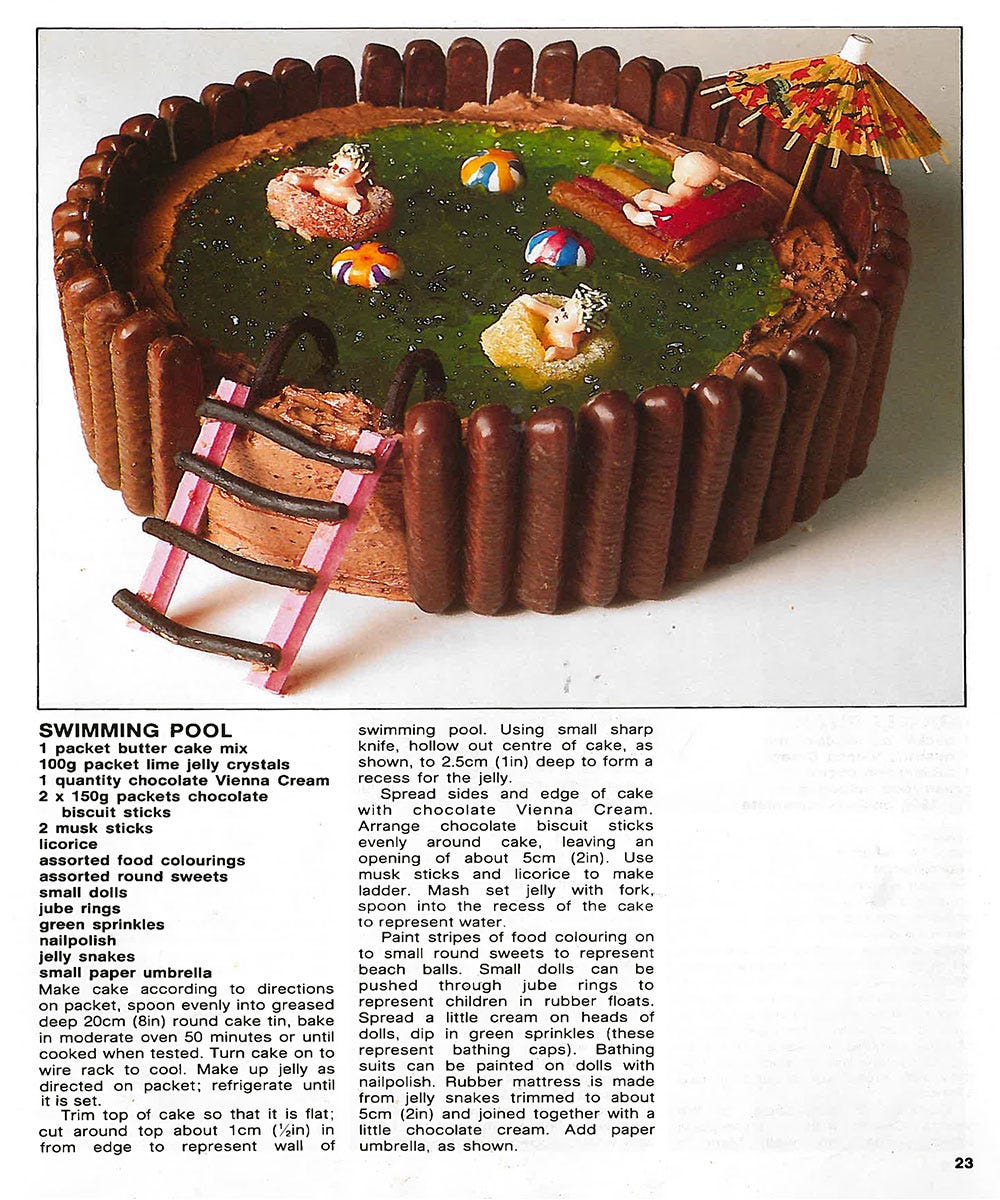
In the episode, the cake that is skipped over is the swimming pool cake - where green jelly is used for the water. This is the moment in Bluey:

And this is the page in the recipe book. My nearly 10 year old has poured over my mum’s battered copy of the cook book, begging me to make this cake for her upcoming birthday. Wish me luck (and no, I won’t be sharing photos).
Writing this post involved (probably unnecessarily) a whole lot of nostalgia viewing of Australian kids TV shows - I could have done a whole post on this subject, but instead thought I’d share these two: If Australian broadcasters or IP funders are in the market for rebooting old Aussie kids IP, then how about Professor Poopsnagle?
Finally, The Rattlin’ Bog by The Wiggles remains something to marvel:
Thanks for reading Business of TV! This post is public so feel free to share it.
Comments
Nothing yet. Say the first thing.
Sign in to join the conversation.