
As always, the list of what I think is important for TV and film producers (and everyone in the wider content industries) to know about is far longer than the time I have to write it. Suffice it to say, there is much to say about:
Longtime YouTubers having major success at the box office
The continuing AI rumbles around IPOs, reliability, copyright (again) and profits
Battles in the visual podcast market
Unhappy noises from creators about platforms limiting their ability to reach their followers
Amazon’s continued push into CTV and the video advertising market.
All of that will have to wait for another day, as instead I’ve taken a partial trip down memory lane triggered by a few recent conversations.
Before I start - sincere thanks to all of your who have taken out paid subscriptions - I’m honoured that you see what I write here has enough value to pay for it (OK, perhaps it might be expensed, but the principle still stands!).
OK, the title of my post is a little clickbaity. Even so, in our upturned TV world, there is a noticeable, and probably natural, desire to find someone to blame for the state of the market: the TV industry itself, leadership, executives. It isn’t uncommon to see or hear these sentiments on LinkedIn or at conferences, especially when people’s livelihoods have been so disrupted.
In essence, a general harrumphing at the failure of TV to ‘get with the programme’ and instead choosing to stuck its collective head in the sand when it comes to internet disruption.
However - and here I’m speaking specifically about the UK - I think this is a misunderstanding of how TV broadcasters have engaged with the internet.
Indeed, I’m going out on a limb to suggest quite the opposite: the UK’s TV broadcasters have collectively invested hundreds of millions, if not billions in the internet over the past 30 years, and despite all this activity, sustainable business models that can rival or replace TV profits have remained somewhere beyond the rainbow.
This is a long post - but as a summary:
The idea that UK broadcasters ignored the internet in general (or YouTube in particular) up until the last few years is for the birds
The reality is there has been heavy and long investment in this frontier space going back nearly 30 years
However the economics of online content businesses continue to be less attractive than those of TV
This is a feature rather than a bug of working in online content, and thus requires a reworking of production methodologies and revenue models to build profitable (and often smaller) businesses
This has a serious knock-on to the complexity and ambition of content that is produced, which you can see across the creator landscape where simpler, less editorially challenging and cheaper content formats dominate.
For clarity, I’m specifically referring to activities outside of streaming TV-like VOD services, such as iPlayer, 4oD/All4, ITVX, BBC Sounds, Sky Go and so on. This is your semi-regular reminder that the UK has had comprehensive catch up and archive streaming services since 2006.
Instead, I’m focusing on the zillions of digital projects and initiatives by British broadcasters going back decades:
UK broadcasters have been on every new tech platform since they launched, signing deals and partnerships with everyone:
YouTube, MSN, Bebo, Facebook, Twitter, Snap, TikTok and many others;
New initiatives from Second Life to the Metaverse, VR and AR experiences, connected TV projects and AI;
Red button interactive services;
Online publishing destinations, apps and websites, subscription services and affiliate deals;
Podcasting in both the first and second wave;
Interactive story telling experiences across multiple genres;
Console, device, PC and casual gaming strategies;
Standalone IP investment funds.
Despite all this investment and activity, the financial return has been hard to find; instead this activity was often seen as future proofing, way finding, experimentation, exploration, innovation, education, audience building and the like.
And while some of these projects had no commercial dimension (obviously true for the public service part of the BBC, plus some of Channel 4’s activities were focussed on delivering the organisation’s educational or public service remit), audiences engagement sometimes missed the levels expected.
So for all this activity, and the support from leadership that came with it, broadcasters struggled to build lasting, profitable businesses out of internet native operations, outside of the TV-like streaming and VOD services which have been the natural evolution of the TV distribution model.
How much was spent? Even a quick tally of the publicly available data of Channel 4’s digital media external commissioning budgets over the past 25 years quickly gets to £210m, and that excludes multiple other digital strands as well as the internal costs of staffing, technical and other resourcing costs. The BBC? Vastly more - even just the BBC Jam initiative was reported to be £92m+. The volume and number of projects is enormous - some live, many archived. Here is just one division’s activities, but there have been so many more:
All this activity came in waves, same as the wider market as the internet evolved and matured. Indeed, there is a book to be written as there are many relevant lessons for us all.
Below is something of a potted history - I've focussed more on Channel 4 because I know the organisation better, however there were vast amounts of activity at the BBC, ITV, as well as smaller channels like Sky Arts and Flextech too.
Late 1990s and the 2000s
This was a period of wide ranging innovation and exploration, combined with the building of online publishing businesses around key genres (or in the case of the BBC, various magazine titles).
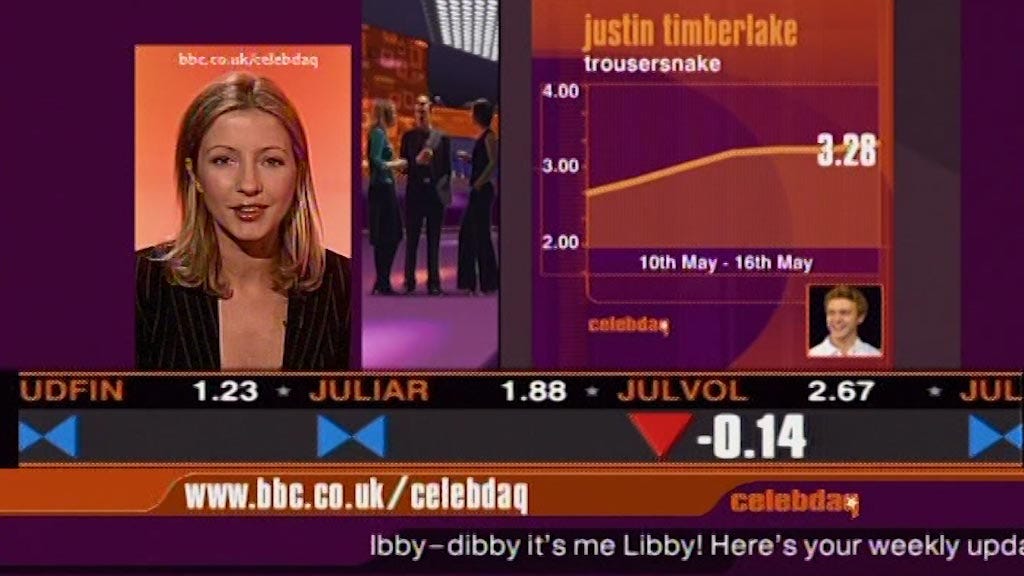
To pick just a couple of BBC projects from so many. Celebdaq was the online celebrity stock exchange game that also had its own TV show on BBC Three.
Jamie Kane was an online murder mystery game from 2005 that revolved around the death of a fictitious pop star. Users were guided through a 15 day experience, interacting with fan message boards, fake CCTV footage and the like as the story unfolded.
The BBC ran H2G2, Douglas Adams’ user generated encyclopaedia which he originally launched in 1999. It was intended to be ‘an unconventional guide to life, the universe and everything’, and was run by BBC Online from 2001 to 2011.

Here are some Channel 4 examples from the same period - again, this barely scratches the surface on the volume of activity going on at that time:
TV shows with sizeable online experiences way beyond standard programme support, often targeting younger demographics: Hollyoaks, T4, Skins and Big Brother to name but a few
Dedicated commercial websites targeting specific audiences: e4.com, 4Homes, 4Food, 4Car, 4Beauty, 4Sport, aplaceinthesun.com
All sorts of user generated video or image projects such as 4Docs, Big Art Mob and 4Mations
New types of storytelling such as Such Tweet Sorrow, where the story of Romeo and Juliet played out on Twitter in text speak
And as previously mentioned, Channel 4 signed its first deal with YouTube back in 2009, along with many other tech platforms - this was to put its full VOD service, catch up and archive, on the platform from 2010 - 2014, when the deal term ended.
Channel 4 Education shifted the majority of its £6m annual budget online, where a whole raft of games were commissioned, such as Privates (trailer below) and Bow Street Runner.
There were also numerous other activities, including the 4iP investment fund that seed funded all sorts of online native IP businesses. For example, investing £350k in mybuilder.com (selling the stake for £5.9m in 2017).
Meanwhile other broadcasters were also making noise with multiplatform initiatives. A great example from 2009 was Sky Arts live streaming One & Other. This was the Antony Gormley & Artichoke’s initiative where over 100 days, 2,400 members of the public got an hour to do whatever they wanted - within reason - on the Fourth Plinth in Trafalgar Square.
Post 2008 crash
This first wave started to stutter, in part thanks to the tightening of budgets post the financial crisis, but also because the digital display and sponsorship advertising market wasn’t generating the profits needed to run editorially-heavy page impression content publishing businesses - and certainly not in comparison to the premium video advertising income that was starting to be generated by VOD services.
For Channel 4, various websites were closed - for example, 4Car, which was originally launched alongside a TV show Driven, but after that was axed the website became an outlier, and eventually was shut in 2009. In this obit for the website, it says of this different time:
By 2004 it [4Car] was pulling in nearly 7 million page views a month, making it one of the UK’s most popular car websites at the time. For a while it enjoyed an editorial budget to rival that of a magazine, employed a substantial staff and lavished welcome largesse among freelance journos.
In the same time frame was the premium rate telephony scandal, where it was found that unfair competitions were being run on air where people had no chance of winning, but were still being charged:
These competition phone lines were pulled for many years, which had a serious knock-on to many broadcasters’ new media income (where telephony often sat); especially for shows where phone voting was a key part of the economic model like reality competition series that were a big part of the schedules.
Simultaneously, as harder looks were being had at financial returns and how aligned these activities were with broadcasters’ core strengths, there were also tough questions that despite being innovative, some projects - especially those not built around TV shows - were not reaching enough users.
In addition, a much under-appreciated point was the burgeoning cost of maintaining an ever-expanding number of projects. All of these initiatives required ongoing tech support, especially those with audience data or user generated material to ensure security. So the more projects launched, the more sprawling the estate of each broadcaster was becoming, and the bigger the ongoing support costs became.
And without a reliable business model, this was always going to become unsustainable.
The early 2010s
At the same time in the early 2010s, there was this explosion in the new form of digital publishing businesses. So companies like Buzzfeed, which had such reach with the younger demographic the then political editor got a lobby pass and interviewed the prime minister.
And yet, the UK’s broadcasters didn’t try to emulate these businesses, perhaps because of recent memories of their own forays in the 2000s that showed how tricky the economics are of running large editorial teams funded by display/social video advertising and branded content.
Instead, broadcasters increasingly focussed on extending and distributing their core TV output. This saw more investment in the explosion of streaming and on demand services. And multiplatform activity focussed on extending TV shows as this was broadcasters’ USP in reaching audiences thanks to the power of TV output in driving audiences to engage with something online.
To indulgently pick one of my favourites, Hippo: Wild Feast Live. Remote cameras witnessed a dead hippo being eaten by all sorts of animals over a two week period - live streamed online, a map where you could track all the animals coming and going, plus a daily live show on TV. All I can find of this project is the video below:
And there were many others, such as:
Embarrassing Bodies: Live from the Clinic involved people uploading images of their ailments to a website, with some being selected to then be treated live online and then later on TV via Skype
Million Pound Drop play along game, where something like 12% of the TV audience played along live online
A portfolio of online and app games such as the Snowman
Ben wheatley’s film A Field in England in 2012 was backed by Anna Higgs at Film4.0, and saw the film released simultaneously online and in the cinema
Big Fish Fight saw over 700,000 sign an online petition about over fishing
Comedy Blaps, which continues to be the first rung on the ladder for new comedy talent.
Mid to late 2010s
So now perhaps we could put ourselves in the shoes of leaders of TV broadcasters for a moment. They have watched and championed all this innovation and cash spent on a whole range of internet strategies for 15+ years, so by the mid to late 2010s they might have been left with the conclusion:
The TV everywhere streaming VOD distribution strategy to get all TV output, catch up and comprehensive archive services, on demand and live streaming onto every platform imaginable is succeeding in transitioning linear TV and building a solid financial future (obviously at this same time, they are seeing the rise of Netflix, which focus ever more attention on this area)
The growth of customer data via the VOD services was vital in reinforcing broadcasters’ linear and on demand advertising position
The acres of online and digital initiatives outside of VOD weren’t building meaningful new income or IP (with of course a few notable exceptions)
Therefore despite best attempts and long periods of experimentation, eventually it appears the conclusion was reached that online activities primarily serve a marketing, audience reach or brand building function, while revenues are sought via IP asset sweating operations on the various video platforms.
The 2020s
Broadcasters continue to shift some of their multiplatform spend into original video content for their own as well as social video platforms, while also focussing on programme support for key titles, as well as individual splashy multiplatform marketing initiatives to launch specific shows.
Of course, many businesses are making cash out of their direct-to-consumer strategies: the growing engines run by the big IP owners such as Zoo55 at ITV, BBC Studios, Fremantle, Banijay, Channel 4 and Little Dot Studios at All3Media; the new generation content production houses like Spirit Studios, After Party Studios, Strong Watch Studios; direct-to-consumer editorial propositions like The Rest is History; reinvented TV titles such as Time Team, never mind all the individual creators and collectives building audiences and making money via multiple revenue streams such as advertising, brand partnerships and so on.
However, there isn’t a huge amount of transparency about how much money is being made by all these activities, especially in comparison to those made by linear or on demand TV.
Can we recognise that same pattern from previous phases, where reach, views and noise are generated, and yet revenues or profits don’t follow at the same level?
I saw a comment recently by Richard Greenfield, said in relationship to Roku’s recent approach to financial reporting:
Roku breaking out platform revenue is a confidence flex.
Is the lesson here that where revenue numbers are stellar, they’ll be broken out? This applies to everyone in this space - from smaller creators, through to TV companies and networks, all the way to the platforms themselves. So one to keep an eye on.
In conclusion
This is such a rich and varied history, and hopefully it is obvious my point isn’t to suggest any sort of failure by those of us working in this arena now or in previous years.
Quite the opposite. Rather, it is further evidence that the following should be front and centre of everyone’s minds:
Despite being a great way to reach audiences, the online content business model is often a pale imitation to that of TV, and where you have to run an awful lot harder to make money online
Healthy tech platform reach and revenues don’t necessarily translate to the same for the IP owners, channels and creators these platforms rely on
Reach and views don’t necessarily equate to revenues and profits.
I hope you found this incomplete trip down memory lane both useful and interesting. My main takeaway is this: I don’t think it is reasonable to finger point at the UK’s TV broadcasters for ignoring the internet for too long, or only treating it as marketing, when you consider the vast sums and leadership support that has been invested in this space going back decades.
Instead I’d suggest it has actually been the reverse: for well over 25 years there has been constant and considerable investment across the UK broadcast industry in a myriad of multiplatform products and services; with broadcasters spending decades hunting solid internet enabled, future-proofed business models outside of VOD and linear TV… while income has been found, unfortunately, it has often proved to be smaller and less profitable than desired.
If we want to further explore the past to help inform the future, perhaps more valuable discussion points could be:
Did broadcasters spend multiplatform or digital money on the right things, in the right way?
Did broadcasters go too early with too great a focus on innovation, and too little on IP and revenue, only to run out of steam in the mid to late 2010s when they needed to invest more heavily at that stage?
Or would that have just resulted in emulating the digital media model of Buzzfeed et al that was popular at the time, and then similarly live to regret it?
Would any of this have created larger and more sustainable businesses when the fundamental model is so less profitable than TV?
What, if we had out time again, would any of us do differently?
Again, hindsight is a wonderful thing, and this might be a subject for a later post.
Postscript: The rest of the world
I’m conscious that not all broadcasters and networks across the world took the same path as those here in the UK. There are many examples where TV has turned a blind eye which resulted in key strategic decisions that have had lasting implications for all of us. Most notably, the decision by US networks to outsource their VOD activities to Netflix in the 2010s rather than bite the bullet and build TV everywhere streaming distribution businesses themselves similar to the UK’s approach since 2006. Even so, we must acknowledge the vast challenge that would have been in a geographically carved up market like the US. Here is a piece I wrote about the history of how VOD services emerged and how the US tale is so different from other territories like the UK:
It was this decision to allow Netflix to grow like a cuckoo in the nest which in turn enabled them to enter markets like the UK and upend many of the existing business models. So the UK’s TV everywhere strategy didn’t inoculate our broadcasters from these types of global players.
Thanks for reading Business of TV! This post is public so feel free to share it.
Comments
Nothing yet. Say the first thing.
Sign in to join the conversation.