
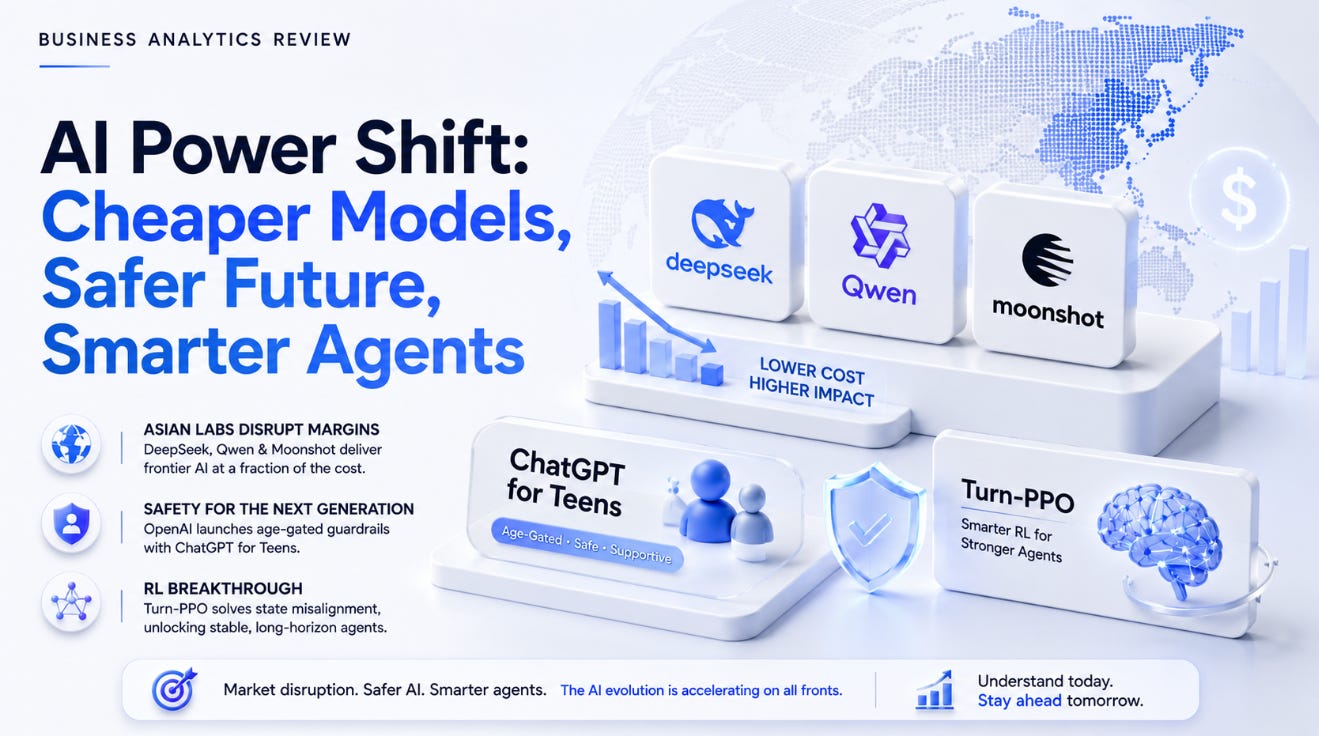
The global artificial intelligence ecosystem is undergoing a dramatic dual transformation, driven by aggressive open-weight parameter efficiency from Asian labs and crucial algorithmic advances in agent reinforcement learning. As Chinese models like Alibaba’s Qwen, DeepSeek, and Moonshot deliver near-frontier reasoning capabilities at drastically lower inference costs, Silicon Valley’s enterprise monetization assumptions face unprecedented margin pressure. Simultaneously, frontier labs like OpenAI are expanding age-specific safety frameworks through dedicated products like ChatGPT for Teens. At the architectural frontier, breakthroughs like Turn-PPO are resolving state representation misalignment in multi-turn reinforcement learning, stabilizing long-horizon agent training. This issue analyzes these market disruptions, safety shifts, and foundational RL engineering improvements.

What Happened: Alibaba released lightweight additions to its Qwen model family, designed to deliver high-tier reasoning, coding, and instruction-following capabilities while operating at a fraction of the parameter count and computational footprint of flagship models from OpenAI, DeepSeek, and Zhipu AI. By maximizing parameter efficiency and post-training optimization, these compact models achieve competitive benchmark scores against dense models ten times their size. The lightweight Qwen models have already seen massive adoption across open-source hubs, surpassing hundreds of millions of downloads as global developers seek cost-effective, high-performing local alternatives.
The Technical Primer: Lightweight models utilize optimized architectural techniques like aggressive weight quantization, group-query attention, and knowledge distillation from larger teacher models. This enables a model with far fewer active parameters to retain dense cognitive representations while dramatically reducing memory bandwidth requirements and inference latency during execution.
Why It Matters:
Hardware Accessibility: Enables high-accuracy agentic and coding workflows to run locally on consumer-grade hardware or edge devices without expensive cloud GPU infrastructure.
Enterprise Token Economics: Significantly decreases token inference costs for enterprise pipelines, making persistent multi-step agent automation financially viable.
Global Open-Source Adoption: Solidifies Qwen’s position as the leading open-weight ecosystem, driving global developer workflows away from locked proprietary APIs.
Key Takeaway: Highly efficient compact models are proving that architectural refinement can outpace brute-force parameter scaling for practical edge deployments.
What Happened: Financial analysis reported by Bloomberg highlights growing strategic concern across Silicon Valley as Chinese AI developers—led by DeepSeek, Alibaba’s Qwen, and Moonshot AI—rapidly close the performance gap with top US frontier models while offering API access at a fraction of the cost. These Chinese open-weight models offer low-latency reasoning and agentic tools that rival closed US systems, undermining the high-margin subscription models that Western AI startups relied on to justify massive private valuations. The resulting price pressure is forcing major US tech giants to adjust pricing tiers and accelerate enterprise bundling strategies.
The Technical Primer: Rather than relying purely on massive compute scaling, Chinese labs prioritize extreme post-training algorithmic efficiency, sparse Mixture-of-Experts (MoE) architectures, and novel reinforcement learning pipelines, achieving high benchmark efficiency per watt.
Why It Matters:
Economic Moat Erosion: High-performance, low-cost open-weight alternatives destroy the ability of proprietary API providers to extract monopoly-level enterprise pricing.
Infrastructure Re-evaluation: Forces US hyperscalers to justify massive capital expenditure on physical compute when software optimizations yield comparable performance gains.
Shift to Hybrid Deployment: Enterprise buyers are increasingly blending proprietary closed models for core reasoning with cheap open-weight models for high-volume background tasks.
Key Takeaway: The rapid democratization of near-frontier open-weight models is turning raw intelligence into a low-cost commodity, compressing industry-wide API margins.
What Happened: OpenAI introduced “ChatGPT for Teens”, a specialized product tier equipped with dedicated safety guardrails, content filtering, and robust parental management features. Designed specifically for minor users, the system allows parents to link accounts, monitor usage parameters, and toggle settings options such as disabling chat history and persistent memory to prevent the AI from profiling psychological distress over time. The launch comes as global regulators intensify scrutiny over the mental health risks and safety hazards associated with unmonitored conversational AI usage among adolescents.
The Technical Primer: Safety architectures for minor-facing AI integrate specialized multi-layer content classification models that run parallel to the primary LLM. These classifiers detect self-harm, adult content, or acute psychological distress in real time, overriding model generation with safe redirect prompts and triggering safety guardrails.
Why It Matters:
Regulatory Compliance Standard: Sets a technical blueprint for complying with stringent global child protection laws, such as the UK Age-Appropriate Design Code.
System Prompt Hardening: Demonstrates advanced constitutional AI principles by applying strict behavioral boundaries without rendering the model useless for educational tasks.
Trust & Family Adoption: Accelerates consumer household adoption of AI assistants by giving parents granular visibility and policy enforcement capabilities.
Key Takeaway: Safety guardrails and age-gated account architectures are becoming essential compliance primitives for consumer AI platforms.
Using AI for marketing analytics? Don’t make this mistake.

The mistake: Never giving your AI a single source of truth for your data. AI can diagnose what’s wrong with your marketing, but only if it can see complete and connected marketing data. See how SegMetrics can turn your AI into a trustworthy analyst. No more hallucinations or vague summaries.

What Changed: Researchers released Turn-PPO, a novel reinforcement learning methodology engineered to eliminate training collapse and instability in interactive multi-turn AI agents. Traditional reinforcement learning algorithms like Group Relative Policy Optimization (GRPO) operate under a token-level Markov Decision Process (MDP), masking out environment query tokens while updating generated tokens. Turn-PPO redefines the RL formulation at the turn level, treating full query-response dialogue turns as unified state-action steps within the MDP.
Why This Matters: Directly applying standard GRPO to multi-turn agent tasks leads to severe instability, entropy collapse, and loss of long-horizon reasoning capabilities. Token-level MDPs suffer from “State Representation Misalignment”: within an LLM response, the next state simply appends one token, but across turns, an entire block of environment feedback is appended. This discontinuity forces value critics to regress toward an averaged, inaccurate state value, distorting advantage estimations. Furthermore, GRPO applies a uniform advantage across all turns in a trajectory, over-rewarding easy turns and failing credit assignment. Turn-PPO solves this by pairing a turn-level MDP with a learnable critic via Generalized Advantage Estimation (GAE).
Technical Breakdown (Easy to Understand): Imagine teaching a student chess token by token while hiding the opponent’s moves during scoring. The scorekeeper gets confused whenever the opponent takes a move because the board state changes abruptly. Turn-PPO updates the scoring system so that the scorekeeper evaluates performance after each complete turn (player move + opponent response), allowing for accurate credit assignment across multi-step games.
Industry Impact: Evaluated on complex multi-turn benchmarks including WebShop and Sokoban, Turn-PPO maintains high training stability, completely prevents GRPO collapse, and achieves superior task success rates both with and without long-reasoning chains.
Opportunities Created: Engineering teams can now fine-tune autonomous agents for multi-turn environment interaction, web navigation, and automated tool use without risking sudden reward cliffs or gradient spikes during RL training.
What Happens Next: Turn-level MDP formulations are set to become the standard baseline for post-training multi-turn reasoning models, replacing naive token-level advantage estimation in open-source agent frameworks.

What It Is: An open-source framework developed by LangChain designed to construct resilient, stateful multi-agent applications structured as directed cyclic graphs.
Why It Matters: By implementing Google’s Pregel graph processing model, LangGraph provides fine-grained state persistence and execution checkpointing, allowing agents to pause, receive human-in-the-loop validation, and resume execution seamlessly.
Potential Use Cases: Multi-step financial auditing, complex legal document generation, and automated cybersecurity penetration testing frameworks.
Explore More: Official Website, Documentation
What It Is: A multi-agent framework utilizing a dual-mode architecture that pairs autonomous role-playing “Crews” with deterministic “Flows” process control.
Why It Matters: Balances role-driven creative execution with structured process enforcement, supporting over 100 LLM backends via LiteLLM integration.
Potential Use Cases: Automated market research synthesis, collaborative software patch generation, and multi-department support ticket routing.
Explore More: Official Website, Documentation
What It Is: An open-source long-term memory engine designed to provide persistent, dynamic memory layers for LLM applications.
Why It Matters: Extracts, structures, and dynamically retrieves user-specific interaction histories, drastically reducing context window overhead while supporting offline execution via Ollama.
Potential Use Cases: Personalized AI coding assistants, persistent executive personal agents, and adaptive customer support bots.
Explore More: Official Website, Documentation

Turn-PPO: Turn-Level Advantage Estimation for Agentic LLMs
A groundbreaking paper introducing turn-level MDP formulations to fix reinforcement learning training collapse in interactive multi-turn agentsThe 2025 AI Agent Index
An empirical evaluation mapping design paradigms, technical architecture, and safety protocols across 30 deployed state-of-the-art agentic systemsAgent Skills & Model Context Protocol Integration
Research formalizing progressive context loading, SKILL.md specifications, and governance frameworks for extensible agent ecosystems

Open-Weight Parameter Efficiency Is Commoditizing AI APIs: Lightweight models like Alibaba’s Qwen prove that architectural parameter efficiency can match larger systems, severely compressing US frontier API pricing margins.
Token-Level RL Explodes in Multi-Turn Settings: Naive GRPO token-level MDP formulations lead to severe state representation misalignment, necessitating turn-level advantage estimation.
Turn-PPO Fixes Agent Reinforcement Learning Collapse: Operating at the turn level rather than token level gives critic models accurate state-value targets, stabilizing multi-turn agent rollouts.
Minor Safety Guardrails Are Shifting to Platform Architecture: Dedicated tiers like ChatGPT for Teens demonstrate that minor safety compliance requires real-time classifiers, parental linking, and state memory controls.
Closed-Loop Strategy Memory Outperforms Raw Context Stuffing: Memory frameworks like ReasoningBank and Mem0 show that extracting dynamic strategies from past agent failures yields far higher success rates than plain interaction logging.

Tool: Unsloth Studio
Why It Matters: Delivers no-code local fine-tuning and local agent integration via
unsloth start, reducing VRAM consumption by 70% while supporting multi-GPU hardware setups.What Opportunity It Creates: Enables engineering teams to fine-tune specialized domain models locally without incurring cloud API usage fees or exposing internal datasets.
Explore: https://unsloth.ai/docs/new/studio
Research Paper: Reproduce DeepSeek R1 Survey & OREAL Framework
Why It Matters: Explores token-level reward assignment and imitation mechanisms to reproduce R1-style reasoning without requiring massive model distillation datasets.
What Opportunity It Creates: Offers lightweight training recipes for researchers seeking to apply reinforcement learning on domain-specific reasoning benchmarks.
Explore: https://arxiv.org/abs/2502.06781
GitHub Repository: DSPy Stanford Repository
Why It Matters: Replaces hand-written prompt templates with compiled Python pipelines that optimize instructions and few-shot examples automatically via GEPA and MIPROv2 search algorithms.
What Opportunity It Creates: Allows engineering organizations to build regression-tested AI systems that automatically re-compile and optimize when baseline models are updated.
Explore: https://github.com/stanfordnlp/dspy
Comments
Nothing yet. Say the first thing.
Sign in to join the conversation.