
Jim Goad is dead. He had apparently been physically ill for some time, and many would argue his brain curdled years ago. I hadn’t read his work (or listened to him; like many aging provocateurs, he had become a podcaster) in more than two decades, but my understanding is that he had long ago become nothing more than a misogynist, racist, right-wing crank.
[Disclosure: When I was a magazine editor in the early 2000s, I published three articles by Goad.]
When he first emerged in the 1990s, there was more to him than that. There was always an ugly side to his work (N.B. I have never read Answer Me!, the four-issue zine he published with his then-wife Debbie), but he sometimes asked questions that were worth asking. His 1997 book The Redneck Manifesto (subtitled America’s Scapegoats: How We Got That Way And Why We’re Not Going To Take It Anymore) is often crude and overwrought, but there’s a real consciousness at its heart. This is how he began Chapter 5, “Workin’ Hard”:
The working class doesn’t write a lot of history books. The working class doesn’t produce many movies or radio shows. The working class doesn’t tend to hire media consultants or theatrical agents. The working class has played an itty-bitty role in fashioning its popular image.
That’s because the working class was too busy working.
A page or two later, he writes, “If someone were to devise a machine that could measure hatred… I’d bet all my wooden nickels that more hatred exists between bosses and employees than between blacks and whites… Of all the hating I’ve done in my life — and I’ve done my share — ninety-nine percent of it was directed at rich white people, most of them my bosses.” Goad had a keen understanding of class in America, and did his research; there are sections of Redneck Manifesto that can be read alongside any “serious” history of labor you can name. But be warned that even the good stuff is delivered in language that you’re probably gonna hate, so if you decide the digging isn’t worth it, you’ll get no argument from me.
Support BA! Burning Ambulance is a 501(c)(3) tax-exempt nonprofit. Donations to us are tax deductible under Internal Revenue Code (IRC) Section 170, and we are qualified to receive tax deductible bequests, devises, transfers, and gifts under sections 2055, 2106, or 2522. Support us through Fractured Atlas or BurningAmbulance.com, or by buying our CDs or becoming a paying subscriber! Everything helps!
Goad’s life went off the rails in the late ’90s, when he was divorced from Debbie and involved with another woman, Anne Ryan. He was physically abusive toward both, and served two and a half years in prison for assaulting Ryan. When he came out, his writing grew more fevered and self-pitying; his second book was an autobiography called Shit Magnet: One Man’s Miraculous Ability to Absorb the World’s Guilt. No New York publisher would touch it, so it was released by Feral House, a small press run by journalist Adam Parfrey.
Parfrey was a few years older than Goad, and had first come to underground prominence in the late ’80s as the co-founder of Amok Press (related to but not part of Amok Books, an LA-based bookstore and mail-order source for fringe literature). The press released only eight titles, including a novel by Nazi propagandist Josef Goebbels, Jack Black’s You Can’t Win (I own a later edition from AK Press, but Amok is thanked for bringing the book to light), and Apocalypse Culture, an anthology of writings on subjects ranging from necrophilia to eugenics to extreme body modification. When the company shut down, Parfrey left Los Angeles for Washington state, where he founded Feral House and remained until his death.
Since 1989, Feral House has published hundreds of books on all sorts of subjects related to history, politics, and pop culture. Some of their best-known titles are Michael Moynihan and Didrik Søderlind’s Lords Of Chaos: The Bloody Rise of the Satanic Metal Underground, Rudolph Grey’s Nightmare Of Ecstasy: The Life and Art of Edward D. Wood, Jr., Jerry Stahl’s Permanent Midnight, Steven Blush’s American Hardcore: A Tribal History, and Parfrey and Cletus Nelson’s Citizen Keane: The Big Lies Behind the Big Eyes. All of these inspired, or were adapted into, movies.
Other Feral House titles that I have read and enjoyed over the years have included Ika Johannesson & Jon Jefferson Klingberg’s Blood Fire Death: The Swedish Metal Story (reviewed here), Michael Tau’s Extreme Music: Silence to Noise and Everything In Between (reviewed here), Mel Gordon’s Voluptuous Panic: The Erotic World of Weimar Berlin, It’s A Man’s World: Men’s Adventure Magazines, The Postwar Pulps (edited by Parfrey, and reviewed here), and Timothy Wyllie’s Love Sex Fear Death: The Inside Story of The Process Church of the Final Judgment (discussed here).
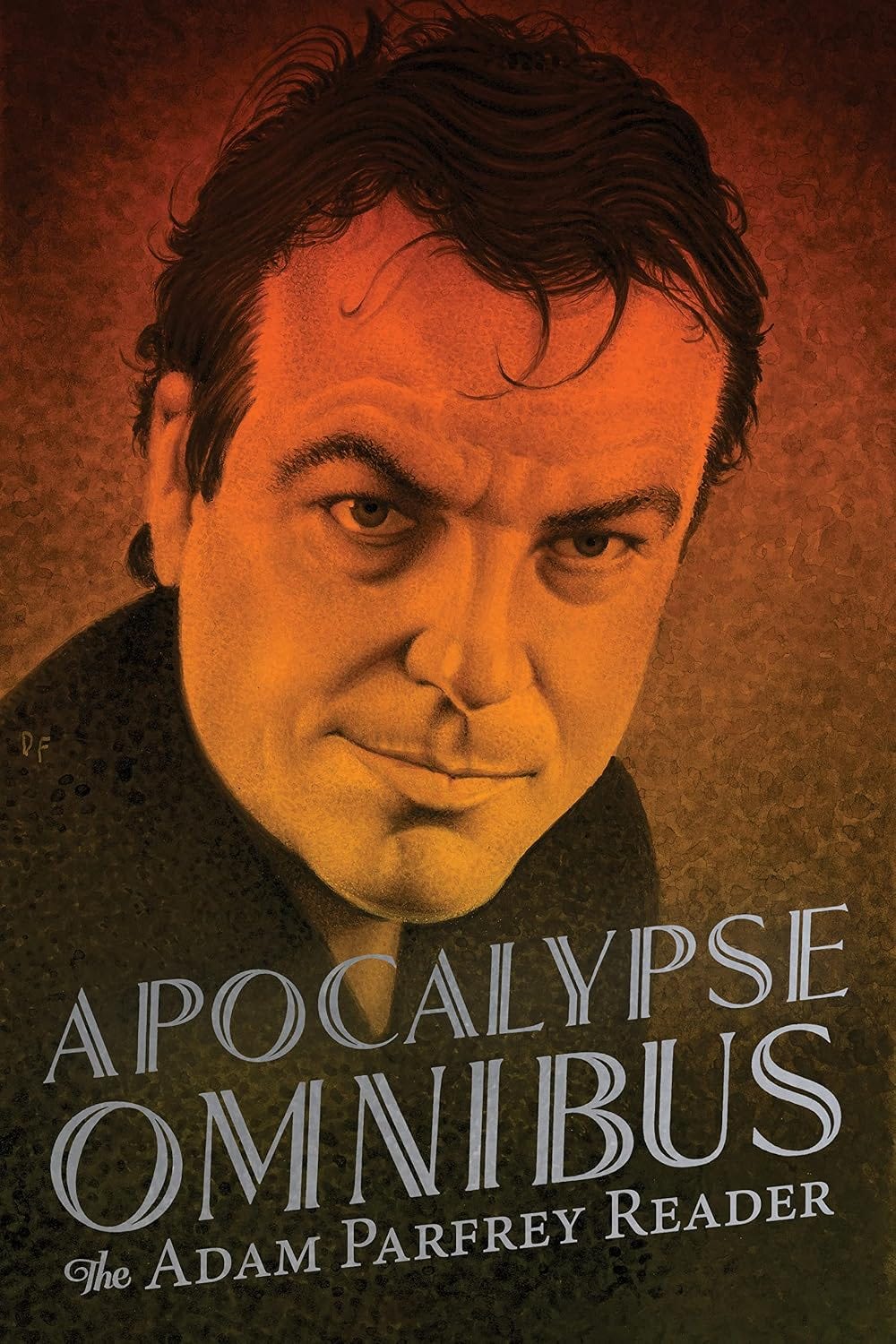
Parfrey died in 2018, but Feral House continues under the guidance of Christina Ward. This summer, they published Apocalypse Omnibus: The Adam Parfrey Reader, a thick collection of his journalism, quotes from interviews (blended together into one mega-interview; it’s a good idea that works pretty well), scans of letters Parfrey received from people like Charles Manson, Ted Kaczynski, and John Wayne Gacy, posts from a blog on the Feral House website, and more. (Buy it from Amazon.)
The book is very much a mixed bag. Some of the more traditionally journalistic pieces, including several investigative/immersive features on fringe religious organizations originally published in the San Diego Reader in the early ’90s and later reprinted in Parfrey’s book Cult Rapture, are fascinating and well-crafted. Others, like a story on a physically handicapped couple who formed a small sex-positive group, exhibit a sneering cruelty that’s more than a little off-putting.
There’s an interesting kind of revisionism at work in Apocalypse Omnibus, especially in the section Fascists, White Supremacists, And Their Friends. It includes an interview with a skinhead, an article on SWAT police, a long story about “soldier of fortune” and right-wing activist Bo Gritz, as well as the introduction Parfrey wrote to the Goebbels novel mentioned above. But perusing this section of the book (which is one-fifth as long as the collection of excerpts from his grumpy, misanthropic “HelL.A.” newspaper columns) will not tell you anything about, for example, Parfrey’s decades of friendship and collaboration with fascist artists Boyd Rice and Michael Moynihan, nor about his correspondence with neo-Nazi writer James Mason.
In the introduction to his book Rants And Incendiary Tracts, Parfrey wrote, “To hold an opinion and dare to express it is the final prerogative of the free man. Announcing an incendiary truth may be the last remaining vestige of human dignity.” In the introduction to this book, Christina Ward writes, “Adam Parfrey understood that the only durable response to challenging ideas is to bring them into the open and examine them without illusion.”
In the same introduction, she provides an explanation of his methods that in 2026 reads to this veteran journalist like ass-covering:
Parfrey did not approach his subjects as a journalist seeking balance or as an academic maintaining distance. He approached them as a collector of evidence, which required access to people and networks that do not open themselves to declared opposition. Access was obtained through building relationships, patience, and, at times, strategic accommodation. He listened without interruption, allowed subjects to speak in their own terms, and, when necessary, reflected their language back to them to gain trust. [emphasis mine]
So when Parfrey espoused personally racist views in letters to James Mason, it was just his way of cultivating a source? What about when he became friends with Holocaust denier Keith Stimely, or when he, Rice, Moynihan, and Nikolas Schreck formed the Abraxas Foundation? Same deal, I guess. You never know when relationships will yield a good story, right? It’s just kinda funny that he never wrote about, say, the Black Hebrew Israelites for Cult Rapture. I guess it might have been too difficult for him to reflect their language back to them to gain trust.
People under 50 have no idea what “the underground” was like in the 1980s and even the 1990s. The amount of misogyny, homophobia, and racism that passed under the aegis of “fearless investigation of humanity’s dark side” would, in 2026, send most people screaming out of the room. Apocalypse Omnibus is a time capsule from that era. The sneering, “look at these freaks” attitude of the cult section; the “isn’t this fascinating?” ingenuousness of the profiles of Nazis; the bilious, eye-bulging hatred in a piece on confrontational feminist and anti-porn crusader Andrea Dworkin: it’s all very familiar to me. Even the prose, overheated and wrathful, is very, very ’80s; you could put these pieces right next to anything from back then by Steve Albini (who regretted, and apologized for, his edgelord years before his death) or Lydia Lunch (who never apologizes for anything).
A lot of people, in the old days, would claim that it was OK to use racist, sexist, homophobic, and ableist language because they didn’t actually hold those views and didn’t know anybody who did, so it was understood in their circles to be all in good fun. Or they’d argue that when you were exploring the dark side of American culture, you had to expect to get a little bit on you. I don’t know what Adam Parfrey actually believed. His writings are deliberately opaque in that regard. He operates as a mouthpiece for his subjects. Which is fine. But his choice of subjects — the people he thought were worth handing a megaphone to — provide some clues.
I’m glad Feral House exists. Their catalog is wide-ranging, full of valuable and informative books. But the world has no more need of edgelords. The age of material and political comfort that allowed (white) “underground” culture to spend its time being “provocative” has passed. We live in an America governed by a senile criminal and his fascist goons, where cities are subject to military assault and citizens are swept up in racist purges, where women’s rights — not just the right not to have children, but the right to vote — are under direct threat, and trans people are being legislated out of existence. In this America, Adam Parfrey’s work has some historical value, but the attitudes underpinning it are a different story. His decades of playing footsie with neo-Nazis and serial killers, occasionally winking at the reader to let us know it’s all fine, we’re just turning over rocks to watch the bugs scatter, don’t feel so much like a warning (the back cover copy to Apocalypse Omnibus begins, “Adam Parfrey saw it coming”) as like a relic: something you find on a dusty shelf in the garage and ask, Why are we still keeping this around?
Comments
Nothing yet. Say the first thing.
Sign in to join the conversation.