
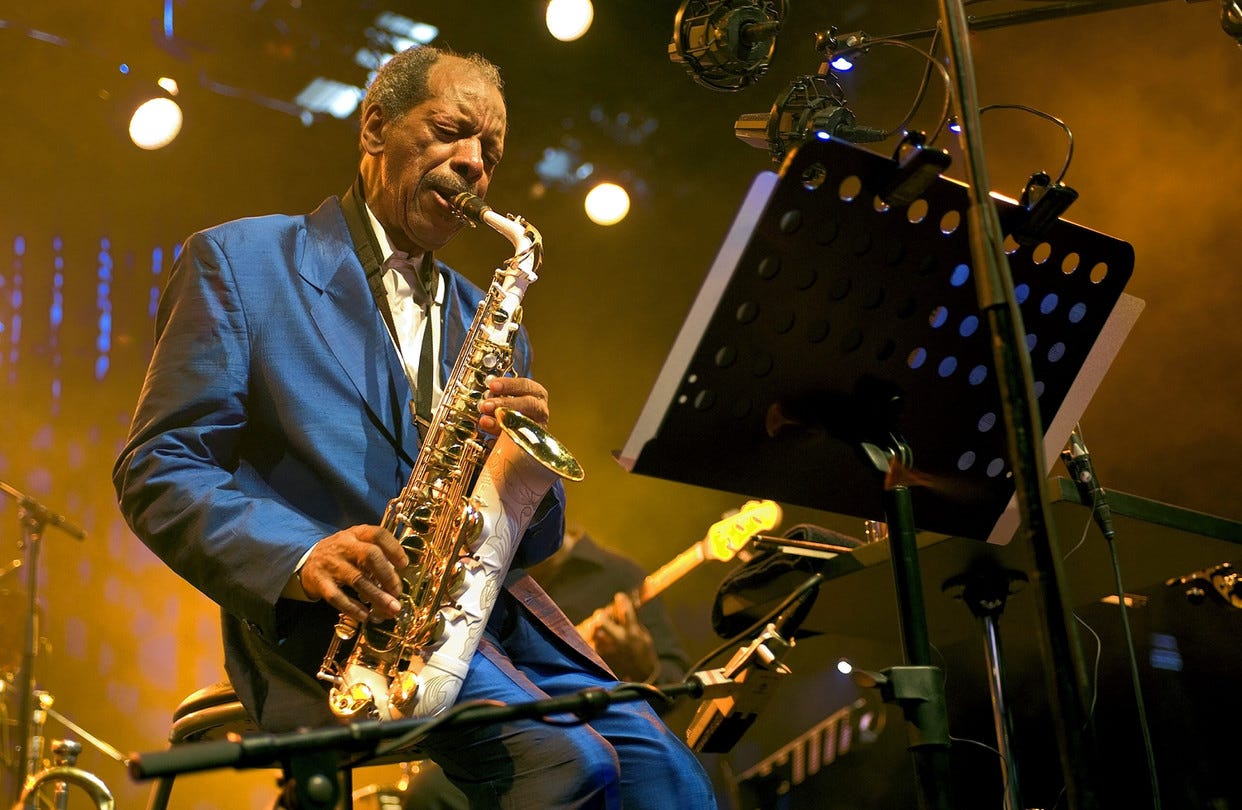
Ornette Coleman was always around, but in the late ’80s and early ’90s, his appearances became less frequent, and thus carried an element of surprise. Virgin Beauty, his 1988 album with Prime Time, got a big PR boost from the fact that Grateful Dead guitarist Jerry Garcia played on three tracks. I think the first time I ever saw Coleman’s name in print was a Rolling Stone review of that album. In 1991, he worked with composer Howard Shore on the soundtrack to David Cronenberg’s Naked Lunch (it’s amazing, and a perfect companion to the film; buy it if you’ve never heard it). In 1993, he performed with the Dead.
But then, in the middle of the decade, there was a sudden flurry of activity. First, he received a MacArthur Fellowship in 1994, which allowed him to start his own label, Harmolodic Records, and sign a distribution deal with Verve/Polygram. Under that arrangement, he released Tone Dialing, the first Prime Time album since Virgin Beauty and one that featured a new lineup of the group, including two keyboard players. The following year, Coleman released two albums simultaneously, with a new acoustic band that included a piano player, for the first time since he’d recorded with Paul Bley in 1958.
Support BA! Burning Ambulance is a 501(c)(3) tax-exempt nonprofit. Donations to us are tax deductible under Internal Revenue Code (IRC) Section 170, and we are qualified to receive tax deductible bequests, devises, transfers, and gifts under sections 2055, 2106, or 2522. Support us through Fractured Atlas or BurningAmbulance.com, or by buying our CDs or becoming a paying subscriber! Everything helps!
Sound Museum: Hidden Man and Sound Museum: Three Women, released 30 years ago this month, featured Geri Allen on piano, Charnett Moffett on bass, and Denardo Coleman on drums. Each album contained 14 tracks, 13 of which were versions of the same compositions and one of which was unique (Hidden Man’s exclusive track was a version of the spiritual “What A Friend We Have In Jesus”; Three Women’s was “Don’t You Know By Now”). They even had almost the same running order: the first six tracks and the last two were the same on each disc. Many of the compositions — “What Reason Could I Give,” “European Echoes,” “Mob Job,” “Mothers Of The Veil,” “Home Grown,” “City Living,” “Yesterday, Today And Tomorrow” and “Biosphere” — were ones he had recorded before, in some cases dating back to the early ’60s. The biggest difference between the two albums was that “Don’t You Know By Now,” the exclusive track on Three Women, was an atmospheric, reverb-soaked R&B ballad featuring vocals by Chris Walker and Lauren Kinhan.
That said, each version of the 13 tunes that the two albums have in common is different from its counterpart, often significantly so. To pick one example, the take of “Biosphere” on Hidden Man is a three-minute flurry, with Ornette clearly leading the music, Denardo battering his kit, and Allen and Moffett filling in the middle, while the one on Three Women is more than a minute longer and begins with a bass solo, followed by a solo piano passage, and when Ornette and Denardo come in they’re both playing much more lightly and airily.
Geri Allen’s approach to the music varies more from track to track than anyone else’s. The two versions of “City Living” are particular standouts to me. They’re both fast, high-intensity pieces with Denardo all over the kit, but as always, there are differences. On Hidden Man, Moffett briefly picks up the bow in a passage that sounds touched by post-production, while on Three Women, the rhythm is a little less intense, with an almost Latin feel. But Allen’s playing on both tracks is what draws my ear. The way she sweeps across the keyboard, then pounds a two- or three-note figure over and over again, then launches another full-spectrum assault, is like an overt homage to Cecil Taylor. It’s a more extreme version of what she did on “Vertical Flowing,” a duo with Ornette that she recorded for her 1997 Blue Note album Eyes… In The Back Of Your Head:
(Taylor and Coleman were friends for decades, and even rehearsed together at one point in the 1980s, but never recorded or performed together, so these Geri Allen sessions are the closest we’ll ever get to knowing what that might have sounded like.)
The two versions of “P.P. (Picolo Pesos)” are another example of the stark variations the quartet was able to ring on the same tune. The Hidden Man take is a speedy, typically Ornette-ish piece with a vamping sax line and a hard-swinging rhythm; Allen’s piano mostly offers trills as the bass and drums jump off. The Three Women version, though, foregrounds the piano and the whole thing has a jumpy, high-energy, almost Caribbean feel that I love.
Allen told Ted Panken in a JazzTimes interview, “Playing with Ornette shifted my conception of the piano. The sound was more important than the notes, though technical prowess was important, too. It’s very much like your first try at double dutch — what not to do, how not to reduce what’s there, but contribute something to help propel the music.”
In a later conversation with fellow pianist Renee Rosnes, also for JazzTimes, Allen said, “When I came into the band, it was a well-developed trio without the piano. So it was more about me finding a space in something that was already complete. At least, it felt complete to me. So he would give me this music and I would hear how he would play. I would hear the velocity and the virtuosity in the approach and the fact that everyone was playing to their full capacity — going for it. So I learned from the combination of hearing him describe the kinds of things that he liked and the kinds of things that maybe were reducing a moment… him articulating the things that were working or not working for him.”
She added, “To hear Ornette’s sound next to you — the impact of what that is, and the sound in and of itself — just the weight of that really made me want to figure out how you develop that when you play a note as a pianist. We have to find a way to do that. It doesn’t feel like a piano anymore, it doesn’t feel like a particular instrument, it’s something more. I think Ornette was looking for that from me: to find that place where it wasn’t really a piano, or it didn’t matter what the instrument was.”
And indeed, what’s interesting about what Allen does throughout the Sound Museum albums is that she really isn’t playing the role of a “jazz pianist.” That’s partly because Ornette Coleman’s compositions don’t lend themselves to that approach. Chords are often beside the point — he relies on melody and rhythm for his structure, so a pianist could get by with just their right hand and fit in perfectly well. Thus, on these records, Allen often plays chords as rhythmic elements rather than harmonic-structural elements. It’s a James Brown-esque “everything is a drum” approach, though the music is not funk-based.
The production on the Sound Museum albums is also a surprise. Ornette’s saxophone is clean and just slightly augmented with reverb; Allen’s piano sounds beautiful; Moffett’s bass is woody and fully present at all times; and/but Denardo Coleman’s kit sounds absolutely huge, surprisingly dry, and is mixed like he’s playing on a rock record. Taken all together, it sounds like no other jazz album I can think of, but it’s also not weirdly garish like 1987’s In All Languages (a double LP that featured Prime Time and his reunited 1959 quartet playing the same set of pieces) or some of Coleman’s other studio releases.
Now for the bad news. Sound Museum: Hidden Man and Sound Museum: Three Women are not easy to find these days. Coleman’s deal to distribute Harmolodic through Verve yielded four albums of new material — Tone Dialing, these two, and Colors: Live In Leipzig, a duo with pianist Joachim Kühn — and reissues of the Prime Time album Body Meta, In All Languages, and his duo album with bassist Charlie Haden, Soapsuds, Soapsuds. But of all that material, only Colors is currently available on streaming services, and none of it remains in print on CD. So if you want to hear these two excellent records, you’re gonna have to either listen on YouTube, or dig them up on Discogs or eBay. But trust me, you’ll be glad you did.
Burning Ambulance is a reader-supported publication. To receive new posts and support my work, consider becoming a free or paid subscriber.
Comments
Nothing yet. Say the first thing.
Sign in to join the conversation.