

Benvenuti!
A quick update: On Saturday, August 15, I will be LIVE here on Substack with fellow Italian food writers and . We will be talking about our favorite summer cooking techniques, from grilling to preserving.
Time: August 15, 1 p.m. EDT (10 a.m. PDT; 6 p.m. BST (London); 7 p.m. CET (Rome).
Link to join: Click here to add it to your calendar and to join the Live.
* * * * * * * * *
ITALIAN COOKIES IN VERMONT!
Later this month, the Vermont Italian Cultural Association is hosting me for two book events:
CONVERSATION AND COOKIES, Thursday, Aug. 27, 7 p.m.-8 p.m., Phoenix Books, Burlington: I will be in conversation with Melissa Pasenen, food & drinks editor at Seven Days. There will be cookies to taste and books for purchase!
A TOUR OF ITALIAN COOKIES, Friday, Aug. 28, 7 p.m.-8 p.m., Barre Social Club: Join the Vermont Italian Cultural Association and me for a “tour” of Italy through its regional cookies, from Baci di Dama and Canestrelletti di Torriglia in the north to Spiced Wine Cookies and Amaretti in the South and the Islands. There will be cookies to taste and books for purchase!
* * * * * * * * *
This week’s recipe is BUCHWEIZENKUCHEN, a jam-filled buckwheat and Hazelnut Cake from ’s debut cookbook, Great Bakes: Modern Classic Recipes from the Midwest. Martin is the 2023 winner of The Great American Baking Show and author of the Great Bakes newsletter here on Substack.
If you’re new to Buona Domenica, you can browse the newsletter archives here, and the full index of recipes (279 and counting!) here. A paid subscription gives you access to all archived newsletters and recipes, as well as The Winelist, a monthly column by Scott Vance. We appreciate your support.'
A few weeks ago, I came across a prompt on a social media platform: “What do you do to slow down?” the poster inquired. Simple enough, and yet it stopped me mid-(doom)scroll. What, exactly, do I do to slow down? In that moment, I could not think of a single thing.
I love my daily walks, for example, but I don’t take them to slow down. I take them to exercise and meet my daily steps goal and work all sorts of stuff out in my head. I enjoy them, but I wouldn’t say they’re relaxing, especially in the August swelter.
Or cooking. I do it every day. It comes as naturally to me as breathing. But it often feels rushed. I’m either testing a recipe with a deadline looming or scrambling to get dinner on the table. (Though I will say, happily, that there is less of the latter now that The Winelist’s is retired and has taken on a sizeable chunk of dinner duty.)
Reading? Probably my favorite pursuit after cooking (and breathing). And yet, even that feels frenetic these days, as I plow through an ever-growing “must read” list (current read: Valentino and Sagittarius, two novellas by Natalia Ginzberg; current listen: East of Eden, Steinbeck’s sprawling masterpiece, which I’d somehow never read before).
I’ve always enjoyed baking as a leisurely pursuit, but—let’s face it—a spring and summer of cookie book promotion, with thousands of cookies baked and still more to come, has tamped my desire to bake for fun.
Or so I’d thought. Then I came across a recipe for Buchweizenkuchen, a buckwheat hazelnut cake from Alto Adige, in ’s debut cookbook, Great Bakes: Modern Classic Recipes from the Midwest. Reading through the recipe, which isn’t difficult but does require a little time and all your attention, I knew I’d found my “slow down” project. In fact, as I paged through the book, I saw that it is filled with such recipes, thoughtfully devised, carefully written in a friendly, confident voice, recipes asking you to invest in them.
Great Bakes is the latest in a small but beloved collection of Midwest-focused books I’ve amassed over the years. Among the titles:
Cooking from Quilt Country: Hearty Recipes from Amish and Mennonite Kitchens, a gorgeous book, by Marcia Adams (1989).
Mrs. Chard’s Almanac Cookbook: Hollyhocks & Radishes, by Bonnie Steward Mickelson; a collection of recipes from Michigan’s Upper Peninsula (1989).
Savoring the Seasons of the Northern Heartland: 200 Recipes Blending Bold, New Flavors with the Traditional Foods of the Upper Midwest, by Beth Dooley and Lucia Watson (2004).
Heartland, the Cookbook, by Judith Fertig (2011).
The New Midwestern Table: 200 Heartland Recipes, by Amy Thielen (2013).
Tastes & Tales Along the Tunnel Of Trees (2013), published by the Friends of the Readmond, Friendship and Cross Village Volunteer Fire and Rescue Squad.
On the Porch, a series of small paperback cookbooks by Jim Voltz, a chef recounting the meals he shares with friends on the porch of his cabin on Crystal Lake, in Michigan.
Midwest Made: Big, Bold Baking from the Heartland, by Shauna Sever (2019)
I have an abiding affection for Midwestern cookbooks. I lived in Michigan for seven years (first in Detroit, then in Grosse Pointe) when I was a reporter at The Detroit News. This, as some of you know, is where Scott and I met, way back in the 1900s. Even after moving to the D.C. area in 1995, we would take our kids Up North every August to hang with Scott’s cousins, days spent tooling around the lake towns along the Leelanau Peninsula, eating breakfast at the Platte River Inn and pie at the Cherry Hut, and searching (often in vain, in my case) for those elusive Petoskey stones. Talk about slow days…
What you probably don’t know is that, most coincidentally, I also have a Michigan connection on my mother’s side: In the early 20th Century, her father moved from Italy to the Upper Peninsula to run a tavern with his brother. Their clientele was Italian immigrants who worked in the mines along the Iron Mountain range. In fact, all of my mom’s four older siblings were born in the U.P. My Abruzzese grandmother was not happy, though—and who can blame her, going from the hills above the Adriatic to the Upper Peninsula of Michigan?! Pregnant with my mom, she took the children and returned to Chieti. Incredibly, I knew nothing of this until I was grown and living in Michigan myself; it was only when my parents visited me shortly after my move that my mom spilled the tea.
So of course I feel simpatico to the Midwest. Italian communities are scattered throughout Midwestern states from western Pennsylvania to Minnesota and Missouri. Most of the cookbooks I mentioned above contain Italian or Italian-ish recipes, from “scaloppini al Marsala” [sic] to “Italian Crème Cake.” My favorite example is the “Porketta” in Savoring the Seasons of the Northern Heartland, a recipe for roast pork with fennel that made its way from Italy to Minnesota’s Iron Range.
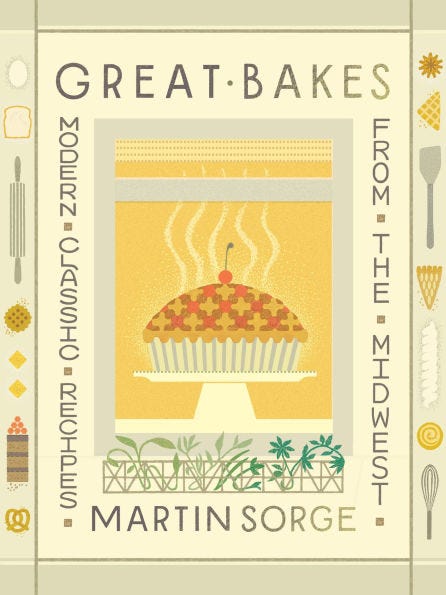
I knew I had to add Martin’s book to my collection when he posted an image of the cover a few months ago—an irresistibly charming illustration of a cherry pie cooling in a window sill. As I’d hoped, when I opened the book I found it contains several Midwestern Italian recipes, including one for apple strudel, an apricot and rosemary crostata, and the aforementioned Buckwheat Hazelnut Cake. But there is much more, too, recipes both classic and clever, that showcase the breadth of Midwestern baking: shortcakes; a Swedish almond-filled coffee cake; Swabian soft pretzels; sausage rolls; sweet corn milk bread; and a giant cherry pop-tart.
I got to meet Martin last month in Chicago, when he attended a cookie book event organized by the Chicago chapter of Les Dames d’Escoffier (thank you, !). Martin writes with warmth and assurance, and he clearly has a deep love for his subject. The dedication at the beginning of the book was so beautifully articulated that I read it out loud to my Michigander husband. Here’s a snippet:
“For the American Midwest. For flyover country. For the heartland. For the Hoosiers. For the Rust Belt. For the breadbasket. For the farmers and the dreamers. For the Great Lakes and the Great Plains. For my great grandparents and my great-grandparents. For the summer sun and the winter wind. For the long-timers and the newcomers. For roots and vines and branches. For the narrow minds, the closed factories, and the open fields…”
For anyone who loves to bake, there is plenty to savor in this sweet book.
Readers: Do you have a favorite regional baking book? Tell us about it!
RECIPE: Buckwheat Hazelnut Cake
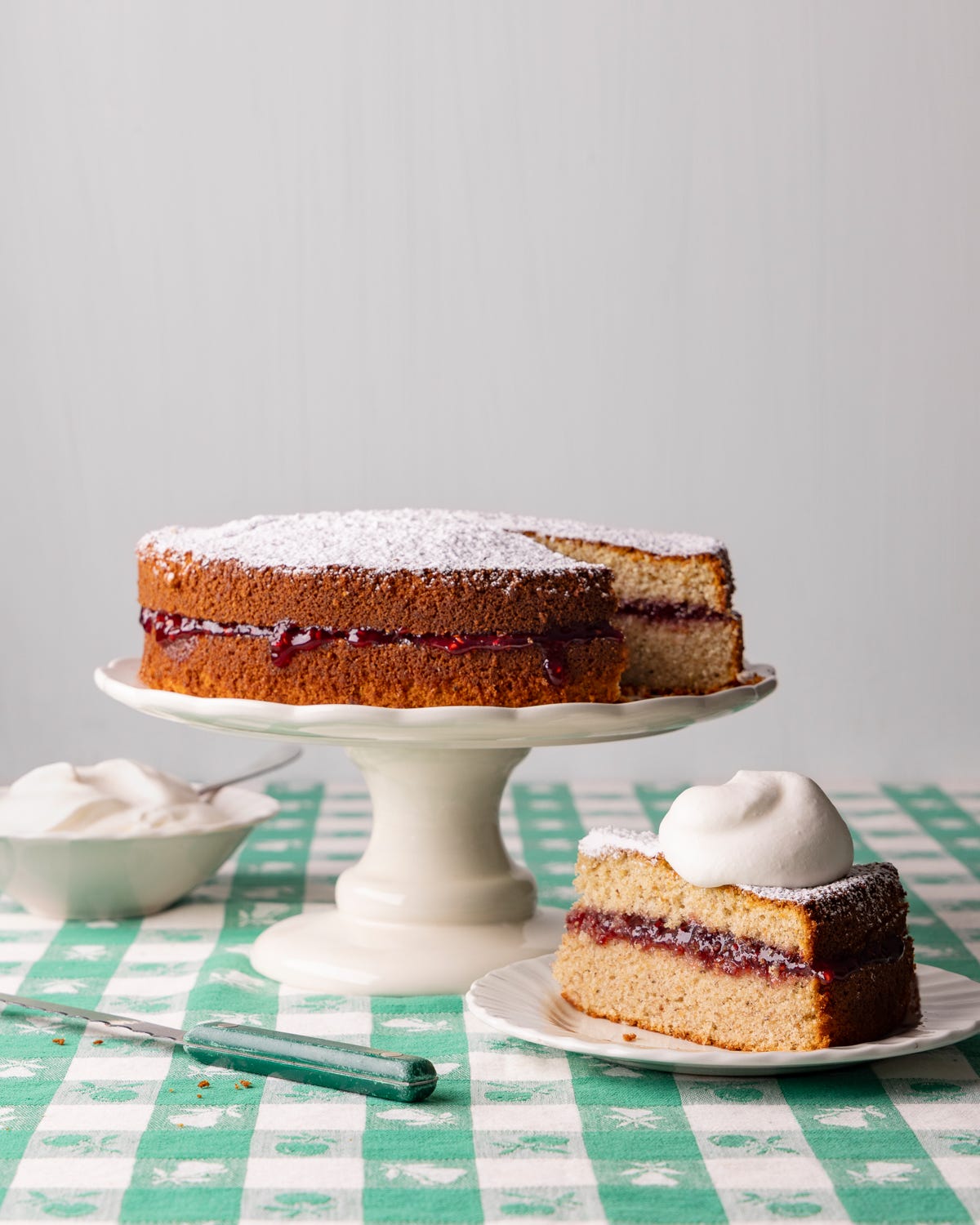
In the headnote to his recipe, Martin recalls a 2019 trip with his husband, Jason, to Alto Adige, the northern Italian region in the Dolomites that borders Austria. He waxes poetic about the slice of Buchweizenkuchen mit Schlag (buckwheat cake with cream) that they ordered for dessert at a mountaintop guesthouse-restaurant.
“Out came a warm, buttery wedge of cake topped with a mountain of whipped cream as generous as the peaks around us. While we lingered, the flavor lodged itself into my brain. The complex cake tasted like nothing I’d had before: earthy, grassy, nutty, with the zing of agreeably sharp-sweet jam and welcome richness of butter. It didn’t taste showy or have a flavor dominated by an extract or a spice. It caught me as subtle yet assertive, comforting yet haunting.”
It was all the endorsement I needed to tie on my apron and get going. Note that there are specific techniques that you need to follow when making this cake, especially allowing the batter to whip at length in a stand mixer, first on high speed, then medium, then low. It’s a technique Martin says he learned from , the baker behind the excellent newsletter Kitchen Projects. It’s not difficult, but it takes a little time. It’s worth paying attention and following the detailed instructions; your cake will be better for it, with a high rise and a tender, even crumb, and you may even find yourself slowing down as you watch the batter slowly whip into a billowy cream.
The only changes I made to Martin’s recipe were to substitute a mix of homemade strawberry preserves and apricot jam for the red currant jam called for in the recipe, as that is what I had on hand; and to top the jam with a layer of whipped cream, à la Victoria Sandwich, as I am of the “more whipped cream is never enough” persuasion.
Makes one 8-inch (20-cm) cake, to serve 8
INGREDIENTS
For the cake:
1 cup (120 g) raw hazelnuts (see Domenica’s Notes)
4 tablespoons (57 g; 1/2 stick) butter (I used unsalted)
1 cup (120 g) buckwheat flour
1/2 teaspoon (3 g) fine sea salt
1/2 teaspoon (2 g) baking powder
1 cup (240 g) heavy cream, cold
3 large eggs, cold
3/4 cup (150 g) sugar
2 teaspoons (8 g) pure vanilla extract
To finish:
1 cup (240 g) raspberry, red currant, or other tart red berry jam (I used a mix of homemade strawberry and apricot-anise jams)
2 tablespoons (15 g) powdered sugar
Whipped cream, for serving (see Domenica’s Notes)
INSTRUCTIONS
1. Heat the oven to 350° F (180° C) with a rack in the middle of the oven. Butter the bottom (not the sides) of an uncoated 8-inch (20-cm) round cake pan or springform pan with at least 3-inch- (7.6 cm-) tall sides. Line the bottom of the pan with a round of parchment.
2. Toast the hazelnuts. Place the raw hazelnuts on a half-sheet pan and bake until they smell toasty, 12-18 minutes. Wrap them in a clean tea towel and rub them around to remove some of their skins. If the skins don’t come off, don’t worry. Let the nuts cool to room temperature. (If you are using already toasted and peeled hazelnuts (see Domenica’s Notes), you can skip this step.)
3. Brown the butter. Put the butter in a small, light-colored saucepan over medium heat. The butter will melt, then bubble. Once the bubbles subside and the butter gets quiet (listen), turn the heat down to low and stir with a heatproof spatula, being sure to scrape the bottom. Cook for another 1-2 minutes, until the little bits on the bottom of the pan are deeply brown but not burnt. You may have to scoot away bubbles to see down to the bottom. It will smell toasty and nutty. Remove from the heat.
4. Grind the hazelnuts and flour. In the bowl of a food processor, add the cooled hazelnuts, buckwheat flour, salt, and baking powder. Blitz for 12-14 pulses, or enough so that the largest pieces of hazelnuts are no bigger than a sesame seed. Set aside.
5. Make the cake batter. In the bowl of a stand mixer fitted with the whisk attachment, whisk the heavy cream on medium-high speed until it holds soft peaks, 1-3 minutes. Scrape the whipped cream into a bowl, cover, and refrigerate. Rinse and dry the bowl and whisk attachment and put them back on the mixer.
6. Add the eggs, sugar, and vanilla to the mixer bowl. Whisk on low speed for 10 seconds to combine, then whack it up to full speed for 8 minutes. Turn the speed down to medium and whisk for 3 minutes. Turn the speed to low and continue to whip for 8 minutes.
7. When the eggs are finished whipping, add the hazelnut-flour mixture in thirds, beating on low until combined. With the mixer on low, slowly drizzle in the brown butter, along with all the browned bits. Take the mixer bowl off the stand, then use a silicone spatula to scrape the sides of the bowl and mix in any errant bits of flour or butter.
8. Fold in half the cold whipped cream until it’s about 75 percent combined, then add the rest and fold until no streaks of cream remain. Pour the batter into the prepared pan and spread it in an even layer. Pick up the pan and drop it from 5 inches (13 cm) above the counter 3 times to pop any large air bubbles.
9. Bake until the cake springs back when pressed in the middle and a cake tester comes out with no wet batter attached, 38-40 minutes. It will be a deep golden brown and may be domed. Remove the cake from the oven, hold it 5 inches (13 cm) above the counter, and drop it onto the counter. This prevents the cake from sinking too much (true!). Set the cake on a cooling rack and leave it in the pan until it is completely cool. The domed top of the cake will end up more or less flat, which is what we want.
10. Remove the cake from the pan and invert it. Peel off the round of parchment and re-invert the cake. Using a long serrated knife, cut the cake in half horizontally. Carefully remove the top layer and set aside. Spread the bottom layer with the jam, then replace the top of the cake. Right before serving, sift the powdered sugar on top of the cake.
For the full experience, you must serve this cake mit Schlag, with whipped cream (see Domenica’s Notes). The cake will last, covered at room temperature, for about 3 days, although it will dry out a bit after the first day.
DOMENICA’S NOTES:
Hazelnuts: I had a stash of Piemontese hazelnuts on hand, purchased online from Gustiamo, so I used those. They are sold already toasted and peeled, so I was able to skip that step.
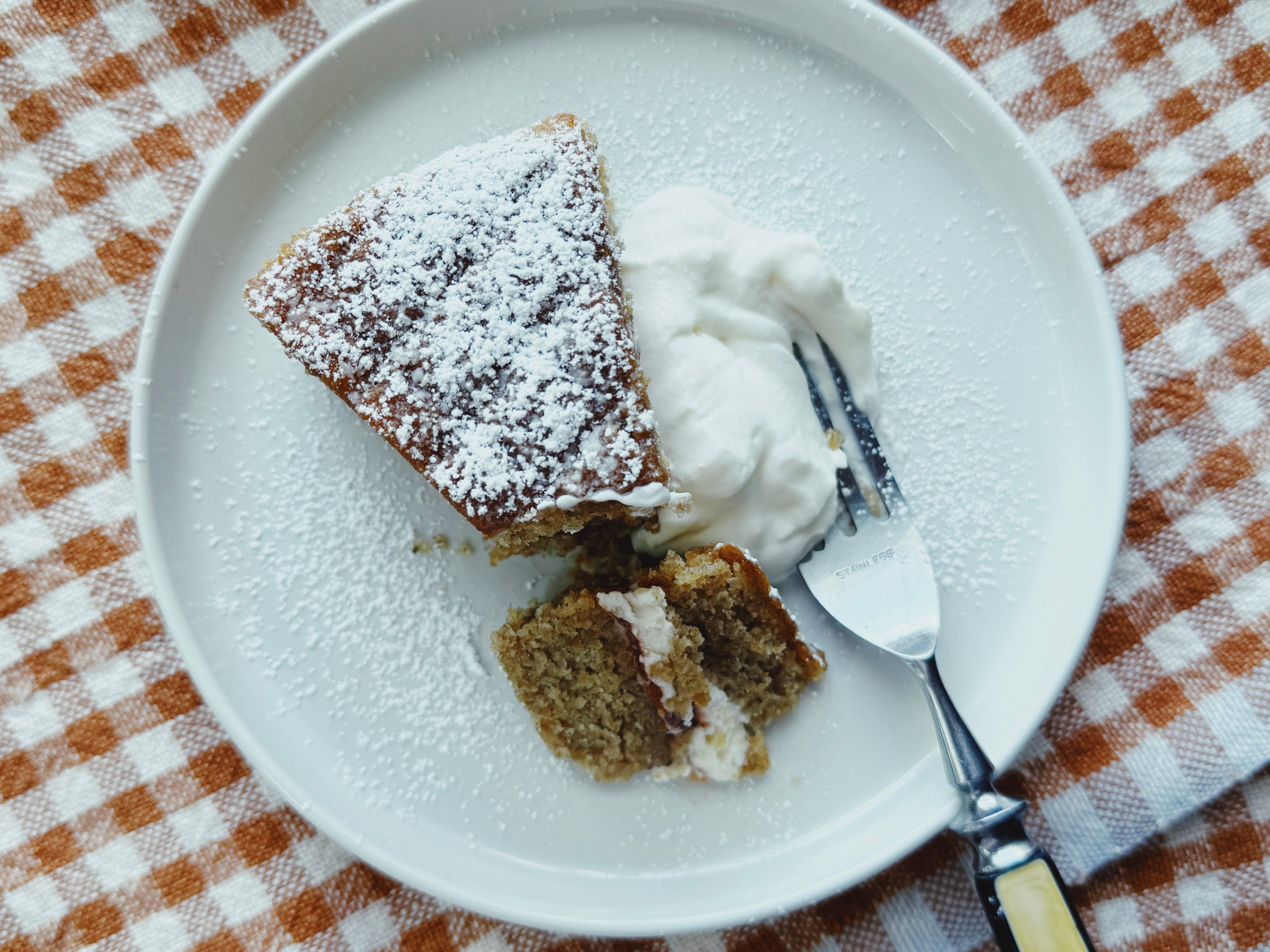
Whipped Cream: I spread a layer of it over the jam filling (Step 10) before replacing the top of the cake, as you would for a Victoria Sandwich. If you do add whipped cream to your filling, be sure to store the cake, covered, in the refrigerator.
Click on the button below for a printable version of the recipe, available to paid subscribers.
Martin's Buckwheat Hazelnut Cake
Thanks, as always, for reading, subscribing, and sharing. Daniela and I will be on break for the next two weeks, returning on August 30 with fresh recipes and art.
Buone ferie!
Domenica
Comments
Nothing yet. Say the first thing.
Sign in to join the conversation.