
Last week, the TSA quote-tweeted a traveler who complained that a rule wasn’t on its website. The reply: “Oh, ok... apologies, we didn’t realize you were going to bring part of a FIRE HYDRANT to the airport.”
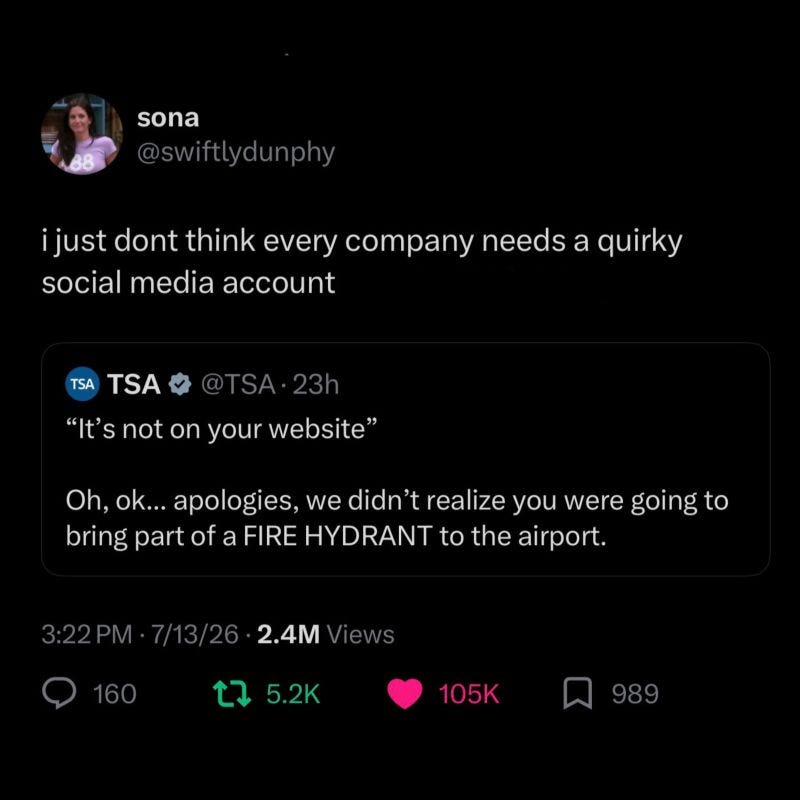
The post got 2.4 million views. The post dunking on it got 105,000 likes. And a thousand marketers piled into the replies to argue whether it was genius or garbage. Admittedly, I was one of them.
Both camps are missing the point for the same reason most brands fumble tone: they think it’s a costume you put on for each room. It’s not. Tone is behavior. And behavior gets judged by who you are, who you’re talking to, and who holds the power in the exchange.
I’ve said it a hundred ways: your brand’s verbal identity is its personality made audible. It comes from your positioning, your values, your reason for existing. That doesn’t change when you cross from your menu to Instagram to your hiring page. If it does, you aren’t building and reinforcing the brand. You’re weakening it through code-switching and inauthenticity.
Tone is voice under specific conditions. The same person who ribs their buddies at the bar speaks plainly at a funeral and carefully in a courtroom. Same human. Same personality. Different room, different stakes, different behavior.
So no, I’m not in the “your Twitter must sound like your terms of service” camp. That’s brand management by fear, and fear builds forgettable brands. The research backs adaptation. A study in the Journal of Interactive Marketing found that a human, casual tone lifts enjoyment and purchase intent in fun, low-stakes settings, but hurts in high-stakes, utilitarian ones. Another, from the Journal of Business Research, found that informal language builds trust with people who already know you and erodes it with people who don’t. Consumers aren’t grading you on consistency for its own sake. They’re deciding whether your behavior fits the relationship.
Many brand leaders skip two tests.
Every channel is a room with its own house rules. X rewards wit and speed. Instagram rewards craft. LinkedIn rewards... whatever LinkedIn rewards. Adapting to the room is respect. Guests feel it the same way they feel a server who reads the table right.
But there’s a line between speaking the room’s language and cosplaying its residents. The “hello, fellow kids” failure isn’t about tone. It’s about identity. When a 40-year-old casual chain starts talking like a 19-year-old’s group chat, nobody is confused. They’re insulted by the impersonation.
Communication researchers call it over-accommodation: mimic your audience too hard and you come off patronizing, not relatable. The moment people sense that the tone is a tactic, that someone in a conference room decided to “do brainrot” this quarter, they stop hearing the message and start auditing the motive.
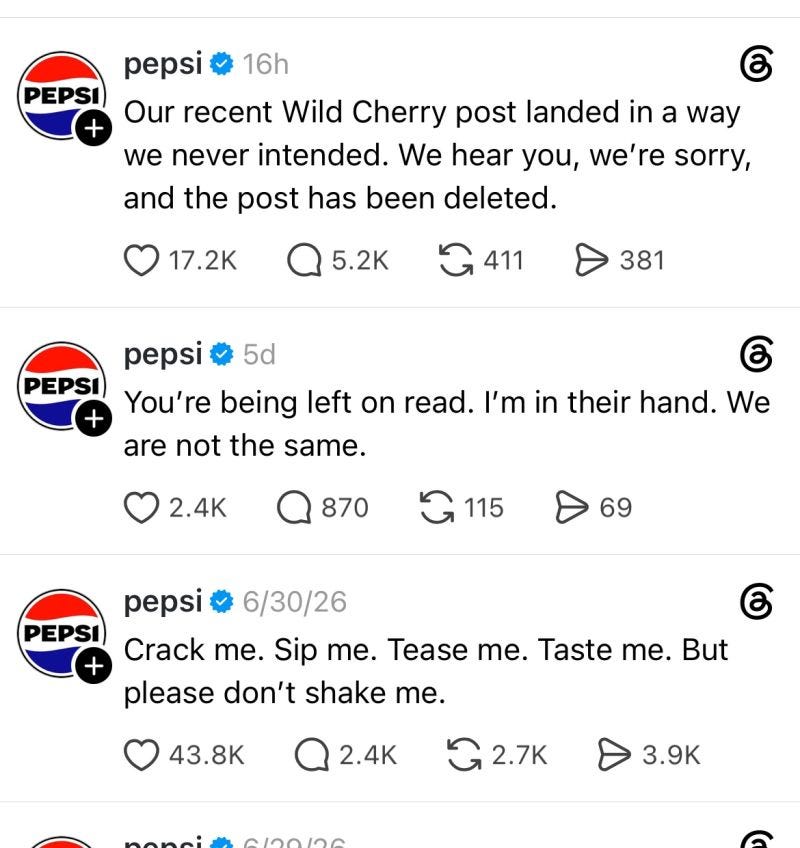
Pepsi recently gave us a clean example. Its Threads account had already gone suggestive:
“Crack me. Sip me. Tease me. Taste me. But please don’t shake me.”
Then:
“You’re being left on read. I’m in their hand. We are not the same.”
A later Wild Cherry post crossed enough of a line that Pepsi deleted it and issued an apology: “Our recent Wild Cherry post landed in a way we never intended. We hear you, we’re sorry, and the post has been deleted.”
We don’t even need to see the deleted post to understand the problem. The surrounding copy tells us the account found an engagement trick and kept turning the dial. The question isn’t whether Pepsi is allowed to flirt. It’s whether this is Pepsi talking or a social team seeing how horny it can make a can of soda before somebody upstairs notices.
Pepsi has spent decades planting itself in pop culture. It has earned the right to be playful. That history doesn’t make every joke native to the brand.
The apology is what happens when there’s no governing voice behind the tone. Nobody knows where the line is until the audience finds it for them.
Here’s the test I give clients: could your founder, your GM, your pitmaster say this line out loud without wincing? Wendy’s roasts work because sass was already in the brand’s bones. “Where’s the beef?” ran in 1984. Duolingo’s owl was always unhinged; TikTok just gave it a bigger cage. In both cases, the channel turned up something that was already true. If your tone requires a personality transplant, you’re not adapting. You’re lying with extra steps.
Earn the slang or skip it. Borrowed swagger reads as desperation from a hundred yards.
Power dynamics might be more obvious with the TSA, but every brand needs to consider them.
Snark is a two-way game between equals. A burger brand can roast a competitor. It can roast itself. It can even roast a customer who walks into the joke swinging, because that customer chose the relationship and can leave anytime.
Nobody chooses the TSA. It’s a mandatory checkpoint run by an agency that can detain you, search you, and confiscate your stuff. When that agency gets sarcastic with a traveler asking a fair question, it’s not banter. And “why isn’t this on your website?” is a fair question about a fire hydrant part, an object no reasonable person has a rulebook for.
This is an institution mocking someone who has no exit. The audience feels that instantly, which is probably why the dunk got 105,000 likes and the original got ratioed.
Credit where it’s due: the TSA’s Instagram was, for years, one of the best things in government communications. Deadpan captions about confiscated oddities. Funny, useful, and pointed at objects, never people. That account taught millions of travelers the rules without asking them to visit tsa.gov. Same voice. Same humor. Different target. That made all the difference.
Punch at things. Punch at yourself. Never punch at the person forced to submit to your systems, searches, and possible detainment.
For most brands, the power gap is smaller than the TSA’s, but it’s never zero. You hold their reservation, their refund, their delivery, their data. Any response to a customer complaint should be written with that in mind. The complainer is one person. The audience is everyone deciding whether you’d treat them the same way.
Your voice is the part you define and defend: personality, vocabulary, point of view, values.
Tone flexes on two dials: formality and playfulness. Channel norms set one part of the range; stakes set the other. High-stakes, high-anxiety moments like billing, safety, complaints, and allergies call for warm and plain. Low-stakes discovery can run hot.
Before anything ships, ask two questions: Would this sound true coming from a real human at this company? And does the person on the other end have enough power to walk away laughing?
If either answer is no, kill it. No engagement number buys back trust sold this cheap.
You live this every day, whether you’ve named it or not. Your best server already runs a tone strategy: playful with the regulars at the bar, gentle with the anniversary table, crisp and clear with the guest asking about a nut allergy. Same person. Same warmth. Different rooms. Your channels should behave like she does.
Your menu is not your meme account. Menu language sells craveability and clarity. It can carry your personality. It should. But the joke never gets between the guest and the decision. Social can be looser because nobody’s holding it while hungry with three friends waiting.
Review replies are your power-dynamic proving ground. A guest with a bad night holds a one-star megaphone; you hold the brand microphone. Snark back at a Google review and every future guest reads it as a preview of how you’d treat them. Take the hit, stay warm, fix it in public. The audience for a review reply is never just the reviewer.
Third-party channels flatten your voice. Don’t let them. DoorDash descriptions, Google Business posts, reservation confirmations, that robotic waitlist text. These are the most utilitarian, highest-anxiety touchpoints you own, and the research says warm and clear beats clever there every time. Personality shows up as care: “Your order’s in the kitchen. Fries go in last so they land hot.” That’s on-brand and useful. No punchline required.
The unhinged-social-intern move is renting, not building. Yes, the chaotic brand account still pulls numbers. But if the shtick can’t survive the intern quitting, it was never your brand’s tone. It was theirs, and it walks out the door with them. Codify what’s true, then let whoever runs the account perform that.
Staff are a channel. The kid at the register speaks in your tone whether you’ve trained it or not. If your Instagram is all wink and your counter experience is all mumble, guests feel the seam. Tone guidelines belong in onboarding, not just the brand book PDF nobody opens.
Adjusting tone by channel isn’t a betrayal of your brand. It’s proof you have a real personality that can read a room. The betrayal is the costume: borrowed slang, the punch-down joke, the personality that appears on one platform and evaporates on another.
Pepsi and the TSA failed for different reasons. Pepsi let a channel tactic outrun the brand behind it. The TSA forgot who held the power and who stood there holding their shoes in a plastic bin.
Know your voice. Read the room. And never make the joke at the expense of someone standing in your line.
No posts
Comments
Nothing yet. Say the first thing.
Sign in to join the conversation.