
Nashville, Tennessee, has historically been recognized as the undisputed epicenter of country music, drawing global visitors to its recording studios, historic performance venues, and bustling entertainment districts. However, over the past decade, the auditory heritage of “Music City” has been paralleled by a profound visual transformation. The city now boasts a thriving, world-class visual landscape characterized by large-scale public murals, street art, and curated graffiti. This explosion of public art has effectively turned Nashville into an expansive outdoor gallery, fundamentally altering the city’s aesthetic, driving a booming sector of its tourist economy, and redefining the socio-geographic identity of its rapidly evolving neighborhoods.
The proliferation of mural art in Nashville represents a complex intersection of community activism, historical preservation, urban redevelopment, and the modern digital economy. From the historically rich corridors of North Nashville to the commercialized walls of The Gulch, and the post-industrial canvases of The Nations, street art serves as both a reflection of and a catalyst for social change. As neighborhoods face the pressures of rapid growth and gentrification, murals have emerged as powerful tools for claiming space, asserting local identity, and engaging in public dialogue regarding the city’s past and future.
This report provides an exhaustive examination of Nashville’s mural art ecosystem. It begins by establishing the sociological framework of the street art movement, details the institutional forces driving the city’s public art renaissance, and provides a comprehensive, sequential analysis of the monumental collaborative project known as “The Nations Wall.” Furthermore, the analysis explores the socio-economic implications of organized mural tourism, the use of art as activism, and the inherent ephemerality of the medium in a rapidly developing urban environment.
Among the most ambitious undertakings facilitated by the Nashville Walls Project is “The Nations Wall.” Located in the rapidly redeveloping West Nashville neighborhood known as The Nations, this installation serves as a monumental collaborative canvas that captures the stylistic diversity and collective spirit of Nashville’s muralists.
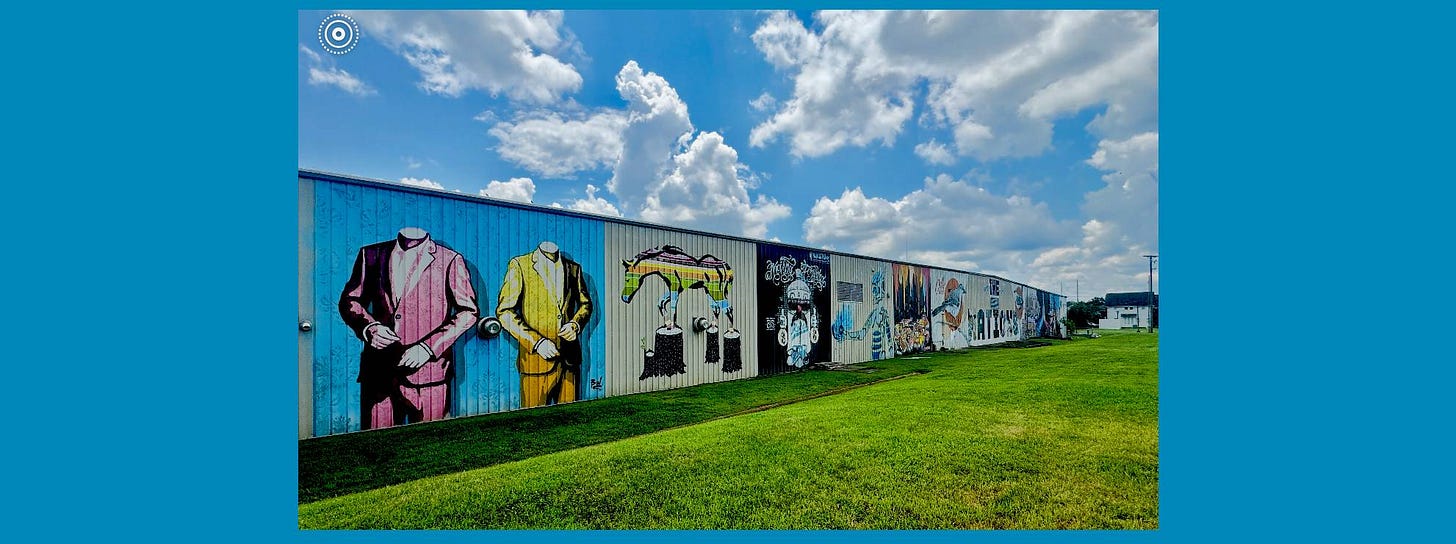
The Nations Wall is situated at the official address of 5901 California Avenue, Nashville, TN 37209. Physically, the murals span the expansive west-facing wall of the Music City Tents and Events facility. Despite the primary address, the artwork directly faces the 1300 and 1400 blocks of 60th Avenue North, running parallel to the street and positioned directly across from the intersection with Pennsylvania Avenue.
The immense scale of the building allowed the Nashville Walls Project to commission a contiguous gallery of individual pieces that flow into one another. The installation was designed to be experienced sequentially from left to right, corresponding roughly to a north-to-south geographical orientation. At the physical and conceptual center of the wall is a massive logo proudly declaring “We are The Nations,” anchoring the diverse artworks in a shared neighborhood identity.
The Nations Wall operates as a strategic exercise in neighborhood branding and placemaking. The explicit labeling of “We are The Nations” in the centerpiece reflects a conscious effort to synthesize a cohesive community identity in an area undergoing rapid demographic and architectural shifts. By aggregating highly distinct styles—ranging from traditional graffiti (Duff, Eshor) and surrealism (Wooden) to sculptural adaptation (Williams) and mixed-media degradation (Miller)—the wall acts as a visual metaphor for a neighborhood attempting to balance its gritty, industrial past with a diverse, cosmopolitan future.
The tension between urban redevelopment and historical preservation is a recurring theme in Nashville’s street art, and it is most profoundly articulated in another major commission within the same neighborhood: The Nations Silo mural.
Located at the intersection of 51st Avenue North and Centennial Boulevard, a towering 15-story abandoned concrete grain silo—formerly the Gillette grainery—has been transformed by the internationally acclaimed Australian street artist Guido van Helten. Commissioned in 2017 by the Nashville Walls Project in collaboration with developer Southeast Venture, the massive 165-foot photorealistic mural serves as the visual centerpiece for “Silo Bend,” a 38-acre mixed-use luxury development project.
Rather than painting abstract shapes, van Helten spent weeks embedded in the local community to identify subjects that accurately reflected the neighborhood’s historical character. He chose to paint a monumental, sepia-toned portrait of 91-year-old Lee Estes, a lifelong resident of The Nations and a dedicated volunteer at the local St. Luke’s Community House. In an era where homes in the neighborhood predated indoor plumbing, Estes represents the working-class, industrial foundation of West Nashville. Adjacent to the towering portrait of Estes, van Helten painted two young children from the local community center, one reaching upward toward the top of the silo.
Van Helten’s silo mural operates as a profound social commentary on the dual nature of gentrification. The artist explicitly stated that he finds the relationship between murals and gentrification to be conflicting, and designed the silo artwork to capture the “harmonious composite of the two sides of social change”. The children looking upward symbolize the emerging future and the influx of new demographics, while the dignified, weathered visage of Mr. Estes commands respect for the generations of blue-collar workers who built the city. The mural acknowledges the uncomfortable reality that large-scale public art often serves as an unwitting agent of gentrification, accelerating property values and potentially pricing out long-term residents. Yet, by etching Estes’ face onto the highest structure in the skyline, the artwork ensures that the working-class memory of The Nations cannot be easily erased by encroaching commercial development.
The Nations Wall represents the culmination of efforts from at least eleven different artists, each bringing distinct mediums, thematic preoccupations, and technical approaches to the collective space. The wall is divided into ten distinct segments:
Part 1: Brian Wooden
The series begins on the far left (north) with a piece by Brian Wooden. The mural features one of Wooden’s signature surrealist motifs: a headless, well-dressed man in a suit. This figure is a recurring element in Wooden’s broader portfolio, appearing in other Nashville works such as Sharp Dressed Man with Roses " and Striding. The use of the headless figure invites themes of anonymity and the homogenization of modern identity, serving as an enigmatic introduction to the installation.
Part 2: Herb Williams
The second section is the work of Herb Williams. Williams is internationally recognized for his intricate, three-dimensional sculptures constructed entirely from thousands of Crayola crayons, many of which have been exhibited at The Rymer Gallery on 5th Avenue. For The Nations Wall, Williams translated his highly saturated, pop-art aesthetic into a two-dimensional mural featuring a brightly striped horse. The vivid, unnatural coloration of animals is a recurring theme in his painted works, functioning as an exploration of artificial intervention in the natural world.
Part 3: Collaborative Integration
While specific standalone documentation of the third section is less prominent in early project catalogs, the collective roster of The Nations Wall confirms the integration of artists operating under monikers such as Rebel Lowks and SickArte within this transitional space. These contributions bridge the gap between the illustrative works of the northern sections and the complex geometric and graffiti styles that follow.
Part 4: Chris Zidek and Folek Kelof
Part 4 stands out as a micro-collaboration within the larger wall. The primary figure in this section was painted by Chris Zidek, who frequently operates under the signature “Zidekahedron”. Zidek’s work is characterized by complex geometric forms and futuristic, multidimensional figures. Uniquely, this section incorporates a distinct ball of flame that deviates from Zidek’s strict geometric style. Local art historians identified the flame as the work of Folek Kelof, another artist featured further down the wall, demonstrating the organic, overlapping nature of street art production where artists spontaneously contribute to adjacent pieces.
Part 5: Troy Duff
The fifth segment is executed by Troy Duff, a prolific local artist deeply rooted in traditional graffiti culture who frequently utilizes the tag “KREST” (or #krestonegraffiti). By featuring heavily stylized, wildstyle graffiti lettering, Duff’s section anchors The Nations Wall to the historical origins of street art. The inclusion of traditional graffiti within a highly curated, corporate-sponsored wall illustrates the formalization of the medium, where once-illicit typographical styles are celebrated as fine public art.
Part 6: The Collaborative Centerpiece
Part 6 serves as the focal point of the entire installation. Positioned as the central mural, it is the most frequently photographed and shared section of the wall. This centerpiece features the giant “The Nations” branding, explicitly tying the art to the cultural identity of the neighborhood. This section was a three-way collaboration: artist Audie Adams (Audroc) was responsible for painting the intricate birds surrounding the text, while artists Tess Erlenborn and Jon Buko collaborated on the design and execution of the massive typography.
Part 7: Eshor and Venser
The seventh piece continues the exploration of traditional street tagging. The Nashville Walls Project officially credits the artist “Eshor” for this segment, alongside a prominent tag reading “Venser”. The presence of these classic graffiti monikers serves to validate underground street culture within a sanctioned public gallery, highlighting the porous boundary between guerrilla tagging and commissioned muralism.
Part 8: Folek Kelof
Folek Kelof returns in the eighth section to provide a highly personal and evocative piece. The mural depicts a pair of battered, dirty hands, accompanied by Kelof’s signature repeated aggressively across the composition. Kelof has stated that the piece represents his own hands, which are “constantly injured and dirty” from the grueling physical labor required to produce large-scale murals. This meta-artistic commentary provides a raw, unfiltered acknowledgment of the blue-collar physical exertion behind monumental public art.
Part 9: Eric Bass (Mobe Oner)
The ninth section transitions into a softer, more traditional painterly aesthetic, executed by Eric Bass, who operates under the name Mobe Oner. This mural is an adaptation of an oil painting titled “Fireflies,” which Bass originally exhibited during a showcase of Nashville muralists. By scaling a traditional gallery oil painting to the size of a warehouse wall, Bass effectively bridges the divide between exclusive, indoor fine art and democratic, outdoor public art.
Part 10: Emily Elizabeth Miller
The final section on the far right (south) end of the wall is by Emily Elizabeth Miller, an artist renowned for her innovative mixed-media approach. Miller’s contribution features an elephant, but rather than painting the subject directly onto the brick, she paints the background and physically plasters a massive paper drawing of the elephant onto the wall. This technique introduces an element of intentional ephemerality. As the paper is exposed to Nashville’s sunlight, rain, and fluctuating temperatures, it gradually decays, peels, and fades. Miller’s work is thus inherently dynamic, embracing the transient nature of street art and reminding viewers that public installations are living entities subject to the ravages of time.
To understand the current state of Nashville’s mural scene, it is necessary to contextualize street art within the broader sociological framework of social movements. Scholars analyzing the lifecycle of social movements generally identify four distinct stages: Emergence (or social ferment), Coalescence (popular excitement), Bureaucratization (formalization), and Decline (or institutionalization). The global graffiti and street art movement—often termed “the message from the street”—has traversed these stages over several decades, and Nashville’s local scene provides a vivid microcosm of this evolution.
In its earliest forms, graffiti served as a tool for marginalized groups to express disenfranchisement, critique corporate greed, and challenge societal norms by reclaiming public space. In Nashville, the “Emergence” and “Coalescence” stages are evidenced by the enduring presence of illicit graffiti and crew tags in infrastructural spaces. For example, the concrete underpasses beneath railroad bridges near 11th Avenue North and the Spring Street bridge have long hosted abstract expressions, “wildstyle” tags, and political resistance art. These localized zones reflect the raw, unsanctioned roots of the movement, heavily influenced by the 1980s hip-hop culture that utilized urban surfaces to articulate messages regarding racial and financial inequality.
As the movement transitioned into the “Bureaucratization” and “Institutionalization” phases, graffiti began to shed its stigma as mere vandalism. In Nashville, this formalization is highly visible through the establishment of organized initiatives, corporate sponsorships, and municipal support. Projects are actively commissioned by local businesses, real estate developers, and neighborhood associations to beautify areas, attract foot traffic, and, ironically, to deter illicit tagging, as underground taggers traditionally respect the work of commissioned muralists. This institutionalization is embodied by organized mural tours, gallery representations of street artists, and large-scale curated walls that blur the line between guerrilla art and civic infrastructure.
A primary catalyst for the formalization of Nashville’s mural scene is the Nashville Walls Project. Founded in 2016 by street art gallerist and art collector Brian Greif alongside Éva Boros, the initiative was established to elevate the city’s visual dialogue to the level of global art capitals like New York, Berlin, and London. Greif, a former broadcast executive who produced the street art documentary Saving Banksy, relocated to Nashville with the specific intention of fostering a sanctioned, world-class street art environment.
The Nashville Walls Project operates by facilitating connections between property owners willing to offer their walls as canvases and a curated roster of local, national, and international muralists. The project fundamentally alters the traditional dynamic of street art by securing funding—often through corporate sponsorships, such as early backing from the Gibson Custom Division and MarketStreet Equities—and acting as a trusted intermediary for local businesses.
A critical element of the project’s strategy is the pairing of international talent with local artists, who often serve as assistants. This collaborative model ensures a transfer of technique, elevating the skills of the local artistic community while integrating global styles into the Nashville landscape. The project has successfully facilitated works across various neighborhoods, including the Elliston Parking Garage on Louise Avenue, which was offered by its owner specifically to utilize murals as a deterrent against pervasive graffiti tagging.
One of the project’s earliest and most significant installations was created by the Dutch artist Niels “Shoe” Meulman in 2016. Located on a parking garage on Fifth Avenue North, the mural features the lyrics “As Long As The Grass Shall Grow” from a 1964 Johnny Cash protest song regarding broken Native American treaties. Executed in Meulman’s signature “calligraffiti” style—a synthesis of traditional calligraphy and street graffiti—the piece demonstrates the project’s commitment to blending the city’s musical heritage with avant-garde visual techniques.
Beyond the Nations, the character of Nashville’s murals shifts dramatically depending on the socio-economic and historical context of the neighborhood in which they reside.
In upscale, highly trafficked tourist districts like The Gulch and 12 South, murals frequently function as drivers of the retail economy. The Gulch is home to Kelsey Montague’s famous What Lifts You wings (230 11th Ave S), a 20-foot-tall interactive mural embedding Nashville-specific icons such as cowboy hats and guitars. The area also features Jason Woodside’s bright geometric patterns, Ian Ross’s sprawling botanical swirls, and Ben Passmore’s Giant Ear & Microphone, which symbolizes empathetic listening and amplifying narratives.
In the 12 South neighborhood, Adrien Saporiti’s I Believe in Nashville (2700 12th Ave S) stands as the city’s most iconic civic brand. Originally painted in 2012 as a monument to resilience following the catastrophic 2010 floods, the bold red, white, and blue design, drawing from the Tristar state flag, became a unifying emblem. The 12 South area also hosts highly photographed works such as Looking Pretty, Music City by Emily Eisenhart, demonstrating how street art in these districts is seamlessly integrated with boutique retail and dining.
East Nashville possesses a more localized, eclectic, and community-driven spirit. Murals here often celebrate local idiosyncrasies and musical culture. Kim Radford’s vibrant Dolly portrait (1006 Forrest Ave) was notably updated with Black Lives Matter messaging in response to quotes from Parton herself, showcasing the responsiveness of street art to contemporary discourse. Other notable works include Brian Deese’s Young Warlords (featuring Steve Jobs and Bill Gates), Mobe Oner’s Greetings from the Athens of the South, and Montague’s 60-foot What Lifts You - Hot Air Balloon. The replication of the I Believe in Nashville mural in East Nashville gained profound new meaning when it was one of the only structures left standing following the devastating March 2020 tornado, serving as a visceral symbol of neighborhood survival.
In the downtown core and Music Row, murals are intrinsically linked to the city’s recording and performance history. The Country Music Legends mural by Tim Davis at Legends Corner depicts a pantheon of country music royalty gathered at a bar—a mural that generated significant cultural commentary when Taylor Swift’s image was famously painted over and replaced by Brad Paisley. Other works, such as the Municipal Auditorium Tickets mural, recreate historic concert stubs dating back to 1965, turning the city’s walls into archival monuments to its auditory past.
While commercialized districts utilize art to drive foot traffic, Nashville’s muralists also heavily utilize public space for overt political activism, social justice advocacy, and the preservation of marginalized histories, particularly within the city’s Black community.
North Nashville, a historically African American neighborhood, features an urgent and community-driven street art scene generated primarily by artists with deep, generational ties to the area. These murals frequently function as sites of resistance, addressing systemic issues such as displacement, mass incarceration, and gun violence, while simultaneously celebrating Black-owned businesses, historically Black colleges and universities (HBCUs), and community resilience. Organizations like the Norf Art Collective have been instrumental in this movement. The Frist Art Museum formally recognized the critical importance of this grassroots movement with an exhibition titled Murals of North Nashville Now, highlighting how public art serves as an essential counter-narrative to the erasure that often accompanies urban redevelopment.
Nashville played a pivotal role in the American Civil Rights Movement, serving as the staging ground for the student-led lunch counter sit-ins of 1960 and the Freedom Rides. Contemporary murals continually reinforce this legacy. A premier example is the Good Trouble mural located at the corner of Rep. John Lewis Way and Commerce Street. Spanning four stories, this massive piece executed by local Black artists Michael McBride and Donna Woodley honors the late U.S. Representative John Lewis alongside legendary Nashville Freedom Riders. Similarly, the Witness Walls installation near the Historic Metro Nashville Courthouse utilizes archival imagery of boycotts and marches transposed onto concrete, transforming municipal architecture into a permanent pedagogical tool. Organizations like Arts4Impact further utilize local artists to create interactive memorials dedicated to fighting systemic issues like gun violence, proving that Nashville’s art scene extends far beyond aesthetic decoration.
The high density, geographical dispersion, and cultural relevance of Nashville’s murals have given rise to a highly structured mural tourism industry. The city has fully embraced the “Instagram economy,” where the physical environment is optimized to produce shareable digital content. Murals have become essential destinations, driving foot traffic, benefiting adjacent businesses, and spawning entirely new micro-industries centered around sightseeing.
To service the demand for mural viewing, the local tourism sector has developed a wide array of guided and self-guided infrastructure. The following table provides a comprehensive comparison of the primary mural tour models operating in Nashville:
Tour ModelKey Operators / PlatformsOperational MechanicsTarget Audience & Sociological ImpactSelf-Guided Digital RoutesQuesto App, GPS Audio Tours
Smartphone-driven routes mapping dozens of landmarks via GPS. Users follow routes like “The Nashville Sound Heist” at their own pace. Costs range from free to $39.99 for city passes.
Independent travelers and budget-conscious tourists. Blends digital navigation with physical urban exploration, gamifying the mural hunting experience.
Open-Air Golf Cart Tours, Joyride, Hello Tickets
Trolley & Bus Charters Old Town Trolley Tours
Boutique Transit Vans Nashville Mural Tours, Mint Julep Tours
A definitive characteristic of street art is its impermanence. Unlike gallery art protected by climate controls and institutional conservation, murals exist at the mercy of the elements, vandalism, and relentless urban development. Nashville’s explosive real estate market ensures that the city's physical canvas is in constant, aggressive flux.
The vulnerability of public art takes several forms across the city:
Architectural Obsolescence: Murals are frequently destroyed or permanently obscured by new construction. For instance, abstract graffiti skylines and elaborate tags (such as Mobe Oner’s Bugs Bunny and Company) located under railroad bridges and on industrial walls are frequently referred to as “endangered art.” They exist only until developers reclaim the lots for massive projects like the Capitol View development. Murals painted on the sides of structures like Holloman Transmission disappear overnight when the buildings are demolished to make way for boutique hotels or luxury condominiums.
Material Degradation: As observed in Emily Elizabeth Miller’s mixed-media elephant on The Nations Wall, the incorporation of paper pasted onto brick guarantees eventual decay due to sun and rain. This structural fragility transforms the mural into a living, dying entity, reflecting the transience of time and the environment.
Vandalism and Reiteration: Iconic pieces like Saporiti’s I Believe in Nashville have been vandalized, requiring the artist to repeatedly return to repaint the work. This treats the wall not as a finished, static product, but as a continuous cycle of creation, destruction, and restoration.
This inherent ephemerality imbues Nashville’s murals with a profound sense of urgency. The art must be documented, photographed, and experienced in the present, as the urban landscape guarantees that the city’s visual identity will be vastly different a decade from now.
Nashville’s ascension as a premier destination for mural and street art is a testament to the city’s dynamic cultural evolution. The transition from illicit graffiti tags beneath railroad bridges to monumental, sanctioned public installations mirrors the broader sociological trajectory of urban art, moving from localized emergence to highly organized institutionalization.
Initiatives like the Nashville Walls Project have successfully bridged the gap between international technique and local narrative. The sprawling, multi-artist collaborative masterpiece of The Nations Wall stands as a geographical anchor for a neighborhood in flux, offering a curated timeline of artistic styles from wildstyle graffiti to fine oil adaptation and mixed-media degradation. Meanwhile, Guido van Helten’s towering silo portrait of Lee Estes forces a public reckoning with the human cost of gentrification, proving that paint on concrete can possess immense emotional and historical gravity.
Simultaneously, the city’s murals operate as powerful engines of digital commerce and tourism. Through an expansive network of golf cart tours, app-guided walks, and boutique van charters, neighborhoods like The Gulch and 12 South have been transformed into interactive, open-air photo studios. Yet, amidst the tourism economy, artists in North Nashville and downtown continue to leverage the medium for profound social activism, demanding visibility for civil rights histories and marginalized communities.
Ultimately, the murals of Nashville are not static decorations. They are transient, vulnerable, and deeply impactful reflections of a city navigating the complex intersection of explosive economic growth, historical preservation, and the enduring need for human expression. As the skyline of Music City continues to rise, it is the vibrant, painted walls at street level that will continue to document the true, evolving story of its people.
Link to Builttothink Mural Study by Nashville Public Art
Here is a categorized citation list of the sources used to compile the information, formatted so you can easily copy and paste it into your article:
The Nations Wall Series & Local Archives
Nashville Public Art, “The Nations Wall – Part 1”: https://nashvillepublicart.com/2019/04/17/the-nations-wall-part-1/
[cite: 1]
Nashville Public Art, “The Nations Wall – Part 2”: https://nashvillepublicart.com/2019/04/24/the-nations-wall-part-2/
[cite: 2]
Nashville Public Art, “The Nations Wall – Part 5”: https://nashvillepublicart.com/2019/05/20/the-nations-wall-part-5/
[cite: 3]
Nashville Public Art, “The Nations Wall – Part 6”: https://nashvillepublicart.com/2019/05/29/the-nations-wall-part-6/
[cite: 4]
Nashville Public Art, “Nations Wall – Part 7”: https://nashvillepublicart.com/2019/06/05/nations-wall-part-7/
[cite: 5]
Nashville Public Art, “Nations Wall – Part 8”: https://nashvillepublicart.com/2019/06/12/nations-wall-part-8/
[cite: 6]
Nashville Public Art, “Nations Wall – Part 9”: https://nashvillepublicart.com/2019/06/26/nations-wall-part-9/
[cite: 7]
Nashville Public Art, “Nation’s Wall – Part 10”: https://nashvillepublicart.com/2019/07/10/nations-wall-part-10/
[cite: 8]
Nashville Public Art, Graffiti and Mural Archives: https://nashvillepublicart.com/category/graffiti/page/3/
[cite: 9]
Nashville Public Art, Nashville Walls Project Features: https://nashvillepublicart.com/category/nashville-walls-project/
[cite: 10]
Nashville Walls Project, Artists, and Urban History
Nashville Scene, “How Nashville’s Murals Are Raising Visibility”: https://www.nashvillescene.com/arts_culture/coverstory/how-nashville-s-murals-are-raising-visibility-and-eyebrows/article_76e096e5-0fc8-5eb1-876d-30e6aa175413.html
[cite: 11]
Brooklyn Street Art, “Guido Van Helten, Mr. Estes, and Changing ‘The Nations’”: https://www.brooklynstreetart.com/2017/07/05/guido-van-helten-mr-estes-and-changing-the-nations-in-nashville/
[cite: 12]
Brooklyn Street Art, “Nashville Walls Project”: https://www.brooklynstreetart.com/tag/nashville-walls-project/
[cite: 13]
Guido van Helten, “The Nations of Nashville”: https://guidovanhelten.com/projects/nashville-tn
[cite: 14]
Graffiti Street, “Guido Van Helten paints the Pillar of The Nations Community”: https://graffitistreet.com/guido-van-helten-paints-the-pillar-of-the-nations-community-nashville-walls-project-2017/
[cite: 15]
Nashville Sites, “As Long As The Grass Shall Grow Mural”: https://nashvillesites.org/records/as-long-as-the-grass-shall-grow-mural
[cite: 16, 17]
Frist Art Museum, “Murals of North Nashville Now”: https://fristartmuseum.org/exhibition/murals-of-north-nashville-now/
[cite: 18]
The Vanderbilt Hustler, “Art as activism in Nashville”: https://vanderbilthustler.com/2024/01/25/art-as-activism-in-nashville/
[cite: 19]
Tennessee State University Digital Scholarship, Analysis of Social Movements and Graffiti: https://digitalscholarship.tnstate.edu/cgi/viewcontent.cgi?article=1071&context=creating_change
[cite: 20]
StyleBlueprint, “Nashville Murals”: https://styleblueprint.com/everyday/nashville-murals/
[cite: 21]
Mural Guides and Tourism Infrastructure
InsideNash, “Nashville Murals: The Complete Guide”: https://insidenash.com/articles/nashville-murals-complete-guide
[cite: 22]
NashvilleGo, “Nashville’s 35 Most Iconic Murals”: https://nashvillego.com/activities/guides/nashvilles-35-most-iconic-murals-and-where-to-find-them
[cite: 23]
Mint Julep Tours, “Exploring Nashville’s Vibrant Street Art Scene”: https://mintjuleptours.com/nashville/blog/2023-08-27-exploring-nashvilles-vibrant-street-art-scene
[cite: 24]
Old Town Trolley Tours, “Nashville Art and Public Masterpieces Guide”: https://www.trolleytours.com/nashville/murals-art
[cite: 25]
Music City Adventure Co., “Discovering Nashville’s Street Art and Mural Scene”: https://www.musiccityadventureco.com/blog/discovering-nashvilles-street-art-and-mural-scene
[cite: 26]
Questo App, “Self-Guided Walking Tours in Nashville”: https://questoapp.com/self-guided-walking-tours/nashville
[cite: 27]
Joyride, “Mural and Instagram Tour”: https://joyrideus.com/nashville-tn/mural-and-instagram-tour/
[cite: 28]
Hello Tickets, “Street Art Tour by Golf Cart”: https://www.hellotickets.com/us/nashville/street-art-tour-golf-cart/a/pa-1404
[cite: 29]
Nashville Mural Tours (Boutique Transit Vans):
https://www.nashvillemuraltours.com/
[cite: 30]
No posts
Comments
Nothing yet. Say the first thing.
Sign in to join the conversation.