
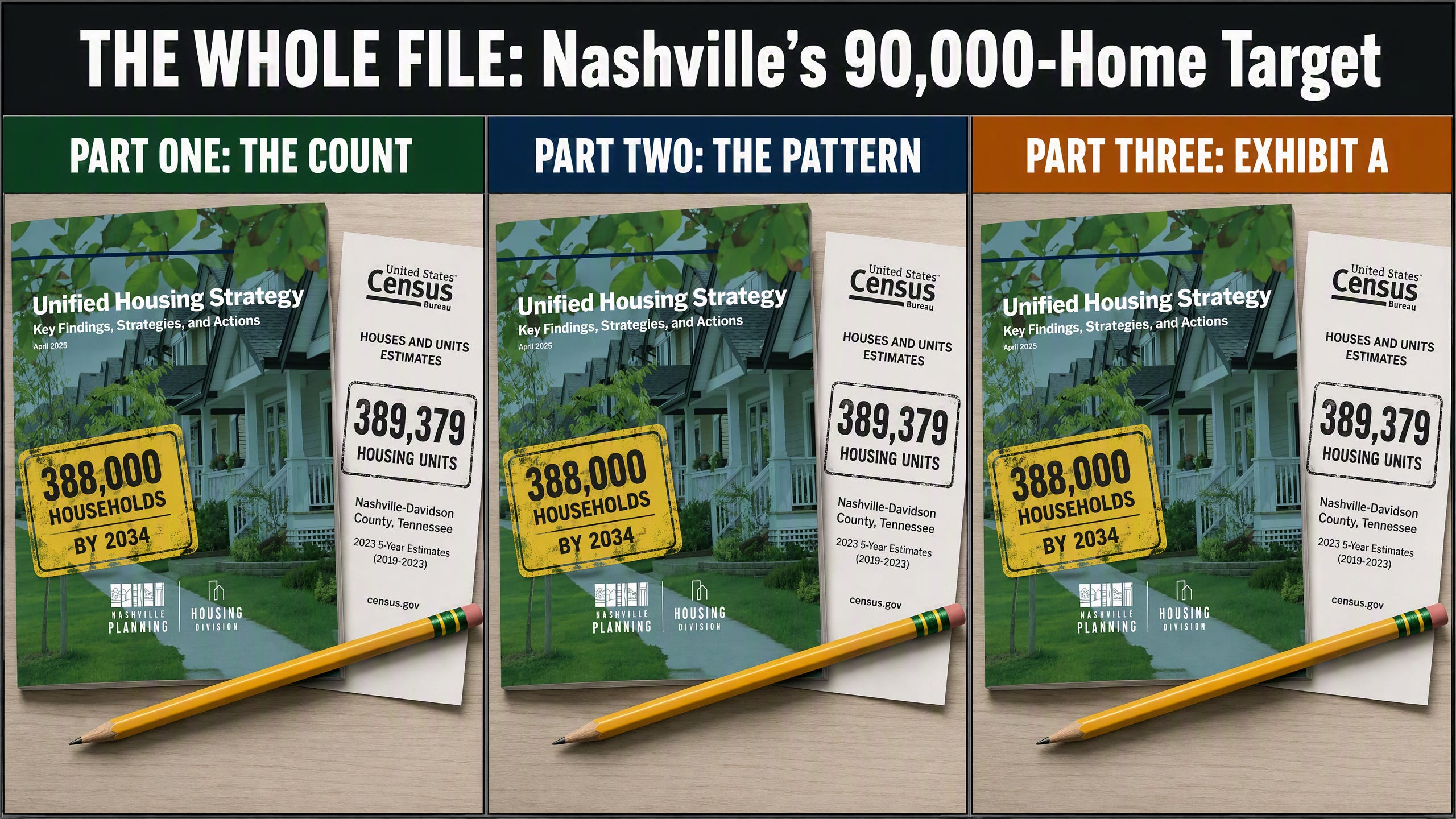
Three pieces went out over three days. This is the short note that puts them in one place, and one honest paragraph about why they exist.
Almost every objection raised in Nashville about scale, traffic, infrastructure or displacement is answered with the same sentence. The city needs 90,000 more homes. It is the card that ends the conversation, and I have played it myself, as has nearly everyone who has spoken about housing in this city, in a hearing, in print, or across a kitchen table. I was testing the population projection behind it within a few weeks. It took several more before it occurred to me to ask a much smaller question: what year does the counting start? A number can travel a long way before anyone asks where it begins.
Here is the arithmetic, and it is all of it. The Unified Housing Strategy projects 892,000 residents by 2034 and calls that an increase of about 175,000. The difference is 717,000, which is roughly what Davidson County had in 2020. So its appendix is counting from 2020, and the only way to know that is to work it backward. Which means every home Davidson County has built since 2020 already counts against the 90,000. Part One counts them.
You may have read something different. The same report’s narrative describes the target as covering the next ten years, which would start the clock at publication instead of 2020. Both readings sit in one document, and it never says which one governs.
The people who most want this to work are the ones still trying to buy a first home. Some are young and a couple of years into a first job. Some are raising kids alone. Some are doing it on one income in a market priced for two. When I talk with them the hope is not ideological. It is that this will finally be the thing that lets them buy.
Part One printed what Metro’s own consultant on the Housing and Infrastructure Study put on paper about those homes. At minimum feasible pricing the buyer needs roughly 230 percent of the area median income. That is a household earning north of $200,000, against a median family income here of about $100,000. I am not going to tell you what to make of that. I am telling you it was said out loud, to the Council, and nobody asked a follow-up.
Metro Planning to the joint Planning, Zoning, Transportation and Infrastructure committees, March 24, 2025, at 24:42 of the Metro Nashville Network video: “Attainability levels are improved, but they still exceed 230% of the area median income, though this is down from 330% of the area median income.”
One note on the word. Metro’s own attainable housing ordinance, approved in February 2026, defines attainable housing as income-restricted at no more than 120 percent of area median income. The prototypes above were measured at 230, which is close to double that ceiling. A word cannot mean one thing in the ordinance and nearly twice that in the presentation.
One word on tone, because in this debate a question is often treated as opposition. Nothing here argues against housing. Nashville built, and built well, and that is in the record. And the question that follows is always the same, the one I get after every neighborhood meeting: so what is your idea? The first step is a flashlight, not a building.
Metro’s own studies already say what to do: do no harm to the people least able to absorb it, then aim at the shortage you actually measured. The Unified Housing Strategy warns on page 44 that supply without protections drives displacement, and it puts that shortage at the bottom of the income range, not across the whole market. Neither step is my invention. Both are theirs, in print. What a review can ask for is smaller still, and it costs nothing: state the year the counting starts.
That request is small. What rides on it is not. A city that cannot say what year its target counts from cannot say how much of it is already standing, and so it cannot say how much more it needs, how much zoning to write, or how much infrastructure to promise.
Size all three to a number that is too large, and the city has entitled more than it needs, committed to roads and pipes it has not funded on top of maintenance already deferred, and sent the bill where every bill here goes, to the property tax. And because the entitlement is by right, what gets built is whatever the market chooses to build, at whatever price it chooses. A number nobody can check is a number that can end any conversation, and this one has ended a great many.
This Substack is reader-supported. To receive new posts and support my work, consider becoming a free or paid subscriber.
Part One, More Homes Than Households. The count. Davidson County already has more housing units standing than the households Metro forecasts for 2034. Free to every reader.
Part Two, The Pattern and the Playbook. How the number kept its job after the count arrived. Eight published steps, one forecast the appendix itself calls more aggressive, and a demand input doubled in writing to restore a published total. Free to every reader.
Exhibit A, Behind the 90,000. The working file. Every lever isolated and tested one at a time against the county’s own data, the consultant’s feasibility sheet reproduced row by row, and the pages the claims trace to. For paid subscribers, who are the reason the arithmetic gets done.
If any figure in any of the three fails your replication, write me. The correction publishes in full.
Make sense of the decisions shaping our places, communities, and daily lives. Subscribe to receive new Built to Think essays and support independent civic writing.
Thanks for reading! This post is public so feel free to share it.
About Built to Think · Chris Remke, AIA [lic. ret.]
Built to Think is a working laboratory for civic sensemaking, founded by Chris Remke
It follows evidence across the full life cycle of place-building, from public promises and development rights through finance, design, construction, operations, market price, infrastructure, taxation, and neighborhood life. Built to Think follows not only what a decision says, but what it sets in motion.
Original text, analysis and tables © 2026 Chris Remke, Built to Think. Quotation with attribution and a link is welcome and encouraged. This file is provided for the personal use of the paid subscriber; republication in whole or in substantial part, in any medium, requires written permission. Government documents and figures reproduced here for purposes of review are cited in full and remain the property of their sources.
Decode the City. Stay Informed.

click image for link
Comments
Nothing yet. Say the first thing.
Sign in to join the conversation.