
Real estate investors are implicitly underwriting cultural networks.
In many cities, culture is not a side benefit to the investment thesis. It is a major driver of the market’s demand engine and helps explain why people move, visit, recruit, and pay a premium to be there. What happens when the real estate system that benefits from this culture starts to unravel the conditions that sustain it?
That question sat beneath our latest Build Order episode, where Jen and I explored Austin through the story of the Curtain Theatre: a hidden Elizabethan replica theater on the shores of Lake Austin, built on private land by a local billionaire, and now slated for demolition. Since no single building, venue, or theater determines a city’s culture, it is easy to give ourselves a pass. But culture does move through networks of artists, patrons, audiences, and chance encounters. If those networks have nowhere to gather, produce, and go next, the “nowhere but here” investment premium may be less durable than it looks.
In markets where culture is a material part of the demand story, the network behind that culture belongs in the underwriting.
To see why, and how to do it well, we need to detour through network theory.
Paris in the 1920s had one of the most concentrated bursts of cultural creation in modern history. Imagine a day in Les Années Folles. (Or rewatch one of my personal favorites, Midnight in Paris.) Within Gertrude Stein’s orbit, you could traverse Cubism and Fauvism with Picasso and Matisse in one minute, glimpse the future of American 20th century literature with Hemingway and F. Scott Fitzgerald the next, and then encounter the early Surrealists in André Breton or Louis Aragon, all within a city where the currents of Art Deco were crystallizing around you. A striking aspect of Paris in the 1920s is how many now-household names were in the same place, at the same time, and personally knew one another.
What do we learn if we treat this artistic community as a network?
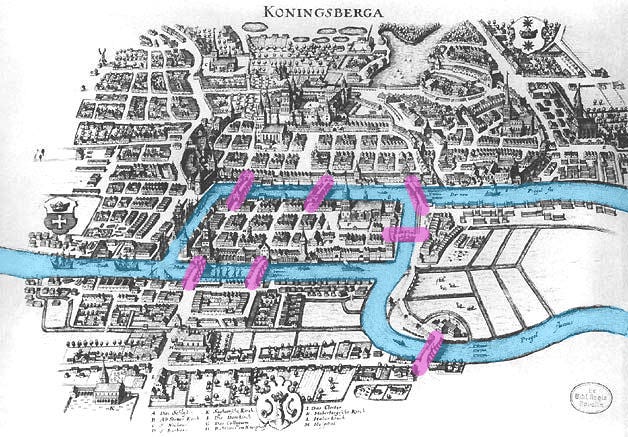
Every good theory must have a good origin story, and network theory traces its own to 1735. A popular city puzzle in Prussia asked whether someone could cross each of Königsberg’s seven bridges exactly once. Leonhard Euler, a Swiss mathematician, solved it by representing each landmass as a node and each bridge as a connective edge.
The insight that emerged was simple but profound: that the structure of a system itself holds information.
In network terms, Paris in the 1920s is what we could call small-world(-ish): highly clustered locally, but with short connective paths bridging any two artists. There are three elements to 1920s Paris that support the small worlds claim:
Small-world networks have clusters: Paris in the 1920s had the Stein/Toklas salon (Picasso, Matisse, writers passing through), the Shakespeare and Company / Sylvia Beach circle (Joyce, Hemingway, others), the Surrealist cohort (Breton, Aragon, Éluard), artists who formed les Ballets Russes (Stravinsky, Diaghilev), and more.
Small-world networks have connective paths that bridge different clusters: As an example, Andre Breton and Pablo Picasso had a strong friendship that connected the Surrealists, who largely kept to themselves, to the Stein and Sylvia Beach circles.
Small-world networks have short path lengths: Without illustrating every relationship in 1920s Paris, I already know I can jump from Gertrude Stein to Igor Stravinsky, Hemingway to Breton, Matisse to Ernst in three strong steps or fewer. The real estate industry understands this concept intuitively. It’s called the six degrees of separation, or the idea that just about everyone knows everyone else through someone else.
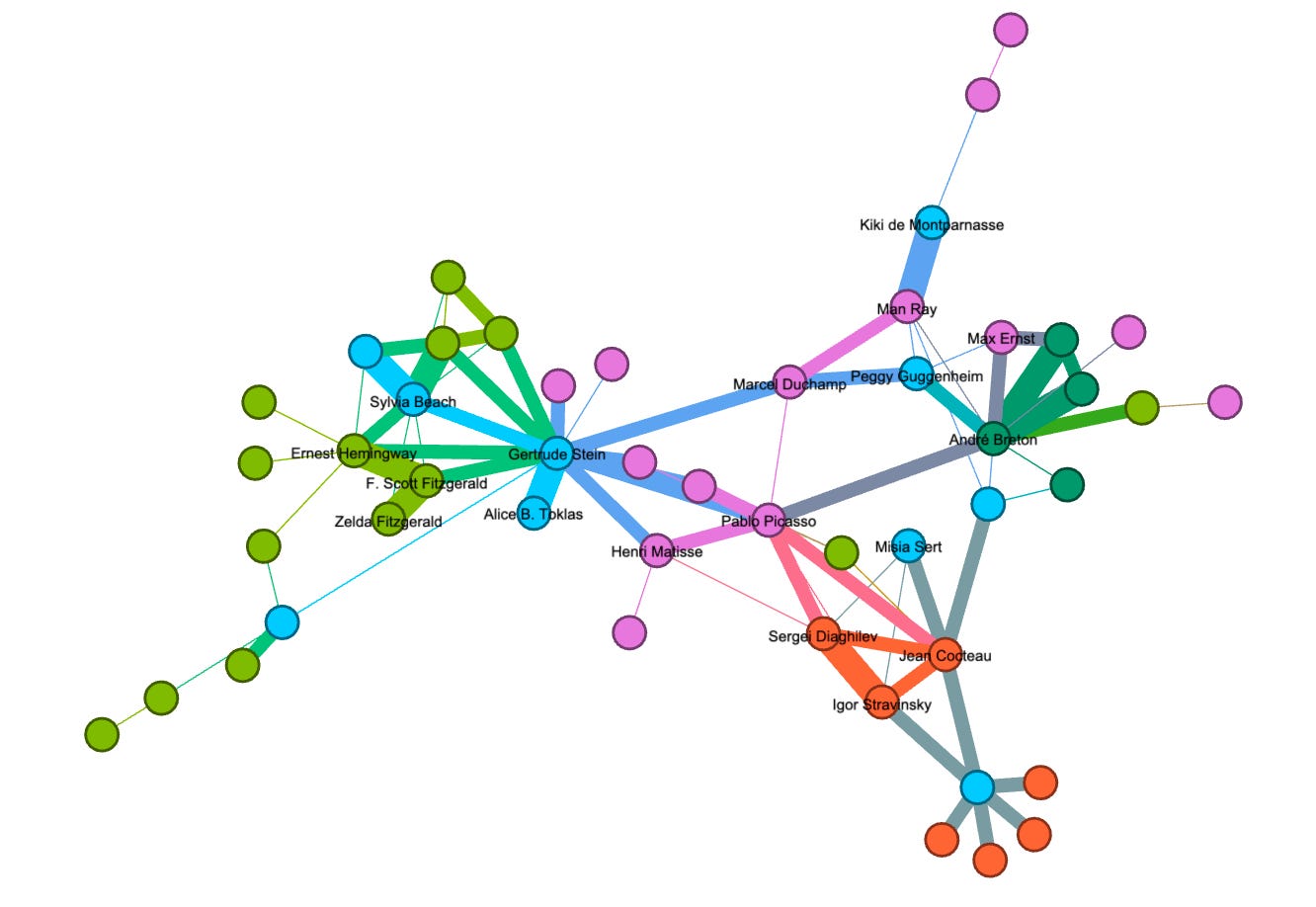
It is the structure of the artistic network in 1920s Paris that helps to explain how its participants could innovate so rapidly at the edge of artistic movements. Information spreads more quickly in small worlds than in other types of networks because of the shorter average path lengths. Not only can good ideas quickly diffuse like a game of telephone, bad ideas can be rapidly tested and ejected from the network. Dense local clusters allow for in-depth refining of specialized knowledge. Consider the feedback on structure and rhythm that Stein gave to Hemingway, shaping the early drafts of future classics. Finally, bridge connections across artistic disciplines allow for borrowing and recombination of ideas across fields, such as from Cubism (painting) to Surrealism (painting/writing) to Primitivism (painting/music). This is known as Granovetter’s weak ties, the concept that it is acquaintances rather than close collaborators who are often the most powerful channels for new information. Anyone who has ever networked for a new job or funding opportunity knows this well.
Small-world networks show us what successful creative networks look like once they exist, but they tell us almost nothing about how those networks survive long enough for something new to emerge. To fill that gap, we need a new concept: node persistence. If two cities share the same small-world network structure, but only one has enough slack — meaning residential affordability, patronage or institutional support, ample studio space and small-format commercial space — for new artists to remain in the network, then that city will have a greater chance of effective information propagation and recombination over time, leading to new cultural innovations. A city’s cultural network is only as strong as its ability to keep uncertain nodes embedded long enough to become important. If nodes leave too quickly, the network never reaches a stable percolation of local ideas.
Two cities with identical network structures can produce very different cultural outcomes:
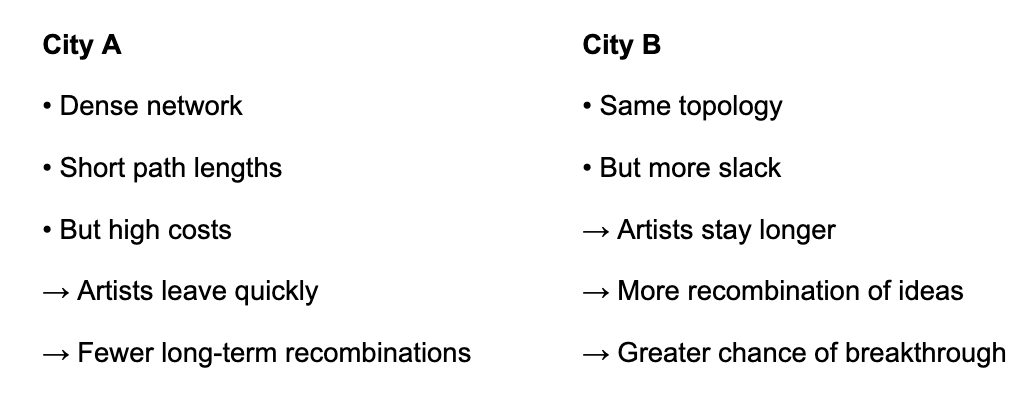
This begins to shed light on what is happening in Austin today. Rents, though down lately, roughly doubled in the 2010s and long-standing venues and artist spaces disappeared. If domestic out-migration from the city proper is pulling away some of the people most likely to participate in Austin’s cultural network (graduating students, working artists still searching for their breakthrough), then rising costs are not just a housing issue. They are a node-persistence issue in the cultural network.
Oversimplified, but useful:
Cultural innovation probability = (network connectivity) × (node persistence)
But there is another way cultural networks can fail and another kind of network that helps to explain it: the scale-free network. Here, a few nodes act as highly connected hubs while the vast majority of nodes have many fewer connections. Scale-free networks show preferential attachment: new participants tend to connect to already well-connected hubs. These networks are also notorious for their fragility. If the hubs disappear, the network can fragment and lose information transmissibility very suddenly.
Scale-free networks help to explain why leading cities like San Francisco, New York, and Los Angeles have durable advantages as new participants seek geographic proximity to taste-setting, well-connected individuals and hubs in the arts, technology, or business, but they also illuminate the early conditions for their failure. The loss of one patron, concert venue, or tastemaker in Los Angeles might register as little more than a blip today, but their repeated loss may eventually, and suddenly, undermine the entertainment industry. In a smaller ecosystem like Austin, the loss of any hub can ripple through the entire cultural network almost immediately.
If culture is part of your demand story, underwrite it like part of the demand story.
Real estate investors routinely underwrite job growth, household formation, income, infrastructure, and other elements essential to understanding a city. But culture is also part of the story. This does not mean that every real estate investor needs to become a preservationist.
This is what I think you need to consider:
If your thesis depends on a “cool city” remaining a cultural gem, map the network nodes that will keep this true: music venues, rehearsal spaces, artist housing, small-format commercial spaces, late-night corridors, and the operators behind them. You are looking for evidence of whether these network nodes are stable or under pressure, and whether they are replaceable or not.
If the cultural premium is concentrated in a small number of fragile hubs, the market may be less culturally durable than it looks.
A district can look culturally vibrant but not be culturally generative. Expensive restaurants, polished hotels, branded retail, and entertainment concepts monetize a city’s cultural reputation, but they do not often produce the next generation of participants and institutions that will keep the culture alive. This distinction matters over the long term.
Cultural consumption will support near-term rents and hospitality demand, but cultural production is what will keep a city’s long-term brand evergreen.
Population growth trends are critical to informing an investment thesis, but the details matter. If domestic out-migration from a city is high, the people who built a particular city culture may no longer be around to sustain it. If these individuals are moving nearby and can easily return to the city core, this is less of a concern. If they are fleeing for other cities, this is a leading indicator of cultural change.
A city that only consumes its inherited culture may still perform well in the short term, but its long-term brand will change.
In culturally generative cities, mobility helps determine whether artists and audiences can stay connected to the core as housing costs push them outward.
One of New York City’s enduring advantages is that its subway system affordably connects peripheral “next neighborhoods” to the core. Artists, musicians, service workers, and audiences may move farther out, but they are never severed from the venues and institutions that underpin the cultural network. Los Angeles is designed differently, but the underlying principle is the same: its cultural network recycles neighborhoods through sprawl, and its freeway system, though hardly frictionless, acts as a surprisingly effective connective lattice across the region.
Getting around a city matters for more than just commuting. It shapes whether people can keep showing up often enough for the cultural network to stay alive.
Some cultural nodes matter more than others. A deeply connected venue, theater, bar, or event space can act as an anchor tenant for the entire cultural network. Investors should understand which tenants are cultural generators and draws to a particular neighborhood, and might consider longer-term leases, percentage rent structures, mission-aligned ownership, cultural master leases, or partnerships with cities, nonprofits, and civic groups.
The most profitable tenant could very well be the lower-rent cultural tenant that supports your full district premium.
Network theory teaches us that culture is a system of relationships.
This is why cultural decline can be so hard to see while it is happening. Culture almost seems to float above a city. And when it is lost, it is through many individually rational, locally maximizing decisions: an artist who moves away for lower cost of living, a beloved venue that shutters due to too-high rents, an entrepreneur that winds something down to pursue another path. Each personal decision makes sense in isolation, but the tragedy is that the network effect may not be desirable.
Cities would be boring if they were frozen in amber. Not every theater, venue, or cultural artifact needs to be preserved for a city to retain its local culture. But cultural creators need to remain embedded in a city long enough for the next new, weird thing to emerge, and the real estate conditions either enable or hamper that.
So where do I land?
If you are investing in a city, don’t underwrite the “nowhere but here” premium based on a network built yesterday. Underwrite one based on whether you think the city is still making room for the cultural network that will emerge next.
This essay grew out of a Build Order conversation. If you haven’t caught it yet, you can watch all our episodes on all your favorite platforms: Substack, YouTube, Spotify, Apple Podcasts, Pocket Casts, iHeartRadio, and Overcast.
Thanks for reading! This post is public so feel free to share it with your friend who nerds out about things like network theory.
Comments
Nothing yet. Say the first thing.
Sign in to join the conversation.