
To: Build Order LP Distribution List
From: Hal, the Build Order Acquisitions Analyst
Re: Optimal U.S. metro for the deployment of one (1) discretionary cocktail expenditure on May 5, 2026
Status: Recommended for committee approval
Hold period: Approximately 25 minutes
We are pleased to present for your consideration a single-asset acquisition opportunity in the Mexican-cocktail vertical. The asset is a Persian-lime-and-blanco-tequila beverage, served on the rocks, with a salt rim, in a glass that may or may not be branded. The transaction will close on May 5, 2026 and will be held to consumption.
The base-case underwriting assumes a $13.80 California state-average house margarita (FinanceBuzz, March 2026), 9.5% LA restaurant sales tax, a 20% gratuity, and a $1.50 line item for “the chips and salsa were not, in fact, complimentary.” The premium-venue case assumes a $19 hand-shaken specialty margarita at a venue on the North America’s 50 Best Bars 2026 list, same tax/tip stack, plus one (1) optional mezcal flight side investment.
We acknowledge that this is not, in the formal sense, a real estate transaction. We have proceeded anyway.
The Build Order acquisitions team has conducted a comprehensive market screen of ten U.S. metropolitan statistical areas to identify the optimal city for the subject transaction. Using a four-pillar weighted scoring framework (Demand 40%, Supply (Chain) 30%, Specialty Supply Density 20%, Key Personnel as Cultural & Bonus 10%), we recommend Los Angeles–Long Beach–Anaheim as the highest-conviction market with a composite score of 76.9 / 100.
LA is the only U.S. metro that simultaneously holds (i) the largest absolute Mexican-immigrant population (14% of the U.S. total per Migration Policy Institute), (ii) the largest absolute Mexican-restaurant footprint (5,400+ in LA County alone per Pew Research / SafeGraph), (iii) HQ status for three of the four largest U.S. Mexican-focused grocery chains (Northgate González, Vallarta, El Super), and (iv) a chef bench that holds a 2024 Michelin star (Holbox), a 2026 James Beard nominee (Komal), and two entries on the North America 50 Best Bars 2026 list (Mírate, Daisy).
No other metro wins more than two of these four dimensions. We are aware that the asset costs $5 more here than the national average. We are recommending we pay it.
The investment thesis rests on a single insight from the produce-logistics literature that we believe the broader market has under-priced: tequila is a Mexican Denomination of Origin product and cannot legally be made in the United States. The right supply variables are (a) proximity to the Pharr–Reynosa International Bridge, which handles over 65% of all U.S. fresh produce imports from Mexico, and (b) port access for bottled-tequila imports under HS code 2208.90. A market that gets these wrong will buy the right limes too late and the right tequila too rarely. LA gets both right.
We screened ten MSAs. The top five are presented below for committee review. We included honorable mentions as well, primarily because writing them down made us feel thorough.
The LA composite breaks down as follows. We have shown the work because the IC has previously expressed a preference for that.
LA Composite = (70 × 0.40) + (75 × 0.30) + (92 × 0.20) + (80 × 0.10) = 28.0 + 22.5 + 18.4 + 8.0 = 76.9
Honesty compels us to disclose that the verdict rotates with the framework. Under a per-capita authenticity reweighting (60/20/10/10), McAllen wins. Under festival-immersion weighting, Denver wins (~400K Civic Center attendees). Under origin-lore weighting, San Diego wins (Tijuana / Rancho La Gloria, 1938). Under U.S. innovation weighting, Dallas wins (Mariano Martinez’s 1971 frozen margarita machine, now in the Smithsonian, and which you’ll never be able to return to Sur La Table). We have selected the framework that produces the answer we believe is correct, which we determined was standard practice in our industry.
The LA MSA’s demographic case is the single most defensible part of this thesis. Per Migration Policy Institute’s 2024 update (using pooled 2018–22 ACS data):
Greater Los Angeles is home to 14% of all U.S. Mexican immigrants — the largest concentration in the country
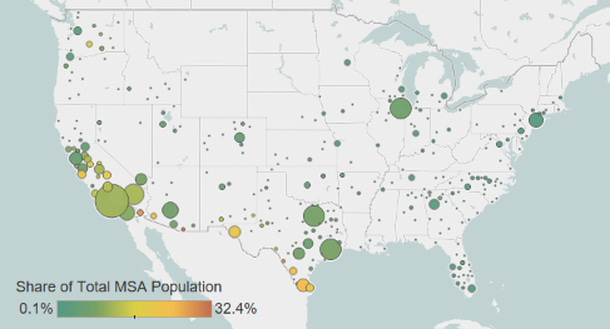
More than 1 in 10 LA-area residents were born in Mexico
For context: McAllen is 25% Mexican-immigrant share by population (highest in U.S.), but holds <150K total residents. LA holds >12.9M total residents.
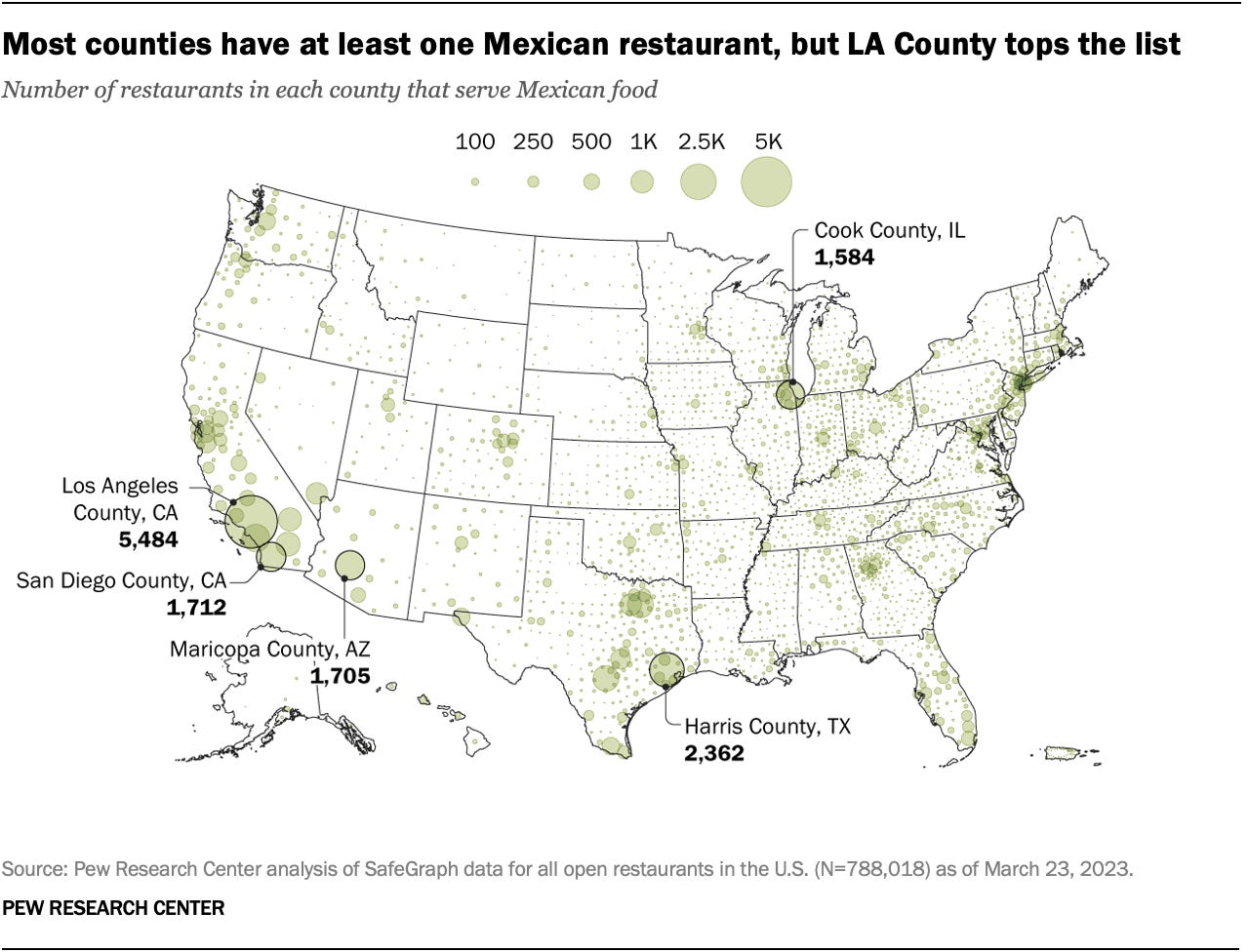
At the restaurant-supply level, Pew Research (Jan 2024) confirms that 11% of U.S. restaurants serve Mexican food and that California + Texas hold ~40% of all Mexican restaurants nationally (CA 22%, TX 17%). LA County alone is 30% of California’s count. That is not just a big number; it is a deeper demand curve, which means more competitive pressure at the venue level, which means a better median margarita. We are buying ecosystem depth.
Every margarita is a four-line bill-of-materials (BOM). Below is the underwritten supply chain by ingredient, with logistics commentary.
Sources:
The Acquisitions team finds the supply chain robust but not invincible. The 2025 tequila contraction and the IEEPA-era tariff backdrop are the single biggest macro risks to the thesis. We note that the Consejo Regulador del Tequila publicly warned in April 2025 that tariffs threaten the category’s U.S. competitiveness. This is the kind of language an industry trade body uses immediately before something gets worse.
A real-asset acquisition is also an acquisition of operating partners. The LA chef and bartender bench is, in our view, the deepest and most decorated talent pool in U.S. Mexican cuisine. Selected highlights:
Gilberto Cetina, Holbox — earned a Michelin star in 2024; #1 on Yelp’s Top 100 U.S. Restaurants 2025 list
Fátima Juárez, Komal — 2026 James Beard nominee for nixtamalized heirloom corn program
Carlos Salgado, Taco María (Costa Mesa) — JBF Best Chef West nominee; nixtamal pioneer
Bricia Lopez, Guelaguetza — Oaxacan cuisine and mezcal authority; James Beard America’s Classics 2015
Maxwell Reis, Mírate / Daisy Margarita Bar — Mírate placed #28 on the North America’s 50 Best Bars 2026 list; Daisy at #44; Reis runs an industry-leading “Salsa Bar” margarita program
However, we felt it was prudent to recognize key players in finalists and honorable mentions.
Honorable mention, San Antonio: Diego Galicia & Rico Torres, Mixtli (2026 JBF finalist)
Honorable mention, Houston: Hugo Ortega (Hugo’s, Xochi); Alba Huerta (Julep — JBF Outstanding Beverage Program 2022)
Honorable mention, McAllen: Ana Liz Pulido, Ana Liz Taqueria — won JBF Best Chef Texas 2024
In acquisitions terms, Greater LA is the only U.S. metro where you can underwrite a top-of-the-house operator on every floor of the stack — fast-casual, neighborhood, destination, Michelin-starred.
As with any investment, there are risks. While we feel the opportunity significantly outweighs the risk, we felt it prudent to disclose the following.
Tariff risk. The 2025–26 IEEPA-era 25% Mexican-import regime (with USMCA carve-outs) has measurably lifted Pharr F.O.B. lime prices and contributed to the first U.S. tequila/mezcal supplier-revenue contraction in years (–4.1% to $6.4B in 2025 per DISCUS). Acquisitions believes this is priced in but cannot guarantee.
Water hardness risk. LA municipal water runs 12–16 grains per gallon, which is materially harder than ideal for ice clarity. Mitigant: every venue on our shortlist filters. Concern: not every venue we’d actually walk into does.
Festival-attendance risk. Fiesta Broadway has contracted from a ~500,000-attendee peak in the 1990s to ~50,000 in 2024. The qualitative experience of “being on a closed-off street with everyone else” has migrated to Denver. This is a real loss for the cultural-immersion thesis.
Origin-lore risk. The earliest documented “Tequila Daisy” reference is a 1936 Iowa newspaper account from Tijuana. Carlos Herrera (1938), Pancho Morales (1942), Santos Cruz (1948), and Margarita Sames (1948) are all post-dated by this. We are buying a market, not an origin myth, but disclose this for thoroughness.
Single-asset concentration risk. This memo proposes the deployment of capital into one (1) margarita. We are aware this is not diversified. We modeled a diversified five-metro portfolio and rejected it after stress-testing the exit scenario, which projected severe impairment to the analyst by approximately 9 a.m. local.
The Build Order acquisitions team recommends approval of the subject transaction at the Los Angeles–Long Beach–Anaheim MSA, base case $22.45, downside case $38.20. Optimal deployment locations include Holbox (rigor), Mírate (program), Daisy Margarita Bar (eponymous), Las Perlas (depth of mezcal book), Madre Oaxacan (500+ mezcals on the back bar), or Guelaguetza (the cultural anchor).
We will report results to the LP base in the May post-mortem, assuming the recommendation is approved, the IC convenes by May 5, the responsible acquisitions analyst is in fact in Los Angeles on the day in question, and we wake up on time on May 6. As of this writing, all are pending.
Salud.
— Hal, the Build Order Acquisitions Analyst
This post is public so feel free to share it with your friends who believe tequila has health benefits.
Build Order is a newsletter about the structures, capital, and operating logic behind things people actually want, typically in real estate. This memo is illustrative. Please do not forward to compliance.
This essay grew out of a Build Order conversation. If you haven’t caught it yet, you can watch our episodes on all your favorite platforms: Substack, YouTube, Spotify, Apple Podcasts, Pocket Casts, iHeartRadio, and Overcast.
Subscribe for more amazing Build Order content! And if you’re already a subscriber, THANK YOU! Please be a dear and share it, and you’ll be our favorite friend of the pod.
Comments
Nothing yet. Say the first thing.
Sign in to join the conversation.