
🖐️ Hey Friends,
Last week I was researching a new feature at work for an upcoming device and needed motion detection. Typically we use PIR sensors but we were a bit cost and space constrained. Also given that this device already had a speaker and mic array I decided to look more into ultrasound sensing.
This led me down a rabbit hole of learning about how bats use sound waves to navigate, which reminded of why I got into engineering and eventually PMing. I’m sure all of us can remember when a piece of science or nature amazed us.
Hence today’s article will be a bit different from our usual programming. The upcoming articles will explore hardware PRDs, pricing, and strategy. However for today let’s appreciate some fascinating technologies we take for granted.
Biomiciry is the practice of taking inspiration from nature to solve problems.
Although we usually start with first principles during the ideation phase of a project, we shouldn’t be afraid of exploring analogous concepts in the world around us. Many of the best designers I’ve been around were great at observing their environment, and using that a brainstorming technique.
I think it’s because it’s hard. It requires one to pause, reflect, and question “why” several times over. How do ants communicate so well? What allows certain birds to create lift versus others? Why do leaves provide cooling? And so on.
Lets walk through some examples of how this is already present in some of the tech we use everyday.
What is it
These are high frequency sound waves that operate in ranges which are beyond human hearing.
What are some use cases
They can be used in smart home devices like speakers for motion and proximity detection to setup routines. For example your devices automatically detect when you’re home instead of using a wake word (“Hey Siri, Alexa”). This detection triggers your lights to turn on and alarm systems to disengage.
Another example is in cars for parking assistance, blind spot detection, and collision avoidance.
How it works
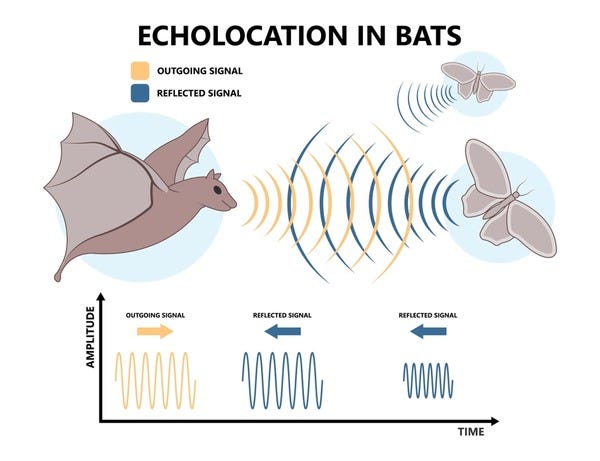
Devices, like a smart speaker, can emit sound waves which then reflect off of near by objects and are picked up by microphones. Then there’s some sophisticated signal processing to detect if there’s motion.
In cars it’s done by using a transducer, a device that does both emitting and receiving of sound waves through piezoelectric crystals which convert waves into electrical signals.

How its inspired by nature
A natural process called echolocation is where animals use sound for detection and navigation.
Bats, and certain birds, emit high frequency sound waves and use echoes to determine the texture, shape, and placement of nearby objects for hunting and navigation in the dark.
Similarly dolphins use echolocation by producing whistles and clicks. Once these bounce off objects it helps them create a conceptual map of their geography.
What is it
Sometimes called dry adhesives - these are products that can adhere to surfaces without being wet or “sticky”. They work by utilizing physical mechanisms like Van der Waals forces instead of traditional chemical bonding.
What are some use cases
Robotic grippers
Bandages that can stick to skin without causing damage
No residue tapes from Nitto Denko and 3M
How its inspired by nature
Geckos have feet that cling to walls, but they’re not really sticky. They have tiny hairs which, when a force is applied, bend and make them adhere to surfaces. This is achieved by intermolecular forces and is being used by NASA for space grippers:
“Behind this phenomenon is a concept called Van der Waals forces. A slight electrical field is created because electrons orbiting the nuclei of atoms are not evenly spaced, so there are positive and negative sides to a neutral molecule. The positively charged part of a molecule attracts the negatively charged part of its neighbor, resulting in “stickiness.” Even in extreme temperature, pressure and radiation conditions, these forces persist.”

What is it
What I mean by efficiency here is structures with high strength to weight ratios, optimization of space, clever material usage, and relative ease of assembly.
What are some use cases
Packaging
Think of cardboard boxes. They utilize a honeycomb pattern to create strong, lightweight, and eco-friendly packaging. This design is also good at absorbing shock and protecting contents.
Automotive components
Some traditionally plastic interior trim components such as door panels, headliners, or seat supports can also be made into a light weight honeycomb structure while maintaining stiffness. This is done through a combination of laminations, thermoforming, and injection molding.
A bunch of other stuff
Architectural elements, crash resistant airplane components, and textiles. Honey comb structures are a benchmark in the field of biomimicry.

How its inspired by nature
Bees are incredible. There are a lot of studies on this but generally if they were to disappear we’d struggle to survive because the crop species they pollinate make up the majority of our food supply.
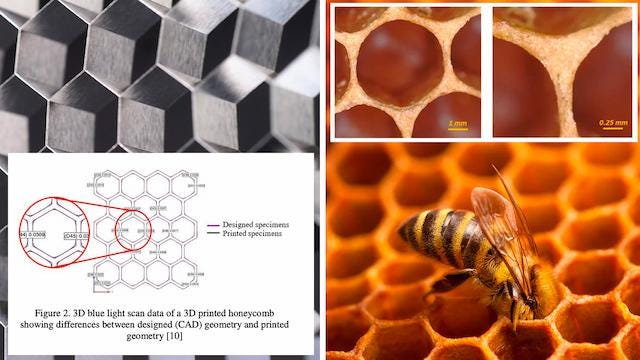
When they construct their hives, bees do so by crafting layers of hexagonal cells. This interlocking design has high load bearing capacities, great strength to weight ratios, is very efficient from a space and material POV, and also provides thermal insulation. All of these properties in a single, natural design is incredible.
If we look at a specific example, in the image below the human made honeycombs on the left have sharp corners, whereas the bee made ones on the right naturally have softer ones. This subtle corner radius is actually better at mitigating node specific fractures, all while increasing stiffness.
What is it
LEDs are all around us and while this next example of biomicry looks like it’s still in the research phase to me, it’s still fascinating.
What are some use cases
Smart lights
Backlit car interior switches and dials
Thermostat displays
How its inspired by nature
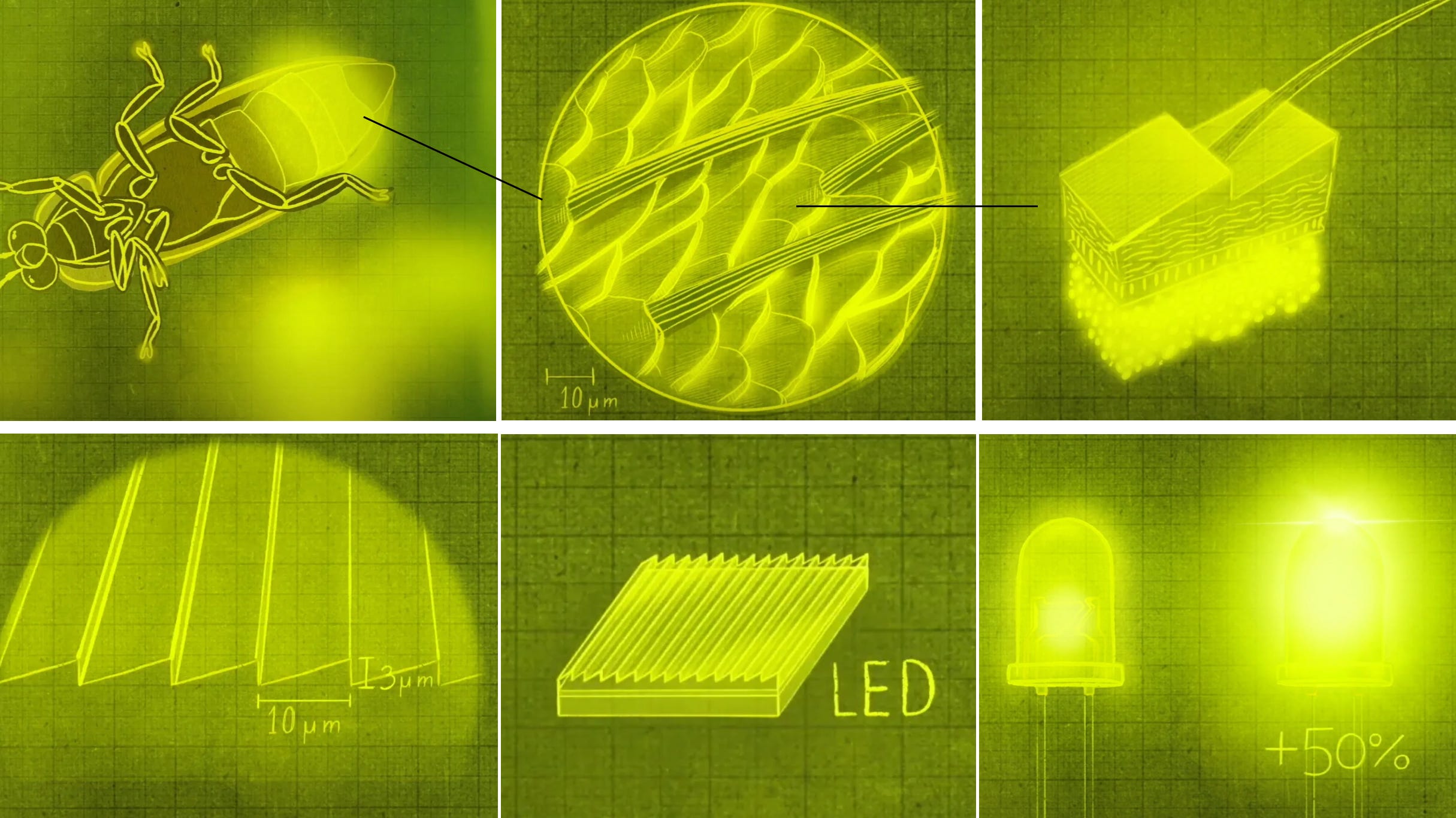
Fireflies emit light through a chemical reaction in their organs which then transmits through a textured structure on their exoskeleton.
This structure is asymmetrical, one side is slanted more than the other, allowing more light to pass through than if it was symmetrical (the former has greater surface area and more opportunities for light to escape through randomization).
Researchers, inspired by this structure, created a jagged layer on top of LEDs (keep in mind that regular LEDs do not have any layer on top). After implementing the jagged structure, they observed light extraction gains by more than 50%. Pretty cool given that LEDs in the market still have some work to do to get greener.
Next time you’re using a device or working on a new project take some time to ask how much of it was inspired by nature. You’d be surprised as to what you’ll find.
Make sure you check out some other articles:
If you enjoyed this, please like and spread the word. If you have any questions on hardware PMing, product development, or careers let’s talk.
No posts
Comments
Nothing yet. Say the first thing.
Sign in to join the conversation.