
Last week I had a discussion with some product leaders about the future of product management, which is a hot topic. My LinkedIn feed is full of various versions of “Product Management is dead”, brought on by the rapid advances in Generative AI. The seeming ability to create any form of document, strategy, plan or even application with a simple prompt has, rightly in my view, sparked a lot of excitement.
I’ve been trying out these tools and they are impressive. I’ve also been digging into what’s under the hood (thank you Hugging Face, open source rocks) to understand them more deeply.
The possibilities are incredible, and things will keep getting better. We are still in the very early stages, and things are moving fast.
They are also filled with issues, still hallucinating just when you thought they’d grasped reality. My excitement is tempered with a healthy dose of scepticism.
However, I’m absolutely not in the camp of “because these tools make mistakes now they are never going to be any good”, because I don’t believe that to be true. Just reflect on how much we laughed at the inability of Gen AI to create pictures of hands a year ago. Now hands are much better and the struggle has evolved to being able create left handed people.
The only real certainty at the moment is that all sorts of things are going to be disrupted and it’s too early to say exactly what.
What is Product Management anyway?
My core interest is the creation of software products, so I’m examining this flavour of product management. One thing I have observed is that there is a lot of subjectivity in the definition of product management, and even more in the definition of the role of product managers.
I thought it would be interesting to try out a technique that I’ve long admired to think this through, Wardley Mapping, and apply it to the practice of product management. This will allow me to be more transparent and considered in my analysis.
Wardley Maps were created by Simon Wardley as a means of guiding strategy, having found that as a CEO is was making it up and lacking suitable tools to really have confidence in a strategy. It’s a great story. Simon made an absolute baller move by gifting Wardley Maps to the world via a Creative Commons licence.
So here is my take on software product management. Per Simon Wardley’s reminder, all models are wrong, some are useful.
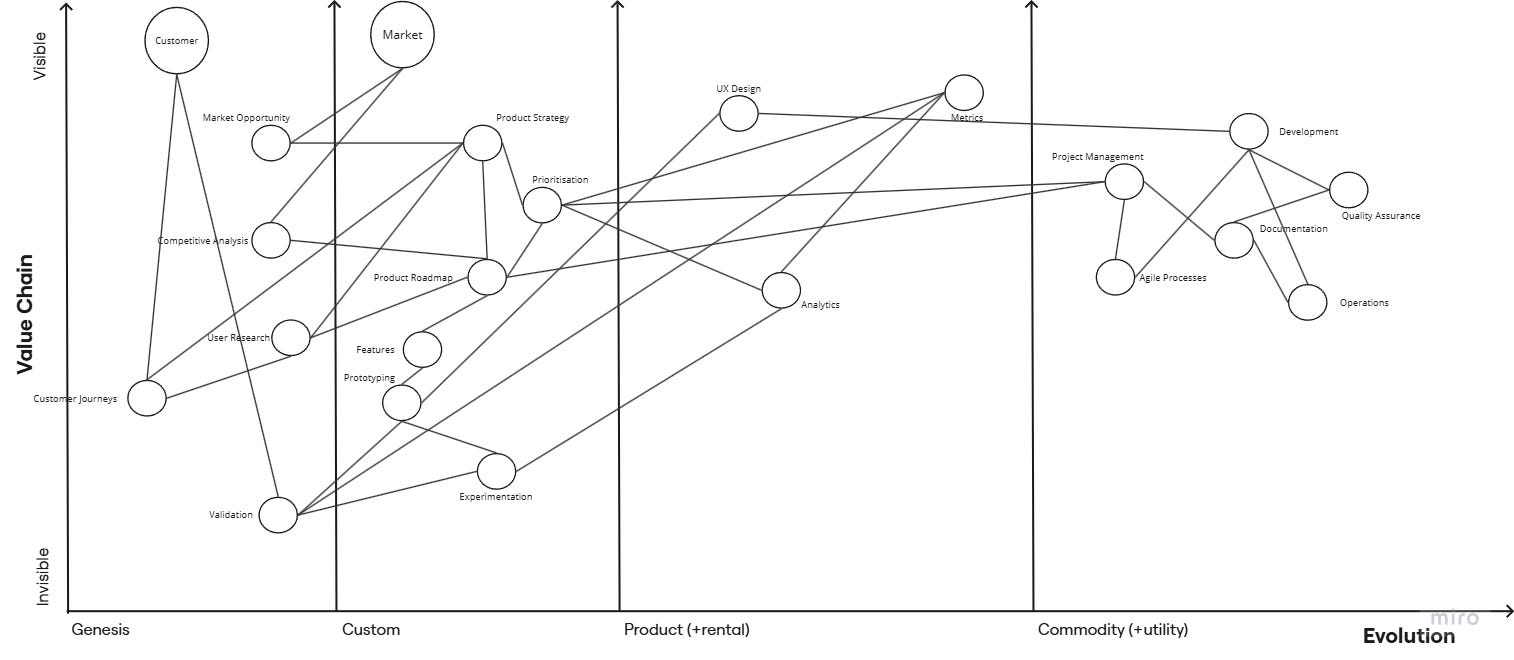
Looking at the map you can make an argument for every single aspect of this process being impacted by AI, and pretty solid one.
Thanks for reading Building and Exploring! This post is public so feel free to share it.
New Tools and Faster Typing
There are lots of early use cases for Gen AI that are already gaining traction, and many elements of product management are already being sped up with new tools. It’s also clear that capabilities that previously required specialist skills are being opened up to new people.
Prototyping is a use case that product managers are already jumping on, and rightly so. Clickable prototypes have existed for a while, but they have just become even richer and faster to create.
And if you can create a working prototype with a simple prompt, then how much further through the lifecycle can you go?
Writing code is obvious use case for AI to massively impact.
In many ways the current direction is just another layer of abstraction in the same way that JavaScript is an abstraction between language that people can read and what computers need.
So a new workflow emerged, where natural language is used to describe requirements and specifications that are interpreted directly by a computer, rather than an intermediary programmer. Or does it? One of the beautiful aspects of natural language is the variety and richness possible, which leaves a lot of room and work for the recipient to do to understand the meaning and intent. The ability to craft precise prompts that elicit the “right” response starts to look a lot like writing code.
But typing has never been the most important aspect of developing software, just the most visible due to it’s historic cost.
Strategy and Decision Making
As the cost of typing tends to zero and your ability to iterate on an idea goes faster more avenues open up. But just because you can, doesn’t mean you should.
Judgement about whether an idea is likely to contribute to a strategic outcome is still crucial. “We should do A over B, because of these reasons” is still something that needs to happen.
Your Now, Next, Later roadmap might need a bit of recalibration though as the rapid testing of hypotheses through AI-powered simulations means cycle times should be greatly reduced.
Anchors and shifting sands
One of the most interesting things to consider about the product management map are the anchors. Product management is, at it’s core, all about how best to allocate capital to create something that solves problems for customers that they are willing to pay for.
Who are the customers and what is your market? That is the starting point for any product.
The emergence of AI Agents raises a whole load of questions. The AI use case Google are currently using in their advertising is someone asking Gemini to book them a nice holiday. Booking a holiday involves a whole load of choices - timing, budget, destination, accommodation, activities and onwards.
So who is your customer in this case? It’s still the person paying, right? Yes, and it’s also the agents. They need to know about your service and prefer it to the alternatives. How do you factor that into your discovery and go to market?
The emergence of AI agents creates a dual-layer market: human customers and their AI intermediaries. So your process must now consider how to optimise for both human needs and agent algorithms.
And what about the role of trust? Trust can play a big part in people choosing one supplier over another. What happens when the marketplace is mediated by machines?
Discovery and Research
Understanding who your customers are, what their problems are and how you might solve them is another area that is already being impacted by AI.
Traditional customer interviews and surveys are being augmented by AI-powered analysis of vast data sets and the rise of synthetic customers.
The challenge shifts from data collection to pattern recognition and insight validation. And with vastly more data comes the need to be pick out the signal from noise in AI-generated insights.
Data is the new oil
The whole of AI is driven by data, so sourcing and processing data increases in importance. But aren’t these activities already part analytics now?
Enterprises have always struggled to wrangle all the data they have access to, and I can’t see that changing as data volumes and sources continue to grow. That is not to say the struggle isn’t worth it - harnessing the potential of all that data is going to unlock capability and opportunity. Machine Learning Ops is the new data pipeline engineering is the new ETL…
And effective product management is going to be underpinned by a strong understanding of model capabilities and limitations.
And what of the nature of analytics? This is going to continue to be key - identifying the right metrics is still going to be crucial. Can AI improve your ability to obtain, process and analyse data? Can your models spot patterns that lay hitherto unidentified? Can AI alert you to an emerging trend that hasn’t yet shown up in your churn numbers? In the same way that infrastructure engineers have been starting to predict server failures and alert and remediate in advance, I expect the same techniques to become possible to more complex products.
Knowledge Work and Knowledge Workers
Another flavour of LinkedIn content slop is the “here are the top 25 jobs that AI is going to replace.”
If knowledge work is primarily driven by people, what happens when knowledge is all codified and available to an army of agents that run 24 hours a day for $0.0024 a question answered?
Why do you even need people any more?
The question isn't really whether we need people, but how their roles evolve. Technology has always changed the nature of work, and the post-industrialisation job market has continued to evolve rapidly as new technologies emerge. And yet people still find useful work to do.
People’s roles in product management are are likely to become orchestrators of human-human-AI collaboration, focusing on activities like:
Setting strategic direction
Evaluating ethical implications
Building trust with stakeholders
Identifying new opportunities that emerge from AI capabilities
The same goes for software engineers and designers. The skills and judgement they bring is still going to be critical, albeit in new workflows with new tools doing a lot of the tasks that take people a lot of time but aren’t so high leverage.
Ethics and Governance
Much has been written about the inherent bias in generative AI models. You don’t have to talk to many people, or spend much time on social media to see that people have plenty of biases.
So is the ethical consideration of bias anything new? But it’s importance is probably increased, and the nature of it is going to change.
Ethics have always been part of business, whether people consciously consider them or not. Professional bodies typically tend to highlight the importance of ethics and enforce standards on their members, for the greater good of society.
I view ethics in product development as asking questions throughout the process about whether you are doing the right thing, avoiding user and societal harm whilst striving for the best outcome from your business. Faster cycles are likely to make it easier to avoid asking those potentially hard questions, or really examining what’s behind the decisions being made.
More of the same, Much Faster
As I work through my map I’ve identified impacts everywhere, as well as the potential emergence of new aspects of product management. What I see really is an augmentation of current practices.
Rather than killing product management, AI is enabling a new paradigm: augmented product management. By automating routine tasks and enhancing decision-making capabilities, AI requires us to focus on what humans do best - understanding complex human needs, building trust, and making nuanced judgment calls about value creation.
The most fun thing about this analysis is waiting to see how wrong I am proven to be! The only thing I’m really confident in is that the binary thinkers flooding my LinkedIn feed are all wronger. More wrong? Hey, ChatGPT, can you rephrase this paragraph and then publish it, please?
No posts
Comments
Nothing yet. Say the first thing.
Sign in to join the conversation.