
Forgive me substack, for I have sinned. It is 6 months since my last post. And I’ve now appropriated a practice that many will hold as sacred. Let’s move on.
A lot has happened in the last 6 months, most of which I prioritised over writing, and I now have a lull, so I’m taking the chance to reflect. Well, I nearly bought a business, started a new project that is consuming most of my time and also run a community event where I challenged 100 product managers to experiment with AI to discover opportunities to innovate their process. Much of what I’ve done might turn into a future post, but the thing I’ve mostly been thinking about is the current pace of change in technology and what it might mean.
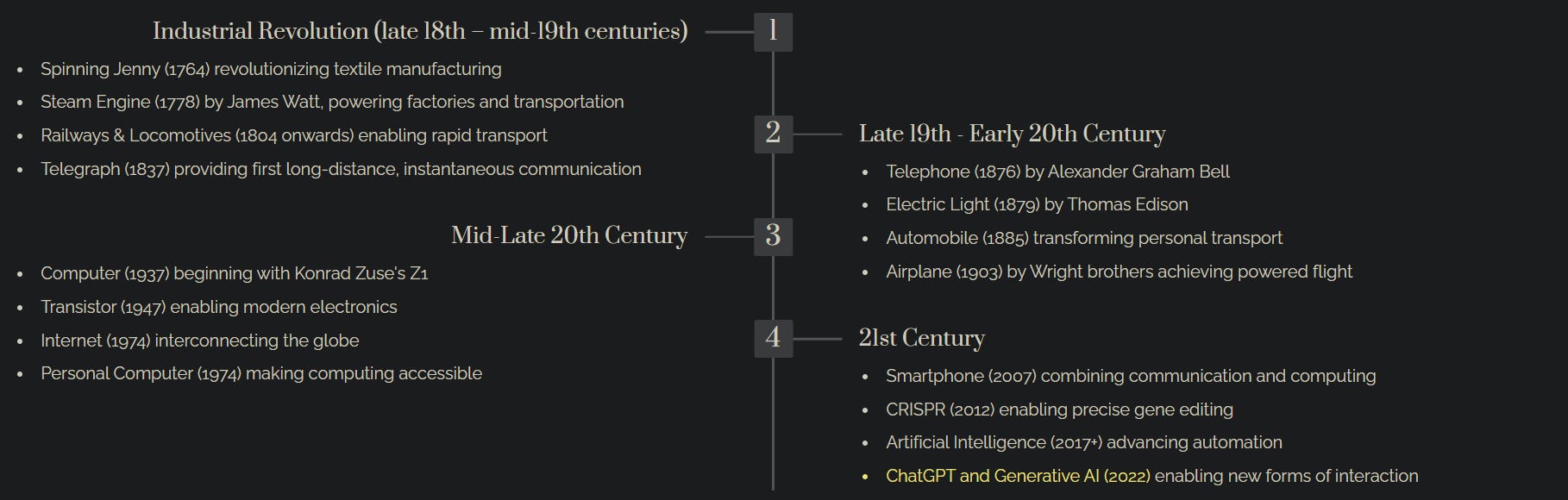
I put together the infographic on major technology changes in about 5 minutes, using the benefit of several of the milestones and a little bit of tweaking for taste. You could argue that there are other milestones that are worthy of inclusions in this timeline, and I encourage you to do so.
And you could go back to the stone age and the wheel, but I think everyone implicitly understands the trend - human innovation continues to introduce new technology that continues to impact people’s lives and the world in general.
My career started as the dotcom bubble was growing - I built my first website as a final year student, a learning resource focusing on Calmodulin - an intracellular messenger protein that is involved in several cellular processes. I hand crafted animated gifs and built interactive graphics from x-ray crystallography readings. The website only ran on Netscape as it relied on a plugin that I got from a professor at UC Berkley on a CD-ROM.
X-ray crystallography is hanging in there, but Netscape and CD-ROMs, I mean, really?
My position is that technology innovation is a net-positive. Sure, there are individual technologies and and applications that are hugely damaging, and it’s hard not to believe that are many areas where the pursuit of innovation occurs without too much consideration of the externalities of those endeavours. The popularity of Jonathan Haidt’s “The Anxious Generation” and “Careless People” by Sarah Wynn-Williams are indicative of people’s wariness of the dangers of new things, in particular social media.
Generative AI is the big change of the last few years. The big concern at the moment is of AI replacing jobs. “What will our children do?” Doubtless people asked similar things during the industrial revolution.
AI will replace jobs. There are many jobs that people currently do that are absolutely candidates for automation using AI. Will that mean people are obsolete?
Enjoying this post so far? Feel free to share it.
Compare and contrast these two snapshots from my Github profile - guess which one came before the recent explosion of AI tools. I’ve not been paid directly for writing code for nearly twenty years…
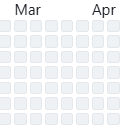
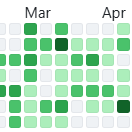
The advent of coding agents has finally got good enough where I don’t need to type code much any more in order to build something, which was always the part of coding that kept me from doing much of it.
I’ve been fortunate that in the last few years I’ve been able to work on products that are making use of this new technology, such as example real-time transcription and summarisation of calls into contact centres.
My current project is not incorporating AI into the product, but we are using AI extensively to facilitate our ways of working, such as, er…, transcription and summarisation of meetings.
So what is the impact? These examples all point productivity gains. Given the finite hours in the day, the ability to offload manual, time-consuming tasks to computers should be hugely beneficial.
I am minded though, of talking to lawyers who lived through the introduction of word-processors and email. Supposedly labour saving devices, these actually just made them busier - as they made it easier to add in extra clauses whilst dramatically shortening the cycle time of creating revisions of contracts and getting them to the other side. Net result, longer documents to review, less time waiting whilst the other side prepared and sent over their counter version…
Once I’ve closed the feedback survey on my AI community challenge I’ll write about it, but I do have some immediate thoughts that prompted me to write this post.
In essence the challenge was to get product managers to try using AI tools to help with their work, rather than build AI products. Sidebar - we need terms to differentiate these two modes: AI-Assisted vs AI-Integrated? Hmm…
The feedback I got was overwhelmingly positive, including lots of constructive ideas to make next time better, which is always so valuable.
Through observing the week and reviewing the feedback the things that stood out tome as being hugely powerful in this were the curiosity and agency of the participants and the power of human connection.
And those are the three take aways that I think are what can help people ride the wave of technological change:
Curiosity
Agency
Human Connection
Curiosity - the same spirit that leads an eight-year old boy to like a 9v battery, just better directed.
Agency - just doing things and not waiting for things to be done, active vs passive.
Human Connection - the speed at which people picked up ideas and were inspired and pushed to do more in a group setting was amazing.
As the title of my post suggests, technological change is a certainty, and enormous value can be accrued from making good use of it. If disruption creates “winners” and “losers”, the winners are often the ones with the values of curiosity, agency and human connection.
Thanks for reading Building and Exploring! This post is public so feel free to share it and subscribe for more.
No posts
Comments
Nothing yet. Say the first thing.
Sign in to join the conversation.