
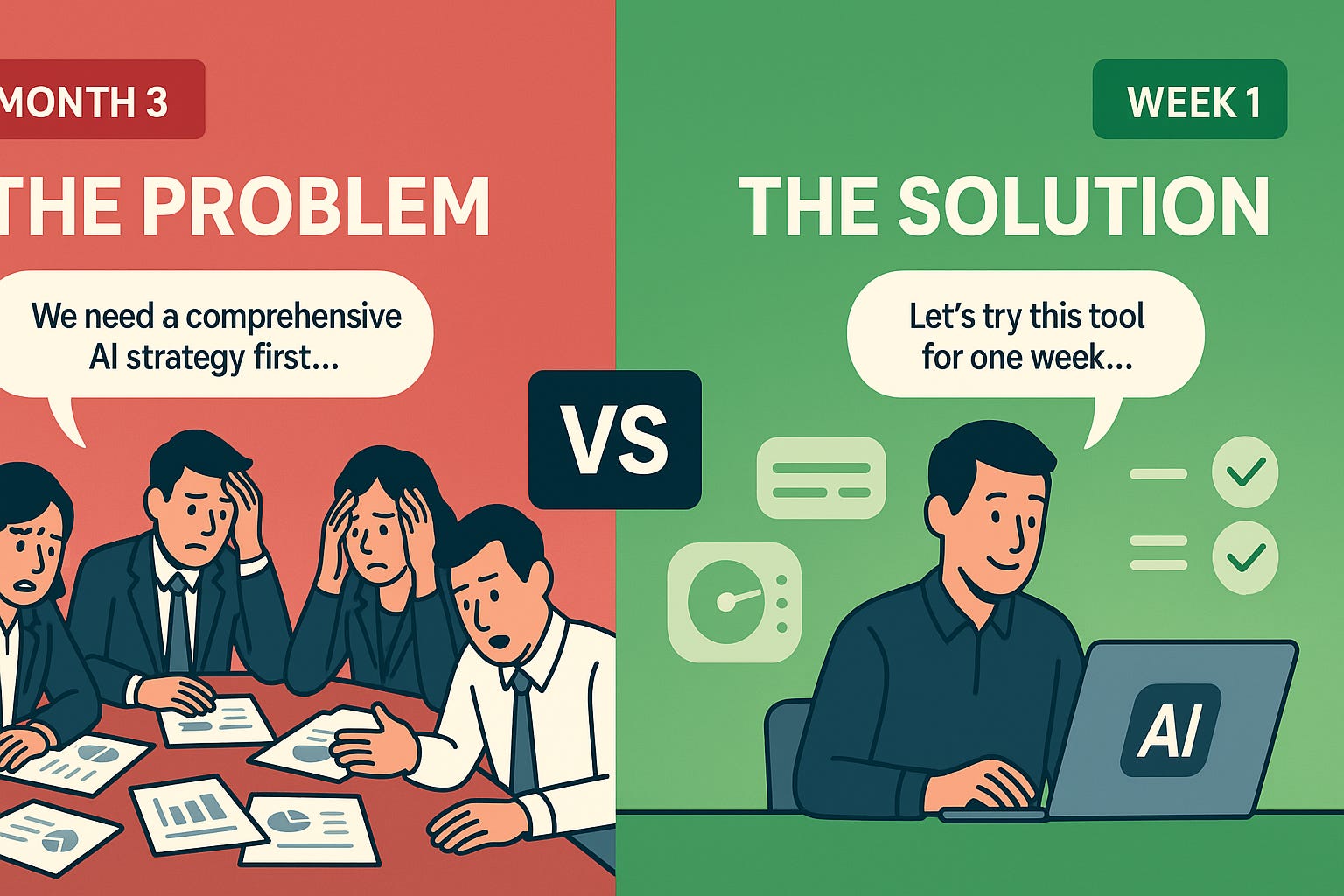
“80% of ‘AI strategy’ meetings could be replaced with ‘just try it for a week.’ Stop planning, start experimenting. The fastest way to understand AI’s value is to use it, not discuss it endlessly.”
Here’s my situation: I keep hearing the same complaint from people.
“We’ve been talking about AI for months, but we still don’t have a clear strategy.”
Sound familiar?
Here’s the thing. While you’re strategizing, your competitors are already three experiments ahead. They’re not smarter than you. They just started doing instead of discussing.
Today, I want to share why the “just do it” approach beats endless planning every single time. Then I’ll give you a simple framework to start experimenting this week.
Let me paint you a picture.
According to McKinsey’s 2024 research, 65% of organizations are regularly using generative AI, nearly double from ten months ago! But here’s what’s wild: most companies are still stuck in strategy meetings instead of actually trying things.
The concept of “analysis paralysis” was first identified by management theorist H. Igor Ansoff back in 1956. That’s nearly 70 years ago, and we’ve somehow perfected this dysfunction in the AI era.
Source: McKinsey: The state of AI in early 2024
Here’s what happens when you get stuck in planning mode:
The Bad: Your competitors start using AI while you’re still debating which tools to evaluate. Six months later, they’ve figured out what works and what doesn’t. You’re still in “strategy phase.”
The Ugly: You miss the entire learning curve. AI isn’t like traditional software where you can plan everything upfront. It’s messy, unpredictable, and requires hands-on experience to understand its real value.
The Expensive: Every day you spend planning is a day you’re not gathering real data about what actually works for your business.
I see people making the same mistakes over and over:
Mistake #1: They try to solve every AI use case at once instead of picking one experiment and running with it.
Mistake #2: They wait for the “perfect” AI tool instead of testing what’s available right now.
Mistake #3: They want a comprehensive 6-month roadmap instead of a simple 1-week experiment.
Sound like anyone you know?
Instead of endless strategy sessions, here’s what actually works:
Week 1: Pick One Repetitive Task Choose something your team does weekly that takes 2+ hours. Use ChatGPT, Claude, or Copilot to handle it. Don’t overthink the prompt, just describe what you need like you’re talking to a human.
Example: A client’s marketing team replaced their weekly social media caption brainstorming (4 hours) with a 15-minute AI session. Same quality, 94% time savings. (If you think you can tell it’s AI writing the content read this).
Week 2: Test Data Analysis Take a spreadsheet you’ve been meaning to analyze. Upload it to an AI tool and ask for insights. Don’t worry about perfect data, just see what patterns emerge.
Example: A small business owner uploaded three months of sales data and discovered their highest-profit customers weren’t who they thought. This insight changed their entire retention strategy and boosted revenue 23%.
Week 3: Document a Process Record yourself explaining something complex to a colleague. Transcribe it with AI, then ask the AI to turn it into a step-by-step guide.
Example: A consultant turned her 2-hour custom client onboarding process into a 30-minute template. Now she onboards clients faster and more consistently.
Here’s the magic: When you experiment first, you gather real-world data instead of theoretical projections.
Your one-week experiment will teach you more than a month of strategy meetings. You’ll discover:
Which tasks AI handles well (and which it doesn’t)
How much time you actually save
What your team’s comfort level is with AI
Where the real business value lies
Plus, you’ll have actual data to make informed decisions about scaling up.
Ready to stop planning and start doing?
Here’s what to do this week:
Pick your experiment: Choose one task from the framework above
Set a timer: Give yourself exactly one week to test it
Track results: Measure time saved and quality compared to human work
Document lessons: Write down what worked and what didn’t
The key is to start small, move fast, and build on what works.
Perfect information is the enemy of good decisions.
While you’re crafting the perfect AI strategy, someone else is already on their tenth experiment. They know what works because they’ve tried it, not because they’ve theorized about it.
Your AI strategy doesn’t need to be comprehensive, it needs to be actionable.
Stop planning. Start experimenting.
The fastest way to understand AI’s value isn’t to discuss it endlessly. It’s to use it, learn from it, and build on what works.
The future belongs to the doers.
What’s your one-week AI experiment going to be? Hit reply and let me know, I’d love to hear how it goes.
No posts
Comments
Nothing yet. Say the first thing.
Sign in to join the conversation.