
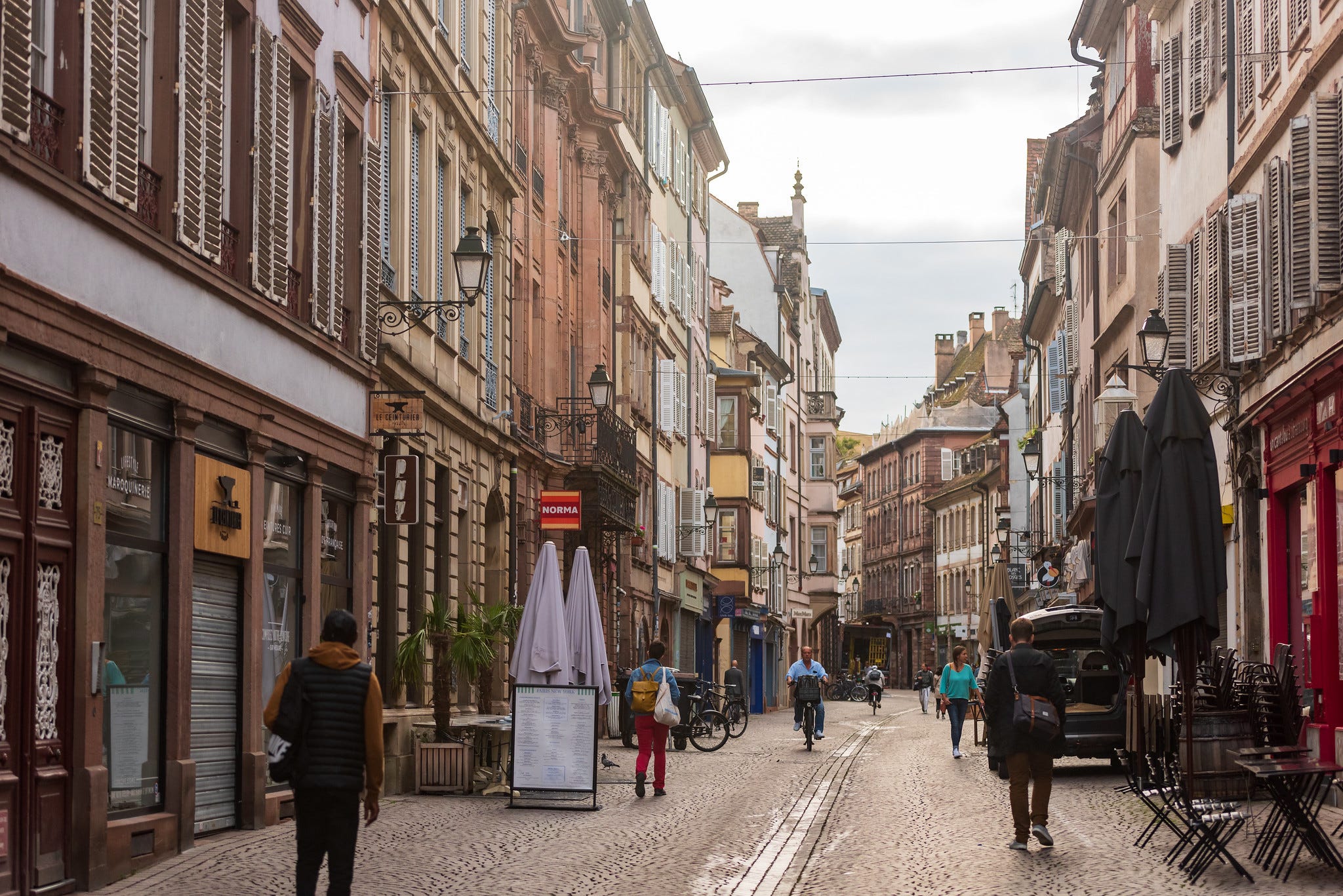
When I think about what makes a great place, there’s a memory I keep coming back to. A few summers ago, I was pushing my young daughter in a stroller through the streets of Strasbourg, France. We were on our way to a café, stopping to admire shop windows, watching trams glide by, and observing the steady rhythm of people moving through the city. She’d point out little things—a street performer, a dog lounging in the sun, an old building with an unusual shape. It was an ordinary day, but it was the kind of day that only happens in places designed for people.
Returning to America, I realized how rare this kind of experience is. For most parents, daily life revolves around the car. Mornings start with a commute through traffic. Every errand, every trip to the grocery store, every afternoon at the park requires loading kids into the backseat and navigating a sea of asphalt. A child’s world is often limited to what they can see through a car window rather than the richness of a neighborhood street.
I don’t think it has to be this way.
The places we build in America demand that we drive further and further, pulling us away from our communities. They rob us of the chance to enjoy beautiful streets, meet our neighbors, and support small businesses. But America is a land of opportunity, and right now, there is an enormous opportunity to build better places—places that put people first.
What’s Stopping Us from Building Better Places?
It’s not that we don’t know how to build great neighborhoods—we’ve done it before. We can see the demand in places all over the country. Home prices in walkable areas far outpace those in sprawling suburbs. And as car ownership becomes more expensive and our population ages, even more people will be looking for communities where they can meet their daily needs without driving.
We can even measure the benefits: pedestrian-friendly places are healthier, safer, and more economically resilient. So why aren’t we building more of them?
The problem isn’t a lack of knowledge. It’s that the modern development model is broken.
Our real estate industry doesn’t create neighborhoods—it mass-produces “units.” A collection of systems—zoning laws, real estate finance, bank lending, appraisals, and insurance—push us toward developments that don’t serve the people who live in them.
Zoning codes separate homes from shops, forcing people to drive for every errand.
Bank financing favors standardized, car-dependent projects over mixed-use, walkable developments.
Suburbs are marketed as affordable but quietly extract time, energy, and wealth through car dependency and never-ending infrastructure maintenance costs.
Over the past few months, I’ve been digging deeper into why we keep building the same broken places—why even well-intentioned developers struggle to create better alternatives. In order to fix something, we first have to understand what’s stopping us from doing things differently.
I Want to Build What’s Next
I’m starting Build Better Places because I want to do more than just talk about these issues—I want to build something different. My goal isn’t just to write about urbanism but to take real steps toward developing human-scale communities and creating a model that others can follow.
This blog is my way of documenting that process—of exploring the questions I don’t yet have answers to:
What does it actually take to finance and build places like this in today’s market?
Which cities and towns are changing their zoning to make this kind of development possible?
How do we make walkable communities affordable instead of an expensive niche product?
What kinds of buildings make economic sense in today’s real estate investment landscape?
There’s no shortage of content about what’s wrong with car dependency and suburban sprawl. What I don’t see enough of is how we fix it. This blog will be my attempt to work through those questions—not as a planner, not as an architect, but as someone who wants to actually build.
What to Expect
This will be a place for essays—thoughts and observations on real estate development, urban design, and the economics of creating better places. I’ll also share case studies, lessons from books I’m reading, and on-the-ground observations from cities that are getting it right.
I’m writing this for two kinds of people:
Investors and builders who want to be part of the solution.
Engaged urbanists who care about making their cities better and want to see how these ideas can actually take shape.
I don’t have all the answers. But I do have a goal: to move from theory to practice—to go from someone should do this to I will build this.
If that’s something you’re interested in, stick around. Let’s build better places—one step at a time.
Comments
Nothing yet. Say the first thing.
Sign in to join the conversation.