
My goal was to rework the system to remove traditional attributes entirely and focus on abstract, player-defined skills that inherently absorb the "essence" of attributes through narrative roleplay.
One of the things I’ve been doing over the past few years is working on my own game. Who isn’t though? I think that’s one of the great joys of this community, all the unique systems that arise from so many different creators, from all corners, nooks and crannies, scratching itches you never knew you had let alone wanted.
The mechanics that I’ve been sharing here are part of a larger system that I’ve been developing for my game, The Gray Hollow, which was well on its way to being finished about a year and half a ago.
I’m always in a hurry to get projects done due to my ADHD. When the dopamine wears off I’ve gotta wait till I cycle back to that project again, that can take a bit of time. I’d rather it not be that way, but what else can I do but embrace what is? Pushing back against the winds of change doesn’t really do any good. Forward is the only direction we can go, backwards isn’t an option, even though it might feel like we’re moving that way sometimes.
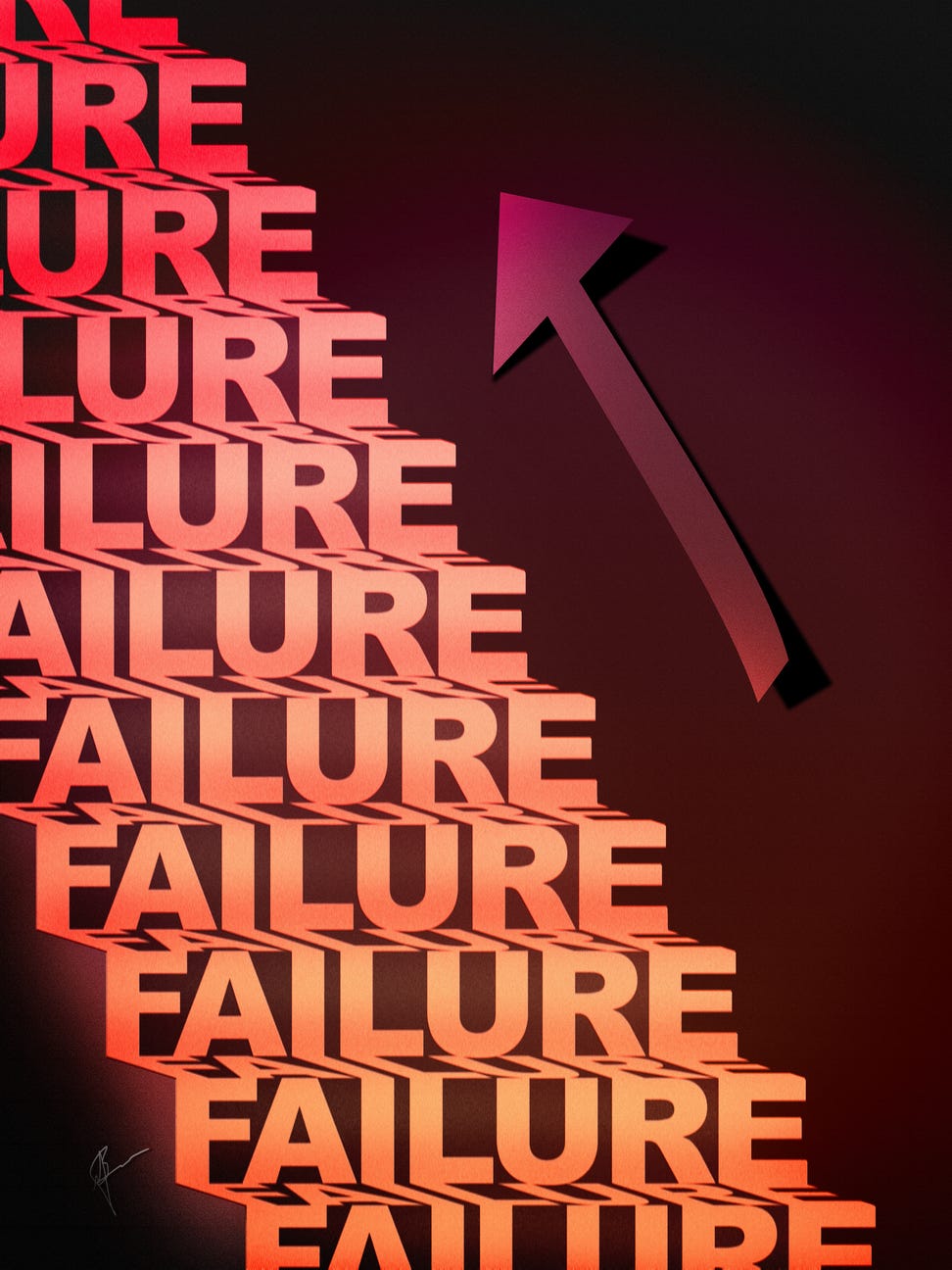
All movement is forward motion, regardless of our perception and ideas about success and failure. Gray Hollow is a good example of this being true. When it started out, the mechanics were over detailed, overly complicated and I was really filling in every little detail I could. My vision was one of those 300 page rule books that covered all these minute details and ‘cool mechanics’ that I was coming up with…
Sometimes our blessings aren’t so obvious. If I had rushed the original idea out the door, I don’t think I’d be quite as happy with it now. As they say, ‘I wish I knew then, what I know now’.
Today I’m focused on creating light weight system and holds the door open for players to dig deeper, but doesn’t force it. Something that honestly suits my own needs and functions to solve some of my personal complaints; the major one is that most checks and results are generally far too random for my liking. The other being that attributes, as they are traditionally used don’t really mimic reality the way we think they do.
Life isn’t random chaos—it follows patterns. Bell curve mechanics (like rolling 2d6 or 3d6) reflect this by making expected outcomes more likely and extremes rare. When you roll 2d6, there’s a 45% chance of landing near the average (6–8), while a 3d6 roll clusters 48% of results around 9–12. This isn’t just math—it’s how reality works. Most attempts fall in a "reasonable" range, while wild successes or disasters are outliers.
Traditional attributes (like Strength or Dexterity) try to simulate realism by applying flat bonuses, but they’re a blunt tool. A +2 modifier doesn’t account for the natural ebb and flow of skill. Bell curves automatically handle this: your "average" performance is the default, and outliers—like crits or fumbles—are baked into the dice physics. No need for arbitrary stat penalties when the dice already model real-world probability.
For example, imagine picking a lock:
With attributes: You roll 1d20 + Dexterity. A fluke roll of 20 succeeds even if you’re untrained; a 1 fails catastrophically despite being an expert. Unrealistic.
With bell curves: Rolling 3d6 + skill bonus means your training (not luck) dictates success. A master (+3 bonus) will reliably hit moderate DCs, while a novice might occasionally get lucky—but rarely enough to break immersion.
Bell curves also let you tier outcomes. A roll of 10 on 3d6 might mean you pick the lock cleanly, while a 13 gets you in silently. No need for clunky "skill ranks"—the dice naturally create gradients.
Bell curves demand trust in the math. Players used to d20’s swingy drama might miss the "gambling" tension, but what you lose in chaos, you gain in verisimilitude. When your sword swing lands exactly as often as a real fighter’s would, the world feels alive.
In short: Bell curves don’t just replace attributes—they outclass them, weaving realism into the dice so you can focus on the story.
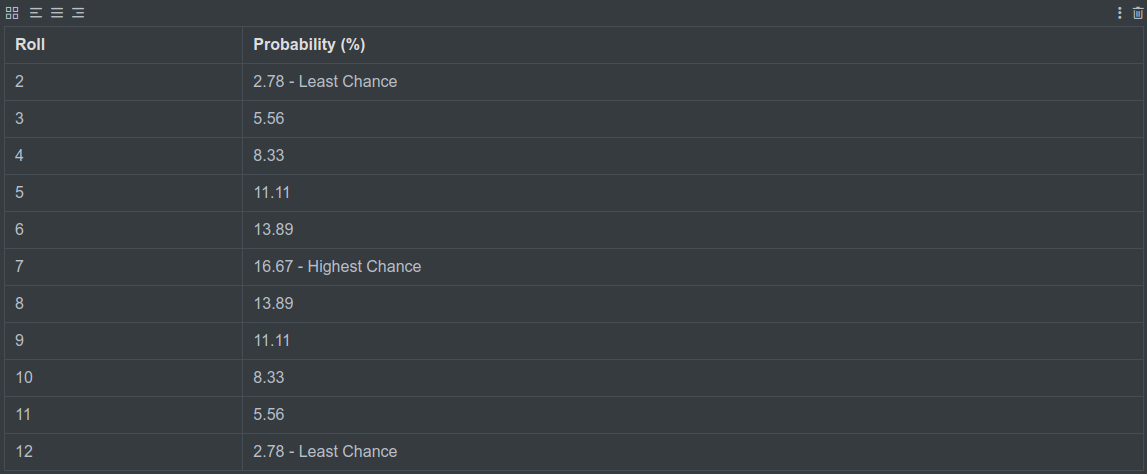
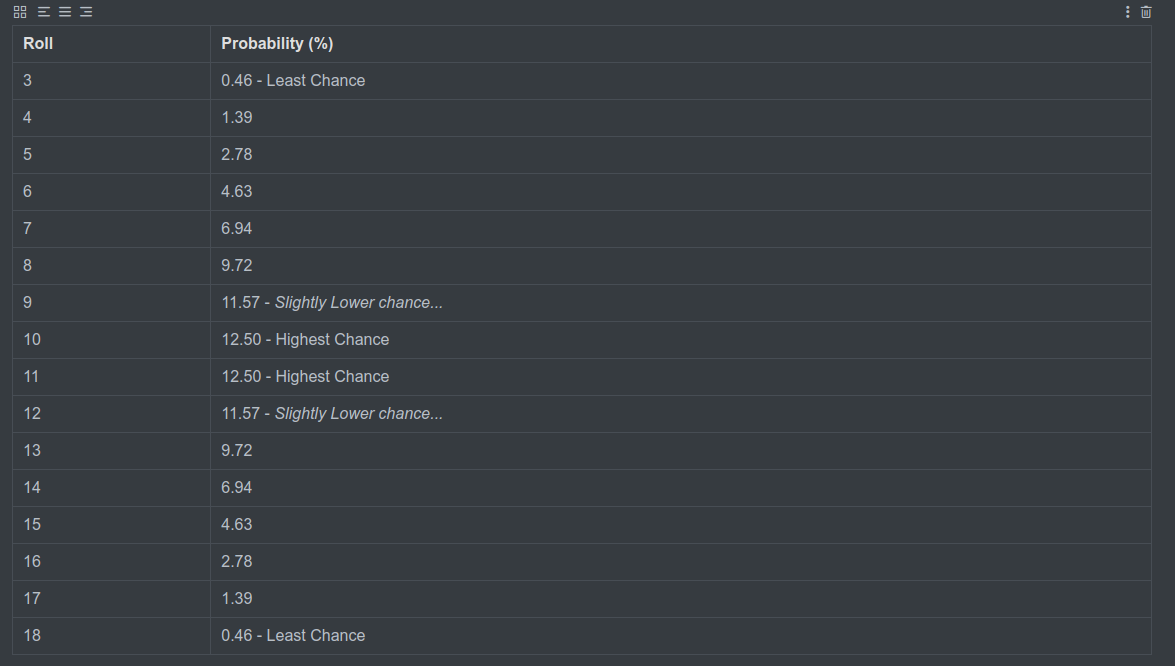
The extra die in a 3d6 roll expands your range of possible outcomes dramatically - 16 distinct results compared to 2d6's 11. This creates a finely-tuned spectrum of success and failure, perfect for modeling nuanced situations. Think of it like a precision instrument: where 2d6 gives you basic volume control (quiet/loud), 3d6 provides studio-grade faders letting you adjust in 1dB increments. Alternatively, imagine 2d6 as a simple thermostat (hot/cold) while 3d6 offers exact temperature control where every degree matters. This granularity lets you dial in exactly the right amount of tension, challenge, or reward for any scenario.
(Centered around 10–11, the peak probability)
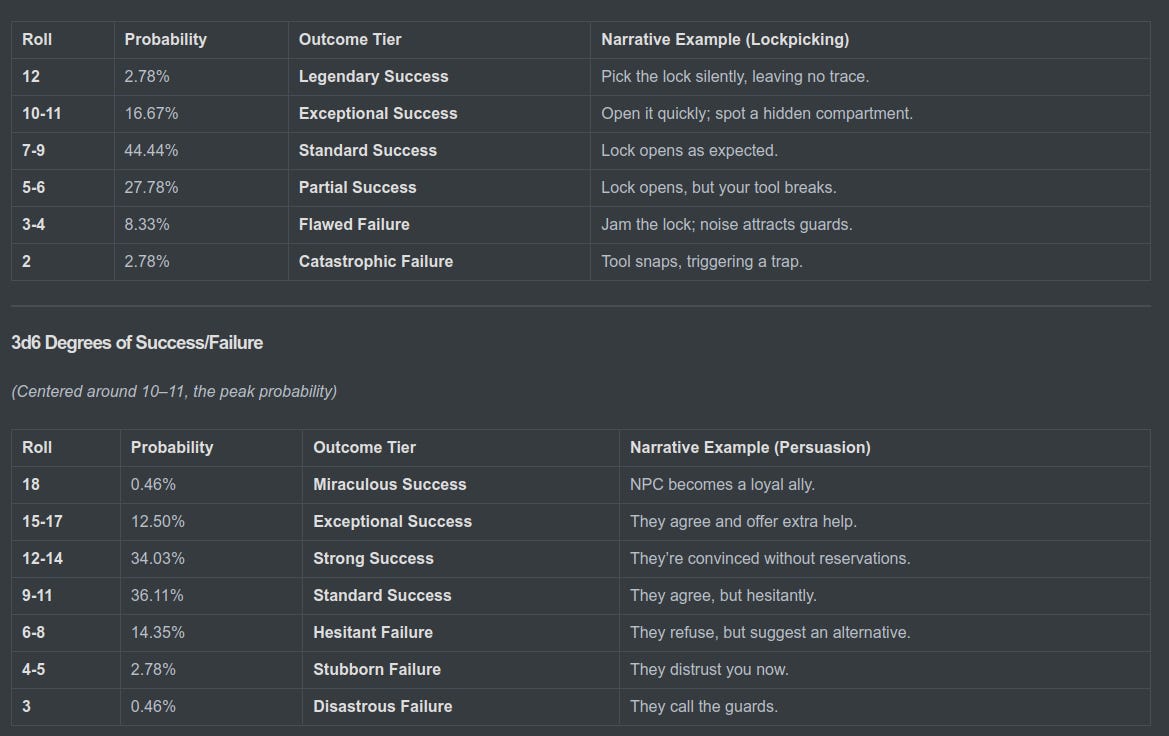
Let’s say your character is negotiating with a merchant while hungry and in a hurry. Here’s how you’d use the tables.
You (or the GM) decide the baseline difficulty based on circumstances. For example, the Merchant’s Mood: Neutral (+0) → Base DC 10. This value is within the standard 3d6 'success' range. But let's say your are (modifiers incoming), Hungry: -1, so your also feeling rather impatient and Rushed: -1 (no time to haggle). But you know the merchant, having done some work for them in the past, Good Reputation: +2 (merchant likes you).
That makes the Final DC: 10 -1 -1 +2 = DC 10 back to neutral.
Please not that the DC can also just be created on the fly, based on a number from -5 to +5 on the fly instead of doing the math if you like. Either method works well. I call these my "Quick but Risky" and my "Analytical" approaches. Sometimes I want to work out the details, other times I just want to get the boring parts over a bit faster.
Your "Silver-Tongued Haggling" skill is Novice (+2).
Roll 3d6 + 2 → You get 4, 5, 6 = 15 + 2 = 17.
**See Abstract Skill And Attribute Resolution System Below.
Start with Context: Adjust the DC up/down based on the situation. Roll + Skill Tier: Add your skill bonus to the dice. Match to the Table: The result gives how well you succeeded/failed.
Base DC: 8 (2d6, "Simple" task).
Modifiers:
Darkness: +2 (harder to see).
Masterwork Tools: +3.
Final DC: 8 + 2 - 3 = DC 7.
Roll 2d6 + 2 (Master skill) → 3 + 4 + 2 = 9.
9 = Standard Success: Lock opens, but it took longer than expected.
What if your character’s "strength" wasn’t just a number, but the way they shatter a tavern door with a shoulder charge—or fail hilariously, splintering the bench instead? Abstract attributes toss rigid stats out the window and replace them with narrative fluidity. Instead of tracking Dexterity or Charisma, you define your character through how they act and what they’re good at. Skills like "Back-Alley Brawling" or "Royal Court Flattery" absorb the essence of traditional attributes, letting you roleplay a "fast" or "clever" character without being shackled to modifiers. The rules become a loom, and you weave the tapestry.
But why ditch concrete attributes? Bell curves already handle realism—your 3d6 roll clusters around likely outcomes, so why double-dip with arbitrary stat penalties? Abstract skills cut the cruft, rewarding creativity. Picture this: Two player characters try to cross a ravine. One uses "Acrobatic Daredevilry" (fast 2d6 roll), the other "Calculated Pathfinding" (careful 3d6). Both might have +2 bonuses, but their approach and story—not a Dexterity score—dictate success. Attributes become flavor, not math.
Of course, abstraction isn’t for everyone. Power gamers might squirm without precise optimization levers. Some players crave the crunch of stacking +1s, and abstract systems demand trust in collective storytelling. Without guardrails, a skill like "Doing Cool Stuff" could strain credibility (though a good table polices itself). And GMs must think on their feet—balancing DCs for "Improvised Fireball Juggling" requires finesse.
Yet the payoff? Characters that feel alive. No more "I rolled a 17 Perception" but "My ‘Paranoid Scout’ instincts ping—something’s off." It’s less "What’s your Strength?" and more "How does your rage fuel your ‘Goblin-Tossing’ skill?" The dice still keep things fair, but the story takes center stage. So—ready to trade spreadsheets for spontaneity?
I’ve reworked many of my mechanics for Gray Hollow to work in just this way. My goal was to rework the system to remove traditional attributes entirely and focus on abstract, player-defined skills that inherently absorb the "essence" of attributes through narrative roleplay.
I’m pretty sure I’ve done that, and here’s a taste of how it works.
No fixed attributes or skills: Players define their character’s traits through how they act, not predefined stats. Skills = Narrative Identity: Skills are invented by the player, for example, "Cat Burglary," or "Barroom Diplomacy", and this skills reflect a character’s story. Bell Curves + Tiered Bonuses: Mechanics focus on how you attempt something (fast vs. careful) and your skill mastery.
The player knows their character is fast, or maybe their slow, so when rolling the dice, success or not, the action is roleplayed in such a way that their attribute is is on display like a painting.
The idea is that you cannot truly define a character by their skills and attributes; Just because someone has a high physical strength doesn’t mean they can endure more than someone who is physically weaker. We are each unique in that some of us are built to handle one thing of another regardless of physical prowess. This is often seen and expressed in the moment and sometimes to the surprise of the individual.
Players invent skills on the fly, giving them names that reflect their character’s unique flair and approach to challenges. Imagine a rogue who doesn’t just have "Stealth" but "Shadow Stalking"—a blend of silent movement, urban intuition, and the uncanny ability to vanish into a crowd, all roleplayed through whispered descriptions or dramatic gestures. Or picture a grizzled diplomat wielding "Ironclad Negotiation", where raw charisma meets unshakable resolve, whether they’re haggling with a merchant or staring down a warlord. Even a tinkerer’s craft isn’t just "Engineering" but "Clockwork Tinkering", where every gear turned is an act of meticulous precision and wild creativity—maybe they hum while working, or talk to their tools like old friends.
These skills aren’t just mechanics; they’re story prompts. Naming them dynamically ("Dragon-Scaring Braggadocio," "Graveyard Whispers," "Last-Chance Gambits") invites players to flesh out how their character works, not just what they can do. The system doesn’t limit you to a preset list—it asks, "What’s your signature move?" and lets you hone it into mastery. Want to be a "Honey-Tongued Liar" or a "Stormborn Swashbuckler"? Write the title, then live it out.
Your skills improve through practice and perseverance. Every time you successfully use a skill (e.g., lockpicking, persuasion), you roll a d4 to see how much XP you earn. As you accumulate XP, you unlock mini-goals and eventually advance to higher tiers of mastery.
However, we've not really even looked at or talked about what skills exist. We don't really need too. Skills are dynamic and abstract ideas that you can apply as needed. Clearly, I enjoy lock picking, you may not, so you can leave that off the list if you like and add whatever relevant skills make sense for you. Use more common ones like climbing, spell casting, swimming, or create your own. I personally think character development is quite personal and should be flexible so that it suits the needs of the player.
Earn XP after succeeding at a skill-based task, roll a d4 and add the result to your skill’s XP pool. You pick a lock and it opens, roll a d4 and add result as XP for your Lockpicking skill. Read a book about Lockpicking, roll a d4 and add the result as XP. Does it get any easier than that? I'm sure it does, but this works quite well.
Advance Tiers:
Reach XP thresholds to unlock tiers (Beginner, Novice, Master).
Each tier grants a +1 bonus to relevant rolls (max +3 at Master).
Please note that I chose those values based what I think feels comfortable without being too long term. I mean it basically happens in the background, and takes around 13 to about 20 successful attempts to reach the first goal. Not very realistic for some skills, right in line for others. Clearly something like mastering swordsmanship would take quite a bit longer, but, no one’s looking if that's what you want to do. You can of course start out as a master if you want too, no one is stopping you from playing your ideal character from the start. But if building that over time is more your thing, then feel free to set higher values, and more level variation.
Start: 0 XP.
First Success: Roll a d4 → 3 XP. Total: 3/50 XP.
Fifth Success: Roll a 4 → 19 XP. Total: 19/50 XP.
14th Success: Hit 52 XP → Unlock Beginner Tier (+1 bonus).
Grind On: Earn 125 XP for Novice Tier (+2 bonus), then 200 XP for Master Tier (+3).
Not to encourage grinding, in fact I advise against such tactics. They are rather pointless for this type of play don't you think? Just set your desired starting goal if that's your plan. Unless you like that sort of thing, then by all means go about your way!
Every task can be attempted in two ways, defined by how you do it—not by preset attributes. Pick one:
Narrative Flavor, Bold/Instinctive 2d6 Fast, risky, and flashy. "I vault across the chasm!" Careful/Methodical 3d6 Slow, precise, and strategic. "I test each brick for loose holds."
No Attributes Needed: Your character’s "strength" or "intelligence" is implied by how they act. A "fast" character might always choose Bold moves, while a "clever" or less capable one leans Careful. Of course there are always time when even a bold character should act carefully.
For more complex tasks (e.g., crafting, diplomacy) use steps to reflect gradual progress:
Steps Required: Simple (1 step), Hard (2 steps), Extreme (3 steps).
Success Threshold: Complete 75% of steps (round up). A Hard task needs 2/2 successes.
Optional - Fatigue: After each attempt, take -1 cumulative penalty (resets after rest).
Example: Picking a high-security lock (Hard):
Roll 3d6 + Skill Tier twice. Succeed on both? Lock opens silently. One success? It jams halfway. Or you can also use the
Examples
Perfect Tools +3 Masterwork lockpicks, a detailed map. Improvising -2 Using a hairpin, bluffing with no prep .Advantage Roll 3d6, keep highest 2 (2d6) / 4d6 keep highest 3 (3d6)."I have the high ground!"
Disadvantage Roll 3d6, keep lowest 2 (2d6) / 4d6 keep lowest 3 (3d6)."I’m blinded by smoke!"
2d6:
Critical Success: Double 6s. "You pick the lock and find a secret compartment!"
Critical Failure: Double 1s. "Your tool snaps, triggering an alarm."
3d6:
Critical Success: Three-of-a-kind (e.g., three 4s). "Your speech unites rival factions!"
Critical Failure: All 1s or a descending sequence (3-2-1). "Your plan backfires spectacularly."
Approach:
Bold: 2d6 + "Silver-Tongued Haggling" (Novice +2).
Careful: 3d6 + "Diplomatic Etiquette" (Master +3).
Modifiers:
Guard is stressed (-1), but you’re well-dressed (+1). Net +0.
Roll:
Bold: 2d6 → 3 + 4 + 2 = 9 → Standard Success. "He lets you pass but warns you to hurry."
Use these to tweak DCs based on context, but keep it quick:
Time of Day: Midnight? +2 to stealth.
Weather: Blizzard? -3 to travel.
Reputation: Feared? +1 to intimidate.
Stacking Limit: ±5 total to avoid overload.






The goal is to just become aware of all that's happening around you at any given moment, then decide the likeliness of success or failure then give a value from 0 to 5 and add or subtract that value accordingly. But if you want to break it down, bit by bit...
And that’s it for this week. It’s getting to be publishing time, and I think I’ve covered enough for now. So, tell me, what you think about an attribute-less system? Let me know in the comments.
Appreciate you all, Happy Mothers Day, please take care of yourselves, and keep an out for others. We’ve only got one another. See you all next week!
No posts
Comments
Nothing yet. Say the first thing.
Sign in to join the conversation.