
The door at the end of the hall is slightly ajar, a warm, golden light spilling out from within. A sign hangs crookedly on the door, its letters etched in elegant script: “Welcome, please come in…” I push the door open, and the room beyond is unlike anything I’ve ever seen.
Shelves line the walls, crammed with curiosities that defy explanation. One shelf holds rows of dark glass jars, each labeled with words like “The Innocent,” “The Rebel,” and “The Sage.” Another shelf is cluttered with body parts—hands, arms, even heads—arranged with a strange kind of care. Before I can take it all in, an older man with wild silver hair and a pair of spectacles perched precariously on his nose hurries over and begined ushering me towards were others have already been seated.
Others are already here, seated in mismatched chairs arranged in a loose circle. Some are familiar faces, others strangers, but all of them share the same look of quiet anticipation.
‘Welcome to the Workshop of Whispers, where personalities are crafted and emotions are bottled like fine wine. The older man claps his hands, drawing everyone’s attention. “Welcome, everyone. Tonight, we’ll be exploring the mechanics of personality, emotion, and morale. How they shape our stories, our characters, and even ourselves. So, let’s begin…”
Welcome back everyone, I hope you are all doing amazing. If not, don’t give up hope just yet. This is a new week with new opporunities. Yes, yet another set of mechanics; at least that’s the norm around Spring time. Happy Spring Equinox if that’s what’s happening in your neck of the woods.
…and since I’ve got nothing else to say, let’s get on it with shall we?
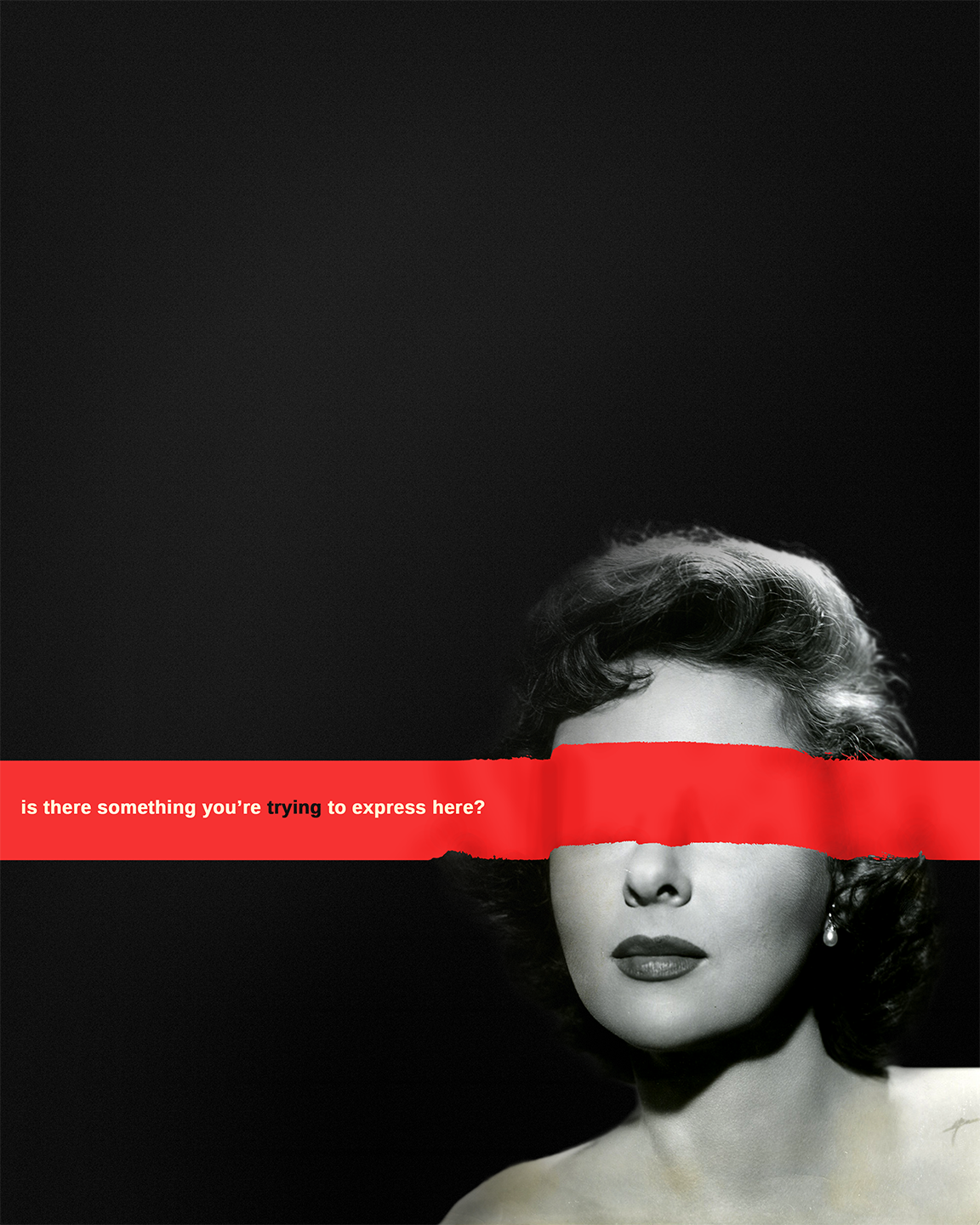
What is a personality? The word "personality" comes from the Latin word "persona," which originally referred to the masks worn by actors in ancient Greek and Roman theater. These masks were used to amplify the actor’s voice giving to the theory that the word persona may derive from per (through) and sonare (to sound), meaning "to sound through". But I'm more interested in the their role in representation of different characters or roles in a play, allowing one actor to play multiple parts.
Over time, the meaning of persona expanded beyond theater to describe the social roles people play in everyday life. This idea was further developed in psychology and philosophy, where "personality" came to mean the unique set of traits, behaviors, and patterns that define an individuals personality. The key here is to hold onto the idea that the personality is a role that is being played out.
Carl Jung, a pioneer in psychology, used the concept of persona to describe the social mask we wear to fit into society. He also explored the idea of archetypes—universal patterns of behavior and personality that appear across cultures and time. These archetypes (the Hero, the Caregiver, the Rebel) are deeply rooted in the human psyche and influence how we perceive ourselves and others.
And they can be just as useful for whipping up a personality for someone you just met at the tavern. When they walked in, they entered with purpose, scouted the scattered drunken faces and then saw you. There was no wander in their step, they had intentions on coming to speak with you. But for what?
No idea, but I can tell you all about their personality.
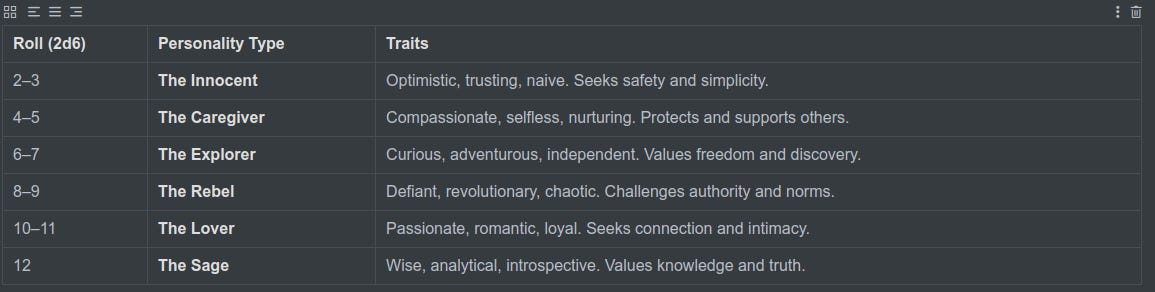
Using 2d6 to roll for the NPC’s core personality type is the first step. Here I've mapped the results to Jungian archetypes, you can of course use whatever you prefer, but I find these work quite well and are recognizable in real life.
Below is the table I've been using, but first a note about human contact.
I don't know about you, but there is often something visceral about meeting someone for the first time. You may not know it, but the majority of communication is non-verbal, and we tend to get a feel for someone upon first seeing them. These can often be based on personal experience and personal stereotyping. But if we put that aside we can gather a general sense of who they are, whether we feel comfortable around them or suspicious.
Everyone rings a different tone on your inner bell,, even if that person is fictional. So awlays let your inner dice rolls speak louder than your outer ones.
Optional Rule: Let's find out which way the scales are tilting; do they fall into the negative side, positive side, or someplace in between? Using a single D6(6 sided die) gives is a simple way of finding out if The Innocent personality is someone who might readily share resources or information, believing you have good intentions. Or The Innocent might refuse to believe that a beloved leader could be corrupt, even when presented with evidence and they might avoid confronting a problem or making tough decisions, hoping it will resolve itself. Roll a d6 and on a 1-3 they swing toward the Negative. On a 4 they are Neutral and on a 5 or 6, they fall toward the Positive side. You could say that 3,4,5 are averages, while 1 and 6 are to the extreme.
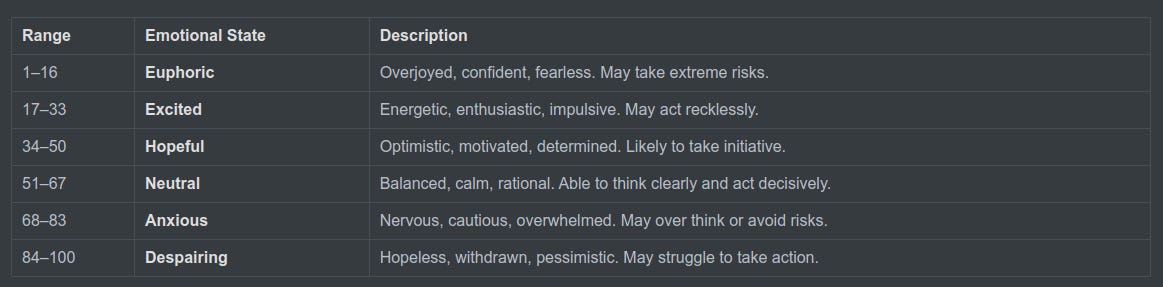
Here I use a selection of emotional states and assign them into ranges on a 1–100 scale. To make it easier to roll, we’ll break the scale into six ranges, each corresponding to a specific emotional state. Upon first meeting someone it's clear how just things are going for them based on their current emotional state. For example someone who is Anxious might have something to hide, have some bad news, or they are here to take your life. While someone who is hopeful likely has good news, new information for you regarding those artifacts you recently brought in, or may be in such a good mood that you might try and persuade them about the offer they refused earlier.
As a rule of thumb, the initial roll is typically to find the Base Emotional State for a given character. Once this initial base is established, feel free to roll for tests using the Optional Rule below.
Optional Rule: If you already expect a certain emotional state and simply want to test it, you can use a d100 and determine in your mind, what are the chances of a given Emotional State based on the current circumstances.
For example, lets say you you've just returned with the Tome of Alhazred the Mad Monk, but you are 10 days late. You know from previous conversations with your client that they are prone to being Anxious, therefore over think things. It's likely they figured you for dead and already sent someone in your place, that's gonna cost you, but not likely going to result in anything too crazy.
Let's say there's a 40% chance of them being Anxious, so roll a d100 and anything under 40 results in an Anxious state. A result that is 40 or higher, likely means that are fine with you being late, or are simply too excited to receive the book to care.
However, you could add some spice to your rolls and say anything less then 10 and higher than 90 means you need to roll for a random Emotional State. You can of course take a guess and test the result by repeating this optional rule instead.
To add nuance within each emotional state, we can use a d6 to determine the severity. This can help you determine to what level the emotion is being felt which can determine a lot of details and answer a lot of questions for you on it's own. Feel free to tie this into the Base Emotional State or use simply use it to find the scale of both a base as well for any current states.
Once the emotional state is determined, roll a d6 to gauge the severity within that range:
1–2: Mild (slightly anxious or cautiously hopeful).
3–4: Moderate (noticeably anxious or actively hopeful).
5–6: Extreme (deeply anxious or intensely hopeful).
You roll a 92 on the d100, placing the NPC in the Despairing range (84–100).
You then roll a d6 to determine severity:
If you roll a 1–2, the NPC is mildly despairing (feeling down but still functional).
If you roll a 3–4, the NPC is moderately despairing (withdrawn and struggling to act).
If you roll a 5–6, the NPC is extremely despairing (hopeless and unable to function).
Tracking morale in a TTRPG can add a lot of depth and realism to your game, whether you're running a solo campaign or a group session. Morale represents the emotional and psychological state of characters (or even entire groups, like armies or factions), places and events, and it can influence behavior, decision-making, and effectiveness.
Further, it makes any experience more dynamic by tying into the natural and familiar feelings and emotional states we experience ourselves. You might also find yourselves working out personal issues by projecting them into a fictional world. It happens when you start to work in this way. A situation that resembles something personal comes up and instead of avoiding it, I suggest working it out in third person.
Looking in on the situation as if you are simply a witness and not directly involved; as if it's happening to someone else. What's fun about this idea is that we can change the outcome, giving us the strength to face it head on.
You might find it useful. But if it becomes too much, there's nothing wrong with putting of that quest for another day. Make small steps if you need to, but take a step. You're not alone, I'm doing it with you.
Tracking morale isn’t just about mechanics—it’s about storytelling. It helps you create richer, more immersible narratives and gives you new ways to engage with the world and their characters. Notable characters, not just your standard run of the mill NPC's. Whether you’re running a gritty war campaign, a lighthearted adventure, or a smash and bash dungeon crawl, morale can add a layer of emotional depth that makes your game unforgettable.
As seen above, when rolling to determine the strength of the emotion, there are modifiers that effect morale. However, those are meant to set the initial mental state of the NPC, or even a PC. There are mechanics in the morale system that can further modify this base state.
Remember, these rules should be flexible like your mind. Modify things like morale and emotional states as you feel they apply best to the story you are experiencing. When you don't know, then come ask the universe for suggestions by using these mechanics. Otherwise move with the natural flow that is already playing itself out and try harder not to direct the show.
Every character, NPC, group, or faction starts with a Base Morale of Neutral (0), which should be treated as common choice. This represents a balanced emotional state—neither particularly motivated nor demoralized. Morale represents the NPC’s overall outlook and resilience. Use a scale of say, 1–10 to track morale through events and interactions that will trigger movement along the scale, causing it to rise or fall.
In certain situations, a base case be set for a given location as well. For example a town overrun with corruption after local leadership went mad a few months ago. A town can have a morale just the same as any individual, faction or group. Same is true for caves, dungeons, forests, etc. Some places are certainly alive and full of their own effect on those that traverse such spaces don't you know? It's true, and any adventurer whose nose has taken them further then their front door knows this to be the case. Just being in such places can often effect morale by a point or two.
High Morale (7–10): The NPC is confident, cooperative, and proactive.
Neutral Morale (4–6): The NPC is balanced but may hesitate in risky situations.
Low Morale (1–3): The NPC is demoralized, uncooperative, or prone to giving up.
A 1–10 morale scale is a great way to provide a clear, at-a-glance reference for tracking morale. Each number on the scale can be paired with a descriptive term that reflects the emotional and psychological state of the character, group, or faction in a very specific way. Feel free to roll for a base Morale, or choose one as a default. Neutral should be treated as a common default.
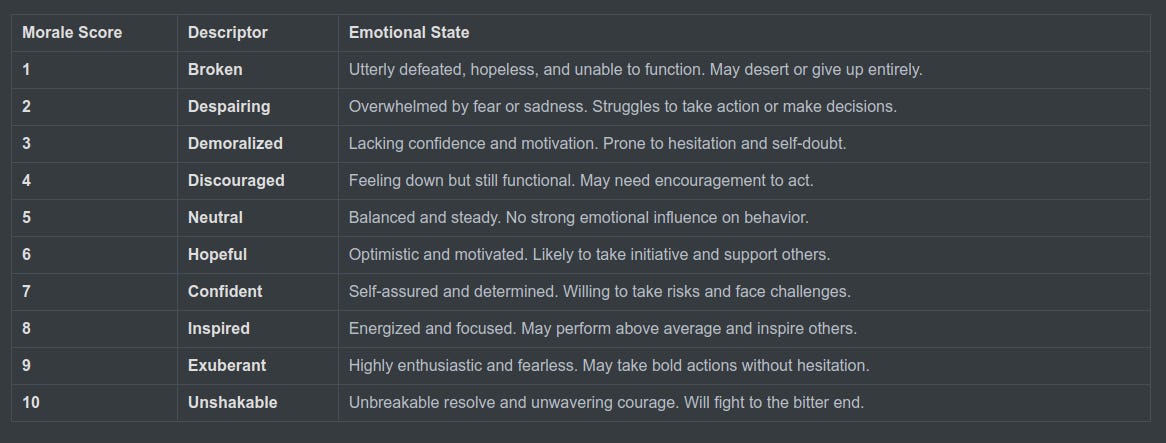
Events can shift morale up or down based on the intensity of the event. But we don't want to boost our morale over every little thing do we? That's a lot of tracking, and that's fine if there is a sensitive role being played and your up to tracking that amount of data. No doubt there is one among you that likes to include as much detail as possible. I love to do that also, until it becomes more like work... Which doesn't take long for me. I admire those of you capable of such a feat, however.
I suggest tracking anything you feel is significant.
You may also find that there is a base morale, or emotional state that a given character finds themselves falling back towards by default. It's not impossible nor unheard of for some peoples default state to be at a particular point on the scale the majority of the time, even in to the extreme. And even at default extremes there is flexibility where the base can shift both temporally and permanently.
Use the following categories to feed any given event in, then modify the current moral based on the Morale Modifier result.

Morale rolls back to it's default base point, wherever that may be, at a rate equivalent to the viscosity of the base state. For example, someone who's emotional base is Anxious and their morale default is Demoralized, they are likely to move back fairly quickly. Any given negative event might trigger them back to their negative thinking patterns. Where a character opposite of these bases (Excited, Inspired) would likely be more aware of the cause of what pains them and be less likely to fall into the traps of lower states.
Morale levels should influence behavior and performance don't you think? Not just of individuals, but of places as well; when certain special circumstances come into play of course. Further, all behavior is a form of communicating our current inner states. I think that's pretty obvious to most of us. People tend to act out negatively when they've got something crappy going on inside.
Here’s a simple way to represent the effects morale has on our mental and our physical selves:

There's an endless way to work morale into a situation and I cannot cover them all. If something feels like it effects morale in a certain way, move it accordingly. You don't always have to check back here with me, just go for it. Always pay attention to what feels right.
Recovery can occur in a variety of ways. Meditation, positive events, changing thinking, rest, even the passage of time can gradually restore morale. For example, a night of celebration after a victory might grant a +1 morale boost. Or morale might really flexible and only last an day or as little as an hour or two.
The personality might be The Sage and morale might be more foreign to such a character. Let's say in these cases, they are more stoic in nature and therefore more likely to have a higher base morale that they are naturally drawn back to over a given a mount of time or hardly shaken from to begin with. Again, extremes on both ends of the scale are possible perspectives.
Decline in morale Negative events or prolonged stress can erode morale. For example, being stranded in a dangerous wilderness might cause a -1 morale penalty each day. Prolonged periods of rain, snow, or generally bad weather might effect morale as well, however, I'd suggest a maximum value, for example, -2, to keep it balanced.
To add more depth, you can introduce thresholds that trigger specific behaviors or events.
For Critically Low Morale the character or group might desert or freeze up altogether. They may began to develop mental issues due to stress and erratic thinking. With a Critically High Morale the character or group might perform extraordinary feats, feel inspired, and gain advantages. They might also get a big ego and take things too far.
Personality: The NPC is a Rebel, so they’re naturally defiant and chaotic. They might challenge authority or push back against the party’s plans.
Emotional State: They’re currently Despairing, so they’re withdrawn and pessimistic. They might struggle to take action or express hopelessness about the situation.
Morale: With neutral morale, they’re not actively working against the party but aren’t particularly motivated to help either.
As the game progresses, the NPC’s emotional state and morale can shift based on events:
If the party succeeds in a major quest, the NPC’s morale might increase, and their emotional state could shift to Hopeful.
If the party fails or makes a poor decision, the NPC’s morale might drop, and their emotional state could worsen to Anxious or Despairing.
Assign specific emotional triggers to each personality type. For example:
The Rebel: Triggers include being challenged, witnessing injustice, or feeling controlled.
The Caregiver: Triggers include seeing others in pain, being thanked, or feeling needed.
When a trigger occurs, roll to see if the NPC’s emotional state changes.
Roll: You roll 2d6 and get a 7. The NPC’s personality is The Explorer (Curious, adventurous, independent. Values freedom and discovery).
Roll: You roll d100 and get a 42. The NPC’s emotional state is Hopeful (Optimistic, motivated, determined. Likely to take initiative). Severity Roll: You roll a d6 and get a 4. The NPC is moderately hopeful (actively seeking opportunities and looking forward to the future).
Roll: You roll 1d10 and get a 7. The NPC’s morale is Confident (Self-assured and determined. Willing to take risks and face challenges).
Name: Kael
Appearance: A wiry, sun-tanned elf with a satchel full of maps and a curious glint in his eye.
Personality: Kael is an Explorer, driven by a thirst for discovery and a love of the unknown. He’s independent and values freedom above all else.
Emotional State: Kael is moderately hopeful, excited about a recent discovery and eager to share it with others. Morale: Kael is Confident, ready to take on challenges and inspire those around him.
The party meets Kael in a bustling port city. He’s poring over a map and muttering to himself about a “lost temple” hidden in the nearby mountains. Kael approaches the party, his eyes lighting up as he explains his discovery. He’s hopeful and confident, believing the party can help him uncover the temple’s secrets.
Dynamic Reactions:
Positive Event: If the party agrees to help, Kael’s morale might increase to Inspired (8), making him even more enthusiastic and cooperative.
Negative Event: If the party dismisses his discovery, Kael’s morale might drop to Hopeful (6), and his emotional state could shift to Neutral (51–67) as he becomes more reserved.
Trigger: Kael’s Explorer personality is triggered by the promise of discovery or the thrill of adventure.
Example: If the party mentions a hidden artifact, Kael’s emotional state might shift to Excited (17–33), and he becomes more impulsive and eager to act.
Situation: The party is debating whether to explore the lost temple or pursue another quest.
Kael’s Reaction: Kael, being Confident and Hopeful, tries to persuade the party to join him, emphasizing the temple’s potential rewards.
Outcome: If the party agrees, Kael’s morale increases, and he becomes a valuable ally. If they refuse, Kael’s morale drops, and he might set off on his own, creating a rival or future complication.
And that’s it for this week. I hope you find that this enhances your roleplaying experiences in some way. Not so sure I’m going to continue with the mechanics next, week, but we’ll see what happens. I’ve got tons more, but you know… gets kinda redundant after while. I am, however, nearly ready to release the Alchemy Mechanic I’ve been working on, so we’ll see. Until then, and as always I appreciate you all, please take care of yourselves and one another. We’re all we’ve got. See you next week, same place, same time…
Thanks for reading Solo Roleplaying Buddha! This post is public so feel free to share it.
No posts
Comments
Nothing yet. Say the first thing.
Sign in to join the conversation.