
"Months ago, you dreamed of a woman in a field of black flowers. She handed you a black rose pedal and said, ‘Find me....’ You woke with your hands clenched—and inside your fist, a single petal. It’s still in your pocket, isn’t it?"
…months pass.
The air is thick down here. Thick with dust, with the weight of centuries pressing down on your shoulders. You lost count of the days long ago, when the torchlight became your only sun and the whispers of the crypt your only company. You’ve eaten things you don’t like to think about. Drunk stale water from cracks in the stone. And still, you wandered.
Because something calls you, from withing the dream, from within this place..
Not with a voice, not with a sound—just a pull, deep in your bones, like a hook behind your ribs dragging you forward. And now, as you round the final crumbling pillar, your flickering torch reveals the truth of it.
The chamber yawns before you, a vast hollowed-out throat of stone. The ceiling is lost in shadow, the walls smooth as if worn down by countless breaths. And in the center of it all—
She waits.
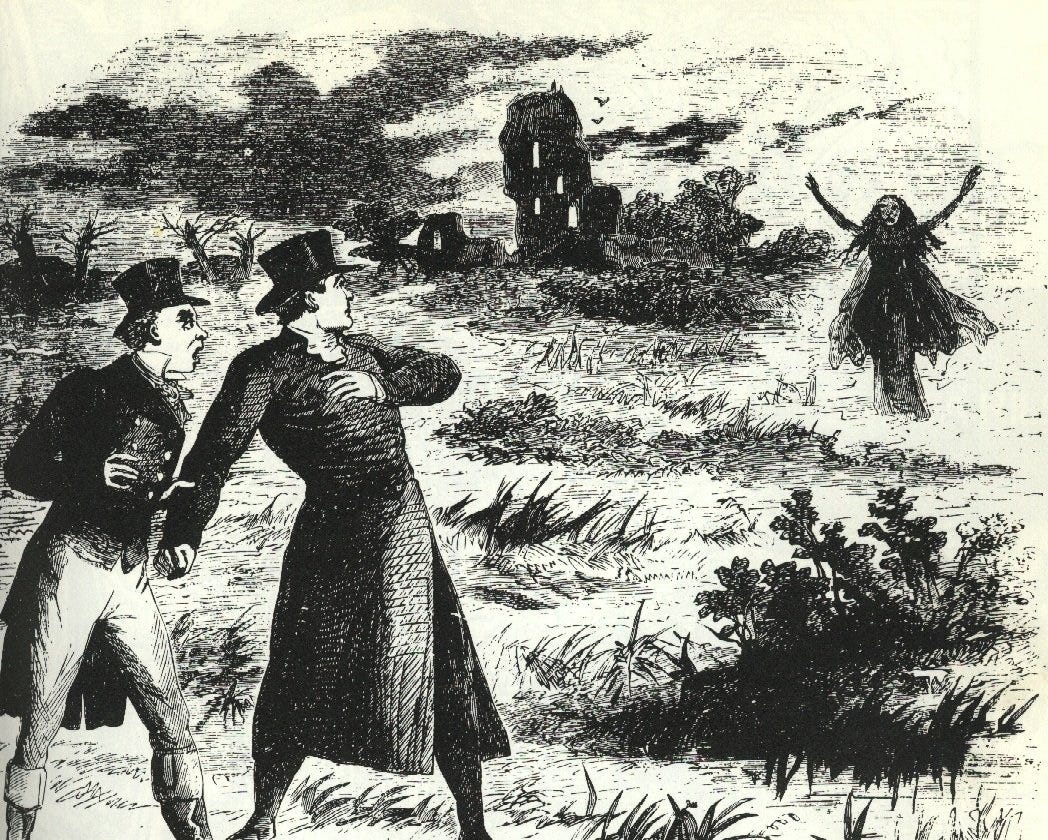
The banshee does not stir as you step forward. She is seated, her skeletal fingers draped over the arms of a throne that might once have been grand, now little more than a jagged mound of rock and tarnished silver. Her robes are the color of forgotten graves, threadbare and whispering against the floor. Her face—
You don’t want to look at her face… But you do.
Hollow eyes, deeper than the crypt itself, stare through you. Her lips are parted, not in a scream, but in something worse… silence. A silence that has been waiting, for you.
A week? A month? However long you’ve been stumbling through the dark, she has been here. Patient. Knowing.
And now, at last, you have arrived.
This week, we’re focusing mainly on mechanics from a design perspective. No doubt we could easily take these ideas and manufacture some mechanics to suit solitaire play, which of course is the goal overall. But for now, let’s look at things from the perspective of the creator rather than the one having the experience.
Imagine you’re stacking blocks. You start with 1 block. Then you add another 1 block. Now you have 2 blocks (1 + 1). Next, you add the last two piles together: 2 + 1 = 3 blocks. Then 3 + 2 = 5 blocks... and 3+5 = 8, 5+8 = 13… and so on. That’s the Fibonacci sequence: 1, 1, 2, 3, 5, 8, 13, 21...
Each number is the sum of the two before it.
You can find the Fibonacci sequence all over in nature. It acts like a secret code the universe can’t stop scribbling. Sunflowers spiral around, their seeds are Fibonacci ratios that effectively line them up, making the most out of the available space. Pinecones and artichokes twist their scales in Fibonacci spirals as well.
Even hurricanes and galaxies coil in these same fractal forms. Nature uses Fibonacci math to grow just enough, just right—no wasted space, no clumsy overlaps. We can then use those same steps to manage a Banshee’s dialogue tree that leans on Fibonacci weights. We’re borrowing the same ancient rhythm that shapes ferns and snail shells. Turns out, horror and flowers aren’t so different: both thrive on beautiful, inevitable patterns.
Game designers can use this cheat code to make choices feel organic. Want players to stumble on a secret boss only 8% of the time? Slap a Fibonacci "1" on it. Need common loot to drop often? Give it a "5" or "8." Even bees use it for family trees. So yeah, Fibonacci isn’t just math—it’s the universe’s way of whispering, "Here’s how to balance chaos and cool."
Weighted Dice Tables make rare outcomes actually rare (secret endings), Loot Drops common items drop often (weight 5), legendary items drop rarely (weight 1). Enemy Spawns, weak enemies (5), strong bosses (1). The example I'm presenting here is a short example adventure that uses a single d12 (twelve-sided die) and the following dialog tables. Normally the tables wouldn't be visible to the player, but here, I'm using them to show you how to manipulate how the player experiences the game based on their dice rolls.
And yes… lesser numbers weight more. I know that’s backwards, however, think of it this way. They have so much weight on them that they are being pressed down into a smaller size, making them hard to find.
And here is a bit of interesting information I’ve not yet explored, but you might want to. The variable being rolled by the dice does not have to be a number. It can be a list of predetermined (and weighted) choices. Those choices can be directions available for travel, actual choices about the current situation, or a single target to attack among a group; each one having their own ‘weight’, i.e. some are harder to kill then others.
There are, in my mind, countless things that can be done; but of course, I’m still sitting on the surface, so I don’t really know the depth of what’s possible yet. Other than some parlor tricks with weighted dice rolls.
The tables themselves don’t even need to be present in the final work, but they are great for working out the format of an adventure, or story you want to explore. Perfect for keeping track of everything and working out branching and the overall flow.
Also… I keep scrolling back up here to add more details as it comes at me from the void. But I think this is dynamic enough that you could use it on top of just about any existing system and create adventures that hide the rules under weighted mechanics; certainly there is a way to emulate particular rules using a series of bell curves and weighted rolls… don’t you think? Hide them inside a ‘choice’ and just provide the results as narration. Or maybe I’m just really high and looking at things from a perspective that’s not quite plausible under normal circumstances. We’ll see later I guess. Later as in, not this week.
..okay… going back down.
In the example below, there are hidden dialogs which lead to various outcomes, one that leads to death, which is the more common result. Feel free to play through it yourself, but everything is sort of revealed to you with my brief playthrough via a Second-person perspective. I'll break down each table and explain what is happening after each dialog result. Feel free to skip over the notes and come back to read them after the story to get feel for what’s happening.
(Roll a d12 for all tables—weights sum to 12 for clean probabilities.)
You stand before her… and pull out your trusty d12 from your pocket while she scrunches her eyes and tilts her head in curiosity. You roll it about her feet and…
You start to think you wish you didn’t loose your glasses when one of your few remaining torches went out the other day… night… whenever that was. Time is sort of melted together down here, and now you lost your only die…
No stress. I can see it just fine…

The moment the die lands on 9, the crypt’s whispers vanish. Not like a hush—like the air itself has been sucked out. The Banshee doesn’t move. Doesn’t blink. Its hollow eyes lock onto yours, and suddenly, you’re not being looked at—you’re being unwound.
It’s in your head now. A needle-thin coldness pricks your temples, slithering behind your eyes. Memories rise unbidden: your first fear, your last lie, that dream you swore you’d forget. The Banshee flips through them like pages, fingers of thought smudging the ink of your secrets. You try to clamp down—it’s private, it’s yours—but the silence presses harder, a weight against your ribs. Your breath comes shallow. Your pulse thrums in your ears, too loud, like it’s trying to fill the void.
Then—a flicker. The Banshee’s lips twitch. Not a smile. The way a grave might shift before something claws free.
"Ah," it mouths. No sound. Just the shape of a word you feel in your molars.
It knows.
Notes:
5-3-2-2 = Fibonacci sequence (5+3+2+2=12). "Silence" (9-10) is rare (16.6% chance). Hidden lore (11-12) is equally rare but unlocks backstory.
Effect: –1 to next roll
Vibe: The Banshee’s pissed. Time’s up.
Path: You’re on the Hostile Highway. That –1 is like a boot shoving you toward combat—next table, even if you roll halfway decent (say, a 4), the –1 knocks you down to a 3, making "The dead are hungry tonight" way likelier. Translation: grab your sword; you’re fighting corpses soon.
Effect: +0 (no mod).
Vibe: She’s toying with you, cat-and-mouse style. "
Path: The Creepy Middle Road. No mod means next rolls are pure chance. Maybe you talk your way out ("Your fear smells like rust…"), maybe she demands a scream. It’s a gamble—but at least you’re not sliding straight into a meat grinder.
Effect: +4 to next roll.
Vibe: She’s studying you. The quiet is worse than screaming.
Path: The Secret Detective Route. That +4 is a golden ticket. Next table, even if you roll a 1, the +4 rockets you to a 5—likely unlocking "You don’t remember me?" or "Show me the petal." This is where lore bombs drop… if you survive the staring contest.
Effect: +2 to next roll.
Vibe: Ominous foreshadowing. Who’s "she"? Uh-oh.
Path: The Mystery Unfolds Lane. +2 isn’t as wild as +4, but it nudges you toward "Your heartbeat is loud" or "They told me you’d come back." Less "instant death," more "slow-burn dread."
Rolls like 1-5 (–1) or 9-10 (+4) force the story down specific tunnels. It’s not "random"—it’s weighted fate. That +4 feels like winning the lottery… until you realize the Banshee’s "gift" is showing you how you’ll die. If you rolled 9-10 earlier, that petal in your pocket will matter. The modifications make sure of it by forcing the reader, the player down certain rabbit holes. Low rolls shovel you toward combat; high rolls crack open secrets. Mods are a way to push the player down certain paths only if they've already opened the door the leads to them. Such as our current, path of Silence.
Silence can feel dangerous and lots of people don’t want to sit in silence because the mind starts to bring up crap we don’t want to take a look at, so we avoid it. There’s nothing wrong with taking a good look at those things that swell up when you sit with yourself. It’s healthier to admit that they exist so you really should take a look so you can process what’s there.
Healing can be painful, but the pain is being released rather than contained. You don’t have to take it all on at once; just admitting that you should work on it is a huge step in the right direction. That being said, if that’s the path you rolled, sit with the banshee of the mind for a bit. Create some dialog that leads to dissolving some of the weights that force you down certain paths.
This ‘forcing’ becomes more apparent as we work out way through the dialogs.
Modified by previous roll’s "Effect."
The second table is where modifiers own you. Fight, flee, or remember—the dice decide, but the weights load the arrow.
Modifier Rules:
Add/subtract modifiers before rolling (e.g., +4 on "Silence" from Layer 1 turns a roll of 2 → 6).
Cap rolls at 1 (min) and 12 (max). So if you roll under, or over 1 or 12, the extra value should be dissolved; or you can find something to do with it. Perhaps they modify the Banshee’s mood in some way. Extra could be seen as excessive, adding to her aggression if it’s above 12, and perhaps lower amounts might tickle her compassion, if it’s even recognizable to her at this point.

(Roll: 5 + 4 = 9 → "You don’t remember me?")
The Banshee’s skeletal fingers twitch. For the briefest instant—shorter than a dying breath—her hollow eyes widen, the corners of her lipless mouth trembling upward. A smile? A snarl? You blink, and it’s gone. Maybe it was never there. Maybe the dark is carving ghosts into your vision.
Then—
A voice. Not from the Banshee. Not from the crypt. It curls into your skull like smoke, weightless and ancient:
"Do you remember me?"
The words aren’t heard. They’re uncovered, like a wound peeling back to show rot beneath. Your throat tightens.
"Search your deepest self… do you feel me there?"
Your eyes drop to the floor. The stone seems to pulse beneath your boots. Remember? This creature—this thing of bone and whispers—how could you—? Then it hits you. Not a memory. A pressure. Like a name lodged behind your teeth, rusted shut. You swallow. The taste is copper and black petals. The Banshee leans forward, her robes hissing.
"Look closer."
Example Branching Steps:
If the player has the petal, it burns in their pocket now.
If not, the Banshee’s face collapses into fury—"Then you are no one." Cue combat.
Notes:
Effect: +5 to next roll
Vibe: A direct threat. The walls creak with shuffling footsteps.
Path: Forces a combat climax. That +5 all but guarantees you’ll hit the Death Scene next (even rolling a 1 jumps to 6—solidly in "teeth and nails" territory). But the player doesn’t know this… remember? These notes are just between you and me…
Effect: +1 to next roll
Vibe: The Banshee fixates on your pulse like a cat to a canary.
Path: Suspense builder. The +1 gently nudges you toward False Peace (roll 6-8) or Dream Revelation (if you’ve got the petal). A "calm before the storm" moment.
Effect: –3 to next roll
Vibe: The air hums with déjà vu. Your childhood nightmares resurface.Path: Unlocks the hidden dream. The –3 drags down your next roll, making Soul Fracture (11-12) nearly impossible—this is the Banshee’s confessional, not your demise.
Effect: Auto-resolve with item check
Vibe: The Banshee’s voice cracks like dry leaves. It’s begging.Path: Instant lore payoff. If you have the petal, the Dream Revelation triggers. If not, her wail catapults you into the Death Scene. No roll—just consequences.
+5 (Hungry Dead): Slams you into combat. Rolling a 2? Too bad—2 + 5 = 7 (False Peace). Rolling a 6? 6 + 5 = 11 (Soul Fracture). No escape.
–3 (Don’t Remember Me): A roll of 10 becomes 7 (False Peace), while a 4 becomes 1 (Death Scene). The penalty protects the rare Dream path.
Hidden 11-12: No mods needed. It’s a binary choice—petal or pain.
Here we have Fibonacci balance, common threats (5), rare introspection (2). And, Mods are used as Fate. The +5 isn’t a suggestion—it’s a shove toward bloodshed on the next table. Finally, the item check cut rolls. The petal bypasses dice entirely. Power lies in preparation.
Example:
First table: Roll 10 (Silence, +4 next).
Second table: Roll 3 + 4 = 7 → "Your heartbeat… loud." (+1 next).
Climax: Roll 5 + 1 = 6 → False Peace.
You survive—this time—because the +4 from Silence overrode the Banshee’s hunger.
Final outcomes based on accumulated modifiers:

(Roll: 11 - 3 = 9 → Dream Revelation)
The Dream Unfolds
(The Banshee’s gaze locks onto you—and suddenly, you are no longer in the crypt. The world lurches, dissolves, and you are trapped inside a memory that is not yours, yet one you know with terrible certainty.)
The Dream: You stand in a twilight garden, the air thick with the scent of damp earth and dying roses. The sky is a bruised purple, streaked with the last embers of sunset. Before you, a figure stands beneath a skeletal tree, their face obscured by the shadows of swaying branches. They extend a hand—pale fingers uncurling to reveal a single black velvet rose petal, its edges shimmering like crushed midnight.
"Take it," the figure whispers—a voice like wind through dead grass. "And when the time comes, you will know."
You reach out. The moment your fingers brush the petal, the dream fractures—
…
(You gasp, back in the crypt, your hand already in your pocket—and there it is. The petal. Real. Solid. Cool as a gravestone against your skin.)
The Banshee’s eyes widen. A choked sound escapes its throat—something between a sob and a snarl. It lunges forward, skeletal fingers trembling as it seizes your wrist. You open your palm. The petal glistens, darker than the void between stars.
The Banshee weeps.
Then begins to howl.
The sound is not just noise—it is a force. Your bones resonate with it, vibrating as if your skeleton is a tuning fork struck by a god. Your vision blurs. Your grip slackens. The petal slips from your fingers—
It falls.
And when it hits the stone floor, it lands with the weight of a meteor. The impact cracks the earth, sends a shockwave through your body. You are flung backward, skull ringing, the world spinning into blackness.
…
Awakening You wake to soft light. Not torchlight. Sunlight.
Blinking, you find yourself staring up into a face you’ve only seen in dreams. The figure from the garden—alive, flesh unrotted, eyes brimming with something like sorrow, something like relief. Their fingers brush your cheek.
"You came back," they murmur.
And for the first time, you realize—
You know them.
(The petal is gone. The crypt is gone. Only this moment remains.)
Roll d12 for Greeting:
Roll 7 → "I’ve tasted your fear." (no modifier).
Roll d12 for Follow-Up:
Roll 4 → "The dead are hungry." (+5 to next roll).
Roll d12 for Climax (with +5):
Roll 3 + 5 = 8 → False Peace (Banshee hesitates).
Rare Path Example:
Roll 10 in Greeting → "... (Silence)" (+4 next).
Roll 2 + 4 = 6 in Follow-Up → "Your heartbeat... loud." (+1 next).
Roll 8 + 1 = 9 in Climax → Dream Revelation.
And finally…
The Death Scene: Devoured by the Hungry Dead
(The Banshee’s wail fades into silence—and then, the scraping begins.)
All around you, the corpses twitch. Fingers curl into the stone. Jaws unhinge. One by one, the dead rise, their hollow eyes locking onto you with a hunger that has festered for centuries.
You run.
It doesn’t matter.
Bony hands snag your ankles, your wrists, your cloak. They drag you down, their weight a crushing tide. The first corpse leans in—rot-stained teeth bared—and bites.
Time stretches.
You feel every splinter of pain as its jaws sink into your shoulder. The tear of flesh. The grind of teeth on bone. A second mouth finds your arm. A third, your thigh. The agony is bright, electric—then dull, as if your body is already surrendering.
Then time snaps back.
The horde surges over you, a writhing storm of teeth and nails. The sound is unbearable—wet ripping, snapping sinew, your own choked screams. You thrash, but there are too many. Too hungry.
Then—
A final, shuddering pulse in your chest.
Your heart stops.
The darkness swallows you whole.
(Silence. Then—somewhere beyond death—the Banshee laughs.)
I’m going to start reeling it in, and mention a few things before sending this off that will end up changing how this might look. I think we might need to take a look at it next time… maybe.
Remember when I talked about Combining a weighted d12 (Fibonacci distribution) with a 2d12 bell curve? Turns out this creates a hybrid system that layers structured probability (curve) atop intentional design bias (weight).
Here’s, briefly, a way to harness both weighted rolls and bell curves for the Banshee encounter:
Use your existing Fib weights for the d12 table (e.g., hostile/common/rare/secret outcomes).
Adjust the roll ranges on the 2d12 table to reflect Fib weights within the bell curve’s probabilities.

Simple Explanation:
Think of it like a loaded lottery where:
The 2d12 Bell Curve decides how likely you are to win anything at all (middle numbers = common, extremes = rare).
The Weighted d12 then decides what kind of prize you get—common stuff (like coins) or rare stuff (like a magic sword)—even if you "win."
Roll 2d12:
Roll 10 (middle of the bell curve → 75% chance): You’ll get some response from the Banshee.
Roll 3 (far left → 10% chance): Something weird happens (like her cryptic silence).
Now roll 1d12 (weighted):
If you rolled middle (10), the weighted die makes "angry dialogue" (41.6%) more likely than "creepy mind games" (25%).
If you rolled rare (3), the weighted die makes "secret lore" (16.6%) possible.
The bell curve sets the stage, and the weighted die picks the actor. Together, they make the game feel fair but still full of surprises. Willing to bet we can simplify that for normal use. That idea just occurred to me after I had finished writing, and rewriting the entire post.
But it gives us something to take a look and explore. I’ll try and come up with some examples to show you next time.
Thank you everyone for stopping by and taking at look at what I have for you this week. I appreciate you all very much much and I’m grateful to be here, having so much fun exploring. As you can see this is way past my usual deadline.
Those deadlines severed a purpose, to keep me on track. But they’ve started to become more stressful and sort of force me into a corner. I really enjoy writing and exploring and sometimes I need more time to make sure what I’m publishing is quality and worth your time.
This is number 104, by the way. Thanks to everyone for coming along for the ride. Please take care of yourselves and watch out for one another as well, because we’re all we’ve got.
No posts
Comments
Nothing yet. Say the first thing.
Sign in to join the conversation.