
It’s interesting how aviation magazines and av-journalism in general has changed in recent decades. When I first started playing the typing/writing game there was what we often referred to as Walter Mitty Articles (Look him up). Mitty, a well known fictional character, always dreamed himself into episodes he’d experience in his mind. Building on that concept, we’d fly airplanes and described how they flew to put the reader in the airplane with us. We helped them play Walter Mitty. The ‘70’s and 80’s were rife with that kind of stuff and I knew when I saw an airplane I thought folks might enjoy knowing how it flew, I knew I there was a magazine which would print it. Pilot reports were the main stays of nearly every aviation magazine out there and over the decades I shot and flew hundreds and hundreds of them.
The foregoing situation no longer exists. In the first place, newsstand aviation magazines almost don’t exist any more and stopped running oddball pilot reports. Worse, most of those magazines that do exist have been purchased by a single corporate entity that, as I think I’ve mentioned here in the past, replaced most of the experienced staff with those who see journalism as an AI-driven function. I’m not one of those.
What follows is a vaguely edited version of a Mitty-type pirep from 1979. Inasmuch as I’ve pirepped (did I just make up a word?) some pretty heavy iron like B-25s, Mustangs, even A4J Skyhawks, this is where I too discovered what GA was like as it was being invented. Come along with me.
“In the Beginning, There was the Aeronca C-3”
Flight, in its most elemental form, was Icarus, flinging his body off a cliff only to find that Copper Tone didn’t work on feathers. Flight in its second-most elemental form was me, floating around over St. Augustine, Florida in a contrivance that would have made Da Vinci giggle . . . the C-3 Aeronca, an almost-airplane whose chromosomes are heavily tainted by an ancestor’s illicit love affair with a box kite. It was an ultralight before the concept was even imagined.
As the first successful “light” general aviation airplane in series production, the C-3 is the seed from which the maple tree of general aviation sprouted. That makes it a maple seed. And, until you’ve floated, wafted and flopped around in a C-3 in a decent wind, you don’t know how accurate the maple seed comparison is (to you Californians, Texans and Okies, who are mapleless a maple seed is one of those winged seed things that floats in the wind).
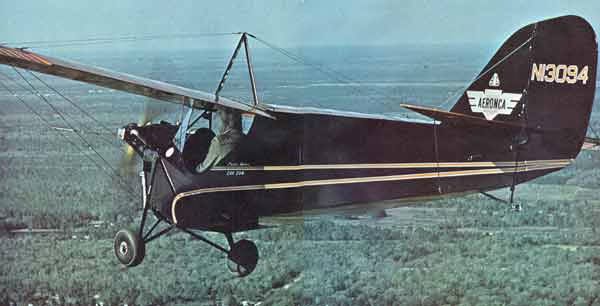
‘You want basic? This is “basic” raised to a higher, although vaguely crude, art form.
In the late twenties and very early thirties, “light” aircraft were Travel Airs and WACO biplanes that dwarfed their pilots and threw shadows the size of small towns. At the beginning, the most common engine, the 90 horse OX-5 seemed as if it was the size and weight of a Volkswagen and a normal propeller nearly out-spanned a Pitts. Even as designs progress to radial engines, they were, in a word, big. Since the engines had the power-to-weight ratios of granite slabs, the engineers (mostly converted bridge builders) had to go for big wings, which meant more wires and struts, which meant more weight, which needed more wing, etc., etc. The Europeans had been playing with some puddle jumper designs, but nobody here had made any serious attempts at designing a really practical light aircraft for the masses.
In 1931, the Aeronautical Corporation of America (later Aeronca) decided to take a crack at the problem and found the first obstacle was that there weren’t a heck of a lot of small, inexpensive engines to choose from. Solution: Build your own engine! Right from the beginning, the goal was to build an airplane that would cost a fraction of the fabric pterodactyls, then in vogue. They figured by cutting everything to the minimum, including the engine, they would come out with a cheaper airplane.
It didn’t take a genius to figure out that hanging a 400-pound V-8 or radial boat anchor in the nose meant you needed a houseboat to float it. So, one of their designer types decided to reduce the number of cylinders. Four was probably the original number but some smart alec in the shop made a wise crack about “Gee, if four is good, two would be fantastic and none would be even better.”
After taking the guy’s funny cigarettes away from him, somebody began to think seriously about the minimal number of parts in a two-cylinder engine. And so it came to pass that unto Aeronca was born a two-cylinder engine that would have looked right at home under an old, gas-powered Maytag washing machine (am I the only one who remembers those?). On a good day and burning high octane kerosene, car gas, cheap bourbon or whatever was handy, the E-113 Aeronca twin could crank out 36 rather spindly horses. Not exactly a Merlin, but then it was so light a single man could carry it around the shop and install it.
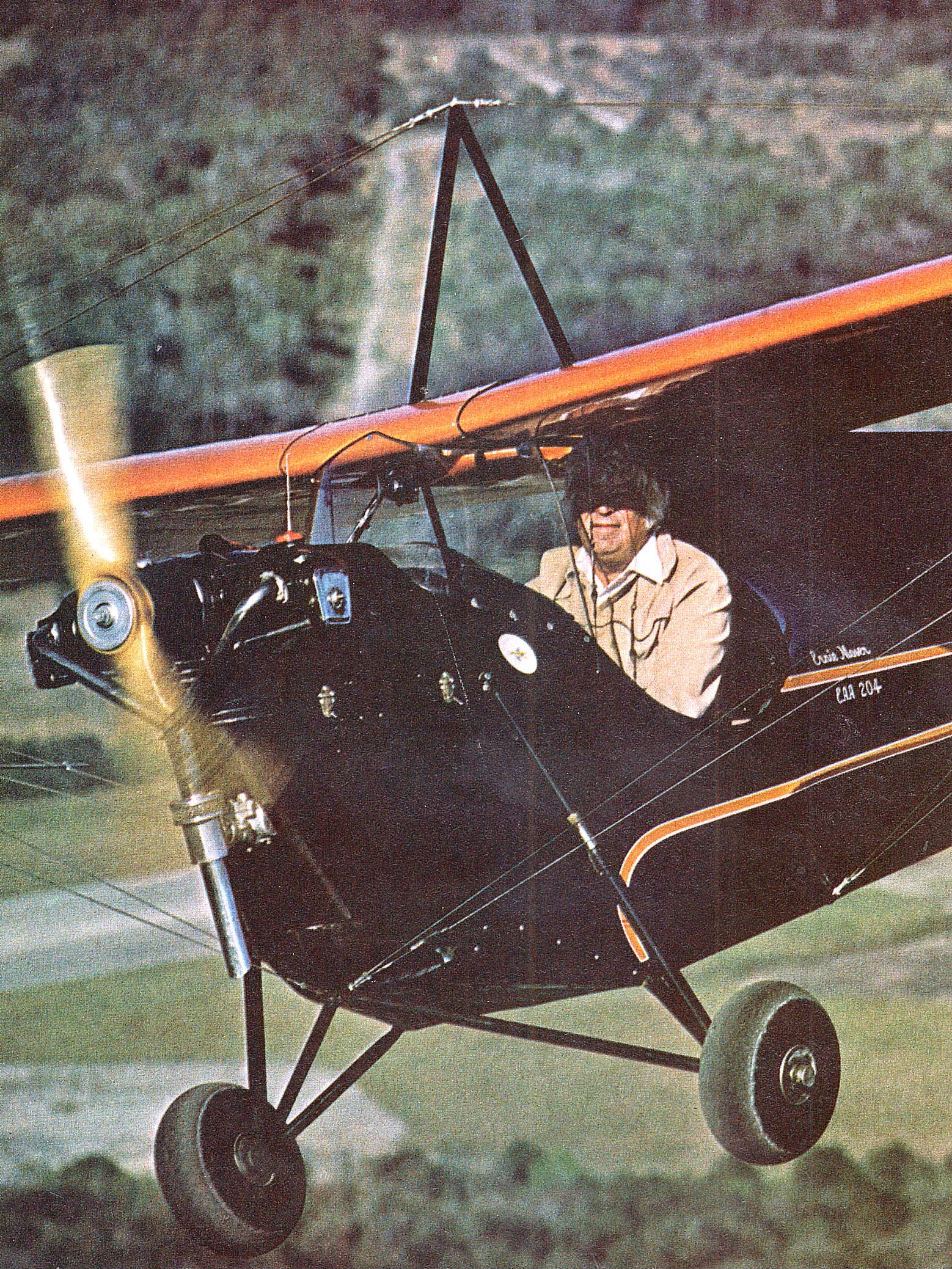
The little Aeronca E-113 engine was the key to building a light, low-dollar training airplane. Shortly after that the four-cylinder Continental A-40 came out, then the Cub series and light aviation was on the way.
Of course, when you’ve only got 36 anemic ponies to drag you around, it’s no secret that, if you expect to climb, you’d better have a hell of a lot of wing. So, the designers tacked on what looked like a fair amount. Only it wasn’t a fair amount. It was a huge amount! With a span of 36 feet and a gross weight (not including rocket pods or ordnance) of 925 pounds, the C-3 was much more lightly loaded than some buzzards and hoot-owls I happen to know.
36 ponies also means you are not going to build up a full IFR panel and you’re going to be pretty picky about what kind of stereo system you install. Weight is the enemy of tiny motors. Also, since cantilevered wings require a lot of heavy internal structure, the designers went for totally wire-braced units. On the ground the entire mess hangs from a bunch of wires attached to a pylon on top the “cabin.” In those days, “drag.” apparently, was something they thought was a unique form of male dress code and had no aeronautical importance.
Exactly how they arrived at the concept of putting the engine at eye level and tucking your feet under it is not known. However, consistent C-3 rumors say a designer on the project had lied about the exact nature of his credentials and was actually an un-employed cartoonist. This would explain many things . . . C-3 and otherwise.
Anyway, that is the rather nebulous history of the C-3. One fact that is true, amazing and, a little frightening is that several C-3s were equipped with EDO floats. Imagine, 36 horsepower, two people and floats!!!
If one looks past first appearances, the C-3 is one of the cutest and most innovative pieces of design work to come from that era. Reportedly, it is even the first to use all metal ailerons. Even today, you’d be hard pressed to find an engineer who would even consider designing a two-place airplane with only 36 horses and a minimum of moving parts. Actually, the C-3 has all the normal components for an airplane, it’s just that they are arranged a little strangely. However, you have to fly one before you discover that the C-3 is not just another ugly face.
The day came time for me to be drafted (or wafted) into the C-3 club which meant learning the entrance dance. Quite literally, the C-3 pilot must lower one’s self to fly the C-3. The wing is only waist high and to get in requires ducking under the wing, finding a man-sized opening in the wire bracing and threading your way through it to the cavernous non-door to the cockpit. There’s a trick involved in getting aboard and I finally worked out a variation on the basic womb-exit technique. Go in head-first, crouch in the seat in a semi-embryonic position and work your feet in and down to the rudders and your head into the upright position. If you’re not limber, forget about flying a C-3.
The cockpit (and I use the term loosely) is “different” (and I under-exaggerate). The stick is to the left of center about six inches, presumably so the pilot can sit on the left. The throttle, however, is in the upper center of the “panel”. Since it’s both unnatural and obscene to fly with a stick in the left hand and the throttle in the right, I found myself flying slightly cross handed. After all, if God had wanted man to fly with the stick in his left hand He wouldn’t have put the throttle on the left side of the Pitts or armament buttons on the stick in more manly flying machines..
There is a uninterrupted line of tiny little pedals spread across the floorboards. I tried the left two first and nothing happened. I realized there was some sort of combination that I was missing. So, I punched the last one on the left and watched to see which one moved the other way and it turned out to be the third one from the left. So, with your feet on the pedals, there is a single unused pedal between your feet. If a second person was onboard, which the airplane was designed for (the C-2 was single place), the other two pedals were theirs. I couldn’t, and cannot, believe the airplane had any performance at all with both seats (which pretty much overlap) occupied. It’s a dog with one person. A super dog with two.
The instrument panel isn’t a real instrument panel. There is a giant padded area that covers the entire top half of the bulkhead in front of you and extends, in an inverted “V” shape well above your head when on the ground. Under that is a flat space with three dials the size of steamboat gauges: airspeed, tach and altitude.
Lined up on the runway (which I couldn’t see except for the edges), I pushed the throttle, the noise out front got louder and I started moving forward. Slowly. The clatter from up in front was just that . . . a clatter. A high-quality lawnmower sounds much, much smoother, if only because its power pulses are muffled rather than being announced by tiny little stub exhausts. Then the airplane was movinig faster. But, not much. The clatter began to increase in rhythm, and I could actually feel the controls begin to work. I pushed the stick forward and the tail sagged into the air and stayed there. By this time, I was certain we were moving faster than I could run. But not much. Then, the maple seed came alive and floated back into its own element. With no input from me. It just happened. And I watched.
Once airborne, there was no way I was going to reduce power. It needed all it could get. As a matter of fact, I’m not certain I knew what to do. Nobody had told me what speeds to use, and the only comment I had to go on was an unrelated comment that 50 mph is . . . “awfully fast” . . . so, as the airplane meandered vaguely upward and vaguely to the right, I tried to hold something around 45 mph. Ernie had told me to drift to the right so I’d have a better chance of making it back, if the engine quit. I thought that an unusual piece of advice, until I found it had quit on him six different times! I had already made up my mind to keep the airplane directly over the airport.
The fairly brisk wind combined with the not-so-brisk speeds of the C-3 to give me three or four minutes after take-off to get used to the airplane before I came to the end of the 8,000 foot runway. Oddly enough, in the air, the C-3 doesn’t seem nearly as blind as it should. The seat forms the bottom of a triangle with the nose and engine at the top. Your head is near the narrow top of the triangle so it’s easy to look out to the sides and guestimate your direction of flight. Also, since you aren’t exactly streaking through the heavens, you have plenty of time to correct any directional wanderings you didn’t plan.
By the time it came time to make my first turn, I was no longer fighting the strange feel of the machine. Only the vague, lackadaisical controls had my attention. There was plenty of control to make the airplane do what I wanted, but that wasn’t always enough to overcome what the wind wanted me to do. Like a leaf in a fast-moving stream, the C-3 is totally at the mercy of the smallest gust, breath or belch mother nature decides to aim at it. I didn’t even try to correct for most of the turbulence because it wouldn’t have done any good. The C-3 rides over them like the bit of thistledown it is.
In terms of performance, I never really figured all the numbers out. I never saw anything higher than 60 mph on the clock, and I couldn’t come close to reading the altimeter ... the needle was bouncing so much it blurred across a band 1000 feet wide. The one bit of performance, which is hard to ignore is that it glides like there’s no tomorrow. I must have been up around 1500 feet when I started considering making a landing. It took me almost a complete lap of the field to get it down to 800 feet to make even a semblance of an approach.
Throughout the entire flight the airplane kept whispering, and then yelling, “.RUDDER! Use RUDDER, Dummy!” Everything was done with lots and lots of footwork, something I had to remember as I turned final.
I only brought the power all the way back once. When I did, the engine sounded like it was going to stop dead. With only two cylinders and a featherweight prop, it doesn’t have much inertia going for it. So, I kept just a tad of power on as I fluttered down final towards the grass alongside one of the main runways.
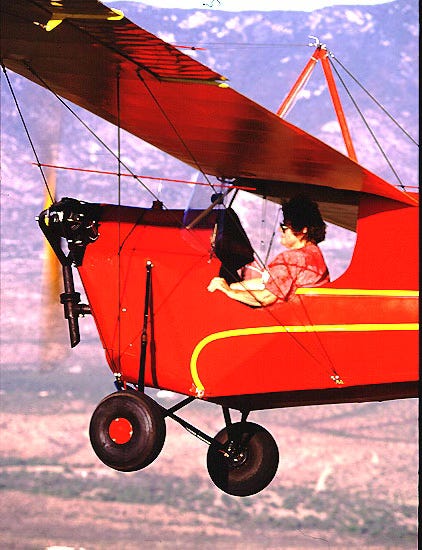
It’s more comfortable than it looks and is loads of fun, but I can’t imagine it with two people on board. Okay, there it comes. Gently, gently! Flare. Ooops! I suddenly found myself another 20 feet in the air, looking down off the top of a gust, I poked the nose somewhere in the down-ward direction. I woke up the two-cylinder rubber band for just a second to stop the rate of descent and flopped back to Earth. Zero grace was involved.
The wind was more playful than dangerous; Jabbing me here and there with a precocious gust or a quick downer. In any other airplane, it wouldn’t have been noticeable. In a C-3 it was really fun. As I passed low over a cross runway, I needed a quick jab with the throttle to stop a downer. then I throttled down and prepared to flare. All this time I was trying to hold around 45 mph, which gave me the ground speed of an armadillo.
Roll-out must have been less than 75-100 feet because the touchdown was at about 30 mph and the tail skid was digging in to slow me. Since a C-3 has no brakes of any kind, I was glad for the tailskid . . . right at that moment anyway. As I tried to taxi back, I learned to hate it because I never could get it to turn worth a damn, not even by gunning the throttle and lifting the tail a little. They finally had to send somebody out to grab a wing tip and swing me around.
Now that I’ve flown it, I would have to say that the C-3 is an interesting little machine. It gets more “interesting” the stronger the wind. It is as docile and forgiving as a heavier-than-air-machine can be, although, a number have been spun in, and it doesn’t exactly knife through the air like a rapier. At first its marginal controls are distracting. At the end, they become endearing as remembrances of the way things used to be.
As I shut down and crawled out from under the wing, one of the guys asked me what I thought of the C-3 and the first thing that came to mind was, “It felt like I had a saddle on a butterfly.” And that can’t be all bad.
Comments
Nothing yet. Say the first thing.
Sign in to join the conversation.