
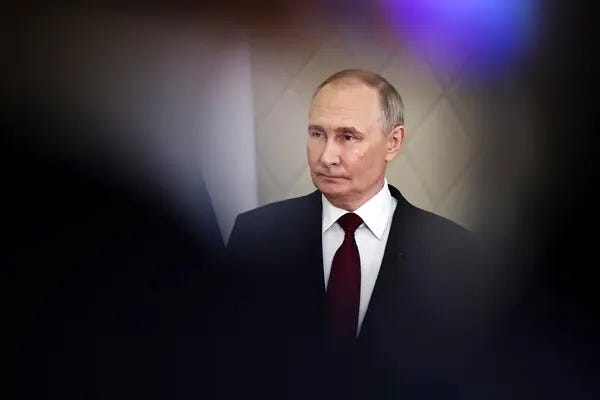
For more than two decades, Vladimir Putin has defined Russia through a backward-looking lens. He is a man shaped and driven by the collapse of the Soviet Union, the loss of territory, and the disappearance of Russian influence across Eastern Europe. Where others saw the liberation of captive nations, Putin sees humiliation. Where Western leaders imagined a peaceful, post-Cold War order, Putin imagines a stolen empire that needed to be reassembled.
But Russia will eventually face a future without Putin. The important question is not merely who replaces him. It is whether his successor continues to view Russia as a diminished empire in need of resurrection or begins to see itself as a potential globally integrated and prosperous nation.
It’s easy to assume that “another” Putin will follow Putin. But what if there is a shift in the Russian collective consciousness? The Brits voted for Brexit. Argentina kicked out their decades-old Peronist bureaucracy. Italians elected a nationalist leader who stands up to EU bureaucrats. The United States elected a genuine outsider as president, twice. Voters in both Europe and South America appear to be seeking dramatic political change. Why not Russia, too?
Imagine that Putin is replaced not by another imperialist but by a national pragmatist—a leader who remains patriotic yet recognizes that Russia’s greatness cannot be restored through territorial conquest but rather regional political and economic integration. Such a leader might conclude that Russia’s most valuable territory is the territory it already possesses, and that its greatest opportunity lies not in rebuilding the Soviet empire but in building a globally integrated Russian economy.
Russia occupies an extraordinary geographical position. It stretches across eleven time zones, possesses enormous reserves of oil, natural gas, coal, timber, and strategic minerals and remains one of the world’s largest grain producers. It also has a deeply rooted scientific tradition, a highly educated population, and generations of accomplished engineers, mathematicians, and technologists.
The tragedy is that much of Russia’s resources and talent have been subordinated to the ambitions of rebuilding an empire. Russian scientists have been directed toward building military power rather than private sector innovation. Any Russian with an entrepreneurial nature has been forced to serve a system built around the ambitions of politicians, state corporations, and oligarchs. There is little opportunity to create anything of value beyond a state-mandated and -supported effort.
Russia possesses the raw materials of a great commercial civilization, but its political machine’s relentless focus on control and conquest have done very little to grow domestic prosperity. On a purchasing power parity basis, the US GDP per capita is around $94,000, Europe’s is around $58,000, Japan’s is around $59,000 and Russia’s is around $52,000. But Russia’s nominal GDP per capita is only about $18,000. Because of Russia’s vast natural resources, their citizens benefit from significantly lower consumer prices.
Given Russia’s massive natural resources, imagine their economy if the country was globally collaborative and cooperative. Imagine if Russia actually took productive steps toward integrating with the EU.
Yes, it is true that Russia has been in a cold war with Europe for decades. But prior to World War I, the Russian Empire was heavily integrated into the European financial system. France and Germany were the primary sources of capital to fund Russia’s early industrialization and extensive railway network. During this period, Russia was also one of Europe’s most important agricultural suppliers, serving as the continent’s largest grain exporter.
The economic opportunity for Russia and even Europe is great. Putin’s war with Ukraine has put Russia’s economy into the ditch and turned them into a pariah among the West. At the same time, Europe’s economy is struggling to keep up with the two global 800-pound-economic gorillas, the United States and China.
Europe’s post-World War II recovery was one of history’s great economic achievements. Yet the energy, confidence, and industrial momentum of that recovery have weakened. Europe now struggles with aging populations, expensive energy, heavy regulation, immigration challenges, and relatively slow economic growth. It remains wealthy by global standards, but it often appears more committed to preserving its legacy political elites and bureaucracy than to creating tomorrow’s prosperity.
A peaceful and commercially integrated Russia could rejuvenate both Russia’s and Europe’s potential. Russian resources combined with the many great capabilities of Germany, France, Italy, and Scandinavia, added to Eastern European industrial capacity, could give the continent new economic momentum, putting its global influence on par with both the United States and China.
The greatest Russian victory of the twenty-first century will not be the conquest of Ukraine or the resurrection of an empire. Achieving those goals would not provide Russia any better leverage in Europe nor the global marketplace. The greatest Russian victory of the twenty-first century would be the liberation of Russia’s own people and potential.
Could a Russian national pragmatist arise? Maybe Putin needs to further bury Russia’s economy and global reputation before the ground is fertile enough for dramatic change. A pragmatic successor could significantly change Russian’s trajectory. Imagine the growth of their economic output and wealth if Russia became more collaborative and cooperative with the West.
Perhaps this is all a geopolitical fairytale. But in today’s strange world, almost everything is at the precipice of dramatic change. Why not Russia?
Thanks for reading The Ramblings of Buck Roy! This post is public so feel free to share it.
Comments
Nothing yet. Say the first thing.
Sign in to join the conversation.