
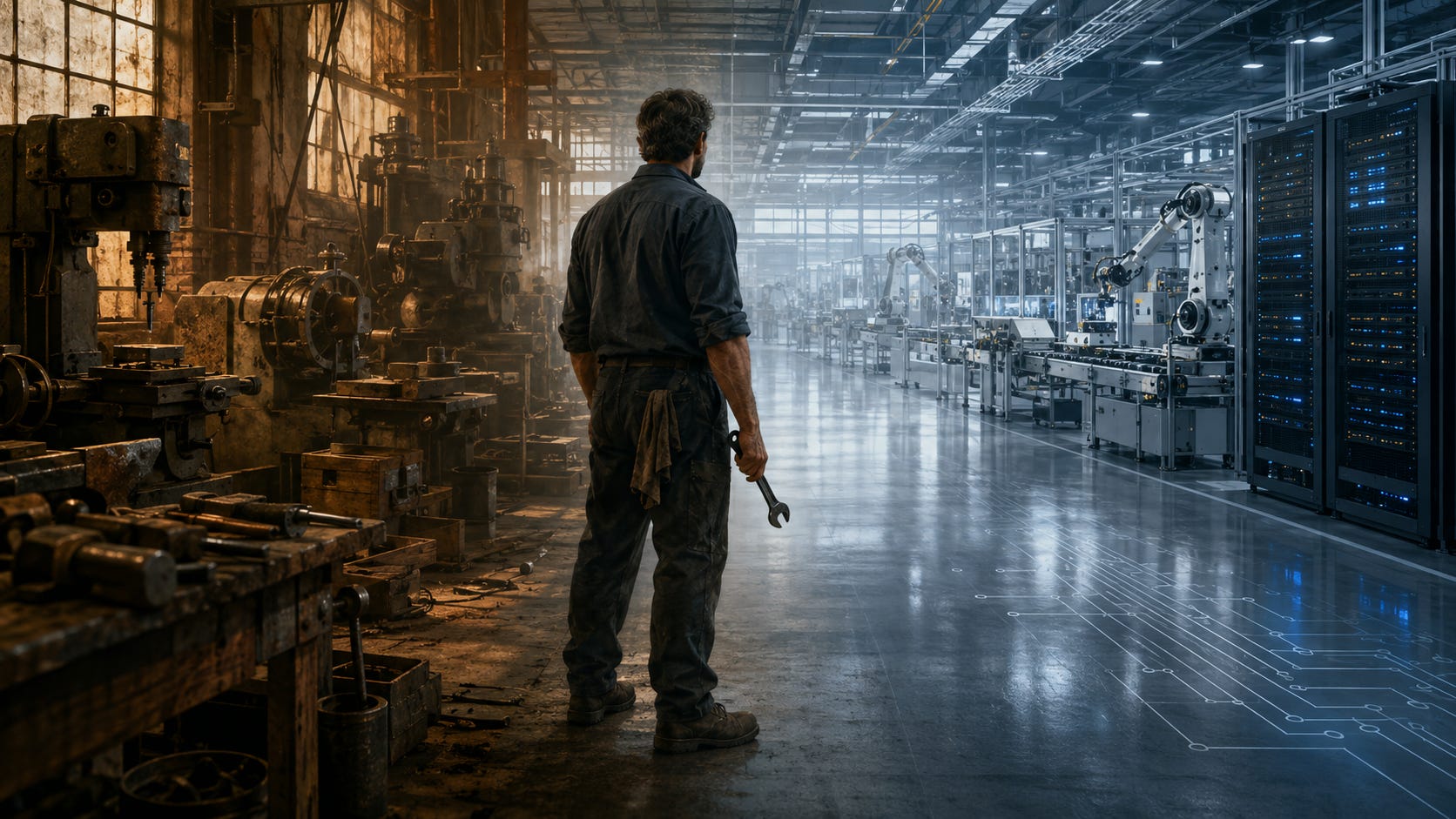
There have always been jobs for service workers and jobs for those with high intellectual skills. But up until about 100 years ago, the great majority of work was manual labor.
Farming, mining, construction, animal husbandry, fishing, forestry, manufacturing by hand, and domestic household maintenance accounted for nearly all jobs before the Industrial Revolution. Even war was manual labor, obviously. From the time agriculture appeared 10,000 years ago and all the way through the 18th century, at least 80+% of humanity worked in some form of manual labor.
Given that survival was predicated on manual labor for nearly all of human history, physical skills and capability were naturally highly valuable assets. They translated into food, shelter, security, and reasonable economic stability. Because manual labor fulfilled humans’ most important needs, it stands to reason that physical capabilities were attractive in mate selection, from the dawn of man up until very, very recently. If so, then it’s fair to wonder if a great percentage of humans, particularly men, have an evolutionary bias toward manual labor—one that, over hundreds of thousands of years, may have even become genetic predisposition.
Such a predisposition served nearly all humans well and propelled us from caves to farms and all the way into urban environments. Then came the Industrial Revolution, which began the slow shift of the economy toward service and knowledge labor. It started with the movement of production out of homes and artisan workshops into what would become factories.
By the early 20th century, ever more farm workers had moved to urban factories. But even in those factories, the majority of work was still manual. Over the course of the 20th century, the farm-to-factory evolution continued to replace lower-productivity manual labor with higher-productivity manual labor. Between 1945 and 1973, productivity grew around 3% annually, with wage growth following in step. The growth of productivity and wages inspired a period of home appliance innovation and a consumption explosion.
Over several decades in the middle of the 20th century, a virtuous economic cycle developed as people purchased automobiles, refrigerators, air conditioners, heaters, washing machines, dryers, vacuum cleaners, dishwashers, blenders, toasters, gas powered grass mowers, and more. All those appliances required more factory workers and created new sectors of service and knowledge workers in advertising, retail, finance, professional services, and appliance repair.
Starting in the 1980s, computers and telecommunication caused a steady decline in manual labor jobs, either through ever more efficient factory automation or the outsourcing of manufacturing to cheaper labor countries. As these manual labor jobs shrunk, more people went into service-oriented work. Meanwhile, our consumption economy gained even more momentum.
Today service sector jobs dominate our overall employment base: health care, education, finance, marketing, media, retail, government, information technology, middle management, hospitality, and professional services.
The digital revolution that began in the 1980s increased demand for labor with high cognitive skills. Today’s economic value increasingly comes from software, the internet, finance, intellectual property, data management and manipulation, branding, algorithms, and information dissemination.
And now comes AI. So what to do with those genetically predisposed for manual labor?
Today manual workers can support the construction of our AI infrastructure, but robots will soon staff factories, warehouses, and commercial transportation. Can manual workers transition to service labor? Not if we need fewer service jobs. Can they transition to knowledge work? Not likely. Will maintenance and repair provide enough jobs to replace those lost in the factory and warehouse? We will know 20 years from now.
All economic evolutions leave people behind. And the one we’re enduring now will be far faster than any we humans have ever experienced. We can look to male labor force participation rates for clues as to how the computerization and internet evolution is already leaving men behind.
In the 1950s, when manufacturing dominated our economy, 97% of “primed-aged males” (men roughly ages 16 to 55) held jobs. Today that number has dropped to about 90%. Much has been written about an increasing failure-to-launch problem with our younger men—those young men who graduate school and never join the workforce at all. Is it possible that some of these men are genetically predisposed toward manual labor and were funneled through a school system that told them such work is beneath them? And what about the 43% of men who do not even attend college?
When AI reduces even more manual labor jobs, how dire will this situation become for those predisposed toward it? After all, the effects of languishing men ripple far beyond the men themselves. They impact marriage and reproduction rates, possibly even crime statistics.
Humans have always adapted to whatever comes. But what we’re experiencing now may be a near total reversal of how most men have worked for almost the entirety of human history. The brakes may be slamming on hundreds of thousands of years of momentum. What should be our policy and societal responses? Imagine a world full of physically capable men without purpose.
Thanks for reading The Ramblings of Buck Roy! This post is public so feel free to share it.
Comments
Nothing yet. Say the first thing.
Sign in to join the conversation.