
Ever wonder why your best ideas strike in the shower, or why you suddenly feel a wave of anxiety while staring at a completely manageable to-do list?
It isn’t just mood or energy it’s resonance. At this exact second, your brain is humming at a specific rhythm, influencing not just how you feel, but how you perceive reality.
The human brain does not process the world in static thoughts. It processes the world in rhythms.
Right now, as your eyes track across this screen, billions of neurons in your brain are firing together in synchronized electrical pulses. We call these brainwaves, measured in Hertz (cycles per second).
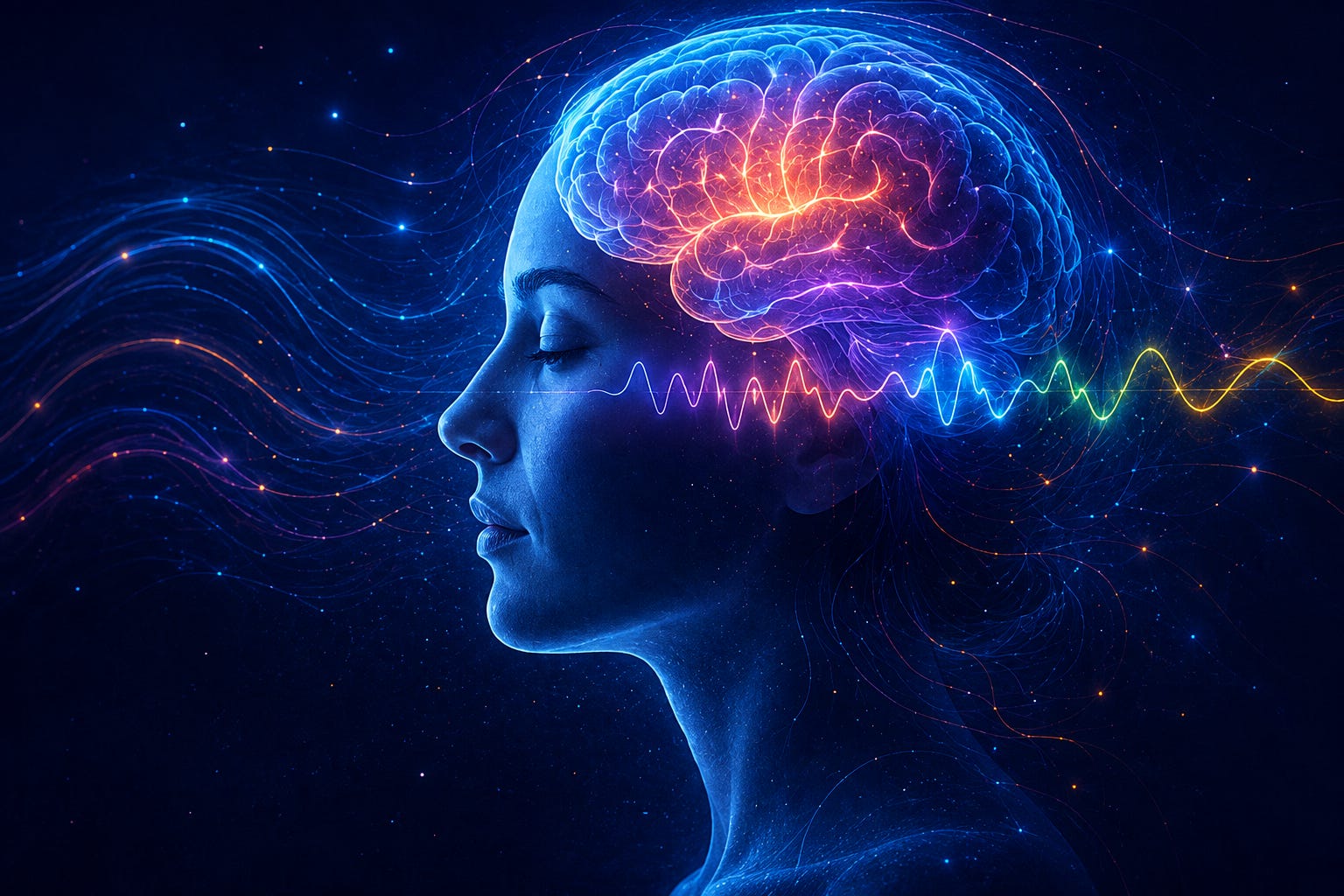
You don’t have one brainwave frequency. Your brain moves through and combines different rhythms throughout the day.
Beta (13–30 Hz) is prominent when you are thinking, planning, analysing and solving problems. But prolonged high-Beta activity can accompany stress and hyper-alertness. You may still be productive, but become more reactive, tense and mentally rigid.
Alpha (8–12 Hz) is associated with relaxed wakefulness. You’re alert, but there is less mental noise. Think of the feeling after a quiet walk when a problem suddenly seems simpler.
Theta (4–8 Hz) becomes more prominent during drowsiness, deep relaxation and some forms of meditation. It is one reason ideas can unexpectedly surface while showering, walking or just before falling asleep when deliberate thinking loosens, different associations can emerge.
Gamma (30–100 Hz) is linked with attention, learning and complex information processing.
And Delta (0.5–4 Hz) dominates deep sleep, an important period for physical and neurological restoration.
But brainwaves are only one part of the story.
When people talk about the “frequency” of shame, guilt, fear, anger, love or joy, they are not talking about brainwave Hertz.
They are describing a different idea: the emotional state from which you are operating.

And that matters because every emotional state gives your mind a different set of instructions.
When you are in shame, your attention turns against yourself.
You don’t simply think, “I made a mistake.”
You begin thinking, “There is something wrong with me.”
So you hide, compare, withdraw or hesitate.
In guilt, your mind keeps returning to the past. You replay what you should have said or done differently, spending today’s mental energy trying to rewrite yesterday.
In fear, your mind becomes future-focused.
It searches for danger before opportunity. You may reject an idea, relationship or decision not because it is wrong, but because uncertainty feels unsafe.
Anger is different. It carries movement.
It can sometimes pull a person out of helplessness because suddenly there is enough energy to say, “This cannot continue.” But remain there too long, and everything can begin to look like something to fight.
Then something changes as you move into states such as acceptance, love, gratitude and joy.
Your attention becomes less occupied with defence.
You listen differently.
You notice options you couldn’t see while afraid.
You recover from setbacks differently.
You become more available for connection, creativity and thoughtful decisions.
And this is how your emotional state quietly begins shaping your life.
Not because the universe simply rewards one emotion and punishes another, but because the state you repeatedly live in influences what you notice, what you believe is possible, how you behave and what those repeated behaviours create.
A person operating from fear asks:
“How do I make sure nothing goes wrong?”
A person operating from love may ask:
“What is possible here?”
Same situation. Different internal state. Completely different range of choices.
And repeated choices eventually become a life.
Yes and sometimes the smallest physical changes are a good place to begin.
When you’re anxious:
Soften your gaze. Instead of staring intensely at one point, become aware of your peripheral vision and the wider space around you.
When you’re mentally stuck:
Take a quiet walk without your phone or headphones. Give your mind a few minutes without something to consume.
When you’re depleted:
Get natural light in the morning and protect your sleep. Your brain needs deep restorative states just as much as it needs productive ones.
And perhaps most importantly, start noticing your emotional starting point.
Before making an important decision, sending that message or reacting to someone, ask:
“What state am I making this decision from?”
Fear may give you one answer.
Shame may give you another.
Love, calm or acceptance may reveal an option you couldn’t see before.
Your frequency isn’t simply about feeling “positive” all the time.
It’s about becoming aware of the state you repeatedly return to because that state becomes the lens through which you experience your life.
Change the state, and you may begin to see choices that were there all along.
No posts
Comments
Nothing yet. Say the first thing.
Sign in to join the conversation.