
A mother once shared that her baby became more active whenever she felt anxious. But when she sat quietly and spoke to her baby, the movements slowly settled.
She asked,
“Can my baby actually understand me?”
A baby may not understand words in the way an adult does. But during pregnancy, the baby is already receiving sound, rhythm, movement, touch, and signals from the mother’s body.
This is one of the deeper meanings of Garbh Sanskar.
The word Garbh refers to the womb, while Sanskar refers to the impressions and influences a person receives.
Garbh Sanskar is therefore based on a simple understanding: a baby begins receiving impressions even before birth.
It is not limited to listening to mantras, reading spiritual books, eating certain foods, or following a fixed routine. These may be part of it, but Garbh Sanskar is much wider.
Pregnancy is not only the development of a body. It is also the beginning of a relationship.

As pregnancy progresses, the baby begins to receive sounds from outside the womb.
The mother’s heartbeat, breathing, movement, and voice become some of the most familiar rhythms in the baby’s world.
The baby may not understand the meaning of every word, but familiarity begins to develop.
This is why speaking, singing, reading, praying, or simply sitting quietly with the baby can become meaningful.
The conversation does not need to be planned or perfect.
A mother may speak about her day, share what she is feeling, read something aloud, or simply acknowledge the baby’s presence.
The purpose is not performance.
It is connection and the gradual formation of a bond.
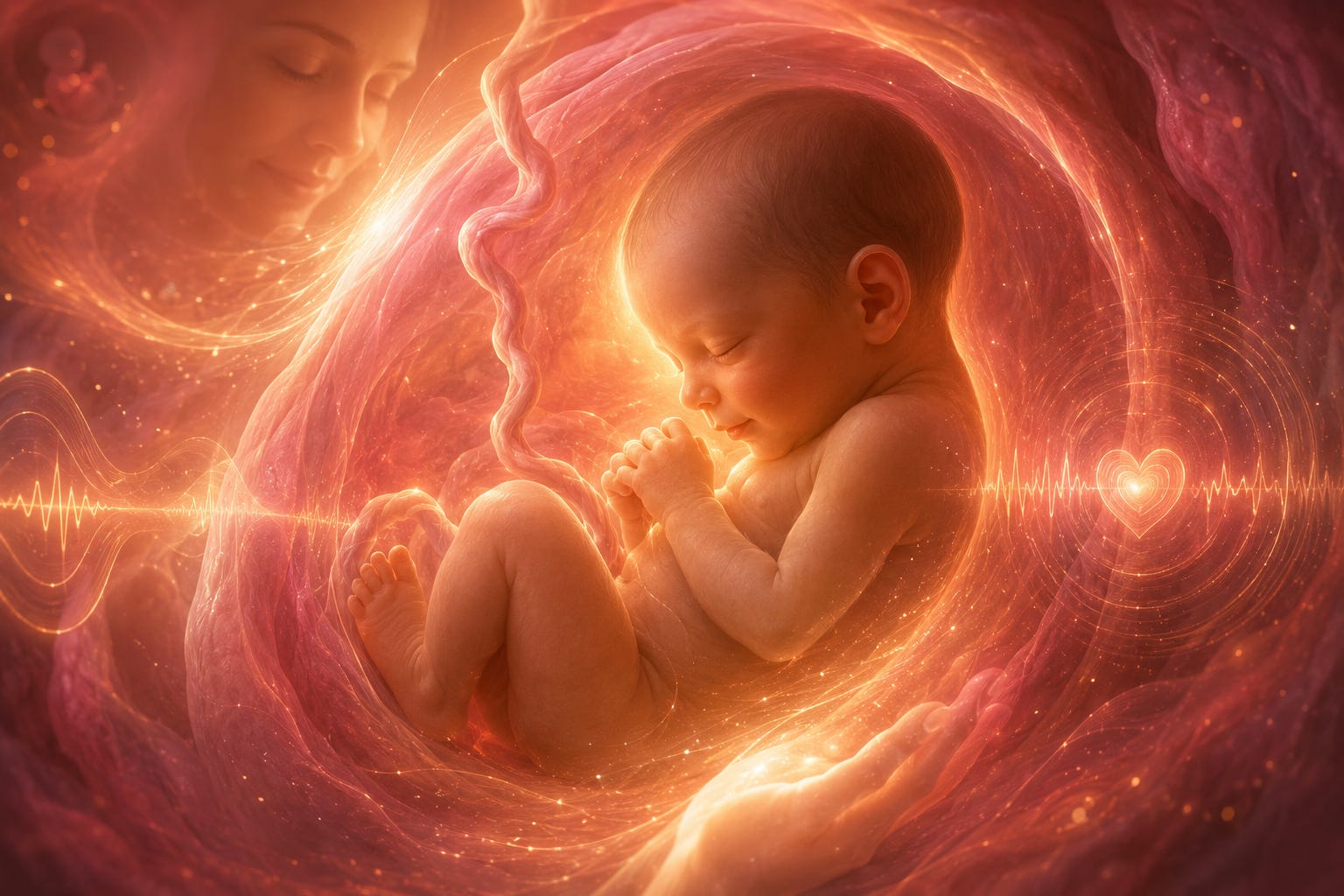
The baby develops within the mother’s complete physical and emotional environment.
Her nutrition, sleep, movement, relationships, stress levels, and sense of safety all form part of that environment.
This does not mean that every passing thought or difficult emotion becomes a permanent impression on the baby.
It means that the baby is growing within a living environment, not in isolation.
How the mother is cared for, how she is spoken to, whether she feels supported, and how her needs are received all become part of the pregnancy experience.
This is why Garbh Sanskar is not only about what a mother listens to or reads.
It is also about the atmosphere being created around her.

Pregnant women are often told:
“Do not feel stressed. It will affect the baby.”
But this can create more guilt and fear than support.
Pregnancy does not require nine months of perfect calmness.
A difficult day, sadness, frustration, fear, or an argument does not decide a baby’s future. Emotions are a natural part of being human.
What matters is whether the mother has the space to understand what she is feeling, receive support, and gradually return to steadiness.
Instead of telling her to “stay positive,” a better question may be:
What would help you feel supported today?
It may be rest, nourishing food, medical guidance, help at home, an honest conversation, or simply someone listening without judgment.
Garbh Sanskar is not about suppressing emotions.
It is about becoming aware of the emotional environment in which the pregnancy is unfolding.

Garbh Sanskar is often presented as something the mother must practise alone.
But the emotional atmosphere around a pregnancy is created by the entire family.
How is the mother spoken to?
Is she allowed to rest without guilt?
Does her partner listen to her concerns?
Does the family create reassurance, or repeatedly share frightening pregnancy and birth stories?
A father can begin bonding with the baby before birth by speaking, reading, singing, or spending a few quiet moments near the womb.
But his role goes beyond interacting with the baby.
One of his greatest contributions is the support and steadiness he offers the mother.
When a mother feels heard, respected, and cared for, it changes the atmosphere around the pregnancy.
Garbh Sanskar is therefore not only a mother’s practice. It is a shared responsibility.

Garbh Sanskar can be understood through three connected environments:
The physical environment
Nutrition, sleep, movement, medical care, rest, and physical safety.The emotional environment
Relationships, communication, stress support, and mental well-being.The conscious environment
Awareness, intention, values, prayer, spiritual understanding, and the bond with the baby.
None of these replaces the other.
A mantra cannot replace medical care.
A healthy diet cannot repair an emotionally unsafe home.
Positive thinking cannot replace genuine emotional or mental-health support.
Garbh Sanskar becomes complete when the mother is cared for as a whole person.

Garbh Sanskar may not always look like a special ritual.
Sometimes it looks like:
A mother asking for help.
A partner listening with patience.
A family choosing not to fill the pregnancy with fear.
A difficult conversation handled with respect.
A mother receiving proper rest and nourishment.
Parents taking a few minutes to consciously connect with the baby.
Garbh Sanskar is not one activity performed at a fixed time of the day.
It is present in the food the mother receives, the words spoken around her, the support she experiences, and the relationship the parents begin building with their baby.
The question is not only:
“What should a pregnant mother do?”
The deeper question is:
“What kind of environment are we creating around this mother and baby together?”
Because the womb is the baby’s first home.
And the mother should not have to carry that home alone.
With warmth,
Dr. Monika Singh Shubhaa
No posts
Comments
Nothing yet. Say the first thing.
Sign in to join the conversation.