
If you’ve spent any time listening to our show, reading my previous Substacks, or paying attention to the LONG COVID world on social media, you’ve probably heard the term MCAS, or Mast Cell Activation Syndrome.
If not, buckle up for a nice, long lecture on the disorder that caused a living hell in my life for three years.
In the Long COVID world, what is happening is a “spikeopathy,” or spike protein causing chronic illness, debilitating health issues, and often a reactivation of latent viruses such as EBV, Lyme, etc.
MCAS is now recognized as one of the top health problems from spikeopathy, besides clotting issues, chronic cardiorespiratory issues, and turbocancers.
Mast cells are known for being attacked by the spike protein and wreaking havoc on the body in a very unkind and often unpredictable pattern.
It’s important to emphasize that MCAS and mast cell problems are NOT exclusive to COVID.
Depending on where you’re getting your information, MCAS can be blamed for nearly every symptom imaginable—kind of like those annoying drug-ad disclaimers in print or on TV that list 5,000 side effects.
On the other hand, many clinicians and skeptics dismiss MCAS as something that barely exists.
Apparently, they have not been on social media, where it’s easy to see the endless conversations from those suffering who are tired of being dismissed.
As with many things in medicine, the truth is somewhere in the middle.
I’m going to first give you a 4th-grade summary of what MCAS actually is, why it’s hard to diagnose and test for, what symptoms it causes, why it’s become such a hot topic, and even who some notable people are in this field.

Mast cells are part of your immune system.
Think of them as your body’s fire alarm!
They’re found throughout the body, especially in places that interact with the outside world—your skin, lungs, digestive tract, and blood vessels.
Their job is to recognize potential threats like parasites, allergens, infections, or injury and release chemical messengers that help coordinate an immune response.
Mast Cell Activation Syndrome, or MCAS, is a disorder in which mast cells become overly reactive and release inflammatory chemicals inappropriately.
Mast cells release hundreds of different substances, but these are the most common ones:
Histamine
Tryptase
Prostaglandins
Leukotrienes
Cytokines
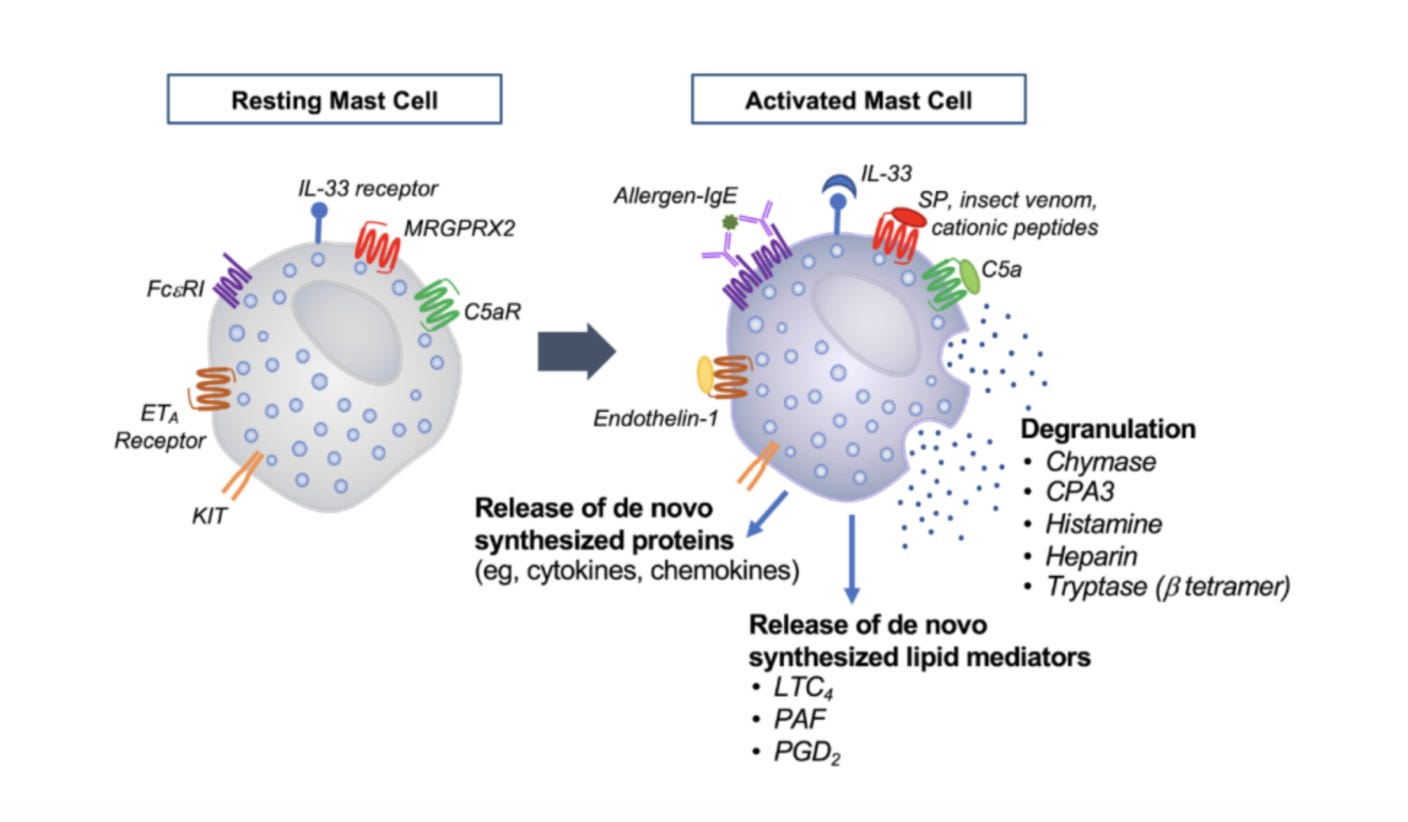
Histamine drives immune responses, regulates stomach acid, and controls sleep-wake cycles.
Yep, betcha didn’t know histamine plays a role in waking you! Those of us with histamine disorders know it all too well.
Tryptase promotes inflammation, tissue remodeling, and changes in airway and vascular tone.
This sucker can wreak havoc throughout the body, causing everything from IBS, hives, and anaphylaxis to brain fog, panic attacks, rapid heart rates, and more!
Prostaglandins are potent, hormone-like lipid compounds that act locally at the site of production to regulate inflammation, blood flow, clot formation, and smooth-muscle contraction.
Common symptoms would be:
Severe menstrual cramps
IBS and gastrointestinal issues
Migraines
Endometriosis
Leukotrienes trigger immune responses, recruit infection-fighting cells, and regulate inflammation.
Think:
Asthma
Hay fever
Nasal congestion
Nasal polyps
Cytokines act as the chemical messengers of your immune system.
If your cytokines are too high, your immune system essentially goes into overdrive, triggering hyperinflammation.
Think of the flu in overdrive.
I get this, and it is NO FUN!
Symptoms can include:
High fever
Chills
Extreme fatigue
Muscle and joint aches
Headaches
Gastrointestinal distress
That is a very BASIC overview and the simplest immunology summary I could give.
These chemicals are incredibly helpful and your FRIEND when they’re released appropriately. They help you fight infections, heal wounds, and respond to things like allergic reactions.
The problem comes when mast cells release these chemicals too easily, too often, or without a true threat.
Now they are the ENEMY, literally going rogue and waging a war on your body that ranges from simply annoying all the way to a living hell.
Unlike mastocytosis, where there are too many mast cells, people with MCAS generally have a normal number of mast cells.
The issue is that the cells don’t behave normally, and we can look at the causes by grouping them like this:
Linked to genetic mutations, often c-KIT, that cause an overproduction or structural defect in mast cells.
Triggered by environmental factors, including:
Infections, such as Lyme disease, COVID, or Epstein-Barr virus
Mold exposure
Toxic chemicals
Hormonal fluctuations, such as during perimenopause
Chronic stress
Cases where clinical testing cannot find a genetic, allergic, or environmental root.
Although mast cells cluster at the body’s “entry points,” as we mentioned before, they actually live everywhere throughout the body.
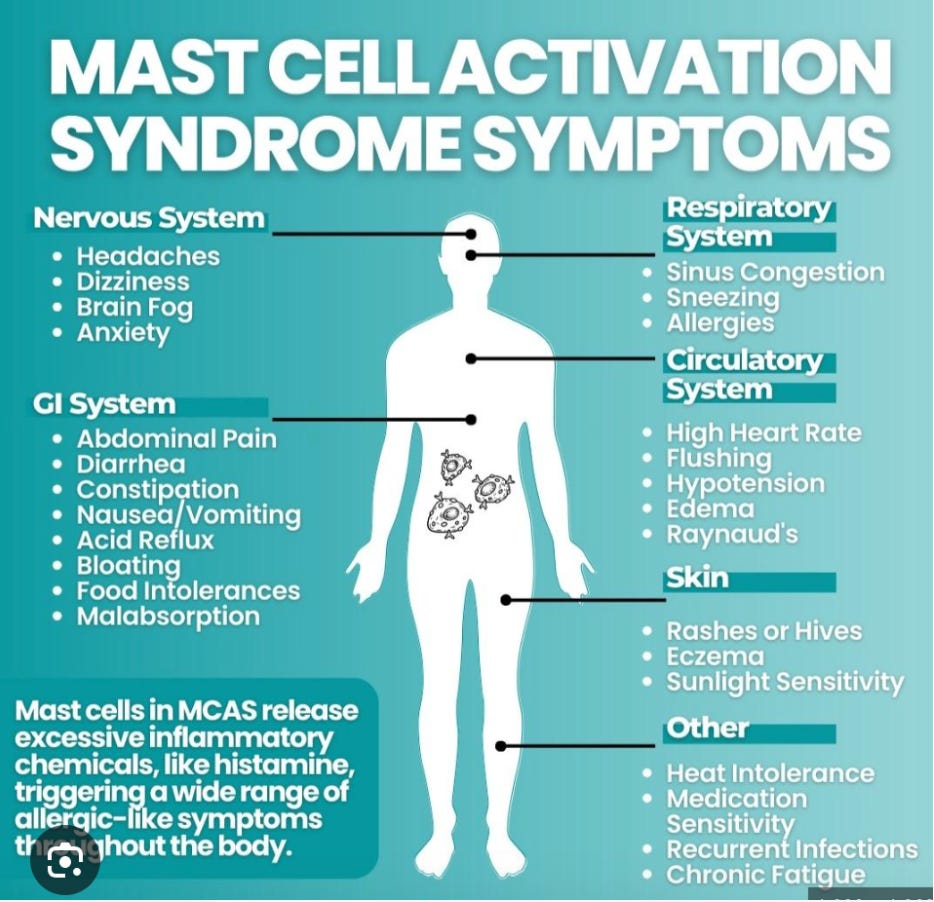
And, as you can correctly guess, symptoms can involve multiple organ systems.
Depending on which chemicals are preferentially released from the mast cells, symptoms can vary widely.
If you have mostly a leukotriene dump, your symptoms will be mostly asthma and hay-fever reactions.
If you happen to have histamine and cytokines being released en masse, symptoms can get very complex and horrific.
Examples of what someone may experience include:
Flushing or unexplained redness and rashes
Hives or itching
Nasal congestion
Shortness of breath
Abdominal pain
Nausea
Diarrhea
Reflux
Rapid heart rate
Lightheadedness
Brain fog
Headaches and migraine attacks
Sudden exhaustion or fatigue
Episodes that resemble allergic reactions without a clear trigger
Sleep disruption
Panic attacks
And more…

Symptoms often come and go and may worsen after eating certain foods, temperature changes, infections, stress, exercise, medications, fragrances, or alcohol.
This is VERY life-disrupting and debilitating, as well as very difficult at times to figure out WHAT is triggering WHAT!
One day, a salad with vinaigrette gives you diarrhea akin to our recent Cryptosporidium outbreak.
The next day, it’s not the salad trying to kill you, but the estrogen HRT you have been told is essential to reverse your middle-aged lady raisin bits that are currently “closed for business.”
It’s a damned double-edged sword.
This is where things become complicated.
Many of these symptoms overlap with dozens of other conditions, including:
Allergies
Autoimmune diseases
IBS—here again, new research is pointing to a histamine or biochemical cause based on mast cells
Generalized anxiety disorders—although I argue that most anxiety is a histamine issue, except for the worried warriors
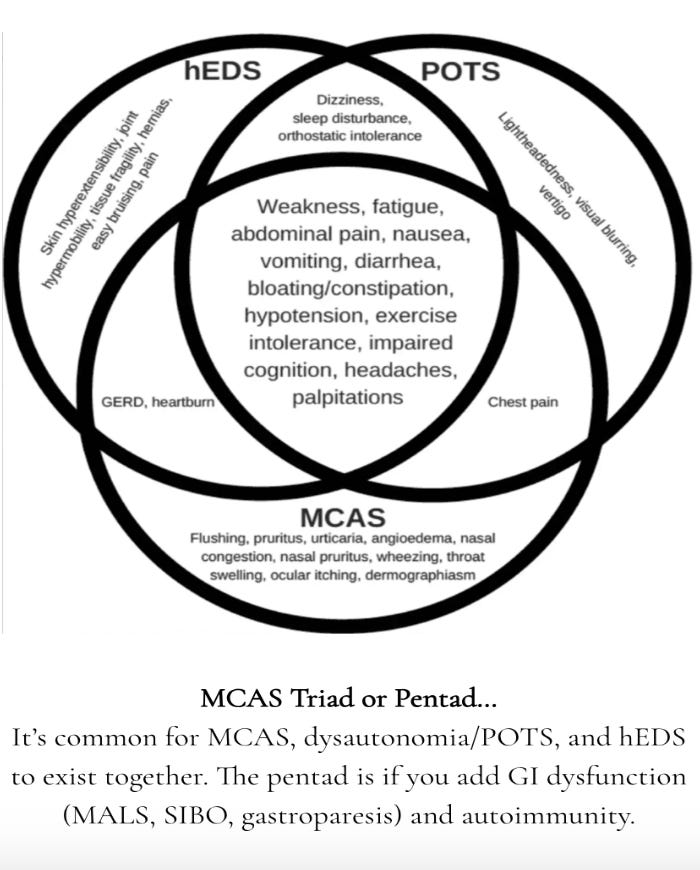
Dysautonomia, such as POTS, or Postural Orthostatic Hypotension
Chronic fatigue syndrome
Hormonal changes in perimenopause and menopause
Thyroid disorders
Whether these conditions share common biological pathways with MCAS—or simply occur together more frequently than expected—is still an active area of research.
Lately, it seems more literature is showing a correlation between those with connective-tissue disorders like Ehlers-Danlos Syndrome, POTS, and MCAS.
This is where many experts disagree, and there isn’t one simple blood test that confirms MCAS.
Current expert consensus generally recommends three things for diagnosis:
Symptoms involving multiple organ systems that occur repeatedly.
Objective evidence that mast cells are releasing excessive mediators during an episode.
Improvement with medications that block or reduce mast-cell activity—especially the use of histamine-blocking medications like Zyrtec, Pepcid, Allegra, etc.
The second point is often the biggest challenge.
Many of the laboratory markers—including serum tryptase or urinary histamine metabolites—can be normal between episodes.
Even when obtained during a flare, they aren’t always elevated.
That means diagnosis often requires careful history-taking, thoughtful testing—such as doing labs during an acute FLARE—and, obviously, ruling out other illnesses.
Over the last decade—and honestly, from what I’m seeing, with the post-COVID world we live in—awareness of MCAS has exploded.
Many patients who were told “everything is normal” despite experiencing very real symptoms are finally finding physicians willing to entertain the idea and investigate for mast-cell disorders.
At the same time, MCAS has become something of a catch-all diagnosis online.
Today, you’ll find claims that MCAS explains nearly every chronic symptom imaginable, and it has become a dumping bucket instead of patients getting the proper diagnosis.
Not every person with fatigue, brain fog, digestive issues, or chronic inflammation has MCAS. These symptoms are common and, obviously, can arise from many different medical conditions.
Good medicine means resisting the temptation to force every symptom into a single diagnosis.
However, I would argue that we have largely been ignoring the surge of MCAS cases for too long and BLOWING PATIENTS OFF while blaming other things as the cause.
How many of us have heard:
“Oh, it’s just your hormones.”
Or, even worse, when that anxiety jolts you out of bed every night at 3:00 a.m.:
“Maybe you’re just stressed.”
I’m going to summarize briefly here and get into more detail in the future.
Treatment depends on symptom severity and individual triggers.
The first step is often identifying and avoiding known triggers whenever possible, while using supportive medications to block symptoms.
Helpful measures may include:
Adequate sleep
Stress management
Treatment of underlying infections or inflammatory conditions
Addressing food triggers
Avoiding alcohol triggers
Avoiding perfume and fragrance triggers
Addressing mold exposure
I literally had to stop all alcohol because I could tell that my heart rate jumped 20–30 beats per minute within minutes of sipping on my favorite Sangiovese.
Some people also find symptom improvement by limiting foods through a low-histamine diet.
I quickly found out that consuming four high-histamine foods together—spinach, tomato, and avocado in a salad with vinaigrette dressing—was the best and most unwelcome colonoscopy prep.
It hit within 15 minutes of eating this ironically labeled “health food!”
A complete list of high- and low-histamine foods is easy to find and is frequently necessary for short periods of time.
What complicates things further is that you can have a histamine “intolerance” on its own, which is a separate condition from MCAS.
And the two conditions CAN coexist at the same time.
Some people only react to high-histamine foods, medications, or supplements they consume because it overwhelms their ability to clear histamine from the body.
In those cases, their mast cells may be working fine—they are simply getting too much histamine into their body from outside sources, such as food.
Now the picture gets complicated—more on that in another chapter.

Other supportive therapies are endless and vary in effectiveness.
Some include:
Targeted acupuncture, such as SAAT, which seems to work best for allergies
Nutraceuticals and simple supplements like vitamin C, quercetin, and luteolin
Plasma exchange
Experimental ozone therapy
EBOO
Oh, the places you can go—and the money you can spend!
Allegra
Zyrtec
Pepcid
Others
Cromolyn sodium
Ketotifen
Singulair
Accolate
Others
In selected cases, biologic medications under specialist guidance
New research involving peptides—more on that in a later article
Other histamine-blocking medications, including cautious use of benzodiazepines
Novel drugs like low-dose naltrexone
Many functional and integrative practitioners discuss MCAS as part of a broader picture involving gut health, environmental exposures, chronic infections, and immune dysregulation.
And now, in the post-COVID world, we are looking deeply into the role of spike protein antibodies and their effect on the immune system and mast cells.
My personal breakthrough came from listening to a podcast by nutritionist Dr. Michelle Shapiro, who shared her experience seeing an exponential number of post-COVID patients suffering from histamine issues.
Having dealt with lifelong histamine problems herself, she readily recognized a pattern that launched her search for specialized therapies for COVID-damaged patients.
One of the leaders who helped bring worldwide attention to MCAS developing after COVID is Dr. Tina Peers in Britain.
While she has been criticized for her focus on using augmented NAC as a primary therapy, she has brought worldwide attention to this increasingly common issue—and to the growing number of women developing MCAS during the peri- and menopausal years as hormones shift.
Regarding generalized MCAS, some of the experts I have followed include:
Other highly regarded experts include:
Dr. Lawrence Afrin
Patients deserve honest conversations about what is supported by research, what is promising, and what remains uncertain.
Let’s just say there is still a lot of debate.
The biggest barrier still seems to be getting people diagnosed, as many clinicians unfortunately want a definitive “test” to confirm that we are suffering from this biochemical warfare inside our bodies.
Toxic mold exposure.
Chronic Lyme disease.
Any of these root-cause illnesses have to be uncovered and then addressed with appropriate treatments targeted at eliminating them.
I know from firsthand experience that it can be overwhelming just trying to survive and manage symptoms, let alone figure out you have MCAS and then determine what to do about it.
Facebook groups, YouTube videos, podcasts, and disappearing down endless rabbit holes reading research studies have taken up my life—but they’ve also been my lifeline.
Sometimes you have to become your own advocate.
Do your own research.
Then use that knowledge in conjunction with a clinician you trust.
Finding that person is another challenge altogether.
MCAS is a real medical condition recognized by allergy and immunology experts.
At the same time, it’s important not to label every collection of unexplained symptoms as MCAS.
Medicine works best when we stay curious, continue learning, and advocate for ourselves.
You KNOW when something is not right.
Keep seeking answers.

If you’ve been struggling with unexplained symptoms affecting multiple body systems, it’s worth discussing them with a clinician familiar with mast-cell disorders.
The goal isn’t simply finding a label.
It’s finding the correct diagnosis, uncovering the ROOT cause, and developing an effective treatment plan that works for YOU.
Next, I’m going to take you through the saga of how my health disintegrated three years ago.
The death spiral that transformed me from a high-functioning physician into a homebound recluse who genuinely believed she was having a midlife crisis... a spiritual collapse... a stress-induced breakdown...
...or perhaps the same rare genetic catecholamine cancer that devastated my mother’s body.
Stay tuned.

This article is intended for educational purposes and reflects both published research and my personal experience. It should not be considered individualized medical advice. If you believe you may have symptoms consistent with MCAS, discuss them with a qualified healthcare professional.
No posts
Comments
Nothing yet. Say the first thing.
Sign in to join the conversation.