
I was deep in economic analysis when a music guru appeared on my screen.
Not an algorithm.
Not an advertisement.
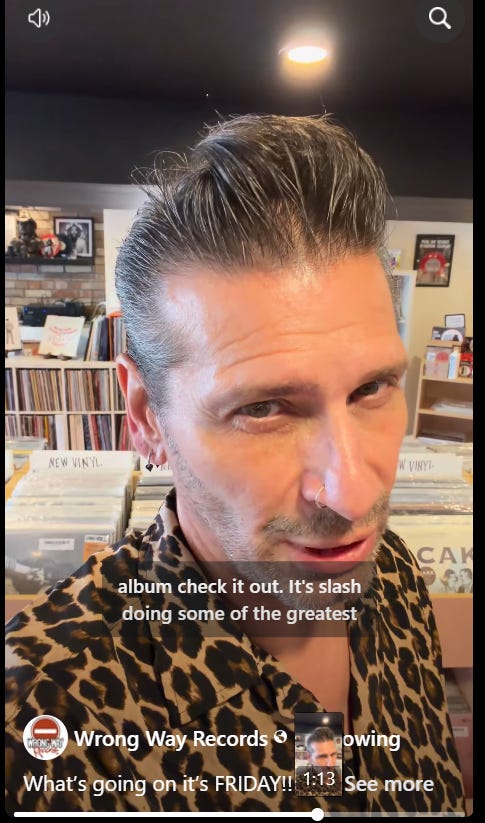
Adam from Wrong Way Records.
Standing among the bins and new arrivals, phone in hand, dispensing musical advice as record-store sages have done for generations.
The technology was modern.
The experience was not.
As he walked through the store discussing the latest arrivals, one sentence stopped me cold.
“Orgy of the Damned. If you don’t know this album, check it out. It’s Slash doing some of the greatest blues you’ve ever heard him play.”
I replayed the video.
Did I hear that correctly?
Slash?
Blues?
A few months ago I would have dismissed the idea immediately.
The Weather Project has taught me to be more careful.
The music playing in the background, the rows of records behind him, and the obvious enthusiasm in his voice transported me back to Saturday afternoons spent wandering record stores decades ago.
Every record store had one.
The Music Guru.
The person who somehow knew more music than everyone else in the room.
Not because they were always right.
Because they listened more deeply than the rest of us.
They had already travelled roads we had not yet discovered.
Every so often they would point toward an album and say:
“You need to hear this.”
And because they had earned your trust, you listened.
For a brief moment they became the music god.
Not a celebrity.
Not an influencer.
A guide.
Someone who had already gone over the next hill and returned with news worth sharing.
So I opened Amazon Music.
And that is when another realization emerged.
Amazon Music had quietly become the listening station.
Older readers may remember the listening booths that once occupied the corners of record stores. You could sit down with a pair of headphones and sample a record before committing your money.
Somewhere along the way those listening stations disappeared.
Or so I thought.
What I was doing at that moment was exactly the same thing.
Adam had made the recommendation.
Amazon Music provided the audition.
Wrong Way Records would provide the record.
The old ecosystem had not vanished.
It had evolved.
The technology was different.
The experience was remarkably familiar.
For the Weather Project, that distinction matters.
I am not collecting records.
I am collecting weather.
Streaming is not a replacement for vinyl.
It is the audition room.
The listening station.
It allows me to determine whether the weather is present before investing in the record.
If the weather arrives, the album earns a place on the shelf.
If it does not, I simply move on.
So I pressed play.
What struck me first was that the album wasn’t really about Slash.
At least not in the way I expected.
He wasn’t standing in the spotlight demanding attention.
He was acting as a conductor.
A host.
A curator.
Gathering musicians around songs larger than any one performer.
The album felt less like a guitar record and more like a celebration.
Then came Crossroads featuring Gary Clark Jr.
That was the moment the weather arrived.
Not because of technical brilliance.
Not because of nostalgia.
Because it sounded alive.
The performance felt less like musicians playing notes and more like musicians sharing something they genuinely loved.
By the end of the track, I knew the record was coming home with me.
Normally I would have waited until Saturday.
Part of the Wrong Way experience is the pilgrimage itself.
The drive.
The browsing.
The unexpected discovery.
The conversation.
The atmosphere.
But when I checked inventory there were only two copies remaining.
For a brief moment I faced a choice.
Protect the experience.
Or protect the weather.
I chose the weather.
The record was purchased online.
But I could not quite bring myself to have it shipped.
There are limits.
Vinnie had a Celebration of Life to conduct in nearby Keswick later in the week on Saturday.
Newmarket would be on the way.
I selected store pickup.
The record would be waiting.
The visit would remain.
The atmosphere would survive.
And that realization may be the real story.
For years we have been told that technology destroyed the record-store experience.
I am no longer convinced.
What I witnessed that afternoon was remarkably similar to what happened fifty years ago.
A trusted music guru stood before a group of listeners and said:
“You need to hear this.”
In 1975 he stood behind a counter.
In 2026 he stood in front of a phone camera.
The medium changed.
The role remained.
The recommendation survived.
The listening station survived.
The pilgrimage survived.
The more I think about it, the less this story is about Slash.
The less it is about Facebook.
The less it is even about vinyl.
It is about the enduring power of trusted guides.
The Weather Project has taught me many things.
One of them is that weather often arrives through people.
A friend introducing you to Tom Waits.
A store owner recommending a blues album.
A musician introducing another musician.
A guide pointing toward a road you might otherwise have missed.
Sometimes the weather comes from the clouds.
Sometimes it arrives through a phone screen.
And sometimes it begins with four simple words.
“You need to hear this.”
Author’s Note
After reading this essay, Wrong Way Records owner Ray Pelletier wrote:
“Our hero, Adam, has forgotten more about music than most people know.”
He went on to tell me that Adam has been collecting and listening to vinyl records since he was seven years old and "continues to acquire new music at a ridiculous rate."
I found that observation fitting.
The Music Guru is not a title bestowed by a record store.
It is earned one record, one recommendation, and one discovery at a time.
The photograph accompanying this essay is a screenshot taken from a video created by Adam Rayfield and is used with the permission of both Adam Rayfield and Ray Pelletier of Wrong Way Records.
No posts
Comments
Nothing yet. Say the first thing.
Sign in to join the conversation.