
Every half-hour brings another wildfire report.
Communities are being evacuated. Homes are being lost. Smoke has spread across provinces and across the border. The federal government says it has responded by funding “10 new wildfire-firefighting aircraft.”
That sounds reassuring.
It also demonstrates the Bathtub Fallacy.
Canada did not buy ten new waterbombers and place them permanently into a national fleet. The federal government funded seasonal access to four land-based air tankers, one birddog aircraft and five heavy-lift helicopters, supported by two temporary tanker bases. Most are contracted for roughly 150 days during the 2026 fire season.
These aircraft are useful. They provide urgently needed surge capacity and can be moved to provinces facing the greatest pressure.
But renting capacity for one fire season is not the same as building permanent national capacity.
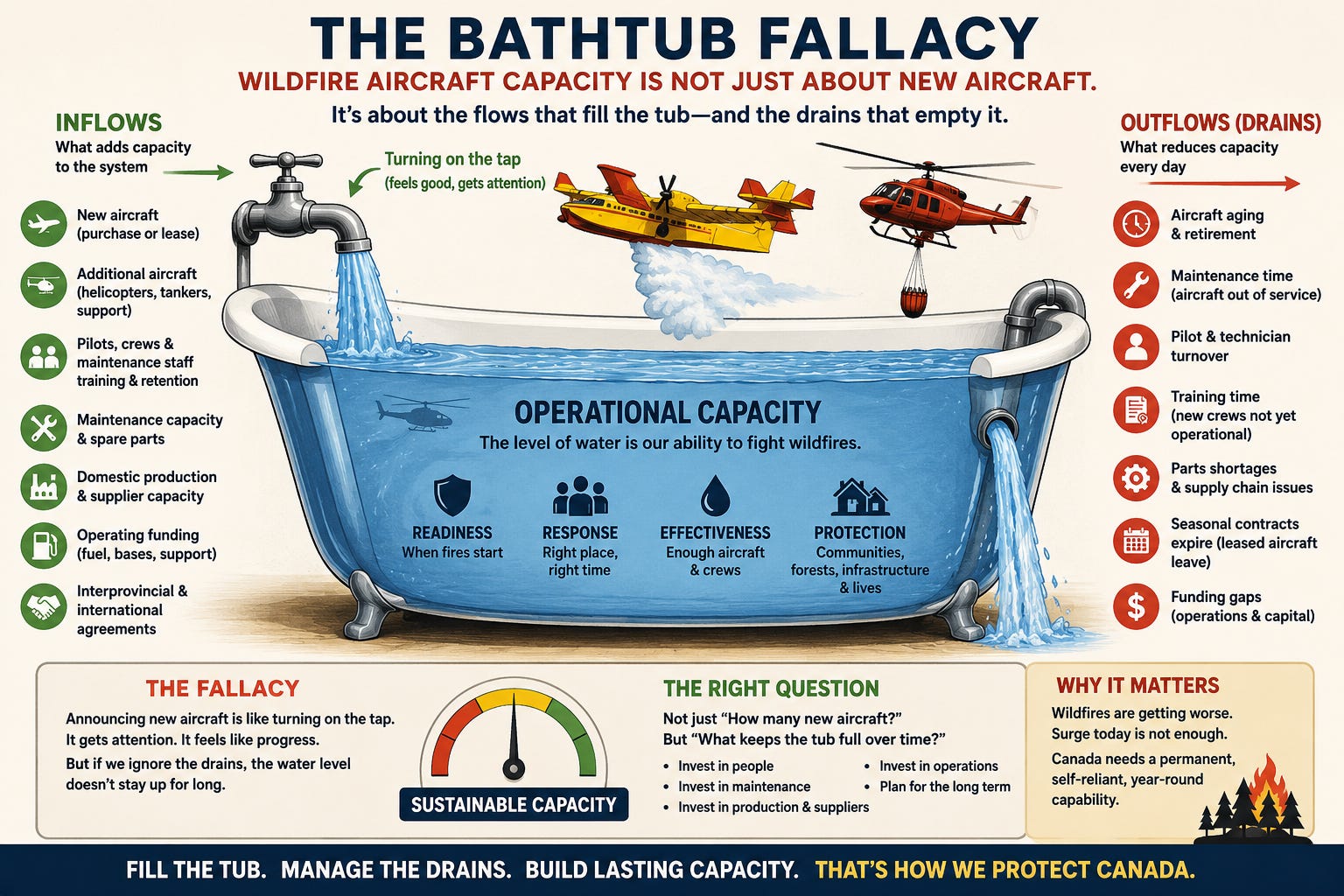
Imagine Canada’s wildfire-response system as a bathtub.
The water in the tub represents our ability to fight fires. It includes aircraft, pilots, mechanics, bases, spare parts, training, fuel, ground crews and operating budgets.
The government has temporarily opened the tap by leasing aircraft.
But water is constantly leaving through the drain:
aircraft age and retire;
aircraft are grounded for maintenance;
experienced pilots and mechanics leave;
provinces compete for the same limited resources;
foreign aircraft become unavailable when several countries burn at once;
temporary contracts expire when the season ends.
Announcing the water entering through the tap tells us very little unless we also know how much capacity is already in the tub and how quickly it is draining away.
That is the missing number.
How many aircraft can Canada place over a fire today—not on paper, but crewed, maintained, fuelled and ready?
How many will remain available in five years?
How many new aircraft are being built each year?
How long must a province wait after placing an order?
And why, when Canada is home to the manufacturer of the world’s purpose-built amphibious firefighting aircraft, is the federal government leasing temporary capacity rather than helping build a permanent Canadian system?
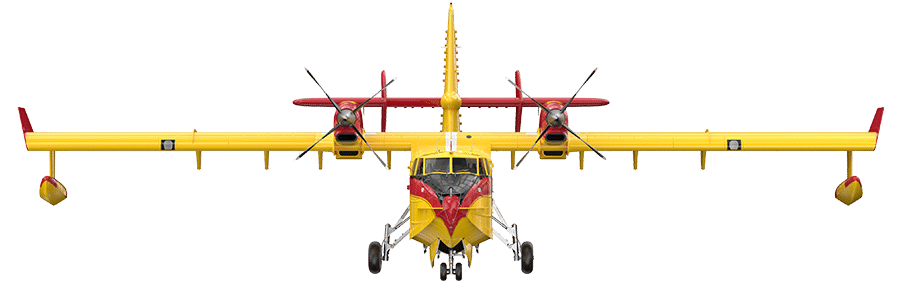
De Havilland Canada is now producing the DHC-515. Its existing order book includes European governments and Canadian provinces, while the company estimates a much larger global replacement market. The first delivery is not expected until 2028, illustrating why production capacity and delivery time matter as much as announcing future purchases.
Canada understands this principle when discussing military readiness.
A submarine is not merely a hull. It requires a shipyard, sailors, technicians, weapons, maintenance, training and a dependable supply chain.
A waterbomber is no different.
Wildfire response is also a system. Yet governments continue to describe it as a collection of seasonal expenditures and emergency announcements.
The ten leased aircraft are welcome.
But they are water from a temporary tap.
Canadians deserve to know what will still be in the bathtub after the tap is turned off.
No posts
Comments
Nothing yet. Say the first thing.
Sign in to join the conversation.