
In 1956, a man named Gillis Lundgren stood in a parking lot in Älmhult, Sweden, trying to fit a table into his car.
The table was called the Lövet. Leaf-shaped, three legs, nothing special. Lundgren was IKEA’s fourth employee, and he was supposed to get this thing to a photo studio for a catalogue shoot. But it wouldn’t fit. The legs got in the way. They always do.
So he took the legs off.
He laid the top down flat, packed the legs beside it, slid the whole thing into the trunk, and drove to the shoot. Problem solved.
What he didn’t know is that he had just invented the modern world.
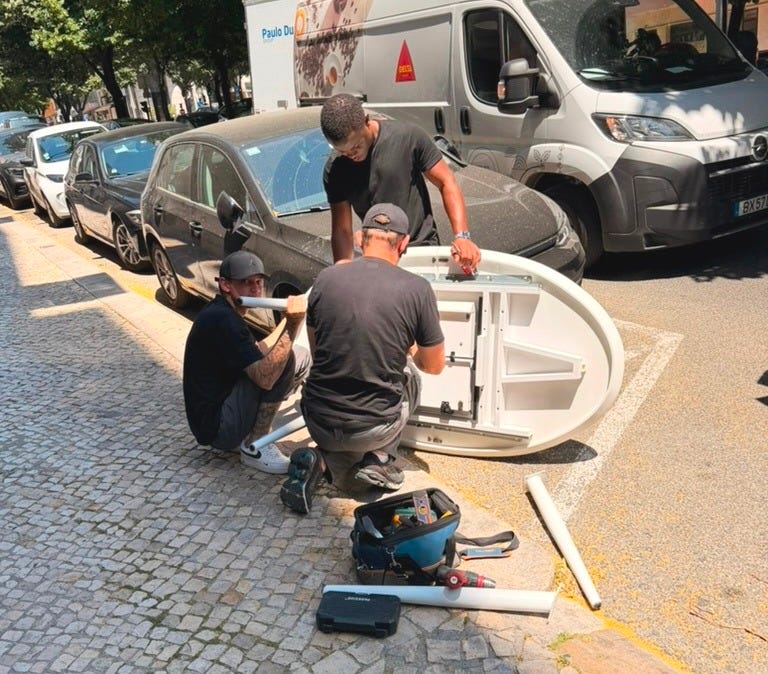
Guinness World Records credits that exact moment, 1956, as the birth of flat-pack furniture as the birth of flat-pack furniture. One annoyed guy with a table that wouldn’t fit. From that small surrender grew a company that taught the entire planet a new verb. We stopped buying furniture. We started assembling it. We brought home the box, found the little wrench, swore at the diagram, and felt something strange when the last screw went in.
We felt proud.
A few years ago, three researchers led out of Harvard and Duke ran a study they named, with a straight face, “The IKEA Effect.” They had people assemble cheap boxes, fold origami, snap together Lego. Then they asked them what their creations were worth. Every time, people valued their own clumsy work like it belonged in a gallery. Lopsided origami. Crooked boxes. Didn’t matter. They built it, so they loved it. They assumed strangers would love it too.
Labor leads to love. Even when the labor leads to garbage.
There was one catch buried in the data, and it’s the thing that matters now. The love only showed up when people finished the thing. Build it and watch it hold, and you fall for it. Build it and watch it collapse, and the feeling vanishes like it was never there.
Pride is not proof. A thing can be entirely yours and still come apart.
Now look at where we are.
AI is the new flat-pack. It handed every person on earth the little wrench. The production cycle that used to take weeks now takes twenty minutes. A website, a logo, a campaign, a deck. Snap, snap, snap, done. And we stand over the finished box feeling the same warm hit of pride Lundgren’s customers felt sixty years ago.
But the only thing AI actually did was speed up the assembly. That’s it. That’s the whole miracle. It made the box arrive faster.
What it really hands you is something just good enough. The thing is, you think you made it. So you trust it. So you’re proud of it. The IKEA Effect, running at the speed of a search bar.
Easy to make has always been easy to forget.
We have felt this exact feeling before. Some of us remember Print Shop Deluxe. You fed in the floppy, picked the clip art, lined up a banner, and just like that you were a master designer. Brochures. Birthday cards. Signs for the church bake sale. We were so proud of those things. For about a year. Then we saw what a real designer could actually do, the spell broke, and we wanted more.
The okay-enough high never lasts. It didn’t last with the banners. It won’t last with the box.
The flat-pack looks great in the photo. Then you move. Somewhere on the second flight of stairs it gives, and you’re holding a shelf in two pieces, thinking, I knew I should have put that one screw in.
That’s the tell. The flat-pack survives right up until the moment it’s tested. Craft is the opposite. Nobody notices it until they go to use it. It’s in the details, and the imperfection, and it holds.
A machine never doubts. That's why it never makes anything great.
A few weeks ago I was coaching an executive who spent his whole career writing code. He said it quietly, almost like a confession. “Our jobs are almost becoming obsolete.” I told him the machine will assemble the box for him all day long. It just can’t tell him whether the box was worth building.
I use the machine all day. I built a small crew of agents to run beside me, gave them British names, and handed Nigel and the agents under him the work that was only ever assembly. They don’t create. They assist, remind, prompt, and work alongside me, and I’m in it the whole way.
Behind them runs a central brain, with memory loops and more than thirty connections wired into hundreds of databases. A story for another day. Think of it as Jarvis in the making, still needing Stark to run the show.
That’s the point. Moving faster on the things that should be fast buys back the slow hours, the ones I spend on the work only I can do, and the ones I’d rather spend looking someone in the eye instead of a screen.
Some of us learned the work the long way. I had a typewriter in high school. I made things before undo existed.
The flat-pack era isn’t going anywhere, and it has its place. The boxes will keep getting faster and cheaper and more convincing.
Let everyone else flood the world with okay. Let the machine provide the instant, the disposable, the thing that looks finished at first glance.
When everyone can make okay for free, the people who still make great become the rarest thing on the table. Their worth didn’t drop. It climbed.
Make the thing only you could make.
Stay human
- Bryan
P.S. What’s the one thing you refuse to let a machine do for you?
I’m Bryan, and if you’re a leader or executive, pull up a chair. Fancy stuff: Built companies in Silicon Valley. Gave a TED Talk. Keynoted 200+ times.
Crashed hard. Found my way back. Lost 85 lbs. Ditched diabetes. Moved to Lisbon. And as it turns out, you can operate differently at any age.
Now I work with leaders and teams who’ve proven themselves but know something needs to shift.
Popular Posts:
Connected Detachment - The looser the grip, the longer it lasts.
Main Character Syndrome - The scene starts when you walk in.
10 Days of Silence - I stopped speaking for ten days. The noise I found was mine.
Comments
Nothing yet. Say the first thing.
Sign in to join the conversation.