
I grew up skiing for fun and competitively. My mom put me on skis and snowplowed with me between her legs and took me down the mountain. It took a hot minute before I wanted to do it on my own. As time went on I’d had a taste of flying and maneuvering snow. Gates, edges, speed, I loved the mountain.
Then I tried to snowboard, back when half the resort didn’t want me there.
It humbled me instantly. Two feet strapped to one board is a different animal. All my graceful skiing meant nothing. I spent that first week mostly on the ground. Catch an edge, go down. Get up. Go down again. Here’s a photo of me mid-turn in my red jacket, a friend face-planted behind me, skiers off to the side who already knew how to do the thing I was failing at.
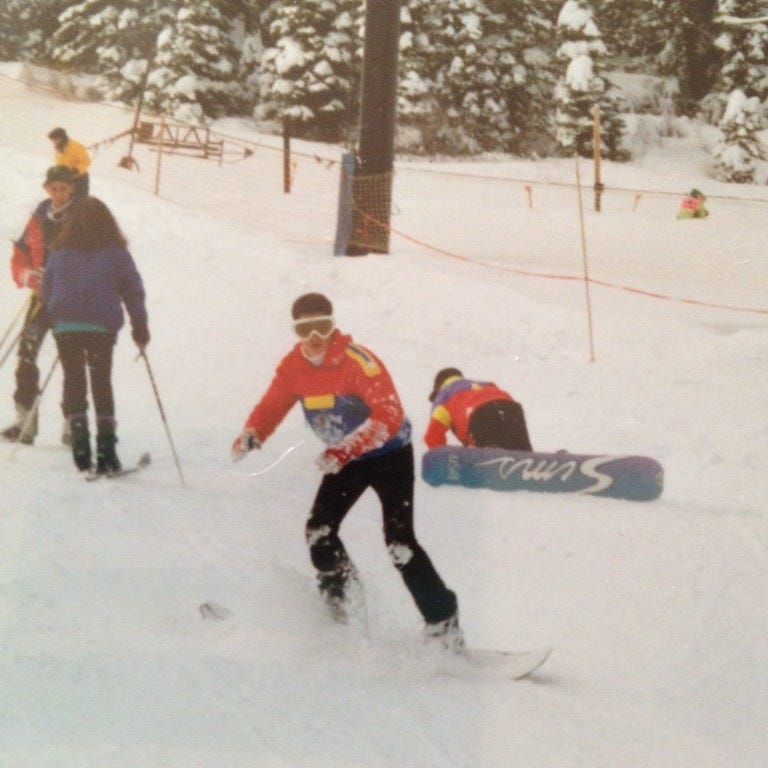
Snowboarding was banned at most resorts then. Skiers thought it was a fad. Something that would pass. So there I was, good at the old thing, falling at the new one, on a board nobody wanted on the hill.
I wasn’t wrong about snowboarding. I was just early. And from where everyone stood, those looked like the same thing.
Which is how I ended up remembering this guy on the ice in 1912.
Forty Below
In 1912, a young fur trader stood on the ice in Labrador and watched something that would outlive him by a century.
The Inuit were fishing through holes in the ice. They pulled the fish into air that sat at forty below. The fish froze almost the instant it hit the air. Stiff. Solid. Done in seconds.
Months later they thawed those same fish and cooked them. The fish tasted fresh. Not preserved. Not passable. Fresh.
The trader’s name was Clarence Birdseye. You’ve seen his name a thousand times and never once thought about it. It’s most likely on your bag of peas in your freezer.
But something nagged at him. Back in New York, frozen fish was garbage. Mushy. Gray. The kind of thing you ate because you had to. Same fish. Same idea. Same cold. So why was the fish in Labrador fresh and the fish in New York ruined?
It wasn’t the cold.
It was the speed.
Freeze a fish slowly and big ice crystals form inside the flesh. They tear the cell walls apart. You thaw it and it falls to mush. Freeze it fast enough and the crystals stay small. The cells hold. The fish remembers what it was.
The secret of frozen food was never the temperature. It was the timing.
The Thing We Call Luck
But here's where it gets strange. We know timing matters. We just act like it's out of our hands.
We talk about timing like it’s weather. Something that happens to us. He got lucky. She was in the right place. Wrong time for that one. As if timing arrives from somewhere else and we just stand in it.
Then Bill Gross actually ran the numbers.
Gross founded a startup studio and watched a hundred companies of his own live and die. He pulled in a hundred more. Then he ranked all two hundred on five things. The idea. The team. The business model. The funding. The timing.
He expected the idea to win. He’d bet his life on ideas.
Timing won. By a wide margin. I know, I was surprised too.
Timing accounted for forty-two percent of the gap between the companies that made it and the ones that didn’t. More than the team. More than the money. More than the idea itself.
The single biggest reason a thing works is when it shows up.
Right, and Early
So timing matters most. Fine. Now the part nobody tells you.
Birdseye was right in 1912. The world wasn’t ready until almost 1930. And it didn’t truly catch on for years after that.
Think about what he was holding. A way to keep food fresh across an ocean and a season. A brand-new thing. And almost nobody could use it. Grocery stores had no freezers. Homes had no freezers. The trucks and the trains had no freezers. He had the answer to a question the world hadn’t finished asking.
So he waited. Not idle. He built the machine. He froze the fish. He sold his company and his patents in 1929 for twenty-two million dollars, worth closer to $400 million today. Then he kept building while the world slowly grew the freezers his idea needed to live in.
He was right for almost twenty years before anyone agreed.
From the outside, being early and being wrong look exactly the same.
That's the part that messes with your head. Not the falling down. The part where you can see it clearly and no one else gives a damn yet.
The Two-Year Knowing
I coached a senior leader at one of the largest media companies you’d know by name. She told me that she’d known for two years it was time to leave.
Two years.
She kept waiting for the right moment. A cleaner quarter. A better market. A sign. She was standing on the ice waiting for someone to pull the fish out for her.
The cost wasn’t that she was wrong. She was right the whole time. The cost was the lag. Two years living inside a knowing she wouldn’t act on.
I said you don’t control when the world is ready. You only control how fast you move on the thing you can already see.
She finally moved. Not fast, but she moved.
Move Before the World Is Ready
Here's what I tell people:
Find the one variable that’s yours. Birdseye couldn’t build the world its freezers. He could control the speed of his own freeze. Stop wrestling the things you don’t own. Pour everything into the single lever that’s in your hand.
Separate early from wrong. When you’re certain and the world is quiet, ask one honest question. Is the idea broken, or is the world just not here yet? They feel identical and they demand opposite things. One says stop. The other says hold the line.
Build through the wait. The gap between your knowing and everyone else’s isn’t dead time. It’s the work. Birdseye froze fish nobody was buying yet. Make the thing before there’s a market for the thing.
Back to the Ice
A man stood on the ice over a century ago and noticed that fast and slow were not the same. Everyone saw cold. He saw speed.
That’s the whole thing. Most people are waiting for the right time like it’s a season that arrives on its own. It won’t. The fish doesn’t freeze because the air is cold. It freezes because it’s cold fast.
You already know your thing. You’ve probably known for a while.
Stop waiting for the world to thaw.
Stay human.
-Bryan
P.S. There's something you've been carrying for longer than you know you should. I'd love to know what it is.
Hit reply or comment below, I read every single response, and you might be surprised what happens when you say it out loud.
I’m Bryan, and if you’re a leader or executive, pull up a chair. Fancy stuff: Built companies in Silicon Valley. Gave a TED Talk. Keynoted 200+ times.
Crashed hard. Found my way back. Lost 85 lbs. Ditched diabetes. Moved to Lisbon. And as it turns out, you can operate differently at any age.
Now I work with leaders and teams who’ve proven themselves but know something needs to shift.
BEing Human is a reader-supported publication. To receive new posts and support my work, consider becoming a free or paid subscriber.
Popular Posts:
Connected Detachment - The looser the grip, the longer it lasts.
Main Character Syndrome - The scene starts when you walk in.
10 Days of Silence - I stopped speaking for ten days. The noise I found was mine.
Comments
Nothing yet. Say the first thing.
Sign in to join the conversation.