
In 1929, in a small German hospital in Eberswalde, a 25-year-old surgical resident named Werner Forssmann walked down a hallway with a catheter snaking through a vein in his arm toward his own heart.
Every senior physician had told him it would kill him. The consensus was that anything foreign passed into the human heart would trigger cardiac arrest.
He believed otherwise. No proof. Just a pattern he’d traced in his head and a willingness to put his body where his hypothesis was.
He convinced the operating-room nurse, Gerda Ditzen, to help. She agreed on one condition. He had to do it on her, not himself.
So he strapped her to the table, called it routine precaution, pretended to anesthetize her arm, and anesthetized his own. He pushed the catheter in. Then released her.
She realized what he’d done.
They walked together to the X-ray room one floor below. He pushed the catheter the full sixty centimeters into his own right ventricle and took the picture himself.
He was reprimanded. Shut out of academic medicine for two decades.
In 1956, he won the Nobel Prize.
You don’t earn the right to act by becoming the expert. You earn it by deciding to act before the experts catch up.
I'm not telling you to thread anything into your own heart.
So don't do the catheter part. Do the conviction part. ;-)
What Firefighters Know
In 1985, a research psychologist named Gary Klein studied twenty-six fireground commanders with an average of twenty-three years on the job.
He wanted to know how they decided what to do when a building was burning down around them.
When he asked how they made decisions, they all said the same thing.
They didn’t.
They didn’t compare options. They didn’t weigh pros and cons. 80% of their calls were made in under a minute. They saw the situation, recognized a pattern from 20 years of fires, and acted on it.
Klein called it Recognition-Primed Decision Making. The U.S. Marines and Army now train their officers around it.
This isn’t an expertise gap. It’s a conviction gap.
Their expertise wasn’t a more sophisticated analytical engine. It was a more refined ability to recognize a pattern and trust it.
The decision was made before deliberation could start.
Most of what we call expertise in life and business is the slow version of that.
The Quiet Going Quiet
In coaching senior leaders at Fortune companies and founders, the pattern I see most often isn't arrogance. It's the silence. Expertise used to set us apart. AI and search hand everyone the same information in seconds. The moat is gone.
A director I’ll call Maya, at one of the largest pharmaceutical companies in the world, told me last week that she’d noticed something uncomfortable.
She used to be the expert in her old role. She knew the answer before the meeting started.
Now she’s in a role where she isn’t the expert anymore, and she only takes a stand when somebody pisses her off enough to make her forget she doesn’t know.
Anger gives her conviction.
Without it, she’s a sapling in a wind that hasn’t even started blowing yet.
This is the pattern at the top right now.
At the rate the world is changing, I see more people waiting for permission from a study, a peer, or a feeling sharp enough to override the doubt.
When was the last time you took a stand because you believed it, and not because you’d been armed with data or moved to anger?
The Day I Lost All My Words
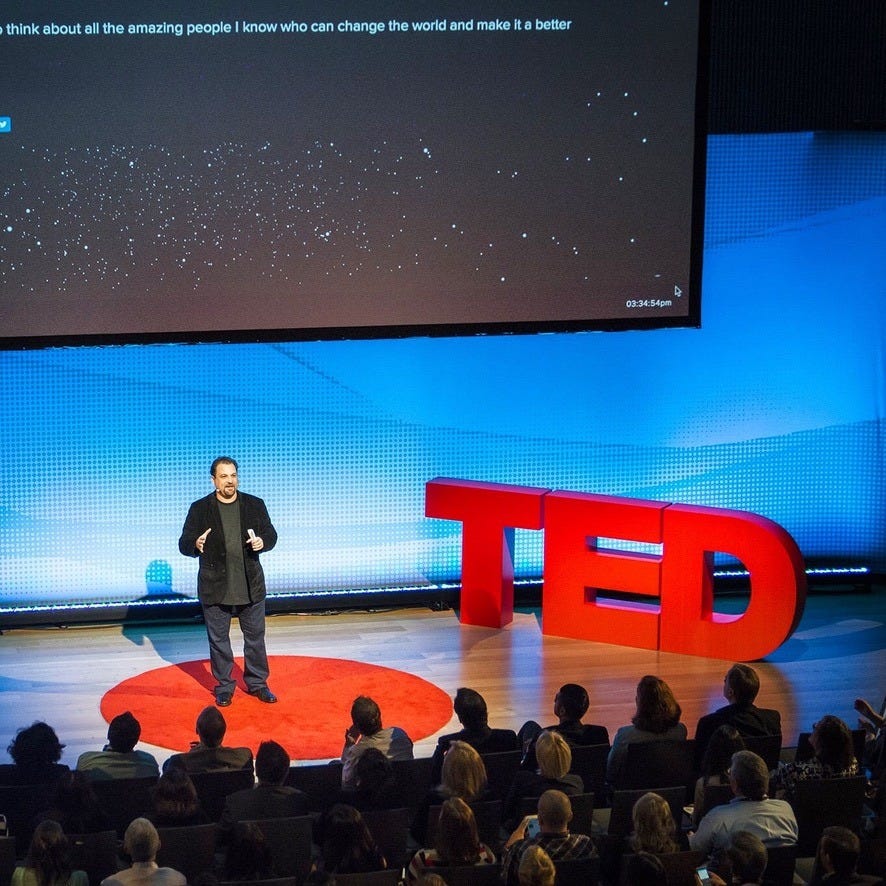
A number of years ago, I was given the chance to give a TEDTalk.
I worked on it for months. TED assigned me a coach. I did three hundred hours with her. I knew every word. Every pause. Every breath. I could give the talk in my sleep.
The day before, in the dress rehearsal in front of the whole TED team, I lost it. Not a beat. The whole thing. I forgot the opening. I forgot the closing. I forgot why I’d ever wanted to give the talk. I started tearing up in front of strangers.
Courtney was in the room. My wife. The person who’s been in every room that ever mattered to me, rooting for me before I knew I needed it.
She walked over to my coach and said one sentence.
He’s a heart speaker. He’s been working so hard he’s burned out, and you’ve coached the thing that makes him him right out of him.
They picked up my script and tore it in half.
My TED coach then said (in a British accent)…
Just go up there tomorrow. Say the thing you actually believe. Don’t rehearse.
I didn’t open it again that night. I woke up, got dressed, walked onto the stage, and gave the talk with pure conviction.
It worked.
The talk, by the way, was about the power of sharing. About how being human with each other was the thing reimagining our future.
I had spent three hundred hours making sure I knew every word of a talk about being human, and almost lost the human in it.
This isn't just me. My longtime client Lynn Smith forgot every word of her first keynote after fifteen years anchoring national news (CNN, Good Morning America).
We worked it together launching her now thriving business. Her TEDx on what cracked it open just dropped this week, and her closing line is the whole article in one breath: if your brain can't tell the difference between an imaginary threat and an imaginary triumph, make something up that's useful. Watch it here.
Rip Up Your Script
Find your conviction floor. Not what you know. What you believe. The thing you’d defend even if the data turned out wrong. Most people can list everything they know and not one thing they believe. Start the list. The ground you stand on isn’t your résumé. It’s your floor.
Stop waiting to be pissed off. Anger is a shortcut to conviction, but it costs you trust, allies, and the room. The same conviction is sitting underneath the anger, available without it. The ones who learn to access it cold becomes unmovable without becoming unkind.
Recognize, then act. Klein’s firefighters didn’t think faster. They trusted the pattern faster. All of us have thousands of patterns stored in our body from years of work (and life). Yet most defer to the room because the room has more letters after its name. Speak from the pattern. Then test it. Being wrong out loud almost always costs less than being right in silence.
The Picture He Took
Forssmann walked back to his ward that day with an X-ray of his own beating heart in his hand. The first picture of its kind ever taken.
The senior physicians who told him it would kill him weren’t wrong on the data they had.
They were just wrong on the only data that mattered, which was that we could decide to be the proof of our own hypothesis.
He waited twenty-seven years for the world to agree.
You will not have twenty-seven years. The world is moving too fast for the experts to catch up before the next thing arrives.
Your job right now is not to wait for the consensus. It’s to make the call from the floor you’ve already built and live with what comes next. Stop asking.
Stay human,
-Bryan
P.S. What are you done carrying? Reply or comment with a word or sentence. You'll be surprised how much just typing it lightens it.
P.P.S. If what you’re done carrying is the weight of too many options, too much noise, or waiting until the room gives you permission to know what you already know, I made something private for that.
It’s called The Triangle of Clarity.
It’s a simple exercise to help you find the floor underneath your next decisions: what you truly want more of, what got you here but may not carry you forward, and the three things that deserve your focus now.
I’m Bryan, and if you’re a leader or executive, pull up a chair. Fancy stuff: Built companies in Silicon Valley. Gave a TEDTalk. Keynoted 200+ times.
Crashed hard. Found my way back. Lost 85 lbs. Ditched diabetes. Moved to Lisbon. And as it turns out, you can operate differently at any age.
Now I work with leaders who’ve proven themselves but know something needs to shift.
Top Recent Popular Posts:
Connected Detachment - The looser the grip, the longer it lasts.
Main Character Syndrome - The scene starts when you walk in.
10 Days of Silence - I stopped speaking for ten days. The noise I found was mine.
Comments
Nothing yet. Say the first thing.
Sign in to join the conversation.