
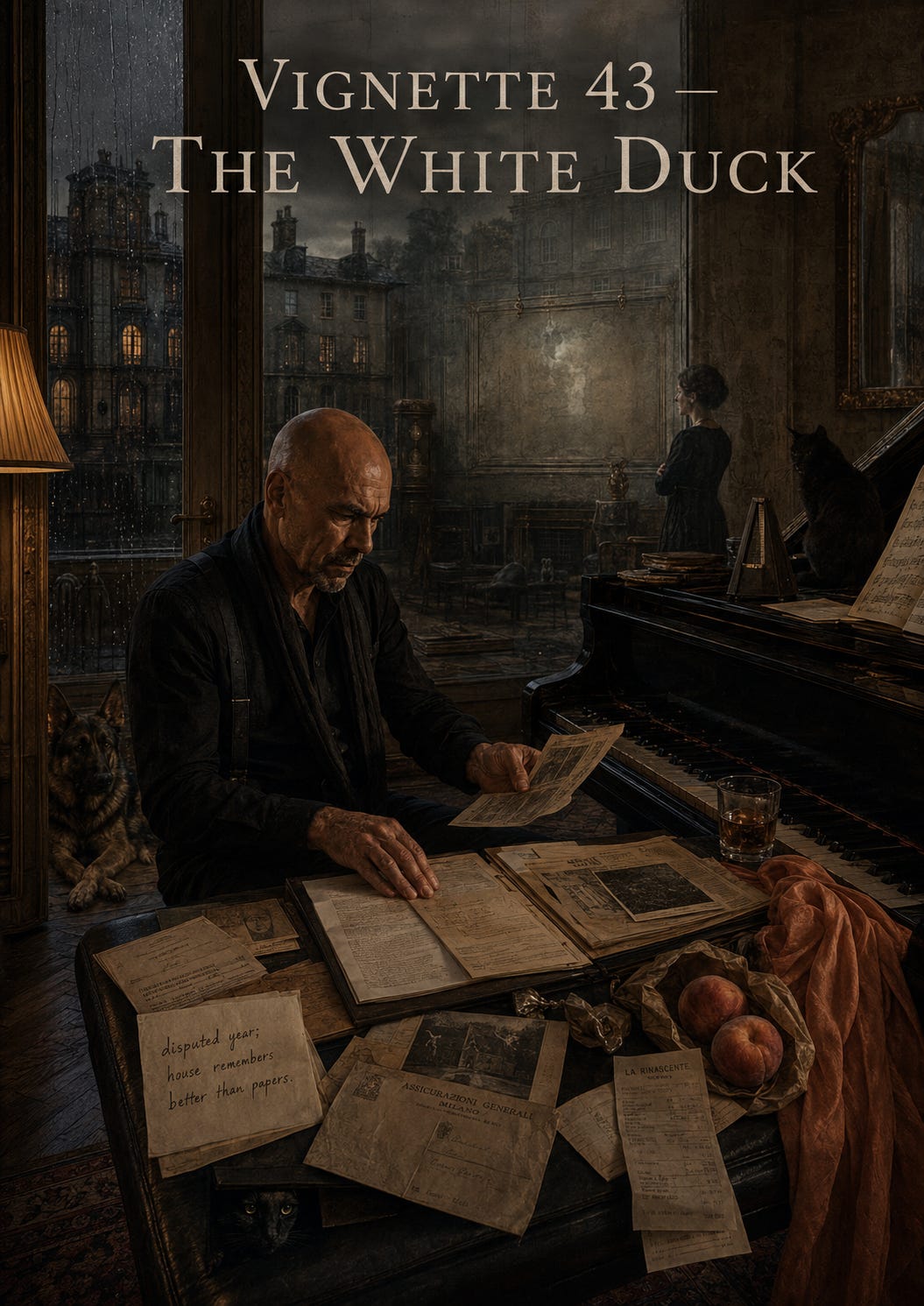
May 15, 1994 — Late Afternoon | Milan / Remembered Norfolk
White was what survived.
Not the date.
Not the file.
Not even the name of the room with any certainty.
Only the white.
Isaac sat in the smaller room of the Milan apartment with Verbruggen’s folder open across the piano bench and a clipping held in one hand so long the paper had begun to warm under his fingers. Outside, spring rain had passed and left the courtyard dark at the seams, the paving stones below holding a diluted strip of late light like old silver. The window stood cracked a finger’s width. Air entered cool and mineral, carrying the city’s faint mixed breath of stone, wet leaves, coffee from somewhere unseen, and the slow civilized traffic of a place that preferred its weather edited.
The apartment was no longer quiet in quite the way he had chosen it to be.
That was Anamaria’s fault.
Not entirely, perhaps. Metro had claimed the radiator beneath the window with the imperial confidence of an animal who believed warmth was less a comfort than an inheritance. Gnome had installed himself beneath the piano bench, invisible except for two accusing eyes whenever paper shifted too close to his jurisdiction. Jaxon slept in the threshold between the smaller room and the hall, broad head on his paws, one ear lifting now and then at the sounds of the courtyard as if Milan were a problem he had not yet agreed to trust.
Still, the alteration had begun with Anamaria.
By the middle of May, she had made a pattern of him.
Lunch first, when she decided he had been left too long among papers and coffee. A shop afterward, if she found the apartment insufficiently lived in, which she often did. Linen one day. Candles another. A ridiculous argument over fruit because she insisted peaches should be purchased as if one were choosing lovers and not provisions. Rehearsal when she wished to punish him properly, arriving with a score under one arm and the air of a woman who had never once asked permission from furniture, men, weather, or God.
She had begun using his piano for work.
That was how she described it.
Work.
As if she did not know precisely what happened to a room when she entered it, took off her gloves, set one hand on the lid of the instrument, and said, “There. Now you may be useful.”
She sang less than she commanded breath. She stopped him for tempo, for color, for insolence, for the unforgivable decency of being correct when she had intended to correct him first. Then, after an hour of music, she would announce lunch as though hunger were a civic responsibility and Isaac had failed the city by neglecting it.
“You are my project,” she had told him that afternoon, cutting a pear with a knife she had borrowed from the trattoria and not asked whether she might use.
“I object to the word project.”
“Of course you do. That is why it is accurate.”
“I was happier when you confined yourself to opera.”
“No,” she said, looking at him over the fruit. “You were quieter. That is not the same thing.”
She had been pleased with herself when she said it.
Not openly. Never vulgarly. But he had seen the satisfaction at the corner of her mouth, the private pleasure of a diva who had identified a difficult role and decided it would submit to her interpretation eventually. She had placed Mateo in his path twice, though she would have called that hospitality if accused. She had watched Marcelli’s name enter his rooms and smiled as if a chord had sounded exactly where she expected it. She had not intended, perhaps, to build anything as precarious as what had begun forming now around three men, three instruments, and too many repeated evenings.
But Anamaria respected accidents only when they proved her instincts correct.
On the chair near the piano lay the evidence of the day’s occupation: her rehearsal score left open and face down, a silk scarf the color of burnt apricot, two paper-wrapped peaches she had bought and then declared his responsibility, and one folded receipt from a shop where she had insisted he needed better napkins if he expected civilized people to continue eating in his kitchen.
Civilized people.
By which she meant herself, mostly.
Possibly Mateo.
Possibly Marcelli, though she said his name differently now, with the smallest audible enjoyment, as if it amused her to imagine two dangerous men discovering that elegance did not spare them from appetite.
Isaac had come back from that lunch, from that shop, from that hour at the piano under her royal tyranny, and found Verbruggen’s folder waiting where he had left it.
The clipping in his hand refused to settle into history.
One source placed the theft in 1990.
Another in 1992.
One private memorandum in Verbruggen’s narrow hand gave only the house and the title, as if the year were beneath his interest or above his confidence. Houghton Hall. The White Duck. A note in the margin: still absent.
The file itself had become thin with contradiction.
That, ordinarily, would have diminished a thing.
Instead the uncertainty sharpened it.
Because what Isaac remembered—what one of his dead paper men had remembered first and then passed into him with all the rest—was not chronology. It was atmosphere. An old house in Norfolk. Corridors carrying cold differently than modern walls did. The shallow complaint of floorboards under runners too fine to deserve such weather. A pale painting in an aristocratic room, its brightness quieter than the gilt surrounding it and therefore more dangerous.
White survived.
Everything else blurred.
Metro shifted on the radiator and gave a low, irritated sound, as if the rainlight itself had offended him. Jaxon opened one eye, saw nothing requiring intervention, and closed it again.
Gnome remained under the bench.
Judging.
Isaac set the clipping down and looked at the smaller stack beneath it: insurance correspondence with the title line cut off, one faded photocopy of a catalogue entry, and a typed note from Verbruggen reading only:
disputed year; house remembers better than papers.
Yes, Isaac thought.
Of course it did.
He leaned back slightly on the bench and let the memory rise the way it always did when body reached further than archive.
Not at once.
Not by command.
The old aliases never returned under direct summons. They came when the room, the weather, and the paper’s degree of offense aligned closely enough that some older version of perception opened its hand.
This one had belonged to Marcus Delacroix.
Or near enough Marcus that disentangling him from the man who came later no longer felt useful.
Marcus had gone to Norfolk under invitation, not for the theft and not after it exactly, but in that strange penumbra when a house had already been violated and still believed, arrogantly, that hospitality might repair what locks and loyalty had not preserved. Some houses did that. They mistook civility for triage. They called in insurers, discreet advisors, family friends, men who knew frames, men who knew paperwork, men who knew how to stand in old rooms and murmur in the correct register about valuation, replacement, confidence, the need not to distress the press with further speculation.
Marcus had always been good at that register.
He knew how to look at aristocratic unease without appearing entertained by it.
How to move through inherited interiors as if raised among them and therefore incapable of vulgar admiration.
How to listen to servants and cousins and estate men without seeming to understand more than politeness required.
That was why he had been invited to Houghton.
Or perhaps not Houghton exactly.
This was where the archive failed him.
There had been a drive lined with rain-dark trees.
That much he knew.
There had been pale stone under an English sky the color of diluted pewter.
A porter’s room or a side entrance or perhaps merely a secondary bell reached by those who arrived with business rather than blood.
There had been old air in the hall—wax, wool, cut flowers too long standing, and beneath all that the damp mineral patience of a house that had outlived empires by refusing to regard them as more substantial than weather.
The year might have been 1990.
Or 1992.
Or, if the file had already begun lying by then, some other adjacent season into which later hands had tried to pin the event.
Marcus did not remember the date.
He remembered the cold.
English country houses always carried two climates: the public one and the private one. The public climate lived in fireplaces, silver, upholstery, portraits trying to hold posture across generations. The private one moved through corridors, under doors, along servants’ stairs, inside stone thick enough to keep memory better than heat. Houghton—or the house his mind continued calling Houghton because the papers insisted and no better certainty had survived—had been all private climate once one got beyond the principal rooms.
A woman in black silk had led him through one of those principal rooms.
Not widow exactly. Not daughter. Not staff. A relation by marriage perhaps, the sort of woman old houses produced when money, breeding, disappointment, and duty were left alone together long enough. She had spoken in that English murmur which always sounded, to foreign ears, as if emotion had been ironed flat and then hidden again in the linen cupboard.
“Everyone keeps asking about value,” she had said.
Marcus had not answered immediately.
That was why men invited him into such rooms. Silence, used correctly, felt like depth.
She stopped before a wall where the loss had occurred and looked not at him but at the place the painting had been.
“It wasn’t valuable here,” she said. “It was specific.”
That was the sentence that lasted.
Not valuable.
Specific.
Marcus had turned then and seen the gap properly.
The room itself was too old and too well composed to appear wounded by one missing work. That was what grand houses did best. They absorbed insult into proportion. But the eye still went to the place at once because it had been prepared for years to expect a certain interruption of color. And what it expected, more than frame or composition, was brightness. The old wallpaper, the furniture, the heavy civilized weight of portraiture elsewhere in the room—all of it had been arranged, over years if not generations, around one pale held thing.
The White Duck.
Even if one had never seen the catalogue or heard the title spoken aloud, the absence announced its old temperature. Something white had once floated there against all the cultivated dusk around it. The wall now looked not empty, exactly, but unrelieved.
Marcus stepped closer.
The wallpaper showed the faint cleaner silhouette where the frame had protected it from smoke and ordinary years. The brass hanging hardware remained. One small mark lower down where a servant’s hand had perhaps once steadied a chair while dusting, or where, on the wrong morning, another hand had brushed the wall while removing what did not belong to it anymore.
“That one,” the woman said, “always made the room behave.”
Marcus looked at her then.
She gave the smallest apology with one shoulder, embarrassed perhaps by the sentence and yet unwilling to withdraw it.
“You know what I mean,” she said.
Yes, he did.
Rooms bent around certain works. Not merely visually. Psychically. A pale Dutch or French or provincial thing in an old English interior could act like a cooling note in a chord otherwise too dark with lineage. Remove it and the rest of the room did not simply look diminished. It looked overconfident, as though all the other objects had been relying on one small creature’s whiteness to keep them from becoming oppressive.
That was what remained now in the memory: not the duck itself, but the behavior it had once imposed.
Marcus had been shown other rooms afterward. Corridors. A breakfast parlour. A library pretending not to listen. The service stair by which trays still moved as if no theft had ever touched the house’s authority. He remembered a footman with nervous hands. A housekeeper too composed by half. Someone speaking of police as though they were weather and therefore beneath notice so long as the silver remained counted.
And beneath it all the same psychic fragility that old aristocratic houses carried once something had been taken from them. Not panic. Worse. Violation of narrative. The house could survive war, debt, scandal, generations of poor marriages, and a hundred dead Labradors buried in the yew walk. But remove one specific painting from one specific wall and suddenly continuity itself began showing its seams.
Marcus had read the corridors that day the way other men read financial statements.
Servants’ routes.
Sight lines.
Which windows mattered and which only wanted to.
Where the public floor gave way to the private one.
What the house had already admitted about itself before any intruder forced the matter.
He had not come there to steal.
He had not touched a thing.
He had not, in all probability, even stood in the room while the exact title was spoken with certainty enough to satisfy a later court.
Yet the body had kept it.
The white.
The cold.
The private climate in the back corridors.
The sentence about specificity.
The way the room had looked not bereaved, but less governed.
He returned slowly to Milan.
The smaller room waited around him with its lamp, its closed afternoon light, its piano still faintly warm from Anamaria’s earlier demands. Rain had started again beyond the courtyard, soft enough that it did not sound like weather so much as revision. On the bench before him the clipping still carried its date dispute like a bad scar. 1990, one paper said. 1992, another insisted. The archive wanted certainty in the way bureaucracies always did. Not because certainty improved truth, but because certainty let files stack neatly and close.
He distrusted that urge at once.
Some crimes did not survive as dates.
They survived as temperatures.
Jaxon stirred in the doorway and lifted his head.
Not alarmed.
Only attentive.
The dog had begun doing that now whenever Isaac returned too far inward. A small practical summons. The living world’s refusal to let him disappear completely into paper, weather, and old rooms. It irritated him less than it should have.
Metro opened one eye.
Gnome, still beneath the bench, made no visible concession to concern, though one black paw had appeared from shadow and rested against the leg of the piano as if claiming the instrument against all human instability.
Isaac touched the corner of the clipping and did not pick it up again.
If records failed here—if the file could not even keep the year in order—what else in his own past now existed more fully as atmosphere than as evidence. How many coasts, houses, dinner rooms, service stairs, donor halls, and winter corridors remained inside him only by pressure and weather while the paper world around them had already begun correcting itself into something cleaner and more misleading.
And if those instabilities could be used—if another intelligence, patient enough and paper-minded enough, understood how uncertainty made better cover than absence—then who else had perhaps already begun living inside the blur.
The thought should have ended there.
Instead, his eye went to Anamaria’s score.
The apricot scarf lay over it now, slipped from the chair back by some draft or feline interference, half covering the notation she had marked in pencil that afternoon. A breath mark. A place where she had stopped him with one lifted finger and said, “No, no. There. You must make room for the body before the note can live.”
He had objected to the wording.
Naturally.
She had ignored him.
Naturally.
Now the line sat under silk in his room as if it had always belonged there.
Habit, he thought, was dangerous because it never looked like entry while it was happening.
Lunch.
A score.
A scarf forgotten with perfect confidence.
A dog sleeping in the threshold.
Cats teaching themselves the warm angles of the room.
A woman ordering him to live more audibly.
Two men beginning to arrive too often after dusk with instruments, hunger, and excuses too well made to remain excuses much longer.
A room could become legible before its occupant consented to be read.
He looked once more at the line in Verbruggen’s hand.
disputed year; house remembers better than papers.
Yes.
But houses were not the only things that remembered in weather.
Apartments did too, if one was careless enough to let them gather routine.
Isaac folded the clipping once and tucked it back into the folder without resolving the date. Let the archive keep its fracture. Let the duck remain pale and unstable and therefore sharper in the mind than any official chronology could have made it.
When he closed the folder, the room seemed to cool by one degree.
He rose and crossed to the window.
Below, the rain silvered the black stones of the courtyard. One opposite window had lit while he sat there. The figure moving behind it stopped briefly, half visible through lace, then turned away. The apartment behind him remained as it had been left—careful, controlled, almost honest in its restraint.
Almost.
Jaxon stood now, slow and quiet, and came to the window without asking. He did not press against Isaac’s leg. Not immediately. He only took up position beside him, shoulder near enough to be known, near enough to count. Metro, dissatisfied with the altered temperature, leapt from the radiator to the chair and settled directly on Anamaria’s scarf. Gnome emerged from beneath the bench at last and moved once around the closed folder, tail high, as if sealing a judgment no court had requested.
Isaac rested two fingers on the latch and let the unresolved white of the duck float once more through memory.
No frame.
No date.
Only brightness surviving better than paperwork.
Behind him, the piano waited for Anamaria’s next intrusion.
The peaches waited in their paper.
The animals arranged themselves around his silence as if they had been hired by some more honest intelligence to keep him from vanishing into it.
That, too, he thought, was a kind of danger.
To be continued…
-By Noble Osborn
This Substack is reader-supported. To receive new posts and support my work, consider becoming a free or paid subscriber.
Comments
Nothing yet. Say the first thing.
Sign in to join the conversation.