
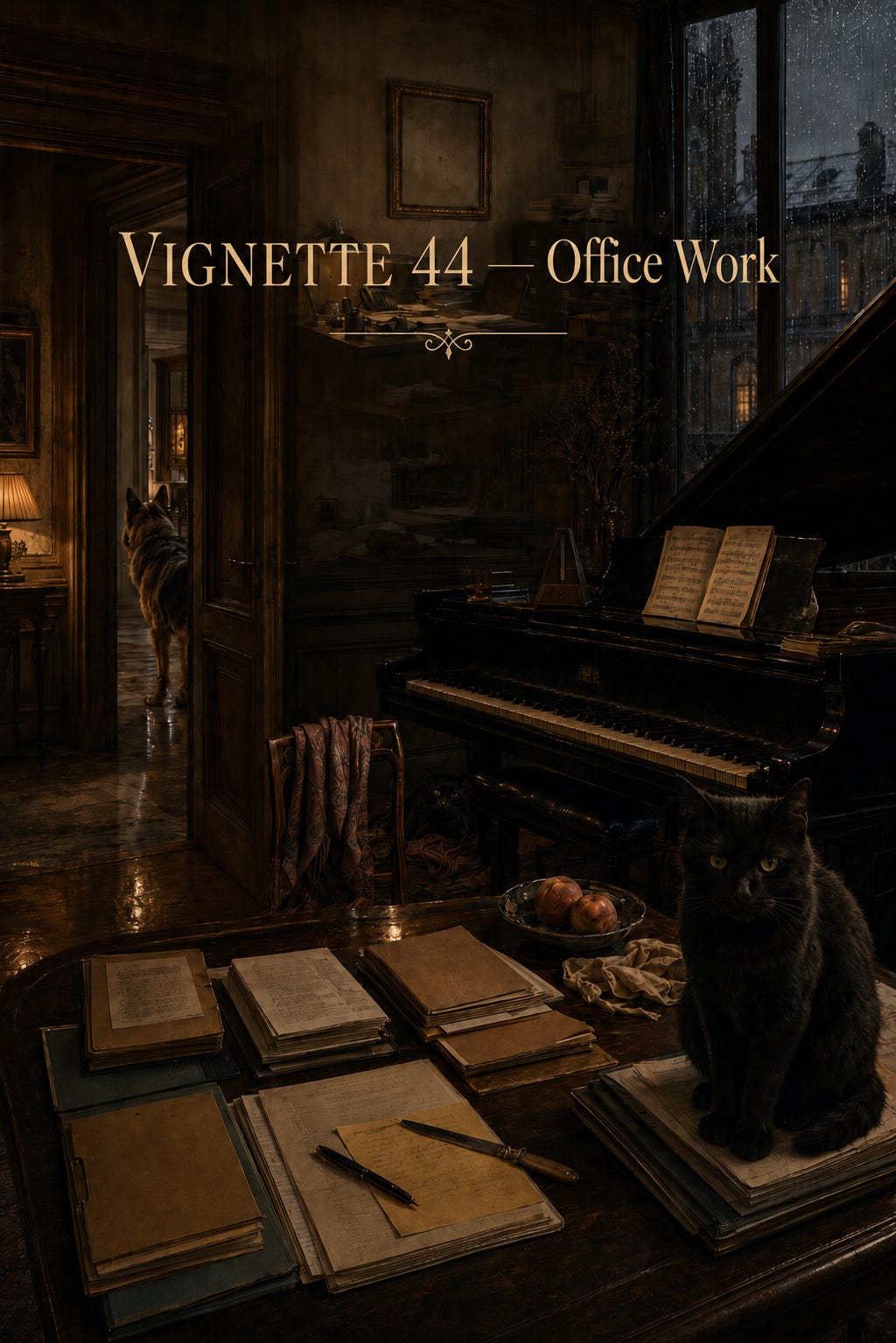
May 24, 1994 — Late Afternoon | Milan / Remembered Monterey, 1991
Routine had entered the apartment under Anamaria’s name and pretended to be kindness.
Isaac noticed it first because the animals trusted it before he did.
Jaxon knew her knock now. Not every knock. Not Bellini’s fussy impatience below, not Marcelli’s measured economy, not Mateo’s hesitation before the second touch of hand to wood. Anamaria struck the door as if she were cueing an entrance: three light blows, spaced like a musical phrase that assumed the room would answer properly. Jaxon had learned the rhythm. He would rise from the rug with grave approval, tail beginning once against the floor before dignity persuaded it to stop.
Metro, less burdened by dignity, went directly to the table whenever she came, because Anamaria brought paper wrapping, pastry crumbs, butcher’s twine, fruit, silk, score pages, and all the other incidental proofs of a life being noisier than Isaac had intended.
Gnome preferred the piano bench.
That, Isaac thought, was how occupation began. Not with violence. With expectation.
By late May she had become part of the apartment’s private weather. Lunch, when she judged he had worked too long among papers. Shopping, when she declared that no man should be trusted to furnish his own domestic life if he owned both a Bösendorfer and towels as joyless as these. Rehearsal, because she had now decided that if she must suffer certain passages of Puccini or Bellini or Verdi before evening, then Isaac would suffer them too and be useful while doing it.
That morning she had used his piano again, one gloved hand resting on the lacquer before she removed the gloves and set them aside as if the room were a rehearsal studio she had graciously agreed to improve.
“You are late,” she had said.
“It is my apartment.”
“That is geography, not punctuality.”
Then, after the hour’s labor, after she had stopped him three times for being too careful and once for being correct too early, she had taken him to lunch and informed him over fish and white wine that he was now her project.
“I object to the word.”
“Of course you do.”
“There are better words.”
“No,” Anamaria said. “There are softer words. I did not choose one.”
He had looked at her across the table.
“And what exactly is the project.”
“To make you less devoted to your own disappearance.”
He might have answered. She had not allowed him time.
“Also,” she added, lifting her glass, “I have excellent instincts.”
“About what.”
“About music. About rooms. About men. About what happens when one places the correct instrument near the correct wound.”
That was Anamaria at her most dangerous: not because she schemed vulgarly, but because she delighted in pressure when pressure proved her right. Mateo, Marcelli, Isaac—three temperaments she had begun drawing into the same circle with the serene satisfaction of a diva who would later deny orchestration while privately admiring the result. She had not set out, perhaps, to make a love triangle. But she was far too intelligent not to notice one once it had begun to sing.
Now the apartment held her traces everywhere.
A scarf lay over the back of the chair by the piano. Two peaches sat in a bowl because she had rejected the first shop, approved the second, and then announced that Isaac’s kitchen lacked fruit with moral seriousness. A receipt for linen napkins remained tucked beneath Marcelli’s copied notes. On the sill, Metro had shed one black hair across a rehearsal score she had marked in pencil before leaving. Jaxon’s water bowl had been moved half an inch because Anamaria had decided his old position asked the dog to lower his head at an insulting angle. Gnome, beneath the bench, had accepted without protest that her shawl—forgotten, or left—was a legitimate sleeping place.
The apartment, once organized by Isaac’s precautions, had begun acquiring a second authorship.
It should have offended him more.
That it did not was information.
He stood at the smaller table off the reception room and separated Marcelli’s pages into three piles: confirmed thefts, disputed thefts, and rooms. The third category was his own addition. Marcelli had sent dates, transport notes, lenders, insurance tempers, dealer habits, movements so dry they looked at first like business and only later confessed to appetite. Useful pages. Exact pages. But Isaac distrusted any file that gave him route without climate. Rooms mattered. A museum gallery remembered differently from a breakfast room. A collector’s hall suffered differently from a chapel. A private office was its own humiliation altogether.
Metro leapt to the table with black-cat entitlement and placed one paw on a police summary.
“No.”
The cat looked at him.
“No,” Isaac repeated.
Metro sat on the disputed pile.
From the doorway, Jaxon exhaled. Gnome remained under the piano bench, invisible except when judgment required eyes.
Isaac lifted the Monterey pages.
What he remembered first was not the painting.
It was the desk.
A broad practical desk in a room built for contracts rather than reverence, its blotter squared, its pens aligned, a yellow message slip held down by a paperknife, everything arranged with the calm authority of a space that believed itself too administrative to be wounded by beauty. Above it had hung a frame. On the other wall there had been only the pale square where another frame no longer was.
He let the pages rest against his fingers and allowed the memory to come the way such things came now—not cleanly, not by command, not as chronology, but as atmosphere rising through paper. The old names never arrived as full men anymore. They arrived as pressures in the body, stored angles of seeing, the retained climate of rooms once crossed under other signatures. Monterey returned that way: dry light beyond the glass, office carpet, cold coffee, the smell of file drawers and machine oil and the stale confidence of a place that trusted schedules more than instinct.
Not Marcus.
Marcus belonged to donor weather, to collector houses, to old money trying to sound less frightened than it was. Marcus was too polished for Monterey’s modest premises, too visibly bred for a room that wanted to look practical rather than grand. The office memory had come to him under one of the quieter office-safe names instead—one of the in-between faces built for estate lawyers, accountants, discreet appraisers, the mild clerical habitats through which private collections passed whenever families grew frightened.
That mattered.
Because the lesson of Monterey was not performance.
It was routine.
He remembered the assistant first. Not the owner. Never the owner first in such rooms. A woman in her forties perhaps, with careful hair and the expression of someone who had already repeated the story too many times to too many men who had found the wrong part of it interesting. She had shown him into the office and stopped just inside, as if unwilling to venture farther without the paintings there to make the space cohere.
One frame still hung.
Glass broken. Canvas cut. Not removed elsewhere with taste, but violated there in place, the old gold carving still trying to decorate absence.
The second wall held less even than that. No frame. Only the clean square on the paint, one brass hook, and below it the desk with its capped fountain pen exactly where a hand had left it before the room learned loss.
She had been speaking—police, timing, owner, devastation, naturally—and Isaac had nodded in the mild attentive way that alias required. But the real lesson had already entered him.
This was not museum theft.
Museum theft announced itself afterward in public language: committees, insurers, newspaper prose, civic injury. Monterey had no mythology. No dignified acoustics. Just a man’s working room split open by appetite.
Someone had entered a space built for contracts and private appointments, ignored the official grammar of the place, and gone straight for the paintings. Not because the paintings were the loudest objects there. Because they were the only truly vulnerable ones in a room that believed paperwork was protection.
That was what remained now.
Not scandal.
Procedure, read correctly.
The outer door lock old enough to be trusted. The assistant’s lunch habit. The owner’s weekly timing. The corridor no one thought mattered because the corridor passed office machinery rather than beauty. A room for signatures teaching itself, day after day, to be legible.
He remembered standing by the desk and looking down at interrupted paperwork. Initials in blue ink. A margin note about shipping so petty it had become grotesque the moment knives arrived. A day planned for appointments, calls, signatures, ordinary business. The room had expected execution of contracts. Instead it had received contempt.
“Were they cut here,” he had asked.
The assistant had swallowed before answering.
“Yes.”
Not removed reverently elsewhere. Not handled like treasure. Cut there, while the lamp and calendar and pen remained within reach. That was the obscenity of it. Not simply the loss of old masters. The contempt for context. The ease with which routine had been read and used.
He lowered the pages.
From the smaller room came the faint settling tick of the piano after use. On the chair lay Anamaria’s score. Gnome slept against it with the confidence of a creature who had accepted entirely too much about the new order of things. Metro stepped off the disputed pile and crossed, deliberately, onto the confirmed thefts. Jaxon remained in the doorway, broad head lifted now, keeping him in the world by the simple fact of still being there.
Administrative rooms, Isaac thought, were always the easiest to violate.
Not because they were flimsy.
Because they believed in process.
Keys. Clocks. Lunch habits. Appointments. Filing order. The decency of corridors. The loyalty of repetition. They trusted the same small sequence so often that eventually they mistook familiarity for defense.
A private office did that.
An apartment could too.
Lunch together. Shopping together. Rehearsal at his piano. Mateo arriving often enough that the cello case had begun to look less like luggage than punctuation. Marcelli’s pages appearing by hand. Anamaria striking the door with that little three-note summons and the dog already knowing before Isaac moved. Metro expecting paper. Gnome expecting cloth. Jaxon expecting the apartment to enlarge, briefly, around the right human company.
A room became readable long before it admitted the fact.
He looked down again at the Monterey file and, beneath Marcelli’s copied notes, wrote on a blank half sheet:
Not a theft from security.
A theft from routine.
The phrase displeased him at once for being both ugly and exact.
Outside, rain moved over the courtyard in thin fast lines. One opposite window showed only books. Another held the shadow of someone passing through a kitchen. Milan kept its spring composure beyond the glass, elegant and withholding as ever, unwilling to confess how many of its better rooms depended on ordinary habits for their safety.
Monterey had not taught him theft.
It had taught him scale without spectacle.
How little theater a crime required when it understood repetition. How a room built for business could be cut open more intimately than a museum ever could. How a life built around sequence—lunch, papers, rehearsals, visits, music, return—might one day discover that the very fact of having become livable had also made it legible.
He set the Monterey pages in the rooms pile and did not release them immediately.
Behind him, Jaxon rose.
Metro turned his head toward the hall.
Gnome opened one eye beneath the piano bench and did not bother moving.
Three light knocks sounded at the door.
Anamaria’s rhythm.
The animals knew before he did.
To be continued…
-By Noble Osborn
No posts
Comments
Nothing yet. Say the first thing.
Sign in to join the conversation.