
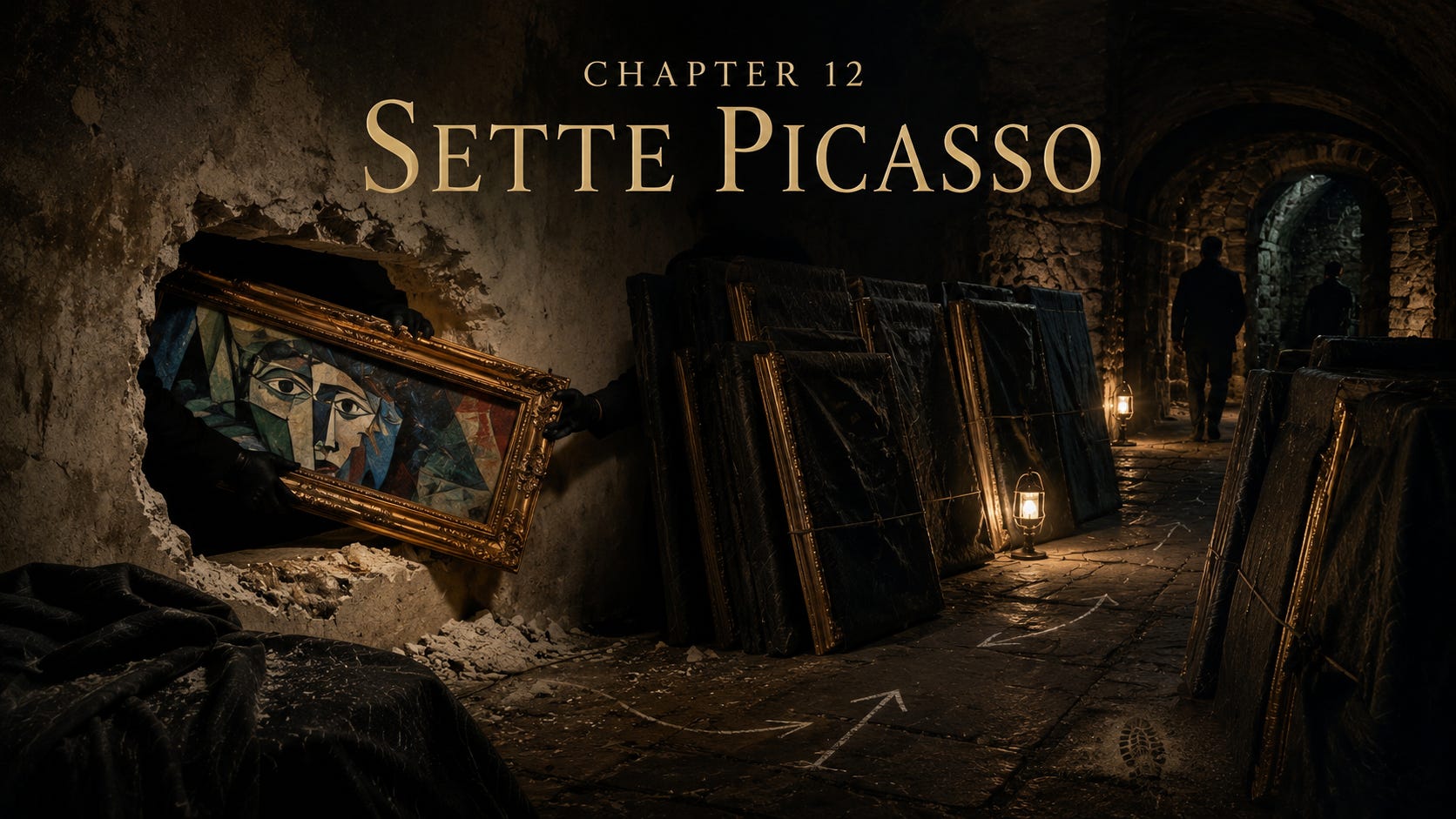
The first painting came through the wall backward.
Not the image.
The frame.
A gilt edge appeared in the narrow opening, protected by dark cloth and held between gloved hands. One upper corner followed. Then the lower rail, approaching plaster at an angle Isaac disliked before the men carrying it understood why.
“Higher.”
They adjusted.
“Not the frame. The cloth.”
One hand shifted.
The painting cleared the opening without touching either side.
Only then did the face of it turn toward him.
Picasso.
A woman assembled from planes no ordinary mirror would have admitted. One eye held the room directly while the other looked somewhere beyond it. Her mouth had been divided by color and restored by line. Under the temporary lamp, the colors appeared almost indecently awake.
Isaac took the lower corner through the cloth.
The frame was lighter than importance suggested it should be.
That always disturbed people who knew paintings only from walls. History ought to have required effort. Instead, two disciplined men could lift a century and carry it through an opening no wider than a domestic door.
“Table.”
They turned together.
The adjoining room had once belonged to a fabric merchant. Empty shelves remained along one wall, their faded labels reduced to decorative marks. Dust softened the unfinished floorboards. A pale rectangle showed where a cabinet had stood for years.
Nothing in the room suggested a gallery.
That was useful.
Beneath the respectable street, ownership divided more neatly on deeds than in stone. Cellars crossed assumptions. Storage rooms touched without caring which business above claimed the darkness below.
Marcelli had found the weakness.
Isaac had made it usable.
That distinction mattered.
Frankfurt had required Isaac to enter a plan already alive in another man’s hands. Zurich changed each time he looked at it.
A schedule moved.
A holding room disappeared from consideration.
One man was removed.
A second vehicle was introduced, then discarded.
No one asked whether Isaac belonged to the operation.
They asked what happened next.
The handlers lowered the first Picasso.
“Hands away.”
They withdrew.
No abrasion.
No loosened gilding.
No damage.
Across the room, Marcelli watched Isaac instead of the painting.
Approval in him had changed.
It had become reliance.
Isaac disliked that more.
“Ready?” Marcelli asked.
“For the second.”
The handlers vanished through the opening.
Above them, Zurich remained asleep beneath the confidence of shutters, locks, insurance and respectable addresses.
Private galleries depended on appearances. A bell rang, a clerk judged a coat and accent, a card changed hands, and everyone pretended commerce had not entered with the visitor.
Marcus Delacroix had understood such rooms.
The name returned not as disguise, but posture.
Marcus knew when to admire before asking price. He knew which paintings dealers truly loved and which they needed patrons to believe they loved. He could attend donor dinners, private viewings and estate conversations without making discretion look purchased.
Isaac had buried the name.
His body remembered the manners.
During the first visit to Bollag, he had let the dealer fill silence with provenance, private owners and rejected offers. Isaac had learned the human temperature of the gallery without appearing to gather anything at all.
That had been Marcus’s gift.
Isaac used it now without needing the name.
The second painting appeared.
Its upper corner approached plaster.
Isaac raised one hand.
“Stop.”
The handlers froze.
“Back.”
Two inches.
“Turn with your hand first. Then your feet.”
The angle changed.
“Now.”
The frame entered smoothly.
Comments
Nothing yet. Say the first thing.
Sign in to join the conversation.