This page did not load. You can still read it on the original site — the toolbar below keeps your place in the directory.
July 29, 1994 — Before Morning | Frankfurt
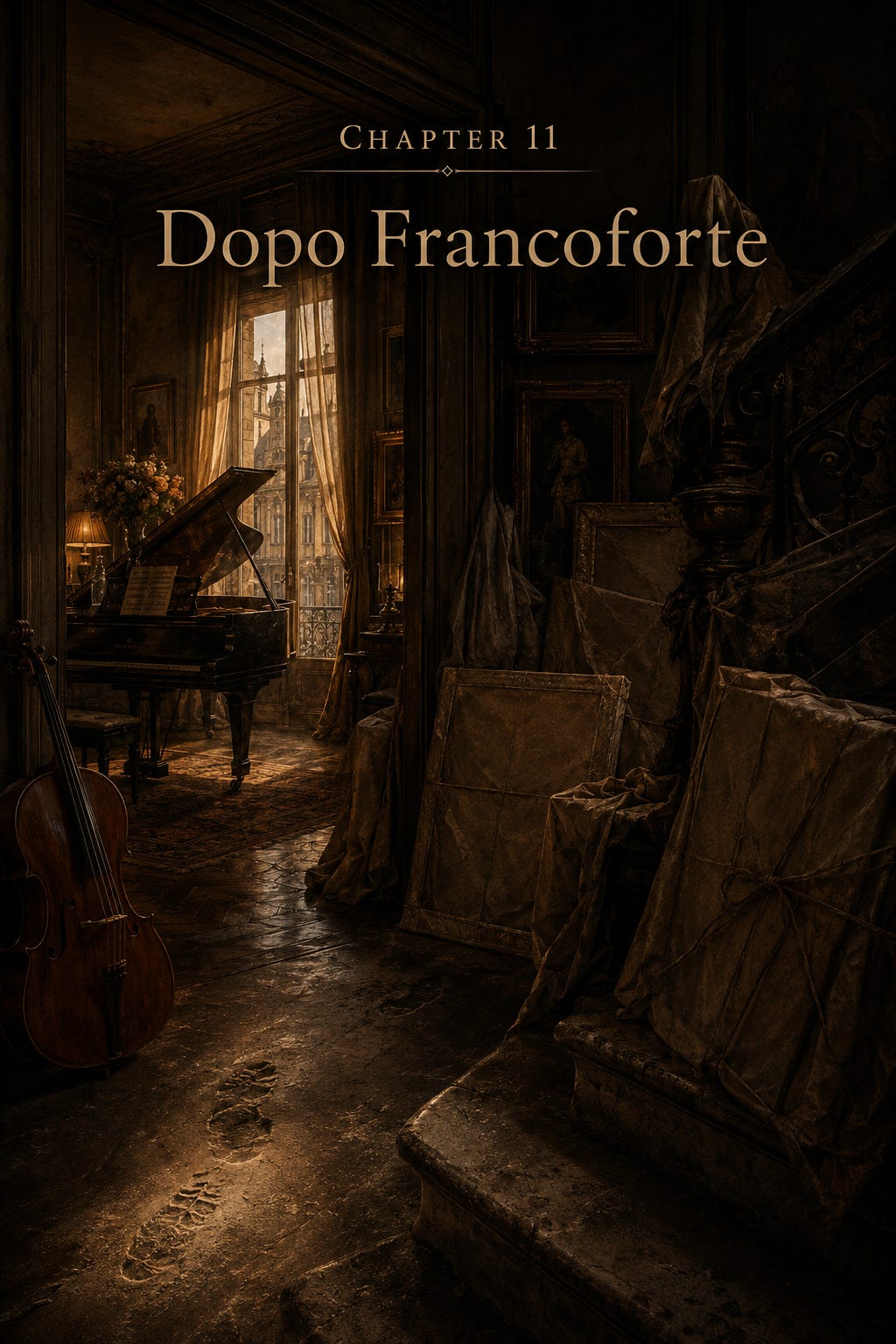
By the second hour, the room no longer looked temporary.
Nothing within it had changed. The blinds remained shut against the coming dawn. Blankets still covered the tables. The lamp without its shade continued throwing a careful pool of light across the three paintings resting against the wall.
Yet the room had acquired a history.
Isaac stood alone before them.
Marcelli had stepped into the adjoining office to telephone Palermo. The handlers waited downstairs beside the vans. For the first time since leaving the museum, no one required Isaac to calculate routes, distances, or contingencies.
He should have used the silence to review the operation.
Instead, he looked at the paintings.
The two Turners still seemed to move despite their stillness. Light drifted across one sky. Water carried wind across the other. Beside them, the Friedrich refused movement altogether. It stood in the room like judgment.
Hours earlier they had been part of a museum.
Now they belonged nowhere.
Not returned.
Not sold.
Not hidden.
Simply suspended.
Isaac found that suspension impossible to ignore.
He had expected triumph.
Relief.
Perhaps exhaustion.
Instead he discovered something far less comfortable.
His pulse had slowed.
His breathing had steadied.
His senses had become astonishingly clear.
Every detail declared itself with unusual precision—the rough grain beneath his fingertips, stale coffee lingering in the pipes, heat gathering behind the blinds, the faint vibration of traffic beginning several streets away.
He had never felt more awake.
The realization arrived without ceremony.
He had wanted this.
Not the theft itself.
The aftermath.
This impossible room.
The first private place after a public wound.
He had told himself that Marcelli interested him because of intelligence, discipline, and opportunity. He had believed Verbruggen’s archive explained his fascination. Beauty. History. Secrets.
Those things mattered.
But they were no longer enough.
Isaac understood now what had drawn him into Marcelli’s world.
It was not possession.
Collectors desired possession.
Collectors wanted objects.
Isaac desired the interval.
The moment after something impossible had succeeded and before the world understood what had happened.
Museums would soon fill with investigators.
Insurance companies would calculate losses.
Journalists would invent explanations.
Police would draw diagrams.
Language would eventually tame the event.
Here, language had not yet arrived.
Only consequence.
He stepped closer to the Turners.
The nearer one held a horizon that refused to settle. Light broke across water in a way that suggested both arrival and departure, as though the painting itself could not decide which mattered more.
Isaac lifted his hand without thinking.
He did not touch the canvas.
He never touched the canvas.
But he hovered close enough to feel the faint coolness radiating from its surface.
Someone had stood before this work in a studio decades earlier and made decisions that still governed the room.
Brushstroke by brushstroke.
Choice by choice.
The painter had known nothing of Frankfurt.
Nothing of alarms or guards or insurance valuations.
Nothing of Isaac.
Yet here they were.
Connected by an act neither of them could have predicted.
Isaac lowered his hand.
The second Turner carried more violence.
Wind pressed against water with visible force. The sky seemed to fracture under its own weight. It was not chaos. It was control disguised as chaos.
He recognized that.
He had built his life on the same principle.
Movement that appeared unpredictable.
Routes that seemed improvised.
But beneath it all, calculation.
Structure.
Discipline.
He wondered, briefly, whether Turner had felt the same clarity he felt now.
Not while painting.
After.
When the work was finished and the room fell silent.
When the painting existed and the world had not yet responded.
The interval.
Isaac turned to the Friedrich.
It did not invite comparison.
It did not invite anything.
A solitary figure stood before a landscape that refused to explain itself. The horizon offered no promise. The sky withheld resolution.
The man in the painting faced away.
He did not perform for the viewer.
He did not acknowledge being seen.
He simply stood.
Isaac felt, with uncomfortable precision, that the painting had been waiting for him.
Not for this theft.
For this moment.
For this recognition.
He had spent years believing that distance protected him.
Distance from places.
Distance from people.
Distance from consequence.
Yet the figure in the painting stood within distance of everything that mattered.
He had not turned away.
He had not moved.
He had remained.
Isaac exhaled slowly.
The room seemed to narrow around that realization.
He remembered the museum.
The quiet before the alarms.
The exact second when intention became action.
He had not hesitated.
He never hesitated.
Hesitation created failure.
But here, in this room, hesitation returned in another form.
Not uncertainty.
Consideration.
He allowed himself to imagine, briefly, what would happen next.
The paintings would leave this room.
They would travel.
They would disappear into systems designed to erase their presence.
Months later, perhaps years, they would reappear in another room.
Another interval.
Another silence.
Another man standing where Isaac stood now.
Would that man feel this?
Would he understand what had passed through his hands?
Or would he see only value?
Isaac suspected the latter.
That had always been the difference.
Collectors accumulated.
Marcelli curated.
Isaac moved.
But movement alone did not explain this.
He stepped back.
The room expanded again.
He became aware of his own body in space.
The weight of his shoulders.
The steadiness of his stance.
The absence of urgency.
He had lived so long inside urgency that its absence felt almost artificial.
He listened.
The building breathed around him.
Pipes shifted.
A door closed somewhere below.
A car passed in the street.
Life continued, unaware.
He thought of Mateo.
Not as a distraction.
Not as an interruption.
But as a presence that existed outside this world.
Mateo would not understand this room.
Not fully.
He would see the paintings.
He would recognize their beauty.
He would perhaps even sense the tension in the air.
But he would not feel this clarity.
This suspension.
This precise alignment between action and consequence.
Isaac did not resent that.
He envied it.
Movement is safer.
He had said that.
He had believed it.
Perhaps he still did.
Rooms learned people.
Neighbors remembered routines.
Concierges noticed familiar faces.
Patterns became evidence.
That was why stolen paintings never remained long in one place.
They moved because movement erased attachment.
Isaac had done the same thing with his own life.
Cities.
Names.
Apartments.
Lovers.
He left before permanence became dangerous.
Yet standing before the paintings, another truth emerged.
He did not merely survive movement.
He craved what movement created.
The suspended world between one certainty and the next.
Marcelli had understood that before Isaac had.
He had not offered employment.
He had offered access.
Access to rooms like this.
Rooms where history paused before becoming history again.
Isaac disliked the realization precisely because it felt true.
He wondered how many such rooms Marcelli had stood in.
How many intervals he had witnessed.
How many moments like this had shaped him into the man Isaac now followed.
The telephone stopped ringing in the adjoining office.
A moment later Marcelli returned.
He looked first at the paintings.
Then at Isaac.
“The route is clear.”
Isaac nodded.
Neither man moved.
Marcelli studied him quietly.
“You should drink some water.”
“I’m not thirsty.”
“That wasn’t my concern.”
For the briefest instant, Isaac almost smiled.
“You’ve done this before,” he said.
Marcelli considered the question.
“Not this theft.”
“This room.”
Marcelli glanced toward the paintings.
“Never twice in exactly the same way.”
Isaac understood.
The answer was enough.
Marcelli stepped closer to the Friedrich.
He did not touch it.
He did not need to.
“You see it,” he said.
It was not a question.
Isaac did not pretend otherwise.
“Yes.”
Marcelli nodded once.
“That is why you are here.”
Not because of skill.
Not because of discipline.
Because he could stand in this room and recognize what it was.
Isaac felt the weight of that acknowledgment settle into place.
Voices rose in the corridor outside.
The handlers had returned.
The interval was ending.
Within minutes the paintings would become cargo again.
Weight.
Timing.
Distance.
Responsibility.
The practical world would reclaim them.
Isaac watched as the first blanket was lifted.
For one last moment the three works stood exactly as they had been left—neither stolen nor recovered, belonging fully to no one.
Then gloved hands reached beneath the frames.
The spell dissolved.
Isaac stepped forward automatically, already calculating doorways, corners, and travel times.
The discipline returned without effort.
But something had changed.
As the Friedrich disappeared into its blanket, Isaac understood that he would remember this room long after he forgot the route that carried the paintings away.
Not because of what had been stolen.
Because here, at last, he had discovered the appetite he had spent years refusing to name.
July 30, 1994 — Frankfurt
Isaac noticed the service door because it had been disturbed.
Not opened.
Not left ajar.
Simply disturbed.
A thin line interrupted the dust beneath its threshold.
Anyone else would have stepped over it.
Isaac opened the door.
The unused stairwell descended into darkness. Stone steps disappeared around a square shaft. A rusted handrail followed them reluctantly. Dust softened every tread.
No one had used the stair in years.
That was why one mark mattered.
Isaac descended two steps before stopping.
On the fourth tread lay the rear portion of a footprint.
Not complete.
Only the heel.
The toe had failed to register.
Plaster had erased part of one side.
Another section had blurred beneath old dust.
There was almost nothing to see.
Yet his body reacted before his mind did.
His breathing shortened.
Not from fear.
Recognition.
He stepped closer.
The heel rested at a slight outward angle.
Weight favored the outer edge.
Along the inner tread one small section had failed to print.
Ordinary details.
Meaningless in isolation.
His muscles tightened anyway.
Boston.
Vorin Dubmar’s house.
The cold outside after the warmth of murder.
He remembered kneeling beside disturbed ground while police still believed they understood what had happened.
He had not found a trail.
Only fragments.
A narrow heel.
Controlled weight.
A departure that wasted no movement.
He had never seen the man.
Only the grammar of the man’s escape.
Land.
Turn.
Leave.
The same economy lived in this partial mark.
Isaac crouched.
He did not touch the dust.
He simply looked.
Logic objected immediately.
Wrong country.
Wrong year.
Wrong crime.
A thousand disciplined men might leave similar traces.
Professional habits often resembled one another.
Memory could invent connections where none existed.
His mind rejected it.
His body did not.
He leaned slightly closer, adjusting his angle to catch the faintest variation in the dust.
There.
A compression line just beyond the visible heel.
Not a second print.
A hesitation.
No—correction.
The man had placed his foot, then subtly shifted weight before committing to the step below.
Testing.
Listening.
Waiting.
Isaac’s pulse slowed.
That detail mattered more than the print itself.
Professionals moved efficiently.
But only certain kinds of professionals paused mid-motion without leaving chaos behind.
This was not uncertainty.
It was control.
Beyond the nearly closed door came muted voices.
“Ready.”
“Wait.”
Handlers.
Paintings.
The operation continued.
Someone had stood here while those paintings occupied the room.
Not passing through.
Listening.
Watching.
Isaac looked farther down the stair.
Nothing.
No second print.
No clear trail.
Only faint disturbances too uncertain to become evidence.
But the absence itself spoke.
Whoever had stood here had not descended fully.
They had not committed to the stair.
They had remained within reach of the door.
Close enough to hear.
Far enough to remain unseen.
Isaac’s gaze returned to the heel.
He imagined the body attached to it.
Height suggested by stride.
Balance suggested by pressure.
A man who did not rush.
A man who did not linger.
A man who understood that presence could be measured in seconds.
The hinge behind him moved.
Marcelli appeared in the doorway.
“What have you found?”
Isaac kept his eyes on the tread.
“I don’t know.”
Marcelli descended one step.
“A footprint?”
“Part of one.”
Marcelli studied the dust.
“I’ve seen better.”
“So have I.”
Neither man spoke for several moments.
Finally Marcelli asked,
“One of ours?”
“I don’t think so.”
“You don’t know.”
“No.”
Marcelli looked again.
“It could be weeks old.”
“It could.”
“A caretaker.”
“Yes.”
“A cleaner.”
“Perhaps.”
Marcelli folded his arms.
“But you don’t believe that.”
Isaac remained silent.
He couldn’t explain what he felt because it wasn’t evidence.
It was memory.
Not visual memory.
Physical memory.
The peculiar certainty with which the body recognized balance, rhythm, restraint.
A man had once left another crime with exactly this economy.
Or someone remarkably like him had.
Marcelli looked at Isaac instead of the print.
“You’ve seen something.”
“I’ve remembered something.”
“The same thing?”
Isaac considered the question.
“I don’t know.”
Voices grew louder outside.
The paintings were moving.
Marcelli listened once toward the corridor before returning his attention to the stair.
“We should go.”
“In a moment.”
Marcelli waited.
He had learned that Isaac’s instincts deserved patience even when they refused explanation.
Isaac studied the heel one final time.
Then, slowly, he shifted his gaze upward.
The wall beside the stair bore faint abrasions.
Not recent.
But not ancient either.
Something had brushed against it.
Fabric, perhaps.
Or a sleeve.
He followed the line upward.
It stopped just below the level of the doorframe.
The man had leaned.
Not heavily.
Just enough to steady himself while listening.
Isaac exhaled quietly.
The picture sharpened.
Enter.
Pause.
Listen.
Adjust.
Leave.
No wasted motion.
No unnecessary contact.
Even the disturbance had been minimized.
Only time had betrayed it.
Dust had settled unevenly.
Light had shifted.
And Isaac had noticed.
Marcelli watched him.
“You’re building something.”
Isaac shook his head.
“No.”
“But you’re not dismissing it.”
“No.”
Marcelli glanced once more at the print.
“If someone was here, they didn’t interfere.”
“No.”
“They didn’t warn anyone.”
“No.”
“They didn’t stop us.”
Isaac finally looked at him.
“That doesn’t mean they weren’t interested.”
Marcelli held his gaze.
“In what?”
Isaac didn’t answer immediately.
He looked again at the stair.
At the absence of further prints.
At the precision of the one that remained.
“At us.”
Marcelli said nothing.
The implication settled between them.
Not threat.
Not yet.
Observation.
Marcelli turned slightly toward the corridor.
“We’re exposed here.”
“Yes.”
“And you’re certain this matters.”
Isaac stood.
“I’m certain I won’t forget it.”
Marcelli nodded once.
That was enough.
Isaac stepped back toward the door, deliberately avoiding the print.
Not to preserve evidence.
To preserve possibility.
The handlers were already carrying the first Turner toward the freight elevator.
Blankets concealed the paintings once more.
Marcelli resumed directing the movement with calm efficiency.
Isaac took his place beside the final crate.
The operation continued exactly as planned.
Only Isaac knew the plan had changed.
Nothing had gone wrong.
Nothing had interrupted the theft.
No alarms had sounded.
No one had been caught.
Yet somewhere beyond the edges of the operation another intelligence had briefly touched it.
He could not prove it.
He could not even name it.
But as the convoy disappeared into the waking streets of Frankfurt, Isaac carried one conviction with him.
The paintings had not been the only things being watched.
August 3, 1994 — Evening | Milan
Mateo knew something had changed before Isaac spoke a word.
He opened the apartment door carrying bread, cheese, tomatoes, and a bottle of wine balanced beneath one arm. His smile arrived first, as it always did.
Then he looked at Isaac.
“What happened?”
Isaac accepted the bread.
“We traveled.”
“I can see that.”
Mateo studied him another moment, longer this time, as though the answer might be written somewhere beneath Isaac’s expression if he only looked carefully enough.
“You’ve brought something home.”
Marcelli answered from the salon before Isaac could.
“Only fatigue.”
Mateo looked toward the older man.
“I wasn’t speaking to you.”
“No,” Marcelli replied. “You rarely are.”
The remark might have become an argument on another evening.
Mateo might have pressed.
Marcelli might have sharpened the edge.
Isaac might have withdrawn entirely.
Instead, Mateo carried the food into the kitchen and began unpacking it with deliberate calm, as though routine itself might steady whatever had shifted.
No one mentioned Frankfurt.
No one mentioned museums.
No one mentioned paintings.
Yet the silence surrounding those subjects settled into the apartment before dinner ever reached the table.
It lingered in the doorway between rooms.
It rested in the corners where light failed to reach.
It followed Isaac as he moved, quiet but persistent, like a shadow that refused to detach.
Mateo sliced bread with unnecessary precision.
“You’re late,” he said, not looking up.
“We were delayed.”
“By trains?”
“Among other things.”
Mateo nodded once, accepting the answer without accepting it at all.
Marcelli poured wine.
“Travel rarely proceeds according to expectation.”
Mateo glanced at him.
“Some people prefer it that way.”
Marcelli lifted his glass slightly.
“Some people understand that expectation is a liability.”
Isaac said nothing.
They ate simply.
Fresh bread.
Ham.
Olives.
Wine.
Mateo filled the room with stories from rehearsal, complaining about a conductor who demanded spontaneity according to a strict schedule.
“He wanted the music to surprise him,” Mateo said, “provided it surprised him exactly where he’d planned.”
Marcelli almost smiled.
“A common ambition.”
Mateo laughed.
Isaac managed one of his own.
It sounded unfamiliar.
Not false.
Just unused.
Mateo noticed.
He always noticed.
But he let it pass.
Instead, he leaned back in his chair and continued talking, describing a violinist who insisted on playing ahead of the beat as though time itself were something to outrun.
“He says it creates urgency,” Mateo said.
“It creates chaos,” Marcelli replied.
“It creates life,” Mateo countered.
“It creates mistakes.”
Mateo shrugged.
“Sometimes those are the same thing.”
Isaac listened without contributing.
The conversation moved around him, through him, occasionally brushing against him without ever quite settling.
He followed it the way one follows music from another room—aware of its shape, its rhythm, but not entirely inside it.
After dinner, Mateo carried the plates to the sink.
Water ran.
Dishes touched porcelain with soft, controlled sounds.
Isaac remained at the table longer than necessary.
Marcelli watched him without appearing to.
When Mateo returned, he dried his hands on a towel and placed a score on the piano.
“Schubert.”
Marcelli looked at it.
“No.”
Mateo folded his arms.
“You object to Schubert?”
“I object to consolation.”
“It isn’t consolation.”
“It is tonight.”
Mateo turned toward Isaac.
“You choose.”
Isaac looked from one man to the other.
Mateo wanted music to restore the room.
Marcelli wanted music to control it.
Neither was wrong.
Both were dangerous in their own way.
“Beethoven,” Isaac said quietly.
Neither argued.
The instruments emerged from their cases with the comfortable ritual of old habit.
Wood against cloth.
Strings tested.
Bows tightened.
Isaac settled at the piano.
Mateo lifted the cello.
Marcelli tuned the violin with precise, economical movements.
Jaxon stretched out beside Mateo’s chair, sighing as though he had been waiting all evening for this exact moment.
Metro claimed the windowsill, tail flicking lazily.
Gnome disappeared beneath the piano before the first note had sounded, as though he understood instinctively where the deepest vibrations would gather.
Isaac placed his hands on the keys.
For a moment, he did not play.
The room held its breath with him.
Then he pressed the opening chord.
Marcelli stopped him immediately.
“Again.”
Isaac looked up.
“The note was correct.”
“The note was defended.”
Isaac held his gaze.
“What does that mean?”
“It means you played as though something might attack you.”
Mateo shifted slightly but said nothing.
Isaac looked back at the keys.
For a long second no one moved.
Then he tried again.
This time he allowed the chord to exist before moving forward.
He did not brace against it.
He did not anticipate its failure.
He simply let it sound.
Marcelli entered.
Mateo followed.
The music found itself.
Beethoven imposed order on the room.
Themes appeared.
Returned.
Changed.
Passed from one instrument to another until no single player possessed them completely.
Isaac recognized the pattern.
That was what the evening required.
No one carrying everything alone.
No one holding the entire structure in place by force.
The first movement unfolded with remarkable discipline.
Not rigid.
Not mechanical.
But contained.
Each phrase placed carefully, as though the music itself understood the necessity of restraint.
Only once did Isaac falter.
A descending phrase beneath his right hand suddenly became a stair.
Dust.
A narrow heel.
Weight settling briefly before turning away.
The memory arrived without warning.
Without invitation.
His fingers hardened.
The piano lost its warmth for a single measure.
The sound flattened.
Marcelli heard it instantly.
Without looking up, he altered his own entrance just enough to absorb the fracture.
A slight shift in timing.
A subtle redistribution of emphasis.
The break disappeared into the structure before it could fully form.
Mateo noticed only that something had passed between them.
Something unspoken.
Something precise.
When the movement ended, silence settled over the apartment.
Mateo lowered his bow.
“You disappeared.”
Isaac rested his hands on the keys.
“For a moment.”
“Where?”
Isaac considered answering.
Frankfurt.
A forgotten stairwell.
A footprint that should have meant nothing.
A detail that refused to remain small.
Instead he said,
“Work.”
Mateo accepted the answer.
Not because he believed it.
Because Isaac had offered as much truth as he could.
Mateo reached for another score.
“The Schubert now.”
Marcelli hesitated.
His fingers rested briefly on the edge of the violin case.
Then he nodded.
No argument.
The opening unfolded quietly.
Nothing in the Notturno demanded victory.
It asked only attention.
Only presence.
Mateo’s cello carried the melody with uncomplicated warmth.
There was no calculation in it.
No attempt to shape the room.
Only sound offered honestly.
Marcelli resisted correcting it.
That, more than anything, marked the shift.
He allowed the line to exist as Mateo intended it.
Isaac supported them both.
Not leading.
Not controlling.
Holding.
The apartment slowly remembered itself.
The flowers Anamaria had left the week before still occupied the small vase near the window, slightly wilted but stubbornly alive.
The smell of coffee lingered from dinner.
Traffic drifted upward from the street in soft, intermittent waves.
A door closed somewhere below.
Voices passed and faded.
Jaxon fell asleep.
Metro abandoned the windowsill for the piano bench, curling into a shape that suggested permanent ownership.
Only Gnome remained hidden beneath the instrument, where the deepest notes seemed to belong to him alone.
For several minutes Isaac almost believed the room had escaped history.
That nothing existed beyond these walls.
That the past could be held at a distance simply by refusing to acknowledge it.
That belief settled gently.
Dangerously.
Like something that might be mistaken for truth if left undisturbed long enough.
The music continued.
Unhurried.
Unforced.
Each phrase allowed to complete itself without interference.
Mateo closed his eyes briefly as he played.
Not in performance.
In trust.
Marcelli watched him once, then looked away.
Isaac felt the weight of both of them without turning.
The final cadence approached without announcement.
No one prepared for it.
No one resisted it.
The last note faded naturally.
None of them moved.
The silence afterward felt larger than the music itself.
It expanded outward, filling the apartment, settling into every space the sound had occupied.
Mateo finally smiled.
“There you are.”
Isaac looked toward him.
“I never left.”
Mateo held his gaze.
“Don’t make me learn the difference.”
Isaac did not answer.
Marcelli closed his violin case with quiet precision.
The sound of the latch seemed louder than it should have been.
No one spoke again.
Outside, Milan continued its ordinary evening.
Cars passed.
Voices rose and fell.
Somewhere, music played from an open window, distant and indistinct.
Inside, three musicians remained where they were, each listening to the silence after the music had ended, each hearing something entirely different.
Mateo heard home.
Marcelli heard control restored.
Isaac heard the empty stair in Frankfurt waiting exactly where he had left it.
And beneath that—
something else.
Not yet formed.
Not yet understood.
But present.
Persistent.
Waiting.
August 15, 1994 — Milan
The photograph showed only the frame.
Dark wood.
An altar.
Bare plaster where a masterpiece had once belonged.
Isaac studied it for a long time.
The accompanying file identified the missing work simply:
Caravaggio — The Nativity with Saint Francis and Saint Lawrence
Palermo — October 1969
Beneath the typed description, Verbruggen had written only three words in the margin.
Cut from frame.
Isaac imagined the sound.
Not dramatic.
Canvas surrendered more quietly than people expected.
One steady blade.
One careful hand.
No struggle.
No resistance.
Within minutes a sacred image that had watched generations kneel in prayer ceased to belong to the room that had given it meaning.
He tried to picture the moment more precisely.
The church empty.
Or perhaps not.
Perhaps someone had been there.
A caretaker.
A priest.
A late visitor lingering in the quiet.
Did they hear it?
Did they turn?
Or did the act occur in that peculiar silence that sometimes settles over sacred spaces—where even intrusion feels absorbed rather than interrupted?
Museums survived thefts.
Churches endured absences.
But this felt different.
The painting had not merely decorated the Oratory of San Lorenzo.
It had participated in it.
Every prayer spoken beneath it had included its presence.
Every candle lit had flickered against its surface.
Every whispered confession had unfolded beneath its gaze.
Removing the canvas had left more than an empty wall.
It had interrupted an act.
Among Verbruggen’s notes, one sentence had been copied from a Sicilian newspaper years earlier.
They did not steal a painting.
They entered the prayer.
Isaac read the line twice.
He believed it.
His thoughts drifted to Cefalù.
The fortress overlooking the sea.
The Contessa leading him through rooms few outsiders had ever seen.
Masterpieces emerged one after another without announcement or explanation.
No labels.
No guards.
No reverence performed for an audience.
Only possession.
Then the Caravaggio.
He had recognized it immediately.
Not from its beauty.
From its absence.
The painting that generations believed lost had been hanging quietly inside the fortress.
Not displayed.
Not celebrated.
Simply present.
As though it had always belonged there.
The Contessa had noticed his recognition without commenting on it.
Instead she had said something that seemed almost casual.
“Rare things should be protected.”
At the time Isaac had heard only a collector defending possession.
Now the sentence carried different weight.
Protected.
Not owned.
Protected.
To the Contessa, custody appeared more important than legality.
The painting had been stolen from Palermo.
Yet it had remained in Sicily.
Perhaps that distinction mattered to her.
Perhaps she believed the first thieves had committed the crime.
Everything afterward had merely prevented a greater one.
He tried to imagine her reasoning more fully.
The church had been vulnerable.
The world careless.
Institutions slow.
Collectors ruthless.
Governments indifferent.
Perhaps she believed that removing the painting from circulation—removing it from desire itself—was the only way to preserve it.
A kind of exile disguised as salvation.
Isaac looked again at the empty frame.
He understood the flaw in that reasoning.
The painting itself might survive.
Its colors preserved.
Its canvas stable.
Its beauty untouched.
None of that restored what had been severed.
The prayer remained without its image.
The room remained without its witness.
Protection could preserve an object.
It could not heal the place from which it had been taken.
He leaned back slightly, letting the photograph rest against the table.
The frame seemed heavier the longer he looked at it.
Not physically.
Conceptually.
It held the shape of something no longer there.
A boundary without a center.
A memory without substance.
He wondered how long it had remained empty before someone decided to photograph it.
Days?
Weeks?
Years?
Had they left it untouched out of hope?
Or out of refusal?
Perhaps replacing it would have felt like admitting the loss was permanent.
Perhaps the emptiness itself had become a kind of memorial.
The apartment door opened.
Marcelli entered carrying a bottle of wine.
“You’ve chosen Sicily today.”
“Verbruggen did.”
Marcelli set the bottle down and moved closer.
He noticed the photograph immediately.
“The Caravaggio.”
Isaac nodded.
Marcelli studied the empty frame.
“A tragedy.”
“Because it disappeared?”
“No.”
Marcelli looked up.
“Because everyone speaks only about the painting.”
Isaac waited.
Marcelli poured two glasses without asking.
“No one mourns the room.”
The observation surprised him.
Marcelli handed him a glass.
“The canvas survives somewhere.”
“I’ve seen it.”
Marcelli looked at him sharply.
“In Cefalù.”
Understanding crossed his face almost immediately.
“The Contessa.”
Isaac accepted the wine.
“She believes she’s protecting it.”
“And perhaps she is.”
Isaac turned the photograph toward him.
“What do you see?”
Marcelli studied the empty frame again.
Longer this time.
“Loss.”
“The painting?”
“The relationship.”
Isaac looked at him.
“The room was built around that image,” Marcelli continued. “Remove it, and everything remaining becomes memory.”
He gestured lightly toward the photograph.
“The altar still stands. The walls remain. The architecture survives. But the meaning shifts. It becomes something that once was, rather than something that is.”
For a moment neither man spoke.
Marcelli finally smiled.
“You see? We agree more often than either of us admits.”
“I’m not sure we do.”
“No?”
“You believe survival justifies custody.”
“And you don’t?”
Isaac looked once more at the photograph.
“I believe survival matters.”
He touched the edge of the frame.
“But some things belong where they are loved.”
The words surprised even him.
They felt less like an argument and more like a realization.
Marcelli noticed.
“So that’s what this is about.”
Isaac didn’t answer.
Marcelli didn’t press him.
Instead he leaned back slightly, studying Isaac rather than the photograph.
“You’re thinking about more than a painting.”
Isaac remained silent.
Marcelli smiled faintly.
“You always are.”
He lifted his glass.
“To beautiful things.”
Isaac raised his own.
“To the places that give them meaning.”
They drank.
The afternoon light shifted across the photograph.
For an instant the empty frame seemed deeper than the wall surrounding it.
Not merely vacant.
Waiting.
Isaac found himself imagining the painting returning.
Not ceremonially.
Not triumphantly.
Simply restored.
Lifted back into place.
The frame filled again.
The room breathing differently.
Would the prayers resume as they had before?
Or would something remain altered?
Could absence ever be undone?
Or did it leave a trace even after restoration?
He thought of the Contessa again.
Of her certainty.
Of her quiet conviction that preservation justified removal.
He wondered if she had ever stood in the Oratory of San Lorenzo.
If she had ever seen the space as it had been.
Or if, to her, the painting existed independently of the room that had once defined it.
Marcelli set his glass down.
“You’re not convinced.”
“No.”
“About her?”
“About any of it.”
Marcelli nodded.
“That’s why you’re good at what you do.”
Isaac almost smiled.
“Doubt?”
“Perspective.”
Marcelli gestured toward the photograph.
“Most people see a missing object. You see a broken connection.”
Isaac looked at him.
“And you?”
Marcelli considered the question.
“I see both.”
He paused.
“And I know which one is easier to repair.”
Isaac didn’t ask which.
He already knew the answer.
Objects could be recovered.
Connections rarely could.
Marcelli stood.
“I should go.”
Isaac nodded.
At the door, Marcelli paused.
“Be careful with Sicily.”
Isaac looked up.
“In what sense?”
Marcelli smiled faintly.
“In every sense.”
He left without elaborating.
The apartment became quiet again.
Isaac remained at the table.
The photograph still before him.
The empty frame.
The absent painting.
The silent room.
He closed the file slowly.
But the image remained.
Not the Caravaggio itself.
Not the figures.
Not the light.
What lingered was the absence.
The interruption.
The moment when something essential had been removed and nothing had replaced it.
He thought again of the blade.
Of the quiet precision.
Of the ease with which meaning could be severed from place.
Some absences became history.
Catalogued.
Discussed.
Analyzed.
Others remained wounds.
Unresolved.
Unhealed.
Still waiting for something that might never return.
August 29, 1994 — Milan
The lawyer arrived without an appointment.
His card bore only a name.
Avvocato Nicola Bellante
Palermo
No firm.
No title.
No unnecessary explanation.
Isaac studied the card for a moment before handing it back to the concierge.
“Show him up.”
Marcelli looked toward the door.
“You know him?”
“I know of him.”
“So do I.”
The answer carried more weight than either man acknowledged.
A moment later Bellante entered.
He wore a light summer suit that seemed incapable of wrinkling despite the August heat. Silver hair. Calm eyes. A slim leather folio beneath one arm.
Nothing about him suggested wealth.
Everything about him suggested permanence.
He shook Isaac’s hand.
Then nodded politely to Marcelli.
“Signor Marcelli.”
“Avvocato.”
No one hurried toward conversation.
Bellante placed the folio on the dining table and opened it with the care of a man accustomed to handling documents that outlived the people signing them.
He removed a single envelope.
“The Contessa asked me to deliver this personally.”
Marcelli accepted it without opening it.
“May I ask why?”
“You may.”
Bellante waited.
Marcelli smiled.
“And the answer?”
“You already know.”
Marcelli laughed quietly.
“I hoped you might be more generous.”
“I am a lawyer.”
“I’ve noticed.”
Bellante folded his hands.
“A property outside Bagheria has recently attracted attention.”
Marcelli’s expression remained unchanged.
Isaac watched closely.
Only the slightest pause betrayed recognition.
Bellante continued.
“The caretaker’s son accepted a payment in exchange for offering access.”
“A misunderstanding,” Marcelli said.
“Exactly.”
Bellante produced a bank draft.
“The payment has been returned.”
Marcelli looked at the amount.
Every lira.
“In full.”
“The misunderstanding no longer exists.”
Marcelli accepted the draft.
“And the caretaker’s son?”
Bellante regarded him calmly.
“He no longer represents anything.”
The room grew still.
Nothing in Bellante’s voice suggested violence.
Nothing excluded it.
Isaac understood what made the lawyer dangerous.
He never threatened.
He merely announced reality after it had already changed.
Marcelli finally opened the envelope.
The letter occupied a single page.
Typed.
Brief.
No accusations.
No legal arguments.
Only one clarification.
The Bagheria property was never available for private use.
At the bottom, beneath the Contessa’s signature, one handwritten sentence appeared.
What belongs to an order should never be mistaken for what is available.
Marcelli read it twice.
Then a third time.
Not because he needed to understand the words.
Because he needed to understand the intention behind them.
He folded the page along its original crease with deliberate care.
“You deliver interesting correspondence.”
“I deliver accurate correspondence.”
Bellante inclined his head toward Isaac.
“The Contessa also asked after your health.”
“I’m well.”
“I believed that would be my answer.”
Isaac studied the older man.
“How long have you represented her?”
“Twenty-seven years.”
“In business?”
“In everything.”
The simplicity of the reply revealed more than a detailed explanation could have.
Bellante didn’t merely manage accounts.
He managed continuity.
Properties.
Collections.
Trusts.
Household affairs.
The legal architecture surrounding the fortress itself.
He would know what belonged to the Contessa.
More importantly, he would know what would continue belonging to her after she was gone.
Isaac understood immediately why she trusted him.
He preserved order.
But more than that—
He ensured that order did not depend on her continued presence.
Bellante closed the folio.
“My business is concluded.”
Marcelli did not move.
“What happens if I ignore the letter?”
Bellante’s expression remained courteous.
“The letter remains true.”
Nothing more.
No threat.
No warning.
Only certainty.
Marcelli leaned back slightly in his chair.
“You’re very confident in that.”
“I am not required to be confident.”
Bellante’s tone did not change.
“I am required to be correct.”
Marcelli’s smile returned, though it carried less ease now.
“And if someone chooses to test that correctness?”
Bellante regarded him for a moment longer than politeness required.
“Then they will discover that correction does not require participation.”
The words settled into the room with quiet weight.
Isaac felt it immediately.
Not intimidation.
Not even authority.
Something older.
Something that did not need to assert itself because it had already been established long before any of them entered the conversation.
Marcelli tapped the envelope lightly against the table.
“You speak as though the outcome has already occurred.”
Bellante inclined his head.
“In matters of ownership, it usually has.”
Marcelli studied him.
“You don’t negotiate.”
“I clarify.”
“And if clarification is rejected?”
Bellante allowed the faintest suggestion of a smile.
“It rarely is.”
Silence followed.
Not uncomfortable.
But precise.
Measured.
Each man aware that something had shifted, even if nothing visible had changed.
Bellante moved toward the door.
Jaxon stood in the hallway watching him.
The lawyer lowered one hand—not toward the dog, but simply beside himself.
Permission without demand.
Jaxon stepped aside.
Bellante paused before leaving.
“The Contessa wished me to remind you of one thing.”
Marcelli waited.
“Correction should never be mistaken for hostility.”
Then he departed.
The apartment remained quiet until the elevator disappeared below.
Even then, the silence lingered.
As though something had been placed within it.
Marcelli unfolded the letter again.
“She’s remarkable.”
Isaac said nothing.
Marcelli smiled faintly.
“Do you know what fascinates me?”
“What?”
“She believes ownership and authority are the same thing.”
“They often are.”
“They’re negotiable.”
Isaac shook his head.
“That’s where you misunderstand her.”
Marcelli looked up.
“You think she sent a warning.”
“She sent a correction.”
“And the difference?”
“A warning anticipates disobedience.”
Isaac looked at the folded page.
“A correction assumes order already exists.”
Marcelli considered that.
Not dismissively.
Carefully.
As though testing the structure of the idea rather than the words themselves.
“And you believe that order includes you?”
Isaac did not answer immediately.
He walked to the window overlooking the courtyard.
Below, Milan continued without interruption.
Laundry moved between balconies.
A woman argued with someone unseen.
A child chased a ball across uneven stone.
Life, indifferent to corrections and ownership alike.
“I believe,” Isaac said finally, “that I exist within it.”
Marcelli watched him.
“That sounds like a distinction.”
“It is.”
“And what happens when your existence conflicts with that order?”
Isaac turned back.
“It won’t.”
Marcelli raised an eyebrow.
“That’s a remarkable level of confidence.”
Isaac shook his head.
“No.”
He thought of the fortress.
Of the Caravaggio suspended in shadow and salt air.
Of Bellante’s twenty-seven years ensuring that nothing drifted out of place.
Of a system that did not react.
It endured.
“It’s an understanding.”
Marcelli leaned forward slightly.
“And if someone else doesn’t share that understanding?”
Isaac met his gaze.
“Then they’ll be corrected.”
The words were not a threat.
They didn’t need to be.
Marcelli exhaled slowly.
For the first time since Bellante arrived, something like genuine caution entered his expression.
Not fear.
But recognition.
He slipped the letter back into its envelope.
“Your Contessa,” he said quietly, “is unlike anyone I’ve ever met.”
Isaac looked toward the window again.
“No.”
He thought of the Caravaggio hanging in guarded silence above the Sicilian sea.
He thought of Bellante’s twenty-seven years preserving an order that had outlived governments, fortunes, and enemies.
He thought of the way Bellante had spoken—not as a man defending something, but as a man describing something that could not be altered.
Then he thought of Mateo.
Of laughter in the kitchen.
Of music left open on the piano.
Of a life that did not depend on permanence, but on presence.
The contrast unsettled him more than Bellante ever could.
Marcelli rose from his chair.
“You’re standing between two very different worlds.”
Isaac didn’t deny it.
“One of them doesn’t move,” Marcelli continued.
“The other doesn’t stay still.”
Isaac allowed himself a faint smile.
“And you?”
Marcelli adjusted his cuff.
“I prefer movement.”
“Of course you do.”
Marcelli paused at the door.
“And you?”
Isaac didn’t answer immediately.
Because for the first time, the answer wasn’t obvious.
He had spent years moving.
Surviving by never remaining long enough to belong anywhere.
Now—
There was a place that expected him to return.
A place that did not demand permanence.
Only presence.
“I don’t know,” he said finally.
Marcelli studied him for a moment.
Then nodded.
“That may be the most dangerous answer of all.”
He left without another word.
The apartment settled into quiet again.
Isaac remained by the window.
Below, Milan continued toward evening.
Unaware.
Unconcerned.
Unchanged.
But something had shifted.
Not in the city.
Not even in the apartment.
In him.
The Contessa’s world did not bend.
It corrected.
Mateo’s world did not correct.
It welcomed.
Isaac stood between them.
And for the first time, he understood that sooner or later—
They would have to acknowledge one another.
He wasn’t certain any of them would survive the meeting.
September 12, 1994 — Milan
Mateo no longer knocked.
His key turned once in the lock before the apartment door opened.
“I’m starving,” he announced, as though the statement itself justified his arrival.
Isaac looked up from the newspaper, one eyebrow lifting in mild acknowledgment rather than surprise.
“I assumed that was why you came.”
“It was one reason.”
Mateo crossed the room carrying a paper bag that smelled unmistakably of fresh bread, roasted chicken, and something sweet tucked beneath it all. The scent filled the apartment almost immediately, warm and grounding in a way Isaac had never quite learned to ignore.
Jaxon met him halfway, nails clicking eagerly against the tile.
“So did you miss me,” Mateo said, crouching to rub the shepherd behind the ears.
The dog’s tail answered before Isaac could.
Metro appeared from the windowsill with the quiet authority of a creature who believed himself indispensable. He inspected the bag, decided it contained possibilities, and followed Mateo into the kitchen with deliberate interest.
Gnome observed the proceedings from beneath the piano, eyes half-lidded, judging everyone present beneath his standards.
Mateo unpacked lunch as though he’d always lived there.
Plates from the cupboard.
Glasses from the shelf.
The good olive oil without asking where Isaac kept it.
“You’ve memorized my kitchen.”
“You have one kitchen.”
“I had.”
Mateo paused, glancing up at him.
“You still do.”
Isaac smiled despite himself.
Perhaps that was the difference.
The apartment no longer felt borrowed whenever Mateo entered it.
It expanded.
The empty chair beside the table no longer looked empty.
The silence between rooms no longer sounded vacant.
Someone laughed more often here now.
Someone sang while making coffee—badly, but with conviction.
Someone left music open on the piano because tomorrow existed.
Mateo moved easily between counter and table, slicing bread, arranging food, pouring wine without ceremony. He hummed under his breath, something Isaac recognized but couldn’t immediately place.
“You’re off-key,” Isaac said.
“I’m enthusiastic.”
“That’s not the same thing.”
“It should be.”
Isaac folded the newspaper and set it aside.
They ate beside the open balcony doors while September drifted into Milan.
The heat of August had finally broken, leaving behind a gentler warmth that lingered without pressing. A breeze moved through the apartment, carrying with it the distant sounds of the city—children shouting somewhere below, a radio playing faintly from another window, the rhythmic clatter of dishes being washed in a neighboring kitchen.
Laundry moved lazily between buildings, white sheets catching the light like sails.
The city seemed content simply to continue being itself.
Mateo spoke about rehearsal.
About a violinist determined to perform faster than the conductor.
About a soprano who insisted on rewriting her own phrasing mid-performance.
About Anamaria terrifying a stage manager by changing an entire scene only minutes before rehearsal.
“She was right,” Mateo concluded, tearing another piece of bread.
“She usually is.”
“That doesn’t make it less frightening.”
Isaac laughed.
A genuine one this time—unforced, unguarded.
Mateo noticed immediately.
“There you are.”
“What?”
“I’ve been waiting for that laugh since Frankfurt.”
Isaac lowered his eyes, the smile lingering but quieter now.
“I didn’t know it had disappeared.”
“I did.”
Neither spoke for several moments.
The silence wasn’t uncomfortable.
It settled between them like something understood rather than avoided.
Then Mateo reached across the table and quietly took Isaac’s hand.
He did not ask permission.
He no longer needed to.
“I don’t need to know your work,” he said.
“I know.”
“I only need you to come back afterward.”
Isaac looked at him.
There was nothing dramatic in Mateo’s face.
No plea.
No demand.
Only trust.
A dangerous thing.
Isaac squeezed his hand once, a gesture small enough to be dismissed by anyone else, but not by Mateo.
“I’ll try.”
Mateo smiled.
“Good.”
He stood and carried the dishes toward the sink, rinsing them with the same casual familiarity he brought to everything else in the apartment.
The gesture was so ordinary Isaac almost missed it.
The apartment had accepted him.
Not ceremonially.
Not romantically.
Practically.
His coat hung over the kitchen chair.
His coffee cup remained beside the sink.
His music rested on the piano, pages marked and folded.
His laughter lingered in the rooms after he crossed into another.
Home announced itself through repetition.
Through small, unremarkable acts that accumulated until they became something undeniable.
Isaac watched him for a moment longer than necessary.
Mateo moved like someone who expected to be there tomorrow.
Isaac had never allowed himself that expectation.
The bell rang.
Mateo glanced toward the hallway.
“Expecting someone?”
“No.”
Isaac rose and crossed the room, opening the door without hesitation.
Marcelli stood there carrying a violin case and a bottle of champagne.
“I appear to have interrupted lunch.”
“You’ve interrupted dishes.”
“Worse.”
Mateo laughed from the kitchen.
“Come in.”
Marcelli entered slowly.
His eyes moved through the apartment with quiet precision.
Mateo’s coat draped over the chair.
The plates in the sink.
Jaxon asleep beneath the table, one ear twitching.
Metro washing one paw on the windowsill with exaggerated care.
The open score on the piano, pages marked in Mateo’s handwriting.
Nothing remarkable.
Everything remarkable.
He set the champagne on the counter.
“I brought this for Anamaria.”
“She’s rehearsing.”
“So she claims.”
Mateo emerged, drying his hands on a towel.
“You missed lunch.”
“I rarely miss anything.”
Marcelli smiled faintly.
“Then you chose poorly today.”
“Perhaps.”
They settled into the afternoon without ceremony.
Coffee replaced wine.
Conversation replaced silence.
Music replaced both.
No performances.
No rehearsals.
No discussions of paintings, routes, collectors, or museums.
No mention of Frankfurt.
No mention of anything that existed beyond the walls of the apartment.
Only friends sharing an afternoon.
Isaac sat at the piano.
Mateo lifted the cello, adjusting it against his shoulder with practiced ease.
Marcelli tuned the violin, each note precise, deliberate.
No one chose the piece.
One simply began.
A phrase, tentative at first.
The others joined naturally, as though they had always known where to enter.
Music filled the apartment without purpose beyond itself.
It moved through the rooms, through the open balcony doors, into the quiet afternoon beyond.
It did not need an audience.
It did not need perfection.
It only needed to exist.
Isaac found himself watching Mateo between passages.
The way his brow furrowed slightly when he concentrated.
The way he leaned into certain notes as though they mattered more than others.
The way he smiled—barely—when something aligned exactly as it should.
Marcelli noticed that, too.
He noticed everything.
When they finished, silence settled comfortably over the room.
Not empty.
Complete.
Marcelli packed away his violin first, movements efficient but unhurried.
“I should go.”
Mateo nodded.
“I’ll walk you down.”
“No need.”
Marcelli picked up the champagne, then paused.
At the apartment door he looked back once.
Isaac remained at the piano, fingers resting lightly on the keys as though reluctant to leave them.
Mateo stood beside the kitchen window, absentmindedly watering Anamaria’s flowers, humming again—still off-key.
Jaxon slept.
Metro had claimed the sunlit portion of the windowsill.
Gnome had not moved, but his eyes were open now, observing.
Sunlight rested across the floor exactly as though it had always belonged there.
Marcelli understood something then.
Frankfurt had changed Isaac.
But not in the way he first believed.
The theft had awakened an appetite.
This apartment had awakened something far more dangerous.
Hope.
He looked at Isaac.
“You’ve built something.”
Isaac followed his gaze around the room, as though seeing it for the first time.
“I didn’t mean to.”
“No one ever does.”
Marcelli smiled, though there was something quieter beneath it.
“Take care of it.”
He left before Isaac could answer.
The door closed softly behind him.
The apartment became quiet again.
Not empty.
Never empty now.
Mateo returned from the window carrying two glasses of wine.
He handed one to Isaac without comment.
“What did he say?”
Isaac looked toward the closed door.
“He told me to take care of this.”
Mateo frowned slightly.
“This?”
Isaac looked around the apartment.
The music still lingering in the air.
The flowers catching the last of the afternoon light.
The animals settled into their familiar places.
The afternoon itself, suspended between what had been and what would come next.
The man standing beside him.
For the first time in many years, the answer came easily.
“Home.”
Mateo didn’t respond immediately.
He simply leaned against the piano, close enough that their shoulders touched.
That was answer enough.
Outside, Milan continued toward evening.
Shadows lengthened across the buildings.
Voices softened.
Lights began to appear in windows one by one.
Inside, for one impossible afternoon, Isaac allowed himself to believe that some things might be worth staying still for.
And for once, the thought did not feel like a weakness.
It felt like a choice.
Read more

Comments
Nothing yet. Say the first thing.
Sign in to join the conversation.