
INSCREVAM-SE (para as aulas em português)/SUBSCRIBE (for the English speaking classes).
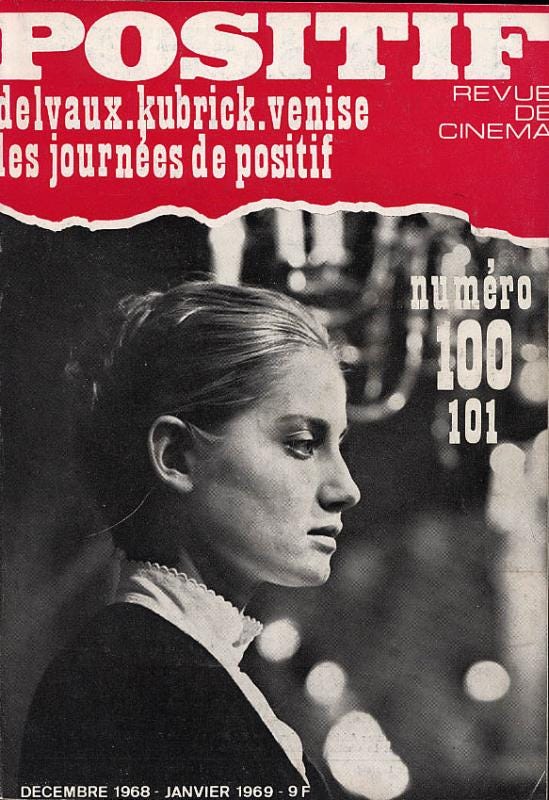
Entrevista com Vittorio Cottafavi por Bertrand Tavernier, Positif nº 100-101, dezembro de 1968-janeiro de 1969:
— Existe alguma influência da ficção científica em Ercole alla conquista di Atlantide ou em I cento cavalieri?
— Em I cento cavalieri talvez não, mas em Ercole certamente sim. O próprio tema pertence à ficção científica. Presume-se que o sangue de Urano, morto por seu filho, ao cair na Terra formou o urânio.
— Mas em I cento cavalieri, a descoberta da armadura é a ficção científica do ano 1000...
— Sim, se você assistir a esse filme com a mentalidade de um homem do ano 1000, é ficção científica. O princípio da guerra total, da arma total.
— Vamos voltar um pouco no tempo. Quando você começou a fazer cinema, um dos seus grandes projetos foi La vida es sueño...
— Sim, como você vê, eu estava pensando em filmes históricos... Mas os produtores a quem eu propunha esse tema nem me cumprimentavam mais. Então, para evitar maiores problemas, aceitei os filmes que me propunham. Isso aconteceu várias vezes. Escrevi uma história de que gosto muito, Il marchait dans l’ombre de la vallée (em português, “Ele caminhava na sombra do vale”), e até mesmo Alfredo Bini, que é um produtor muito corajoso, me disse que era abominável, que não acreditava que coisas tão abomináveis pudessem acontecer na minha cabeça (risos). Então, fiz um exame de consciência. Talvez fosse a maneira de expressar essas ideias que as tornava tão assustadoras. Sabe, o problema para um realizador italiano é sempre o mesmo: ou ele alcança um certo sucesso comercial e consegue impor sua vontade, ou tem tanto apoio da crítica que consegue forçar a mão dos produtores, embora com muita dificuldade. Antonioni conseguiu impor o que queria fazer, mas pagou um preço muito alto por isso durante anos. Eu não tive essa sorte ou esse mérito. E, nesse caso, ou eu aceito ou me rebelo. A rebelião consiste em não filmar.
— Mas naquela época você fazia filmes muito comerciais.
— Oh, não, tenha cuidado, meus filmes nunca renderam muito dinheiro e, justamente por isso, os produtores me criticaram várias vezes por tratar histórias populares de uma maneira não suficientemente popular. Os filmes de peplum se saíram muito bem, mas meu último filme não alcançou os resultados esperados. O filme foi muito difícil de fazer. O produtor insistia em uma direção, eu em outra. Eu insisti mais do que ele, o que me permitiu fazer o que eu queria: libertar o gênero histórico das amarras da história. Consegui concretizar as ideias brechtianas em um espetáculo cinematográfico, algo muito difícil, porque no teatro há a presença física dos atores, há algo que pode levar os espectadores a permanecerem sentados, sem se tornarem sonhadores que se identificam com uma personagem, com uma ação. O cinema é um meio mágico que estabelece uma cumplicidade tão secreta com o espectador que este pode, a qualquer momento, libertar-se da sua condição isolada e mergulhar na história. Ao adaptar as ideias de Brecht, eu esperava que o espectador de I cento cavalieri não tomasse partido, que permanecesse distanciado em relação ao que lhe era mostrado. Não sei se consegui. Fato é que o espectador ficou completamente deslocado, confuso. Não encontrou os eventos tradicionais aos quais estava acostumado. Além disso, não havia heróis, amigos ou inimigos, pessoas que estavam certas e outras que estavam erradas. Todos estão certos e errados ao mesmo tempo, e o herói é frequentemente patético, um tanto cômico e ridículo. O verdadeiro herói, Dom González, é ainda mais ridículo. Ele é o General, o mais ridículo de todos. A mistura do cômico e do trágico que se alternam sem descontinuidade, a intervenção do nosso mundo no contexto do ano 1000, esse salto para trás da nossa sociedade, da nossa política, das nossas ideias refletidas nos rostos dos árabes e dos cristãos espanhóis incomodam muito. Além disso, há experiências que o público não aceita facilmente, como na sequência da batalha. O espectador pensa: “Mas o que está acontecendo? Este filme é de má qualidade.” Ele não entende que isso é intencional, que visa mostrar que, ao redor do homem prestes a matar seu semelhante, até mesmo os elementos mais visíveis da Natureza desaparecem. Não se consegue mais distinguir quem é amigo ou inimigo quando o filme muda para preto e branco, já que apenas as cores diferenciavam os lados opostos. E então, no momento em que se vai matar, há uma concentração, uma vontade de suprimir algo que precisa ser refletido internamente, e assim a cor é eliminada: o elo mais visível que une o homem à Natureza, ao mundo que o rodeia. E, durante a batalha, não há mais música heroica, mas sim um trecho de flamenco acompanhando a carnificina, com castanholas, palmas... Isso não me trouxe nada do ponto de vista crítico, já que os críticos não assistiram ao filme, enquanto o público permaneceu bastante indiferente. Claro, a frieza do público me leva a crer que alcancei certos resultados com meus experimentos brechtianos, já que ele realmente permaneceu muito indiferente (risos). Mas ele não tirou nenhuma conclusão moral ou social, o que era um dos meus objetivos. Talvez eu não tenha atingido meu objetivo, embora tenha sido bem-sucedido no método... Felizmente, nunca disse que estava fazendo Brecht, o que fez com que pelo menos salvássemos o nome de Brecht (risos).
— Então agora você escolheu a rebelião?
— Sim, eu tinha duas opções: forçar, obrigando um produtor a fazer o que eu queria, ou recusar. Ofereceram-me muitos projetos, uma quantidade incrível de faroestes. Eu tinha um projeto que poderia passar por um faroeste, mas não quis fazê-lo. Senti-me perdido. Quando eu fazia peplum, filmes de Hércules, filmes de capa e espada, estava fazendo algo muito ligado à tradição, à cultura italiana.
— Até mesmo Hércules?
— Sim. Hércules é um deus grego, mas os latinos o adotaram. Podemos muito bem aceitá-lo. Já o faroeste é um gênero clássico. Gosto demais de certos faroestes que, para mim, são obras fundamentais. Tinha a impressão de estar concebendo um embuste. Um falso faroeste é como um falsificador. Agora mudei um pouco de ideia, depois de ver os filmes de Sergio Leone, que, misturando uma certa prosopopeia, uma característica distintamente latina, com uma visão barroca e excessiva do mundo, soube dar ao tipo de faroeste que faz um toque muito original. Talvez mais japonês do que italiano, mas, em todo caso, nada a ver com os Estados Unidos. Ele explora delirantemente a exasperação da espera, com o vermelho do sangue que mancha todo um plano. Mata-se 10 pessoas de uma só vez. É o grande mestre da espera. Ele consegue manter o público em suspense durante 10 minutos, quando poderia ter mostrado imediatamente o que vai acontecer. As pessoas se entreolham, quase sem se mexer... Além de Leone, acho que há dois ou três faroestes italianos que não devem ser completamente descartados. Damiano Damiani fez um filme, Quién sabe?, que não é nada mau. E há outro... Esqueci o nome do diretor, mas você o encontrará em suas fichas[1]: um filme com Tomas Milian, que interpreta um mexicano que precisa se vingar. Meu “faroeste” se chamava Un metro de sombra e se passava em uma pequena república da América Central, em plena revolução. Essa revolução não era liderada pelo povo contra o governo, mas sim desencadeada por um agente de um magnata do petróleo, que queria se apoderar do petróleo do país. E quando ele consegue o que quer, a situação desmorona novamente, porque outro “petroleiro” inicia outra revolução. As pessoas que lutam não percebem que estão lutando não pelo seu país, mas pelo ouro negro. Os quartéis-generais de ambos os exércitos ficam em escritórios, talvez em Nova York. Um “metro de sombra” abaixo da linha do Equador é essencial para a sobrevivência. Mas os “petroleiros” devem ser muito poderosos junto aos produtores, porque sempre me responderam que esse assunto não podia ser abordado, que, em todo caso, não interessava ao público. Acho que não interessava aos “petroleiros”...
[1] La resa dei conti, de Sergio Sollima.
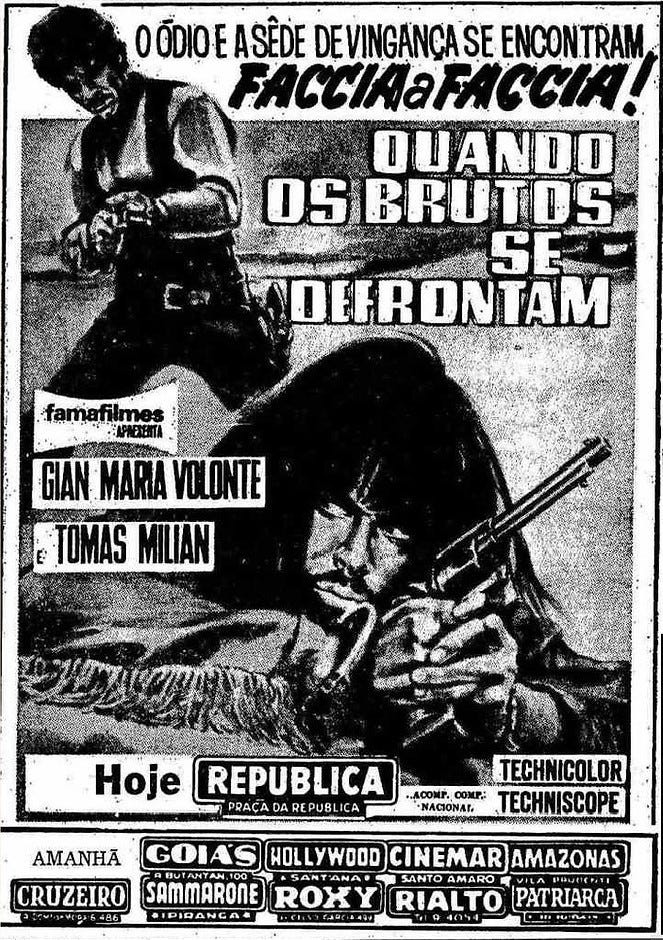
Bertrand Tavernier, Positif n° 106, junho de 1969 (sobre Faccia a faccia):
Apesar da sua reputação, Faccia a faccia é um dos faroestes italianos mais interessantes. Quando você elogia suas qualidades, os críticos mais sérios olham para você com um sorriso irônico, declaram que tentarão assisti-lo algum dia e prontamente partem para o Festival de Cinema Industrial de Bradsberg, em Hesse (não confundir com o festival de cinema dos professores de escolas seculares de Sambre-et-Meuse, realizado a cada sete anos em Bradsberg, na Baviera), onde podem dormir durante a exibição de 682 curtas-metragens da Alemanha Oriental sem legendas.
Faccia a faccia é, no entanto, um dos faroestes italianos mais interessantes depois dos de Leone. O tema é mais ambicioso, o discurso mais sutil, o tom mais original: todo o filme gira em torno de duas personagens, um professor de história tuberculoso (Gian Maria Volontè) e um bandido muito temido, Beauregard (Tomas Milian), e descreve a relação entre eles. O intelectual é fascinado pelo bandido e tenta imitá-lo, usando sua inteligência onde o outro usa seu instinto. Ele age de forma mais fria, mais metódica e, pouco a pouco, seu antigo amigo passa a ter medo dele e acaba por matá-lo no deserto. Paralelamente, uma terceira personagem, que está do lado da lei, passará pela evolução inversa, ficará revoltada com os métodos dos “vigilantes” e salvará a vida de Beauregard.
O principal centro de interesse, portanto, é o roteiro, escrito pelo diretor Sergio Sollima. Sua construção é bastante surpreendente e bastante pessoal: cada sequência contradiz ou desmistifica a anterior sem qualquer consideração pelas regras dramáticas mais óbvias. Sollima parece interessado apenas na dialética moral que opõe as duas personagens principais, uma dialética que questiona continuamente as noções de heroísmo, justiça e verdade. Gradualmente, um tema central emerge: a lenta ascensão do fascismo, que orquestra a violência animalesca e instintiva para melhor explorá-la. A sequência-chave é aquela em que Volontè interroga um espião que ele desmascarou por causa de sua “cultura”: “Você foi à universidade, isso é evidente”, diz ele enquanto o tortura, “sentimos que você não é como os outros. Então você compreenderá que faço isso sem ódio... Eu não te odeio, você sente isso, não é?” E o mata depois de declarar que “matar apenas um é um assassinato, 10 é um ato de violência, mas 1000 se torna um ato organizado, uma guerra, uma necessidade”.
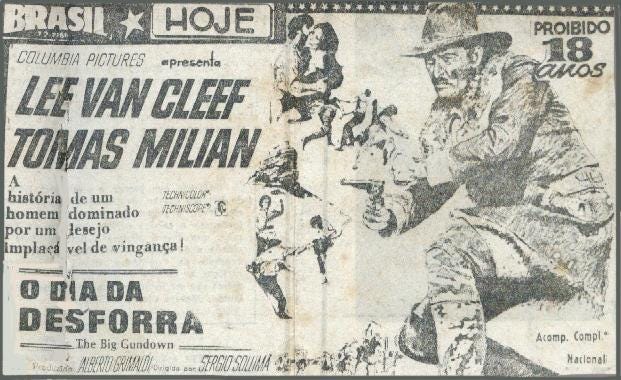
Sollima, por sua vez, faz pouco uso da violência, e seu filme é um dos menos sádicos feitos na Itália. As personagens são o mais importante e essa preocupação se repete em La resa dei conti, que Cottafavi tinha em alta conta e que opõe Tomas Milian e Lee Van Cleef segundo o mesmo esquema moral, baseado em uma inversão gradual, mas absoluta, de valores.
Essas qualidades por si só são suficientes para que prestemos mais atenção aos seus filmes seguintes. Há, evidentemente, falhas no roteiro de Faccia a faccia, algumas reviravoltas na trama são um tanto abruptas e a direção se apoia demais na combinação de zoom out e panorâmica. Talvez a dublagem e a cópia um tanto precária também contribuam para essa impressão... De qualquer forma, o tema é suficientemente apaixonante para que se perdoem esses erros ou falhas, tanto mais que Sollima se sai brilhantemente em muitas sequências e nos revela, de passagem, uma garota extraordinária, Carole André, que transforma este esboço excitante em uma peregrinação obrigatória.
Sylvie Pierre, Cahiers du cinéma nº 215, setembro de 1969 (sobre Corri uomo corri):
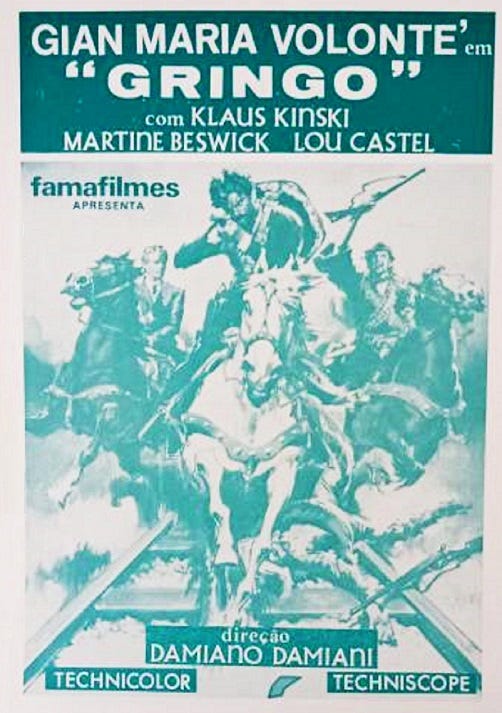
Somos imperdoáveis por não termos mencionado na nossa edição nº 211 o interesse de Faccia a faccia, e nosso colega Dominique Aboukir (nº 213) foi bastante severo com La resa dei conti, do mesmo Sollima, que está decididamente em grande forma ultimamente. O talento – de Sollima? Talvez... veremos isso mais tarde... Por ora, simplesmente identificamos, um após o outro, três faroestes bastante honestos e, melhor ainda, inteligentes e simpáticos, pois não há outras palavras para descrever o efeito produzido por uma evidente euforia em filmar, euforia em atuar, euforia em narrar, um prazer contagiante que o cinema experimenta ao exercer seus truques e reviravoltas, cujo segredo Hollywood parece ter perdido por cansaço, ansiedade financeira ou culpa ideológica. Em Faccia a faccia, o sucesso baseia-se principalmente em Gian Maria Volontè, perfeitamente à vontade e inspirado como um nietzschiano da Sierra (vale ressaltar que a presença de Volontè em um filme italiano quase sempre garante uma felicidade particular do roteiro). Em Corri uomo corri, Tomas Milian continua a fazer mil caretas, para nosso deleite. A veia política se confirma. A seguir…
Serge Daney, Cahiers du cinéma nº 216, outubro de 1969 (sobre C’era una volta il West):
C’era una volta il West marca o apogeu (e talvez o declínio) de uma série de filmes assinados por Sergio Leone cujo interesse é a priori imenso: eles constituem a primeira tentativa, ainda que pouco consequente, de cinema crítico, ou seja, não mais em contato direto com a “realidade” (mesmo se às vezes o recurso à verdade histórica – que Leone conhece bem – possua um valor estratégico), mas com um gênero, uma tradição cinematográfica, um texto global, o único que conheceu uma difusão mundial: o western. Não é pouco.
Como um cinema crítico é possível? Depois de muitos anos os americanos renunciaram ao western racista e beato (DeMille); por isso, a partir dos anos 1950, um surto de filmes humanistas (Daves) ou crepusculares (Ford, Peckinpah). Senso crítico, mas não cinema crítico. Este só poderia ser elaborado do exterior. Mas de onde? De um dos raros países que também possuía um cinema de série, paralelo, tradicional e popular: a Itália. Ou, mais exatamente, Cinecittà no momento preciso em que o peplum desaba, minado por paródias (Sergio Leone já está aí). Ora, o essencial está aí: não que um demiurgo qualquer tenha decidido um dia fazer um cinema crítico, subversivo e vagamente político, mas que esse cinema seja antes de tudo (ou em última análise) o único produto de uma evolução econômica. Para a Cinecittà trata-se somente de reinvestir homens, cenários, figurantes e capital em um novo gênero de filmes. É um caso de amortização. Essas origens vis e baixamente comerciais fazem (farão/fariam/poderiam ter feito: o futuro nos dirá) a grandeza do western italiano. Por duas razões (pelo menos). 1) Porque tem havido até hoje razões ruins para se amar os filmes B e porque convém modificá-las. Admitamos que nos poucos países em que o cinema constitui uma grande indústria, o cinema B forma uma espécie de lúmpen-cinema, bom no máximo para lubrificar a máquina, amado de maneira esnobe e contrabandista (em uma espécie de obreirismo cinéfilo), não podendo aspirar à qualidade, nem mesmo à consciência clara dos elementos (temas, situações) que ele confecciona porque esta (a consciência) é reservada aos filmes de qualidade: digamos, mais para Zinnemann que para Dwan. 2) Admitamos hoje que na Itália é possível alguma coisa que Hollywood não podia concretizar: a tomada de consciência desse lúmpen-cinema, efetuando, sob a máscara de formas ancestrais (portanto, sem renegar seu caráter popular), um eufórico trabalho de desconstrução. “Uma força não sobreviveria se, inicialmente, não tomasse emprestada a aparência das forças precedentes contra as quais luta” (Nietzsche).
Esse trabalho pode ser bem conduzido sob uma condição: que o western italiano conserve seu caráter de massa. Não se trata mais, sucumbindo à obsessão pela unidade, de desmistificar em um único filme toda uma tradição, todo um conjunto de convenções e de reflexos, os resultados práticos desta operação sendo nulos mesmo se os filmes são belos (cf. Tourneur). Isso quer dizer que o western italiano deve ser produzido em massa e para as massas. E isto apesar do grande obstáculo: a recuperação pelo cinema de qualidade (o filme de arte, a burguesia) de individualidades demasiadamente conspícuas, o que é o caso, hoje, de Sergio Leone.
Quanto aos meios desse trabalho, eles começam a ser conhecidos (mas admitamos que só foram seriamente utilizados nos filmes de Leone e nos do misterioso Sollima). Eles consistem ora em mostrar o que o western clássico ocultava, ora a exagerar o que ele mostrava. A força dos filmes de Leone está em exaurir a retórica habitual do western, em fazer da inflação o equivalente de uma negação. Em relação a isso seria interessante mostrar como ao western habitual, construído sobre trechos excepcionais (High Noon, The Tin Star), Leone opõe uma sucessão ininterrupta de tempos fortes que se anulam reciprocamente: ao máximo de intensidade corresponde um mínimo de significado. Interessante também ver como esse cinema se dá a escolha dos meios (também chamada de gratuidade por todo um rebanho bem-pensante que deve ser submetido com urgência à leitura dos textos decisivos de J.-J. Goux), como da beleza (atores e paisagens), da justeza, de tal ou tal estilo de narração (elipses ou longas durações) se faz um uso estratégico a tal ou tal momento. (E isto no caso de Sollima e do magnífico La resa dei conti.) Etc. Quanto a Sergio Leone, de quem pouco foi questão aqui, é igualmente possível empreender a partir de hoje a decriptação de uma “obra” que já é pletórica em tiques e em tropos.
--------------------
Leituras complementares: “O cinema americano na história do cinema” e a conclusão do livro Il cinema in U.S.A., por Sergio Sollima; o texto de Pierre Baudry, “Trois films de Sollima” (Cahiers du cinéma n° 218, março de 1970); a edição Sergio Sollima/Richard Fleischer/As duas vanguardas da Foco; o livro “Sergio Sollima, le cinéma au couteau”, de Vincent Jourdan (à venda); a entrevista com Jourdan sobre Sollima e a conversa com Jourdan sobre Sollima para a página Microciné Revue de cinéma et de télévision.
Interview with Vittorio Cottafavi by Bertrand Tavernier, Positif No. 100-101, December 1968-January 1969:
Is there a sci-fi influence in Ercole alla conquista di Atlantide or I cento cavalieri?
Perhaps not in I cento cavalieri, but surely in Ercole. The very theme belongs to science fiction. We can assume that, after he’s killed by his son, the blood of Uranus, falling to Earth, will form Uranium.
But in I cento cavalieri, the invention of the armour is the science fiction of the year 1000...
Let’s go back a little bit. When you started making films, one of your big projects was [Calderón de la Barca’s] Life is a dream...
Yes, as you can see, I was already thinking of historical films... But the producers to whom I suggested the story didn’t even acknowledge me. So, in order not to bore myself too much, I accepted the films they offered me. This happened many times. I wrote a story I really liked, He marched into the shade of the valley [in French, Il marchait dans l’ombre de la vallée], and even [Alfredo] Bini, who is a very courageous producer, told me it was abominable, that he didn’t believe such abominable things could enter my mind [Laughs]. I examined my conscience right away. Perhaps it was the way of expressing these ideas that rendered them wholly terrifying. You know, the problem for an Italian director is always the same: either he achieves a certain commercial result and is able to impose whatever he wants, or he is so supported by the critics that he is able, with great effort, to force the hands of producers. Antonioni was able to impose what he wanted to do, but he paid a high price for it for many years. Me, I had neither this luck nor this merit. And, that being the case, either I accept it or I rebel. Rebellion consisting of not filming anything.
But at the time you made really commercial films, didn’t you?
Oh no, look, my films never made much money and, precisely, the producers reproached me many times for treating popular stories in a not very popular manner. The peplum films all did very well, but my last film [I cento cavalieri] did not deliver the expected results. It was a really difficult film to make. The producer pushed one way, I pushed another. I pushed more than him, which allowed me to do what I wanted: to free the historical genre from the facts of history. I was able to realize Brecht’s ideas in a spectacular cinema, a very difficult thing to do, because in the theater there is the physical presence of the actors, there is something which can force the spectators to remain seated, without becoming dreamers who identify with a character, with an action. Cinema is a magical media, one that establishes such a secret complicity with the spectator that he can at any time free himself from his isolated condition and dive into the story. By adapting Brecht’s ideas, I expected the spectator of I cento cavalieri to not pick a side, to remain distanced in relation to what he was being shown. I don’t know if I succeeded. The spectator was completely displaced, diverted. He didn’t find the traditional events which he is accustomed to. Besides, there was no hero, no good or bad guys, no people who are right and people who are wrong. Everybody is right and wrong, and the hero is often pathetic, somewhat comical and ridiculous. The real hero, Don Gonzalo, is even more ridiculous. The mix of tragedy and comedy alternating without discontinuity, the intervention of our world of today in the context of the year 1000, this backward jump of our society, of our politics, of our ideas reflected in the faces of Spanish Arabs and Christians are all quite disturbing. Furthermore, there are experiments which the spectator does not easily accept, such as in the final battle [when the film turns black and white]. The spectator thinks to himself: ‘what’s going on, this is a low-quality film’. He doesn’t understand that it is intentional, in order to show that, surrounding the man who is about to kill his fellow man, the very elements of Nature, even the most visible ones, disappear. We no longer see who’s friend or foe, because only the colors differentiated the two sides. And then, in the moment when he’s about to kill, there is a concentration, a desire to suppress something that should be reflected internally, and so we eliminate color: the most visible link connecting man to Nature, to the world surrounding him. And, during the battle, there’s no more heroic music, but instead a flamenco piece accompanying the massacre, with castanets and clapping hands... This didn’t bring me anything from the point of view of the critics, who didn’t even see the film, and audiences were left cold. Of course, the coldness of the audience leads me to think I obtained some results in regard to my Brechtian experiments, because they really were very cold! [Laughs] But it did not obtain from them moral or social observations, which was one of my goals. Maybe I didn’t achieve my goals, while perfectly succeeding in my methods... Fortunately, I never said I was doing Brecht, so at least Brecht’s name remains intact! [Laughs]
So, now you’ve chosen rebellion?
Yes, Hercules is a Greek god, but us Latins adopted him. We accept him very well. Meanwhile, the Western is a classical genre. I really love some Westerns which for me are fundamental works. But I had the impression I was doing a trick, a fakery. A fake Western, like a counterfeit. Nowadays I’ve changed my mind somewhat, after seeing the films of Sergio Leone, who mixes a certain prosopopoeia, a quite Latin characteristic, with a baroque, excessive worldview; he knows how to give to the type of Western he makes a very original style. Maybe more Japanese than Italian, but anyway, it’s got nothing to do with America. He deliriously plays on the exasperation of the wait, on the redness of the blood that stains a whole shot. Ten people get killed at once. He is the great master of the wait. He can hold the audience’s breath for ten minutes, when he could have just showed what would happen right away. People stare at each other, almost paralyzed... Besides Leone, I think there are two or three Westerns all’italiana which are not to be entirely rejected. Damiano Damiani made a film, Quién sabe?, which isn’t bad at all. And then there is another... I forgot the name of the director, but you’ll find that in your files: a film with Tomas Milian playing an Indian who must get his revenge[1]. My Western was called Un metro de sombra [in Spanish, A meter of shade] and it took place in a small republic in Central America, during a revolution. This revolution wasn’t brought forth by the people against the government, but set off by the agent of an oil tycoon who wanted to put his hands on the country’s oil. And once he gets what he wants, the whole thing collapses again, because another oil tycoon launches a new revolution. The people who fight don’t know they are fighting not for their country, but for black gold. The headquarters of both armies are in offices, maybe in New York. A ‘meter of shade’ under the Equator is fundamental for survival. But the oilmen must have a lot of power over film producers, because they always told me this story couldn’t be made, that there was no way it could interest audiences. I believe it didn’t interest the oilmen...
--------------------
Bertrand Tavernier, Positif No. 106, June 1969 (on Faccia a faccia):
Yet, Faccia a faccia is one of the most interesting Italian Westerns, despite its reputation. When you praise its qualities, serious critics look at you with a wry smile, declare they’ll try to see it someday, and promptly head off to the Bradsberg Industrial Film Festival in Hesse (not to be confused with the Sambre-et-Meuse secular schoolteachers’ film festival held every seven years in Bradsberg, Bavaria), where they can sleep through the screening of 682 unsubtitled short films from East Germany.
Faccia a faccia is, however, one of the most interesting Italian Westerns after Leone’s. The theme is more ambitious, the subject matter more subtle, and the tone more original: the entire film revolves around two characters, a tubercular history teacher (Gian Maria Volontè) and a much-feared bandit, Beauregard (Tomas Milian), and describes their relationship. The intellectual is fascinated by the brigand and tries to emulate him, using his intellect where the other relies on instinct. He acts more coldly, more methodically, and little by little his former friend grows afraid of him and eventually kills him in the desert. Incidentally, a third character, who is on the side of the law, undergoes the opposite evolution, becoming disgusted by the methods of the “vigilantes” and saving Beauregard’s life.
The main focus of interest is therefore the screenplay, written by director Sergio Sollima. Its structure is quite surprising and rather personal: each sequence contradicts or demystifies the previous one without any regard for the most obvious dramatic rules. Sollima seems to be interested only in the moral dialectic between the two main characters, a dialectic that continually calls into question the notions of heroism, justice, and truth. Gradually, a central theme emerges: the slow rise of fascism, which orchestrates animalistic, instinctive violence in order to better exploit it. The key sequence is when Volontè interrogates a spy he has unmasked because of his “culture”: “You went to university, it shows,” he says as he tortures him, “we can tell you’re not like the others. So you’ll understand that I’m doing this without hatred... I don’t hate you, you can feel that, can’t you?” And he kills him after declaring that “killing just one is murder, 10 is an act of violence, but a 1000 becomes an organized act, a war, a necessity.”
Sollima, for his part, makes very little use of violence, and his film is one of the least sadistic made in Italy. The characters are what matter most, and this concern is evident in La resa dei conti, which Cottafavi held in high regard and which pits Tomas Milian and Lee Van Cleef against each other according to the same moral framework, based on a gradual but absolute reversal of values.
These qualities alone are enough to warrant closer attention to his subsequent films. Of course, there are gaps in the script of Faccia a faccia, some plot twists are a bit too abrupt, and the direction relies a little too heavily on the combination of zoom out and pan. Perhaps the dubbing and the somewhat rough printing are also to blame... Nevertheless, the subject matter is sufficiently compelling to excuse these errors or shortcomings, especially since Sollima acquits himself brilliantly in many sequences and, in passing, introduces us to an extraordinary young woman, Carole André, who transforms this exciting essay into an essential pilgrimage.
--------------------
Sylvie Pierre, Cahiers du cinéma No. 215, September 1969 (on Corri uomo corri):
We are unforgivable for not having mentioned in our issue 211 the interest of Faccia a faccia, and our colleague Dominique Aboukir (No. 213) was very harsh with La resa dei conti, by the same Sollima, who is definitely on a roll these days. Sollima’s talent? Perhaps... we’ll see about that later. For now, let’s just point out three very honest Westerns, and even better than that, intelligent and enjoyable, because there are no other words to describe the effect produced by an obvious euphoria in filming, euphoria in acting, euphoria in storytelling, a contagious pleasure that cinema takes in exercising its twists and turns, the secret of which Hollywood seems to have lost, whether through weariness, financial nervousness, or ideological guilt. In Faccia a faccia, the success rests mainly on Gian Maria Volontè, who was perfectly at ease and inspired as a Nietzschean of the Sierra (it is worth noting that Volontè’s presence in an Italian film now almost always guarantees a particular joy in the script). In Corri uomo corri, Tomas Milian still wreaks havoc with a thousand grimaces, much to our delight. The political vein is confirmed. To be continued.
--------------------
Serge Daney, Cahiers du cinéma No. 216, October 1969 (on C’era una volta il West):
C’era una volta il West marks the apogee (and perhaps the decline) of a series of films by Sergio Leone whose interest is, a priori, immense: they constitute the first somewhat substantial attempt at critical cinema, that is to say, no longer directly engaged with “reality” (even if sometimes the recourse to historical truth – which Leone knows well – has a strategic value), but with a genre, a cinematic tradition, a global text, the only one to have achieved worldwide distribution: the Western. That’s no small feat.
How is a critical cinema possible? Americans long ago abandoned racist, sanctimonious Westerns (DeMille), leading, from the 1950s onward, to a flood of humanitarian films (Daves) or melancholic ones (Ford, Peckinpah). Critical thinking, but not critical cinema. The latter could only develop from the outside. But from where? From one of the few countries that also possessed a parallel, traditional, and popular film industry: Italy. Or, more precisely, Cinecittà at the very moment when the peplum genre was declining, undermined by parodies (Sergio Leone, already). But the key point is this: it’s not that some demiurge decided one day to make critical, subversive, and vaguely political films, but that this cinema is above all (or in the final analysis) the sole product of economic evolution. For Cinecittà, it was simply a matter of reinvesting people, sets, extras, and capital in a new genre of films. It was a matter of amortization. These base and crassly commercial origins constitute (will/would/could have constituted: only time will tell) the greatness of the Italian Western. For at least two reasons. 1) Because there have been, until now, bad reasons to like B-movies, and it’s time to change them. Let’s admit that in the few countries where cinema is a major industry, B-movies constitute a kind of lumpen-cinema, good at best for keeping the machine running, loved in a snobbish and clandestine way (in a kind of cinephile workerism), unable to claim quality, or even a clear awareness of the elements (themes, situations) it handles, since this awareness is reserved for quality films: let’s say Zinnemann rather than Dwan. 2) Let us admit today that in Italy something is possible that Hollywood could not accomplish: the awakening of this lumpen-cinema, carrying out, under the mask of old forms (therefore without denying its popular character), a euphoric work of deconstruction. “A force would not survive if it did not first borrow the face of the previous forces against which it fights.” (Nietzsche).
This work can be carried out on one condition: that Italian Westerns retain their mass appeal. It is no longer a question of succumbing to a desire for uniformity and demystifying an entire tradition, a whole set of conventions and reflexes, in a single film. The practical results of such an operation would be nil, even if the films were beautiful (see Tourneur). This means that the Italian Western must be mass-produced and for the masses. And this despite the major pitfall: the co-opting by highbrow cinema (art house, bourgeois) of overly conspicuous individuals, as is the case today with Sergio Leone.
As for the means used to achieve this, they are beginning to be recognized (although it must be said that they have only been used seriously in the films of Leone and the mysterious Sollima). They consist sometimes of showing what the classic Western obscured, and sometimes of exaggerating what it showed. The strength of Leone’s films lies in exhausting the usual rhetoric of the Western, in making excess the equivalent of negation. In this respect, it would be interesting to show how, to the conventional Western built on a set piece of bravura (High Noon, The Tin Star), Leone opposes an uninterrupted series of intense moments that cancel each other out: maximum intensity corresponds to minimum meaning. It is also interesting to see how this cinema gives itself a choice of means (immediately called gratuitous by a whole herd of right-thinking people who should be urgently referred to the decisive texts of J.J. Goux), how beauty (actors and landscapes), accuracy, and this or that style of narration (ellipsis or drawn-out scenes) are strategically employed at various moments. (And this is evident in the case of Sollima and the magnificent La resa dei conti.) As for Sergio Leone, who has been little discussed here, it is also possible to begin deciphering a “body of work” that is already overflowing with tics and tropes.
--------------------
Further reading: “Il cinema americano nella storia del cinema” and the conclusion of the book Il cinema in U.S.A., by Sergio Sollima; Pierre Baudry’s article, “Trois films de Sollima” (Cahiers du cinéma No. 218, March 1970); the Sergio Sollima/Richard Fleischer/The Two Avant-Gardes edition of Foco; the book “Sergio Sollima, le cinéma au couteau”, by Vincent Jourdan (on sale); the interview with Jourdan about Sollima and the conversation with Jourdan about Sollima for the Microciné Revue de cinéma et de télévision page.
SUBSCRIBE (for the English speaking classes)/INSCREVAM-SE (para as aulas em português).
No posts
Comments
Nothing yet. Say the first thing.
Sign in to join the conversation.