
This week marks the end of a holy time around our home: Father’s Month. What, you’ve never heard of this holiday? Well, I suppose it is my coinage.
Father’s Month is a hallowed window of dad-homage that opens on the morning after Mother’s Day and closes at midnight of Father’s Day. My own private Lent. Ramadan, but with jokes. (I told my wife she should embrace her mistakes. She gave me a hug.)
To be fair: no one really celebrates this occasion, even in my own family. But that unfortunate oversight hasn’t stopped me from making the joke.
To me, “Father’s Month” is a reminder that after centuries of veneration of moms, dads are finally getting some due. Especially among scholars. For the first century-and-a-half of social science, nearly all of the research on family dynamics focused on the importance of motherhood. Fatherhood was completely ignored.
Today all that’s changed. Just as the flowering of women in academia has righted centuries of wrongdoing that overlooked the role of women in male-dominated fields, the growth of men in parenting has resulted in groundbreaking research into the role of fathers in childrearing.
Here are three recent findings that caught my eye:
Thanks for reading The Nonlinear Life! Subscribe for free to receive new posts and support my work.
‘Behind Every Dad Bod Is a Healthy Dad Brain’
Darby Saxbe is a clinical psychologist and the author of the new book Dad Brain. Here’s how she describes the imbalance in father research:
For more than a decade, my research lab at the University of Southern California has studied how fatherhood affects men’s brains, bodies, health and relationships. Although there’s plenty of evidence that fatherhood matters for kids and for moms, we’ve rarely put the spotlight on dads themselves.
Her big takeaway: “Men who prioritize fatherhood may lose some sleep, gain some extra weight and enjoy less free time, but they can also discover a richer life with greater meaning, purpose and connection. And when it comes to brain health and mental fitness, becoming a father is one of the best things you can do.”
Some highlights of how this new research is changing our view of men:
Being around children inspires men to exercise what psychologists call their “social brains,” which in turn lead them to pursue healthier lifestyles.
Men with two children have an estimated brain age that’s 0.6 years younger than their childless peers; for men with three children, it’s 0.7 years younger. That’s similar to the brain benefit associated with exercising 2.5 hours a week.
A British study analyzing participants from their late 30s to their mid-70s, looked at men’s and women’s performance across five domains of cognition. Men with children showed a cognitive advantage over non-dads, scoring better on all five domains. Results for women were more mixed.
Saxbe believes that these findings into fathers has the ability to shift the often dismal conversation around men in our public sphere:
Ultimately, the traits of a good dad are also the traits of a good man: strength coupled with a willingness to look out for the young and vulnerable, to teach but also listen, to lead by example, to tackle daunting challenges and to persevere with grit.
Thanks for reading The Nonlinear Life! This post is public so feel free to share it.
Postpartum Depression Is Coming for Fathers
Emi Nietfeld is a daring young writer who wrote a stunning memoir a few years back called Acceptance. She’s also a new mom whose husband, Byron, began to go through startling changes on their birth of their daughter.
He couldn’t sleep, even when the baby did. Our new diet of Trader Joe’s trail mix and frozen breakfast burritos deeply disturbed him. Every after, he valiantly tried to orchestrate a homemade sit-down dinner, only for our child to start screaming at 5 p.m., destroying any semblance of routine.
I had no idea what was going on. Then I learned new dads can get depressed, too.
She began researching what some researchers call “male PPD” and found a minefield. Scholars take it seriously. Here’s a line from a summary from a recent academic study: “Recognizing and treating paternal PPD can improve quality of life for the father and the family unit and decrease the risk for emotional and behavioral problems in children.” Those same scholars also encourage “further studies.”
Yet even bringing up the topic among lay people triggers hostility, rage, and, well, the comments section.
Nietfeld cites research from the lab of Saxbe to show that new fathers’ brains experience similar shifts to moms’ brains, including losing functioning in areas of the brain associated with executive functioning, visual processing, attention, and empathy. “The men who spent more time with their infant and more time as primary caretaker experienced more changes.”
Again, not everyone is happy with this emerging field of inquiry. Nietfeld speaks with a perinatal mental-health specialist, Elyse Springer, who says people react in horror to this topic at conferences. “Can’t women have just this one thing!”
Springer’s response: “Are you wanting all moms to be solo, single moms?” She goes on:
Fathers’ mental health has a similar impact to moms’. Depressed fathers are three times more likely to hit their 1-year-olds; 18-year-olds whose fathers were depressed, anxious, or experiencing elevated stress when they were babies are more likely to suffer from cognitive, emotional, and physical development problems.
Emi’s story has a happy ending, in large part because after the early months where breastfeeding dominates their home, Bryon is soon able to take on more responsibility for caretaking. He and a friend take their babies for long walks and their bonding deepens with their children. But the couple’s story is a reminder that there is still a lot of science about how having babies changes not just moms’ bodies but also dads’ in ways that we still don’t fully understand.
Check out my new book, A TIME TO GATHER

The Science of Dad Jokes
One treasured part of fatherhood is corny jokes. (Why can't you hear a pterodactyl go to the bathroom? Because the P is silent.)
Now it turns out there may be an empirical reason these jokes elicit groans—and love.
The Washington Post ran a piece this week on the anatomy of a dad joke that quotes Paul Silvia, a professor of psychology at the University of North Carolina at Greensboro. In his study of more than 32,000 dad jokes found on r/dadjokes, Silvia identified three qualities that make up the best ones:
Puns (“So long, boiling water. You will be mist.”)
Literalization (“I’m worried about the calendar. Its days are numbered.”)
Pedantry (“What’s blue and smells like red paint? Blue paint.”)
Silvia suggests something that what my children would certainly agree with: the most notorious dad jokes have an almost irritating quality to them, as when a a child says, “Dad, I’m hungry,” and their ingenious father responds: “Hi, hungry. I’m Dad.”
What I used to say to my children when they would roll their eyes, groan, or walk out of the room in response to such high-quality humor was: “Any reaction is a victory!”
And that may be the point: Just as research has shown that dads’ “rough-housing” with children—officially called “rough-and-tumble play,” or RPT—has a positive impact on memory and stimulation, so rough-and-painful jokes create emotional uplift and psychological well-being.
Perhaps in a world in which “mother’s intuition” is still considered a sacred gift of becoming a mom, “father’s inhibition” can be seen as a sacred gift of becoming a dad.
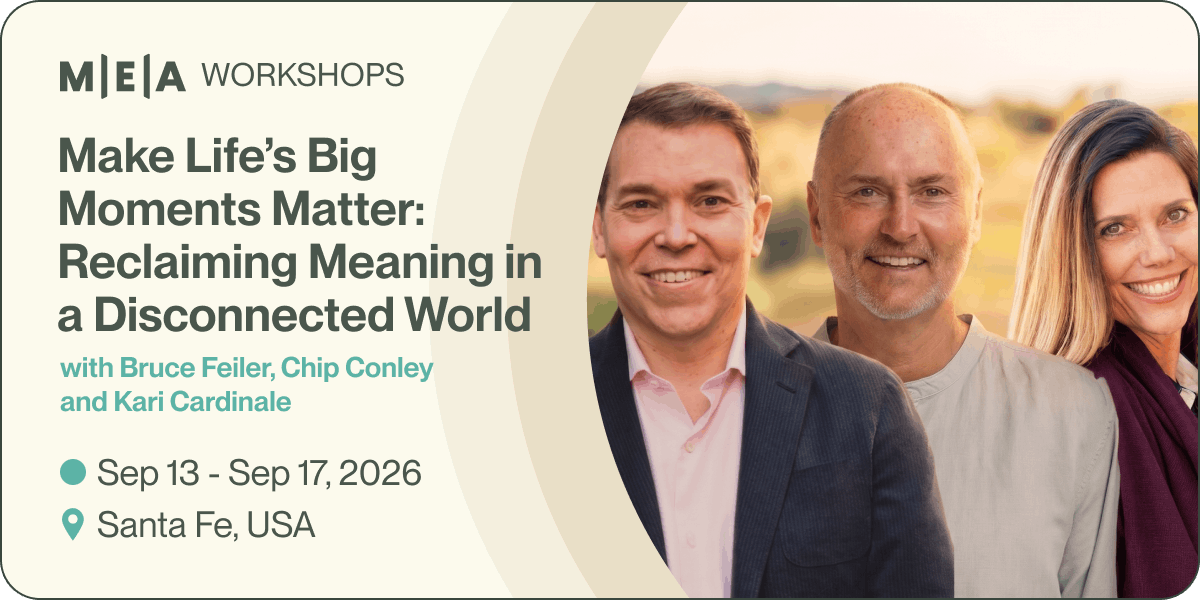
In other news, I’m overjoyed to announce today that for the first time anywhere ever I’m teaching a four-day workshop this September in Santa Fe with the great Chip Conley and the brilliant Kari Cardinale of Modern Elder Academy. The workshop is called Make Life’s Big Moments Matter: Reclaiming Meaning in a Disconnected World, and you can sign up now.
They’re offering a special early enrollment rate for a limited time. I hope to see you there.
Also, click on the links below to follow some of my recent appearances talking about my new book, A Time to Gather.
🌞
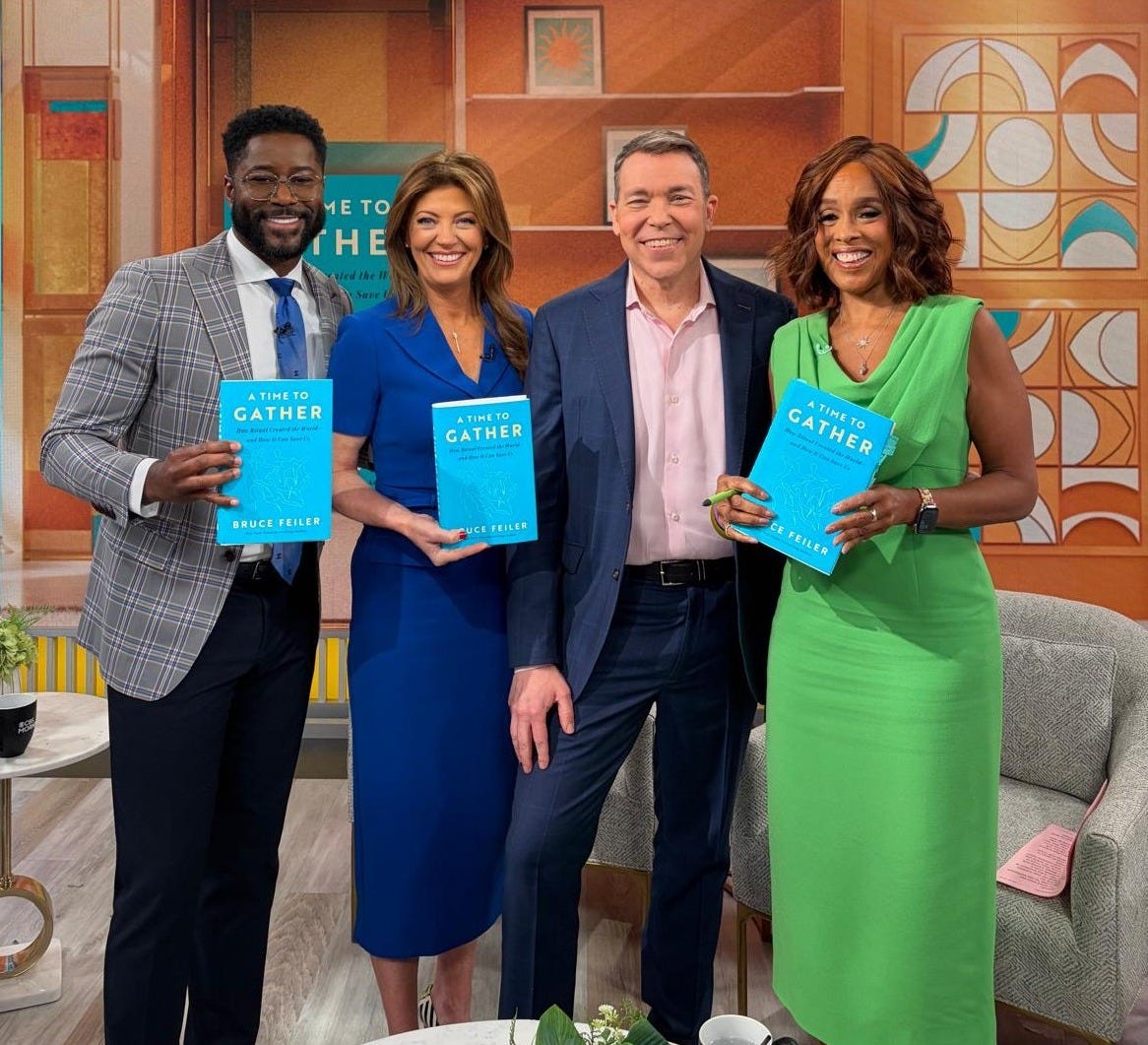
My CBS Mornings Interview about A TIME TO GATHER!
Exclusive: Watch Esther Perel + Bruce Feiler on the Power of Connection
How Rituals Can Save Your Family — and the First Review of A TIME TO GATHER!
Me on NPR: "How to Master Lifequakes and Find New Meaning in Your Life"
Or, you can contact me directly.
Comments
Nothing yet. Say the first thing.
Sign in to join the conversation.