
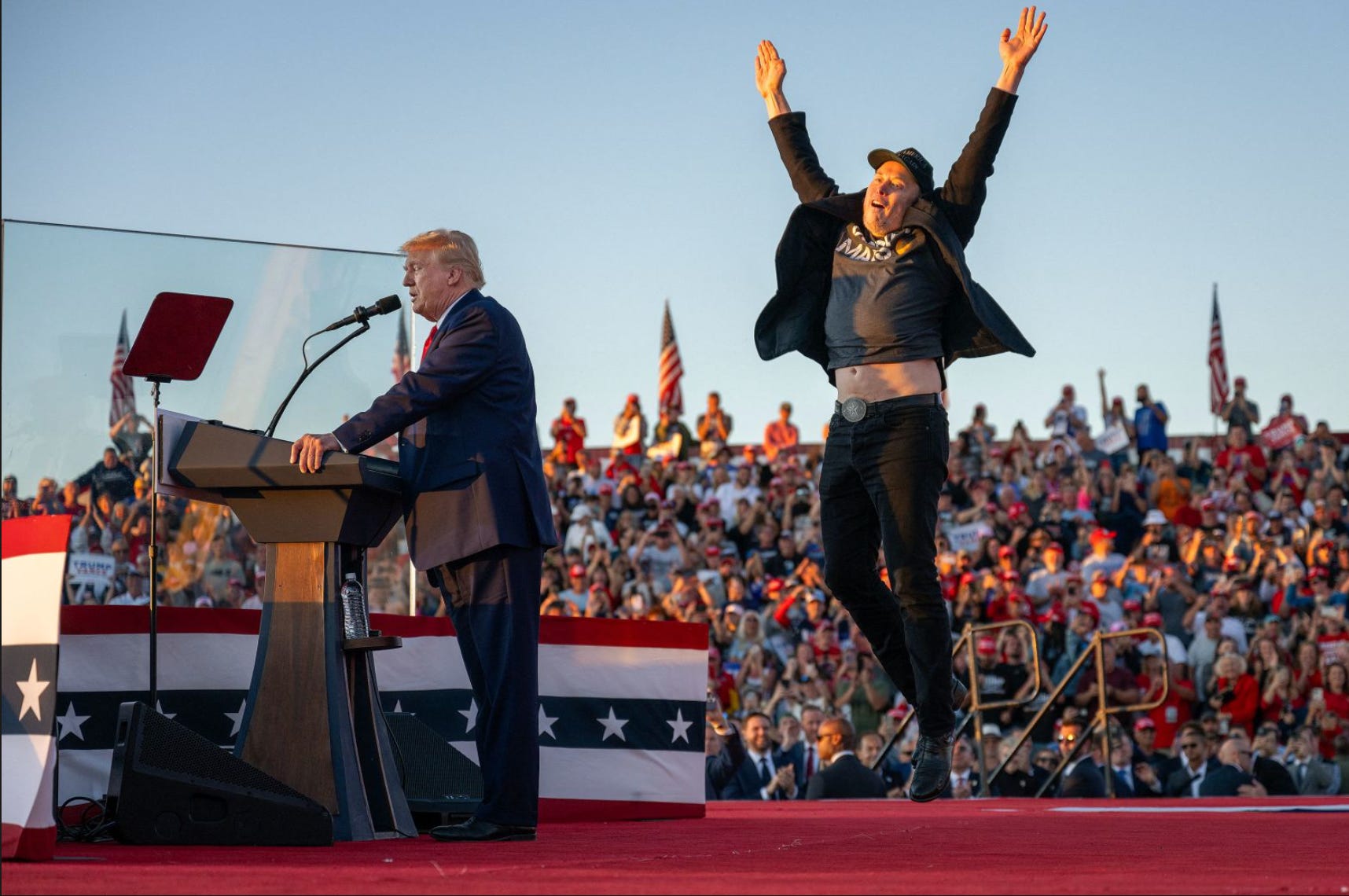
Donald Trump poses an unmistakable danger to the American constitutional republic. His contempt for democratic restraints, his personalization of public power, his attacks on independent institutions, and his willingness to treat political opponents as enemies all demand sustained opposition. But focusing exclusively on Trump risks misunderstanding the scale and history of the crisis. Trump did not create the political and economic conditions that made his movement possible. He exploited conditions produced over decades.
The deeper challenge is the modern Republican Party: its governing philosophy, institutional alliances, economic priorities, and repeated use of cultural conflict to obtain working-class votes for policies that primarily strengthen corporations, investors, and the wealthy.
This does not mean that every Republican voter is malicious, wealthy, or indifferent to suffering. Many Republican voters work hard, struggle financially, love their communities, and sincerely believe they are supporting freedom, responsibility, and national renewal. Nor does it mean that Democrats have always defended working people courageously or consistently. Democratic administrations have participated in deregulation, punitive welfare policies, corporate-friendly trade agreements, and the financialization of the economy. Wealthy donors and corporate interests exert influence in both parties.
Nevertheless, the differences between the parties are real. For nearly half a century, the Republican Party has pursued a remarkably consistent project: reduce taxes on corporations and high earners, weaken organized labor, limit public investment, deregulate private capital, and then invoke deficits, often enlarged by Republican tax policy, as justification for cutting programs on which working families depend.
Trump is not an interruption of that project. He is its most aggressive, authoritarian, and culturally combustible expression.
For several decades after the Great Depression, both major parties operated within a broad economic consensus. The federal government accepted responsibility for regulating markets, protecting the right to organize, investing in infrastructure, supporting homeownership, providing retirement security, and preventing another economic collapse. The arrangement was deeply flawed: Black Americans, women, immigrants, agricultural laborers, and domestic workers were frequently excluded from its protections. Yet it established an important principle: that democratic government could place limits on concentrated economic power.
Beginning in the 1970s and accelerating with Ronald Reagan’s election in 1980, Republicans set out to dismantle that consensus. They argued that taxes, labor unions, environmental protections, and social programs were suppressing individual freedom and economic growth. Their political solution was to liberate capital from public obligations.
They reduced tax rates on high incomes. Regulations were weakened. Union power declined. Public services were increasingly described as wasteful or dependency-producing. Government assistance to ordinary people became suspect, while subsidies, tax preferences, contracts, and legal protections benefiting corporations were treated as necessary incentives for growth.
This was not simply a dispute about the size of government. Republicans did not consistently seek a smaller government. They sought a government that would be less active in protecting workers and consumers but fully capable of protecting property, policing marginalized populations, subsidizing favored industries, enforcing restrictive social policies, and projecting military power.
The central question was therefore not whether government would be powerful. It was whose interests that power would serve.
Republican leaders have spent decades presenting themselves as guardians of balanced budgets. Yet their governing record repeatedly contradicts their rhetoric. Deficits are condemned when public money might be used for health care, food assistance, housing, education, environmental protection, or stronger social insurance. Deficits become much less urgent when the proposed expenditure takes the form of tax reductions, defense appropriations, business subsidies, or expanded systems of policing and immigration enforcement.
The 2017 tax law illustrates the pattern. It reduced individual and corporate tax liabilities, but many of its individual provisions were temporary while its reduction of the corporate tax rate was permanent. The Congressional Budget Office estimated that the law would increase federal deficits by approximately $1.9 trillion between 2018 and 2028 after accounting for economic feedback and debt-service costs. Economic growth was projected to offset only part of the lost revenue. CBO’s analysis of the 2017 tax law
The same contradiction appeared on an even larger scale in 2025. Public Law 119-21 reduced projected federal revenues by roughly $4.5 trillion while cutting approximately $1.1 trillion in direct spending. According to CBO, the law would add about $3.4 trillion to deficits before macroeconomic and debt-service effects and approximately $4.1 trillion once additional interest costs were included. CBO’s enacted-law estimate and debt-service analysis
This is not fiscal conservatism in any ordinary sense. It is fiscal selectivity. Revenue is deliberately reduced, the resulting deficit is portrayed as a national emergency, and programs serving ordinary households are then placed on the chopping block.
A government genuinely committed to fiscal responsibility would examine both spending and revenue. It would ask whether tax advantages for capital gains, inherited wealth, pass-through businesses, and corporations produce sufficient public benefit. It would scrutinize military contracts and subsidies with the same intensity applied to food assistance. It would not demand sacrifice primarily from people with the least political and economic power.
Defenders of tax cuts for corporations and the wealthy often claim that the benefits eventually reach everyone through investment, job creation, and higher wages. Some tax reductions can stimulate economic activity, particularly during recessions, and not every provision of a large tax bill affects only the rich. But the distribution of benefits matters, as does the question of what government must cut, or borrow, to finance those benefits.
CBO’s analysis of the 2025 reconciliation law found that households near the bottom of the income distribution would lose resources, largely because of reductions involving Medicaid and the Supplemental Nutrition Assistance Program. Households in the middle and at the top would gain resources, principally through changes in federal taxes. On average, the lowest tenth of households were projected to lose about $1,214 annually, while the highest tenth would gain about $13,622. Nearly 64 percent of the law’s total net increase in household resources would go to the highest-income tenth. CBO’s distributional analysis
This is the substance hidden beneath the language of economic populism. Republican leaders speak about forgotten workers, distressed communities, and families battered by high prices. But when governing choices must be made, their policies continue to benefit those who already have the most resources.
Money is not merely a private reward. In a political system, it is also power. Wealth purchases lobbying, campaign advertising, legal expertise, media influence, access to public officials, and the ability to endure long political contests. When policy consistently transfers resources upward, it also transfers democratic influence and political power upward.
That is why economic inequality is a constitutional concern. A republic cannot remain meaningfully self-governing if formal political equality coexists with extreme concentrations of private power.
The weakening of organized labor is one of the most consequential developments in modern American politics. Unions do more than negotiate wages. They provide workers with an institution through which they can bargain collectively, contest arbitrary treatment, participate in public life, and counterbalance corporate power.
For that reason, attacks on labor have been central to the Republican economic program. These attacks have included support for so-called right-to-work laws, opposition to stronger organizing protections, restrictive interpretations of who qualifies as an employee, and rules that make it easier for businesses to avoid bargaining responsibilities through subcontracting, franchising, or worker misclassification.
Republicans present these measures as protections for individual choice. The House Republican Policy Committee, for example, defends right-to-work laws and attacks the Protecting the Right to Organize Act as benefiting “union bosses.” House Republican Policy Committee statement: Yet the practical effect of right-to-work systems is to allow employees to receive the benefits of collective bargaining without contributing to the institution that performs the bargaining. This deprives unions of resources while leaving employers’ collective institutions—corporations, industry associations, lobbying organizations, and chambers of commerce—untouched.
Workers pay a price for this imbalance. Bureau of Labor Statistics data for 2025 show median weekly earnings of $1,404 for full-time union members, compared with $1,174 for nonunion workers. Those raw figures do not by themselves prove that union membership causes the entire difference; occupation, industry, education, and geography also matter. They do demonstrate, however, that unionized employment remains associated with substantially higher compensation. Bureau of Labor Statistics union report
Weakening unions also weakens democracy. When workers lose institutions capable of organizing across racial, religious, regional, and occupational lines, political life becomes more individualized and more vulnerable to resentment. Citizens cease to see themselves as members of a class with shared economic interests. Instead, they are encouraged to see one another primarily through cultural divisions.
The federal minimum wage remains $7.25 an hour, unchanged since July 2009. A person working forty hours a week for fifty-two weeks at that rate earns only $15,080 before taxes. The federal tipped cash wage can be as low as $2.13 an hour when the tip-credit rules apply. U.S. Department of Labor minimum-wage guidance
Many states and cities have adopted higher minimum wages, proving that political action can establish stronger local standards. But the refusal to raise the federal floor reflects a broader ideological choice. The economic value of work is treated as whatever an employer can compel an individual worker to accept, even when that amount is insufficient for housing, food, transportation, health care, and family life.
Opponents of a higher minimum wage warn that excessive increases can reduce hiring or burden small businesses. Those concerns should inform the design and phasing of wage policy. They should not become excuses for permanent inaction. A serious pro-worker program could combine a higher wage floor with targeted assistance for genuinely small employers, stronger competition policy, affordable health care, and measures to reduce commercial rents and other operating costs.
A wealthy society should not build its business model on wages that require workers to depend on food banks, public assistance, multiple jobs, or unpaid family care simply to survive.
Modern Republican rhetoric has changed. The language of country clubs and unrestrained globalization has given way to denunciations of elites, multinational corporations, unfair trade, and the abandonment of American workers. Some Republicans now criticize outsourcing and acknowledge the destruction that deindustrialization brought to many communities.
Not every part of this critique is false. Corporate globalization did hollow out communities, and Democratic policymakers often participated in the decisions that made it possible. But genuine economic populism must be judged by results, not tone.
Does a policy make it easier for workers to organize? Does it raise wages? Does it expand health coverage? Does it make housing more affordable? Does it require wealthy households and corporations to contribute proportionately to the country that protects their wealth? Does it reduce monopoly power? Does it help families survive unemployment, disability, illness, and old age?
The Republican record does not meet that test. CBO estimated that the Medicaid provisions of the 2025 reconciliation law would reduce federal deficits by nearly $887 billion but increase the number of uninsured people by 7.5 to 14 million in 2034. CBO’s Medicaid analysis. The same law provided additional funding for defense, homeland security, and immigration enforcement while reducing projected spending on Medicaid, food assistance, and student loans. CBO’s legislative summary
This is not a transfer of power from elites to working people. It is a transfer of resources away from vulnerable households, accompanied by rhetoric that tells struggling citizens their real enemies are immigrants, public employees, transgender people, teachers, protesters, and the poor.
Culture is a legitimate part of politics. Citizens have sincere disagreements about religion, family, education, race, gender, abortion, immigration, and national identity. These disagreements should not be dismissed as distractions invented from nothing.
Political movements can, however, manipulate genuine moral differences. They can amplify particular fears until those fears displace every other public concern. A worker who cannot afford medical treatment is encouraged to focus on a school curriculum. A family whose rent is rising is told that immigrants are the central cause of its insecurity. A community stripped of jobs, hospitals, and public services is offered symbolic combat against people with even less power.
The 2024 Republican platform demonstrates this fusion. It promises tax cuts and renewed prosperity for workers, but it also calls for the largest deportation operation in American history, attacks “radical gender ideology,” demands funding cuts for disfavored school content, and couples extensive military commitments with promises of fiscal restraint. 2024 Republican Party platform
Scapegoating is politically useful because it redirects anger horizontally. Workers blame other workers—immigrant against native-born, rural against urban, white against Black, Christian against Muslim, citizen against refugee—rather than looking upward at those who set wages, prices, rents, working conditions, and tax policy.
The people targeted in these conflicts are often the very people whose labor sustains the economy. They harvest food, build homes, care for children and older adults, clean offices, cook meals, deliver packages, staff hospitals, repair infrastructure, and keep communities functioning. A politics that depends on degrading them is not a politics of working-class solidarity.
When my wife and I volunteer with mutual-aid organizations, the people beside us are usually friends and neighbors who identify as Democrats, often progressive Democrats. We seldom encounter Republicans in those spaces.
That personal experience is not a scientific survey, and it should not be used to claim that Republicans never serve their communities. Many conservatives volunteer through churches, veterans’ organizations, disaster-relief groups, service clubs, and informal networks that may not use the language of mutual aid. Their contributions should be acknowledged honestly.
Still, our experience raises an important question: What does a political philosophy teach us to believe we owe one another?
Mutual aid begins with recognition. The person who needs groceries, rent assistance, transportation, or medical supplies is not an abstraction, a burden, or a category in a political argument. That person is a neighbor. Assistance is not proof of moral failure. It acknowledges that every life is vulnerable and that survival has always been collective.
The strongest mutual-aid tradition goes beyond charity. Charity can preserve a hierarchy between the giver and the recipient. Mutual aid recognizes shared dependence and shared power. Today I bring food to you; tomorrow you may drive me to a medical appointment, repair my home, care for my child, or stand beside me on a picket line.
A democratic republic depends on precisely this civic imagination. We must be able to see people outside our immediate family, religion, race, or political identity as members of a common community.
Trump’s distinctive contribution has been to fuse the Republican Party’s long-standing economic hierarchy with a more openly authoritarian political style. He promises to protect working people while demanding personal loyalty, attacking institutional restraints, and portraying opposition as treason. He turns economic anxiety into cultural grievance and cultural grievance into permission for concentrated executive power.
Yet the Republican establishment’s accommodation of Trump should not be understood as an inexplicable surrender. Much of the party accepted him because he continued delivering central Republican priorities: tax reductions, deregulation, conservative judicial appointments, hostility to organized labor, greater power for employers, and cuts or restrictions affecting social programs.
Trump changed the party’s manners, language, and relationship to democratic norms. He did not reverse its fundamental distribution of economic allegiance.
Defeating one candidate, therefore, is not enough. A movement that removes Trump while leaving intact the conditions that produced Trumpism will remain vulnerable to the next demagogue, perhaps one more disciplined, competent, and ideologically focused than Trump himself.
Criticism of Republicans is insufficient unless it is accompanied by a credible alternative. Democrats cannot merely defend institutions in the abstract while families experience insecurity in their daily lives. Constitutional democracy will remain fragile if citizens associate it with unaffordable housing, medical debt, precarious employment, declining public services, and a permanent fear of economic ruin.
A democratic economic program should make freedom tangible. Freedom means being able to leave an abusive employer without losing health care. It means having enough bargaining power to demand safe conditions and fair wages. It means being able to raise a family without financial collapse, obtain an education without lifelong debt, and retire with dignity. It means not being one illness or rent increase away from homelessness.
Such a program should include stronger organizing rights, a living wage, universal access to affordable health care, serious housing investment, progressive taxation, enforcement against monopolies and wage theft, paid family leave, stronger retirement security, and sustained investment in schools, infrastructure, public transportation, clean energy, and care work.
It must also protect the rights of minorities and immigrants, not as a secondary cultural concern, but as an essential part of economic solidarity. Employers gain power when they can divide workers by citizenship, race, gender, or legal status. Equal rights are therefore part of working-class politics, not a distraction from it.
The central challenge confronting the United States is larger than Donald Trump. It is a political and economic project that has spent decades weakening the institutions through which ordinary people exercise power. That project has shifted resources toward wealth, undermined organized labor, resisted a living wage, used deficits selectively, and transformed cultural difference into a weapon against solidarity.
A constitutional republic cannot survive through legal reforms alone. Elections, courts, legislatures, and written rights are indispensable, but they require a social foundation. Citizens who live in constant insecurity are vulnerable to fear, scapegoating, and authoritarian promises. Citizens who possess education, economic security, reliable public institutions, and organizations of their own are better equipped to govern themselves.
The call to action must therefore be broader than “vote against Trump,” although voting remains essential. We must vote in every election, especially state and local contests that determine labor law, voting access, education, health care, and reproductive freedom. We must support candidates who demonstrate their commitment to working people through policy, not branding. We must join unions, tenant organizations, mutual-aid networks, congregations, neighborhood associations, and civic groups. We must defend targeted neighbors when politicians attempt to turn them into scapegoats. We must contact lawmakers, attend public meetings, support independent journalism, and hold Democratic officials accountable when they yield to corporate power.
Most of all, we must rebuild the habit of solidarity.
The answer to a politics of hierarchy is not contempt for Republican voters. It is organizing strong enough to show that working people have more in common with one another than with the billionaires and corporations that profit from their division. The answer to authoritarianism is not merely a return to the conditions that preceded it. It is a more democratic economy, a more inclusive society, and a public life organized around the conviction that every person deserves security, dignity, and a meaningful voice.
Trump must be opposed. But the work cannot end with Trump. We must confront the party, policies, institutions, and concentrations of wealth that made Trumpism possible, and build a republic in which no future demagogue can so easily turn insecurity into hatred and hatred into power.
Comments
Nothing yet. Say the first thing.
Sign in to join the conversation.