
President Donald Trump has long treated international politics as a test of personal dominance. Threats are advertised as strategy, unpredictability as genius, and temporary concessions as historic victories. When the consequences become uncomfortable, he often changes course, rebrands the retreat, and insists that everything unfolded exactly as planned.
That habit inspired the derisive acronym “TACO”—“Trump Always Chickens Out.” The description is glib, but it captures a recurring political pattern: Trump makes an extravagant threat, markets it as an ultimatum, and then searches for a face-saving escape once markets fall, opponents refuse to capitulate, or the promised victory proves elusive.
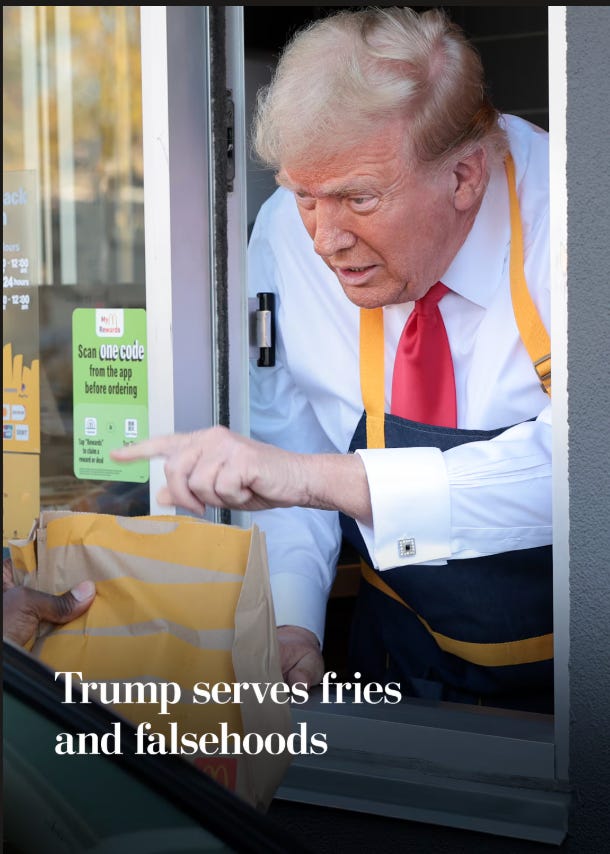
In Iran, however, Trump appears to have encountered a crisis that cannot be managed with slogans alone. He has walked into the geopolitical equivalent of a McDonald’s, demanded a TACO, and discovered that it is not on the menu.
Every obvious course now carries serious costs. Escalation could spread the war and consume more American weapons. Sanctions would take time, require international cooperation, and punish the very Iranian civilians Trump claims to support. Withdrawal would expose the distance between his declared objectives and what the war actually accomplished. A negotiated settlement may be necessary, but Iran understands his eagerness for a deal and has little reason to accept terms that allow him to claim an unqualified triumph.
The central problem is no longer simply how to pressure Iran. It is how Trump can leave a conflict of his own making without admitting that military force failed to produce the easy victory he appeared to expect.
Trump’s familiar negotiating method depends upon creating the appearance that his opponent has more to lose than he does. He raises the stakes, establishes a dramatic deadline, predicts surrender, and counts on the other side to become frightened enough to concede.
That approach is most effective when the confrontation remains theatrical. It becomes far more dangerous when missiles are flying, soldiers and civilians are dying, shipping is disrupted, and national prestige is at stake.
Iranian leaders have studied Trump’s behavior. They know he values the announcement of a deal almost as much as its substance. They also know that he is politically sensitive to gasoline prices, stock market declines, falling approval ratings, and negative television coverage. These vulnerabilities give Tehran an incentive to wait. If Iranian leaders believe Trump needs a quick exit more urgently than they do, his threats lose much of their coercive power.
This is the paradox of performative unpredictability. A leader who constantly reverses himself may initially appear difficult to anticipate. Over time, however, the reversals become a predictable pattern of their own. Opponents learn to withstand the first threat, disregard the second deadline and wait for the eventual retreat.
Trump may still order additional attacks. But Iran’s leaders can reasonably ask whether each escalation represents a sustainable strategy or another attempt to manufacture leverage before Washington searches for an off-ramp.
Trump’s first option is to intensify the conflict dramatically. The theory is straightforward: inflict enough military and economic pain that Iran rushes to the negotiating table and accepts American conditions.
The difficulty is that versions of this strategy have already failed to produce a durable resolution. Airstrikes can destroy installations, weapons and infrastructure, but they cannot automatically compel a large, politically cohesive nation to surrender its strategic objectives. Iran has retained the ability to retaliate against American forces, regional allies and commercial shipping. Intensified pressure has therefore produced intensified retaliation rather than uncomplicated submission.
Recent reporting has underscored the limits of bombing as a means of resolving the Strait of Hormuz dispute. Despite sustained military pressure, Iran has continued to obstruct one of the world’s most important energy corridors. Approximately one-fifth of the world’s oil normally passes through the strait, making every new round of hostilities a threat to energy prices and the wider global economy. Associated Press reporting describes both the military impasse and current efforts to find an off-ramp.
Further escalation might damage Iran, but damage is not the same as capitulation. Tehran can answer conventional American superiority asymmetrically, with drones, missiles, attacks on bases, pressure on shipping and action by aligned groups elsewhere in the region. The United States may be capable of winning virtually any individual military exchange while still failing to create the political outcome Trump promised.
Escalation would also endanger American troops and regional partners. Every additional strike creates another opportunity for miscalculation: a missile that kills a large number of Americans, an attack that draws another country directly into the fighting, or a retaliatory cycle that neither government originally intended.
A president can order an escalation in minutes. He cannot dictate where the resulting chain reaction will end.
Trump’s rhetoric frequently presents American military capacity as inexhaustible. Actual defense planning is more complicated. Aircraft, ships, and launchers may remain available even as the specialized weapons they employ become scarcer.
Air-defense interceptors are an especially serious concern. Defending American bases, allied cities and ships from repeated Iranian missile and drone attacks can require enormously expensive weapons. Some interceptors take years to manufacture, and the same inventories may be needed for Europe, the Indo-Pacific and other contingencies.
An analysis cited by the Associated Press concluded that replacing several categories of advanced weapons used in the Iran conflict could take years. It also warned that diminished inventories could create a period of vulnerability in the Western Pacific, even if the United States retains enough munitions for plausible operations against Iran. That distinction, between being able to continue the present war and remaining prepared for the next crisis, is critical.
Reporting has also indicated that senior military officials privately raised concerns about shortages of air-defense interceptors needed to protect American personnel and allies. Axios reported that these concerns helped inform advice to pause attacks around the Strait of Hormuz.
This is precisely the kind of constraint that political boasting cannot overcome. A war may be described as unlimited, but production lines are not. Continuing to expend scarce defensive weapons in pursuit of unclear political objectives could weaken American preparedness far beyond the Middle East.
The conflict’s costs do not stop at the battlefield. Instability around the Strait of Hormuz affects oil supplies, insurance rates, shipping schedules and manufacturing costs. Those pressures eventually reach consumers through higher gasoline, transportation, food and electricity prices.
Businesses facing unpredictable energy and shipping costs delay investment or pass their expenses on to customers. Countries dependent on imported fuel encounter inflation and fiscal strain. Supply chains still vulnerable to geopolitical disruption are forced to absorb another shock.
This creates an uncomfortable contradiction for Trump. Escalation is supposed to demonstrate strength, yet every additional attack can give Iran greater power to disrupt the global economy. The more Trump attempts to bomb Tehran into reopening the strait on his terms, the more the conflict may raise the economic price that American voters associate with his presidency.
War is being used to force Iran to surrender leverage, but the war itself has enlarged Iran’s leverage over energy markets.
A second option is to expand sanctions and attempt to strangle Iran economically. This approach has the superficial advantage of appearing forceful without immediately risking another major military escalation.
But sanctions are neither quick nor self-executing. Their success depends upon enforcement, diplomatic cooperation, and the willingness of other governments to bear collateral economic costs. Countries already frustrated by disrupted energy supplies may be reluctant to participate in an indefinite American pressure campaign. Some will seek exceptions; others will quietly evade restrictions or create alternative trading arrangements.
Sanctions also tend to operate over months or years, while Trump’s political timetable is much shorter. The 2026 midterm elections are approaching, and voters are judging the administration on prices and stability now, not on what a sanctions regime might accomplish several years in the future.
Most importantly, intensified sanctions would inflict severe hardship on ordinary Iranians. Food, medicine, employment and household purchasing power would suffer long before the country’s most protected political and military elites felt equivalent pain.
That reality collides with Trump’s claim that America stands with the Iranian people. A policy cannot credibly be sold as liberation if its most immediate result is deeper deprivation for the population supposedly being liberated.
Sanctions may form part of a diplomatic settlement, but as a substitute for strategy they offer no rapid or morally uncomplicated escape.
Trump could simply announce that the United States has achieved its objectives, reduce military operations and bring American forces home. Politically, this would be the purest TACO maneuver: redefine success, stage a triumphant announcement and attack anyone who questions the result.
Such a declaration might appeal to Americans who want the conflict ended regardless of the rhetoric used to end it. It could save lives, stabilize energy markets and prevent the further depletion of American weapons. In practical terms, accepting an imperfect peace may be far wiser than escalating an unsuccessful war merely to protect a president’s pride.
But declaring victory cannot erase unresolved conditions. If Iran retains decisive influence over transit through the Strait of Hormuz, if its nuclear and missile capabilities remain disputed, and if regional hostilities continue, Trump will have difficulty explaining what the United States won.
Earlier agreements and ceasefires have demonstrated how large the gap can be between an announcement and a lasting settlement. The Council on Foreign Relations noted that an earlier arrangement concerning the strait was only a beginning and left major questions—including sanctions, nuclear restrictions and regional security—unresolved. A headline proclaiming “deal” cannot substitute for enforcement, implementation and durability.
Trump can declare victory whenever he wishes. He cannot require Iran, global markets, American voters or the historical record to believe him.
The remaining alternative is serious diplomacy. That would involve accepting that Iran also possesses leverage and that a sustainable settlement will require reciprocal concessions.
A workable agreement could address navigation through the Strait of Hormuz, limits and monitoring related to Iran’s nuclear activities, phased sanctions relief, regional military de-escalation, prisoner issues and mechanisms for resolving alleged violations. Such an agreement would almost certainly be imperfect. It would also be more valuable than a “perfect” settlement that exists only in presidential speeches.
Yet negotiations pose a special psychological and political problem for Trump. He entered the conflict presenting compromise as weakness and military pressure as the route to unconditional success. The more ambitious his promises became, the harder it became to accept an ordinary negotiated outcome.
Iran understands this dilemma. Its leaders know Trump wants a deal he can market as historic. They can therefore demand compensation for giving him one. His public hunger for a dramatic announcement weakens his bargaining position, while his repeated threats make it harder for Iranian officials to compromise without appearing to surrender to coercion.
Diplomacy is still the least destructive option. But it requires patience, technical expertise, consultation with allies and the ability to distinguish national interests from personal political theater. It also requires acknowledging that the United States cannot obtain every objective simply because its president insists that it must.
Trump has reportedly turned repeatedly to advisers for a solution. But advisers cannot manufacture a painless option when presidential decisions have eliminated the easy ones.
They can offer variations on escalation, containment, sanctions or diplomacy. They can calculate military risks, propose negotiating formulas and identify possible concessions. What they cannot do is guarantee that Iran will surrender, that oil prices will fall immediately, that depleted munitions will replenish themselves or that the public will accept a rhetorical victory in place of a strategic one.
Nor should advisers be eager to take ownership of a failing policy merely to shield the president from its political consequences. When responsibility travels only downward, and credit travels only upward, the rational instinct is self-preservation. Few people volunteer to swim in a reflecting pool that has become another Washington swamp.
The president wants an option that is decisive but not dangerous, forceful but inexpensive, immediate but durable, and capable of producing Iranian concessions without American compromise. No adviser can supply such an option because it does not exist.
The Iran conflict is unfolding as Trump’s domestic standing has deteriorated and the midterm elections approach. Polling has shown widespread dissatisfaction with his handling of the war and the economy. A Washington Post–ABC News–Ipsos survey reported a worsening political environment for Republicans, with voters troubled by Trump’s leadership on Iran and by the economic consequences associated with the conflict. The poll also found heightened Democratic motivation ahead of the midterms.
It is safer to say that Trump’s popularity has reached new lows in particular polls than to claim an uncontested all-time low across every measure. Nevertheless, the direction of public sentiment is politically ominous. Presidents rarely help their parties when voters perceive them as presiding over war, inflation and disorder simultaneously.
If November produces a Democratic wave, the final two years of Trump’s term could become deeply unpleasant for him. A Democratic-controlled House could initiate aggressive investigations, scrutinize the origins and conduct of the war, examine military expenditures and use oversight hearings to expose internal disagreements. Control of either chamber would complicate his domestic agenda. Subpoenas, budget confrontations and renewed arguments about presidential war powers could dominate Washington.
Trump may discover that a conflict begun as a display of command has helped create the conditions for political paralysis at home.
The deepest problem is not that Trump lacks good options today. It is that his administration appears to have entered or expanded the conflict without a realistic and attainable end state.
Military action should answer fundamental questions before it begins: What precise political result is being sought? Can force plausibly produce it? What happens if the adversary refuses to yield? How will retaliation be contained? What resources will be required? What compromises are acceptable? How does the war end?
When those questions remain unanswered, military superiority becomes a trap. The United States can strike more targets and still move further away from its political objectives. It can win battles while losing control of escalation, economic stability and diplomatic legitimacy.
Trump treated coercion as though it were identical to strategy. Iran has demonstrated the difference.
The president’s bad options are not merely strokes of misfortune. They are the foreseeable products of launching a war on expansive promises, underestimating the adversary’s capacity to endure and confusing the ability to destroy with the ability to dictate.
Trump is stuck, not because the United States is powerless, but because American power was employed without a credible political destination. Escalation threatens a wider regional disaster. Sanctions promise prolonged civilian suffering and uncertain results. A theatrical declaration of victory would leave crucial objectives unresolved. Diplomacy requires precisely the compromise and discipline that Trump has spent years portraying as weakness.
There is no TACO available because there is no cost-free retreat. There is only a choice among consequences.
The least damaging course is an immediate, sustained diplomatic effort backed by Congress, American allies and professional negotiators. Its goals should be concrete and limited: protect commercial navigation, prevent nuclear proliferation, halt attacks on American forces, reduce regional hostilities and establish an enforceable framework for further negotiations. The United States should reject both fantasies of unconditional surrender and empty declarations of victory.
Congress must also reassert its constitutional responsibility over war. Legislators should demand public explanations of the administration’s objectives, costs, legal authority, munitions use and exit strategy. They should refuse to finance an indefinite conflict whose goals shift whenever the president’s rhetoric does.
Finally, voters must insist upon accountability. They should ask every candidate whether war is being used to protect the country or merely to protect a president’s image. They should demand leaders who understand that strength includes restraint, that diplomacy is not surrender, and that no American president should be allowed to gamble with lives and global stability simply because he cannot admit a mistake.
The nation does not need another slogan, another deadline or another theatrical “deal.” It needs an honest exit from a dangerous war—and a democratic commitment to prevent the next reckless one.
Poor Donald may be unable to order his TACO. The American people, however, are not required to remain trapped in the restaurant with him.
Comments
Nothing yet. Say the first thing.
Sign in to join the conversation.