
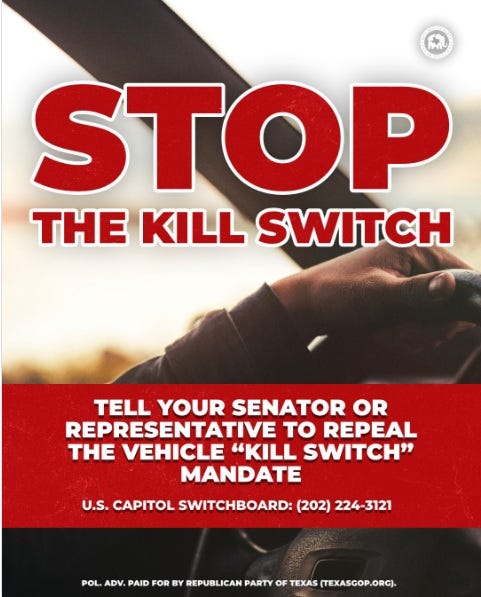
When I was born, in 1954, cars had no seatbelts or airbags and getting a copy of your ignition key only cost a few bucks. There was absolutely nothing tracking what you were doing or where you were going. Today a new key fob can cost over $200 and everywhere you go is being tracked. If something isn’t done all 2027 cars, manufactured in the US, will require “kill switches” and a host of other technologies overseeing your every movement. These technologies will add thousands of dollars to the price of buying a new car and additional thousands of dollars to maintain the new surveillance equipment. And as the public begins to understand the implications of these technologies it is quite likely no one is going to buy them. You would think the auto manufactures would have learned something from EV fiasco which cost the manufactures tens of billions in losses.
I fondly remember getting my drivers license back in 1970 at the tender age of 16. Most weekends my parents let me drive their Ford LTD which had quite a bit of power as well as a couch sized back seat which came in handy for dates and partying at the Drive-In Theaters. On a typical weekend we would get our bottle of Boone’s Farm, roll a few joints and party like it was 1999. In Dearborn, home of Ford Motor, another popular “make out” site was Ford Field which was located beside the Rouge River. The Dearborn Police would occasionally knock on the fogged up car windows to make sure one had died from Carbon Monoxide poisoning. But they pretty much left us alone knowing full well what we were up to. On a typical Friday night you would find over 50 cars parked down at Ford Field. In 1978 I bought a brand new chocolate brown Trans Am which had a 400 cubic inch V8 and a big eagle emblazoned across the hood. It was the most powerful car I ever owned and only cost $6300 dollars at the time.
Well those days are basically dead and gone. Most Drive-In theaters longer exist. Most of todays cars are so small you’d have to be a contortionist to have sex in them. Cars are becoming more unaffordable by the year. To buy something comparable to my ‘78 Trans Am you’d have to pay ten times as much as I did in 1978. And beginning in 2027 all new cars will have “kill switches” which will detect if you’ve been drinking and cameras video taping your activities in the car. They will also be recording everything you say. And you can thank your Globalist Congressmen, President Biden and Congresswomen Debbie Dingell, for turning you car into a surveillance trap.
The “Kill Switch” law was tucked into the U.S. Infrastructure Investment and Jobs Act (Section 24220) in 2021. It was passed by both houses and signed by President Biden. So without a doubt the House, the Senate and Biden can be blamed for its passage.
=====
The 2021 U.S. Infrastructure Investment and Jobs Act (Section 24220) mandates that all new passenger vehicles must be equipped with advanced, passive drunk and impaired driving prevention technology by roughly 2026–2027. This mandate, often termed a “kill switch” in public debate, is intended to monitor driver performance and disable the vehicle if impairment is detected.
Key Aspects of the Kill Switch Law
* Legislative Origin: The requirement was passed as part of the Infrastructure Investment and Jobs Act (HALT Drunk Driving Act) in November 2021.
* Mandate Details: It requires the National Highway Traffic Safety Administration (NHTSA) to set standards for technology that can “passively monitor” driver performance to identify impairment and prevent operation.
* Implementation Timeline: While the law was passed in 2021, the final safety standards were set to be finalized within three years, with the mandate expected to apply to all new vehicles shortly thereafter, often cited as the 2026–2027 timeframe.
* Goal: The technology aims to significantly reduce traffic fatalities caused by intoxicated drivers, with advocates suggesting it could save thousands of lives annually.
* Controversy and Privacy: The provision has faced backlash, with critics raising concerns about government overreach, privacy, and the potential for remote, arbitrary shutdown of vehicles.
Recent Political Action
Efforts to repeal this mandate, such as the Kill Switches in Cars Act (H.R. 6563) and subsequent amendments, have been introduced by lawmakers to prevent federal funds from implementing this technology, though these efforts have faced challenges in fully overturning the 2021 law.
Google AI [history of car kill switch law in united states]
=====
Now you could argue that passage was a no brainer. According to an Ipsos poll 82% of respondents support or somewhat support the Congressional mandate for drunk driving prevention technology in all new cars, up from 77% before the law passed last year. But I highly doubt those polled understood just how intrusive this technology will be when fully implemented. And 78% of respondents said they are much more or somewhat more likely to support the technology if it comes at extra cost to consumers. But how many would have supported the “kill switch” if they had known it will add an additional $500 to $2000 cost for each new car. How many would have supported the “kill switch” if they had known that these technologies go far beyond stopping drunk driving.
The average car is already crazy expensive: about $50,000 dollars. And the cost of insurance and maintenance is also skyrocketing. As I wrote in my last essay our Congressmen don’t really give a flying fuck about what their constituents want. But they do care about the PACs that contribute to their campaigns -- like the insurance companies. And it turns out that 13 top insurance companies wanted this to pass.
=====
A new Ipsos poll shows that 9 out of 10 Americans support technology that is integrated into a car’s electronics to prevent drunk driving. The new poll results come one year after the bipartisan HALT Act was signed into law as part of the Infrastructure Investment and Jobs Act. The law gave the National Highway Traffic Safety Administration (NHTSA) three years to establish an auto safety standard for all new cars that detects and prevents impaired driving. 91% of respondents said the technology is a good or very good idea. Support for the technology spans gender, age, income and regional differences. The most common factor that influences support for impaired driving prevention technology in all new cars is cost, according to the poll commissioned by Mothers Against Drunk Driving (MADD). 78% of respondents said they are much more or somewhat more likely to support the technology if it comes at extra cost to consumers. “MADD agrees that safety should not just be a luxury for people who can afford to pay for it,” said MADD National President Alex Otte. “Advanced, passive technology that prevents impaired driving should be as standard as seatbelts and airbags – not an upcharge and not an option. There’s a crisis on our roads, and every month we wait to get this technology on all new cars means more than 1,000 preventable deaths and 25,000 preventable injuries caused by drunk driving.”
The bipartisan HALT Act, led by Congresswoman Debbie Dingell in the U.S. House of Representatives and Senator Ben Ray Luján in the U.S. Senate, sets the three-year timeframe for NHTSA to identify the new auto safety standard, then gives auto makers another two to three years to implement it. The three-year timeline began on November 15, 2021. Victims and survivors of impaired driving were the driving force behind the legislation, with strong support from MADD, traffic safety partners, leading alcohol companies and 13 top insurance companies. “We have the technology now to stop drunk driving, and every day we fail to implement it, more lives are lost to preventable tragedy,” said Congresswoman Dingell. “I’m proud that a year ago, we passed this critical priority as a part of the Bipartisan Infrastructure Law. It is beyond time we made sure it is implemented in vehicles and start saving lives.” According to the Ipsos poll, 82% of respondents support or somewhat support the Congressional mandate for drunk driving prevention technology in all new cars, up from 77% before the law passed last year.
Americans Overwhelmingly Support Auto Technology that Stops Drunk Drivers, New Ipsos Survey Shows (11/15/2022)
https://madd.org/press-release/americans-overwhelmingly-support-auto-technology-that-stops-drunk-drivers-new-ipsos-survey-shows
=====

I have written extensively about Debbie Dingell. In 1996 I ran against her husband, John Dingell, for US Congress. Debbie is what I’d call a dyed in the wool Globalist. And she is as dumb as a bag of rocks which makes her particularly dangerous. She supports the forced adoption of the UN’s Agenda 2030, EV’s, 5G and many additional globalist agendas. And she was absolutely instrumental in the drafting and passage of the “Kill Switch” legislation. You might call her the Witch of the Kill Switch.

Here is a brief list of all Senators that voted for the 2021 HALT Act:
=====
The “kill switch” provision (advanced impaired driving technology) was included in Section 24220 of the Infrastructure Investment and Jobs Act (H.R. 3684), passed by the Senate on August 10, 2021. The bill passed with a 69-30 vote, supported by all 50 Democrats/Independents and 19 Republicans.
Key Senate Support (2021 Vote):
* All Democrats: (e.g., Schumer, Durbin, Manchin, Sinema).
* 19 Republicans: Blunt, Burr, Capito, Cassidy, Collins, Cornyn, Cramer, Crapo, Ernst, Fischer, Grassley, Hickenlooper (D), Hoeven, McConnell, Moran, Murkowski, Portman, Risch, Romney, Tillis, Young.The mandate was part of the bipartisan infrastructure package signed into law in 2021.
=====
And here is a brief summary of all House members that voted for the 2021 HALT Act. As you might have guessed it was primarily supported by Globalist House Democrats.
=====
The HALT Act (Drunk Driving Prevention - Federal)
In 2021, the federal House of Representatives passed drunk driving prevention provisions (the Honoring Abbas Family Legacy to Terminate Drunk Driving Act) as part of the INVEST in America Act (H.R. 3684) on July 1, 2021.
* Vote Result: Passed 221-201, largely along party lines.
* Who Voted For It: It was supported primarily by House Democrats and pushed by Rep. Debbie Dingell.
=====
If you want to learn more about Debbie Dingell’s Globalist record read through the following essays I wrote back in 2023.
=====
=====
=====
Representative Debbie Dingell: Globalist Witch from the North
·
December 30, 2023
A true believer is someone that blindly embraces a religious or secular ideology without questioning the underlying tenants of that ideology. We see this particularly on the left. For example the gay indoctrinated progressives are now supporting the Islamic group Hamas, totally unaware that most Muslim theocracies throw gays off of roofs to their deat…
=====
But no one is more responsible for mandating “Kill Switches” and Surveillance equipment, in our cars, than Debbie Dingell. She began her crusade back in 2019 after a Michigan family was tragically killed in a car accident caused by a drunk driver while returning from a family vacation.
=====
Today, Congresswoman Debbie Dingell (D-MI) released updates to her legislation to reduce drunk driving deaths across the country. The updated legislation, the Honoring Abbas Family Legacy to Terminate (HALT) Drunk Driving Act, will require the commercialization and standards for passive alcohol detection systems in all new cars.
In January, Dingell first announced legislation to take action to prevent drunk driving. The Abbas Stop Drunk Driving Act came after a Michigan family was tragically killed in a car accident caused by a drunk driver while returning from a family vacation. Dingell honored their lives on the house floor and pledged action to reduce drunk driving accidents.
“Drunk driving has brought pain to my community in Dearborn and the country,” said Dingell. “Change and progress never come as fast as we’d like, but we need to do everything we can to ensure what happened to the Abbas family never happens again. The DADSS technology has the potential to save lives. The HALT Drunk Driving Act honors the Abbas’ family legacy by exploring the use of passive alcohol detection technology in all new cars. I’m committed to continuing to work with advocacy groups, industry, and federal regulators so we can ensure the tragedy of the Abbas family is the last tragedy caused by drunk driving.”
The Driver Alcohol Detection System for Safety (DADSS) is an innovative technology that passively tests drivers intoxication. The technology does not require action from the driver, such as blowing into a breathalyzer, but will prevent the car from moving if tests for blood alcohol concentration (BAC) are above 0.08 percent – the legal limit in all 50 states except Utah.
“For over a decade, MADD has supported and promoted research and development of advanced drunk driving prevention technologies,” said MADD National President Helen Witty. “This technology could save 7,000 lives every year. We can’t afford to wait any longer for this safety feature to be equipped in all cars.”
Drunk driving is the number one cause of death on America’s roadways. More than 10,000 deaths—about 30 percent of all fatal crashes—are caused by drunk driving each year. The Driver Alcohol Detection System for Safety (DADSS) Program is a private-public partnership is developing and testing technology that would not require any additional action – such as blowing into an interlock device – to prevent a drunk driver from starting a vehicle. The goal of the DADSS program is to develop technology that is accurate and precise at stopping drunk drivers while being unobtrusive and not creating any inconvenience to a sober driver.
Dingell Releases Updates to Drunk Driving Bill
Washington, September 17, 2019
https://debbiedingell.house.gov/news/documentsingle.aspx?DocumentID=1906
=====
Then after the “Halt Act” was passed in 2021 Dingell is supporting yet another bill to Prevent Drunk Driving Fatalities and Support Law Enforcement in 2026.
=====
This bill has been endorsed by: Mothers Against Drunk Driving (MADD), American Automobile Association (AAA), Advocates for Highway and Auto Safety, Community Anti-Drug Coalitions of America (CADCA), Consortium of Forensic Science Organizations, American Society of Crime Lab Directors (ASCLD), American Academy of Forensic Science, National Association of Medical Examiners, International Association of Coroners and Medical Examiners, Society of Forensic Toxicologists, American Board of Toxicologists, the International Association for Identification, Distilled Spirits Council of the United States (DISCUS), National Prevention Science Coalition to Improve Lives, National Safety Council, National Sleep Foundation, Responsibility.org, Safe Kids Worldwide, Society for Public Health Education, Stopdistractions.org, Students Against Destructive Decisions (SADD), Truck Safety Coalition, Institute for Safer Trucking, Association for Safe International Road Travel, American Association of Motor Vehicle Administrators, Governors Highway Safety Association.
Reps. Gillen, Lawler, Dingell Introduce Bipartisan Bill to Prevent Drunk Driving Fatalities and Support Law Enforcement (01/28/2026)
https://gillen.house.gov/media/press-releases/reps-gillen-lawler-dingell-introduce-bipartisan-bill-prevent-drunk-driving
=====
=====
H.R.6704 - Drunk Driving Prevention and Enforcement Act of 2025
119th Congress (2025-2026)
https://www.congress.gov/bill/119th-congress/house-bill/6704
=====
Basically HALT Act mandated the development of the Kill Switch technology, while H.R.6704 seeks to accelerate that deployment through incentives, while also strengthening enforcement and data collection. Again Dingell has her fingerprints all over both pieces of legislation.
=====
The main difference between H.R.6704 (Drunk Driving Prevention and Enforcement Act of 2025) and the HALT Drunk Driving Act (passed in 2021) is that the HALT Act mandated the development of technology, while H.R.6704 seeks to accelerate that deployment through incentives, while also strengthening enforcement and data collection.
* HALT Drunk Driving Act (2021): Signed into law as part of the Infrastructure Investment and Jobs Act, it directs the National Highway Traffic Safety Administration (NHTSA) to set safety standards for new vehicles to have passive, anti-drunk driving technology by roughly 2030.
* H.R.6704 (Drunk Driving Prevention and Enforcement Act of 2025): Introduced in December 2025, this bill builds upon the HALT law. It focuses on accelerating the implementation of that technology by establishing a, “5,000,000 [per year]” prize competition for manufacturers. It also creates a “Traffic Safety Enforcement Center of Excellence” to aid police and a system to track drug-involved crashes.
Key Aspects of H.R.6704 (2025)
* Accelerated Deployment: Aims to bring consumer-ready passive, anti-drunk driving technology into cars faster.
* Prize Competition: Authorizes a 5 million annual prize for developing technology that meets safety standards.
* Enforcement & Data: Establishes a “NHTSA Traffic Safety Enforcement Center of Excellence” and a “National drug involved crash data collection system”.
* Purpose: Pairs new in-vehicle technology with improved law enforcement tactics.
Google AI [what is the difference between H.R.6704 and the halt drunk driver act]
=====
Right after passage of the Halt Act people were saying this mandatory measure should set off red flares.
=====
Buried deep within the massive infrastructure legislation recently signed by President Joe Biden is a little-noticed “safety” measure that will take effect in five years. Marketed to Congress as a benign tool to help prevent drunk driving, the measure will mandate that automobile manufacturers build into every car what amounts to a “vehicle kill switch.” As has become standard for legislative mandates passed by Congress, this measure is disturbingly short on details. What we do know is that the “safety” device must “passively monitor the performance of a driver of a motor vehicle to accurately identify whether that driver may be impaired.”
Everything about this mandatory measure should set off red flares.
First, use of the word “passively” suggests the system will always be on and constantly monitoring the vehicle. Secondly, the system must connect to the vehicle’s operational controls, so as to disable the vehicle either before driving or during, when impairment is detected. Thirdly, it will be an “open” system, or at least one with a backdoor, meaning authorized (or unauthorized) third-parties can remotely access the system’s data at any time.
This is a privacy disaster in the making, and the fact that the provision made it through the Congress reveals — yet again — how little its members care about the privacy of their constituents.
The lack of ultimate control over one’s vehicle presents numerous and extremely serious safety issues; issues that should have been obvious to Members of Congress before they voted on the measure.
For example, what if a driver is not drunk, but sleepy, and the car forces itself to the side of the road before the driver can find a safe place to pull over and rest? Considering that there are realistic mechanisms to immediately challenge or stop the car from being disabled, drivers will be forced into dangerous situations without their consent or control.
The choice as to whether a vehicle can or cannot be driven — for vehicles built after 2026 — will rest in the hands of an algorithm over which the car’s owner or driver have neither knowledge nor control.
If that is not reason enough for concern, there are serious legal issues with this mandate. Other vehicle-related enforcement methods used by the Nanny State, such as traffic cameras and license plate readers, have long presented constitutional problems; notably with the 5th Amendment’s right to not self-incriminate, and the 6th Amendment’s right to face one’s accuser.
The same constitutional issues abound with this new technology, but with the added confusion surrounding what Congress even means by “impaired driving.” Does it mean legally drunk, or perhaps under the limit but still “impaired” to a degree? Would police be summoned automatically by the system in order to make that determination? These are questions that should have been addressed openly and thoroughly during the legislative process, not left to later, back-room negotiations between interested parties other than individual car buyers – manufacturers, regulators, insurance companies and law enforcement.
Ironically, or perhaps intentionally, there also is detail in the legislation about who would have access to the data collected and stored by the system. Could it be used by police, and could they access this information without a warrant? What about insurance companies, eager to know with what frequency their customers drove after drinking alcohol, even if it was below the legal limit? Such a trove of data presents a lucrative prize to all manner of public and private entities (including hackers), none of which have our best interests at heart.
Adding what amounts to a mandatory, backdoor government “kill switch” to cars is not only a violation of our constitutional rights, but an affront to what is — or used to be — an essential element of our national character. Unless this regulatory mandate is not quickly removed or defanged by way of an appropriations rider preventing its implementation, the freedom of the open road that individual car ownership brought to the American Dream, will be but another vague memory of an era longer to be enjoyed by future generations.
Bob Barr represented Georgia’s Seventh District in the U.S. House of Representatives from 1995 to 2003. He served as the United States Attorney in Atlanta from 1986 to 1990 and was an official with the CIA in the 1970s. He now practices law in Atlanta, Georgia and serves as head of Liberty Guard.
Biden’s ‘Infrastructure’ Bill Contains Backdoor ‘Kill Switch’ For Cars (11/29/2021)
https://dailycaller.com/2021/11/29/barr-bidens-infrastructure-bill-contains-backdoor-kill-switch-for-cars/
=====
5 years ago Bob Barr, and many others, made some great arguments against the HALT Act. Back then we could only speculate about the technologies that would be used to implement it. Today we know what technologies will be employed and it is frankly shocking. It is now absolutely imperative that we stop the car manufacturers from implementing these technologies. These technologies will stomp on our Constitutional Rights, increase the cost of new cars by at least another $2000 dollars and significantly increase the costs of maintaining that car by additional thousands of dollars.
Here is a brief summary on how biometric monitoring can determine if you are drunk. Note that these technologies will be implemented by all car manufacturers, not just Ford Motor.
=====
Ford, along with industry partners, is testing technology to detect drunk driving through passive, non-intrusive sensors. These systems monitor driver behavior—such as eye movement and reaction times—via cameras, while other sensors can detect BAC (Blood Alcohol Content) through breath or touch. If a BAC of 0.08% or higher is detected, the vehicle is designed to prevent the engine from starting.
Key Technologies for Detecting Drunk Drivers:
* Camera-Based Monitoring: Infrared cameras track eye movements, such as slower saccades (rapid eye movements between fixations) or facial features, to detect impairment, with some systems achieving high accuracy in distinguishing intoxicated behavior.
* Passive Breath Analysis: Sensors located within the steering wheel or door trim can detect alcohol levels in the driver’s breath without requiring a formal breathalyzer test.
* Touch-Based Sensors: Technology is being developed to read BAC through the skin, using light to detect alcohol levels when a driver touches a sensor on the steering wheel or starter button.
* Vehicle Input Monitoring: AI systems analyze driving patterns, such as acceleration, braking, and steering, to detect irregular behavior associated with intoxication.
Implementation and Functionality:
* Pilot Programs: As of August 2024, specialized sensors are being used in pilot programs, such as one on a Ford Mustang, to analyze BAC data.
* Safety Action: These systems aim to work automatically; if the driver is over the legal limit, the car will not move.
* Driver Alert System: Current Ford vehicles feature a Ford Driver Alert System that monitors driving patterns for fatigue, providing audible and visual warnings.
These advancements in camera-based systems can detect alcohol impairment are part of a broader industry trend to improve road safety. Furthermore, you can find information on how new camera-based systems detect alcohol impairment in drivers.
Google AI [how does ford’s biometric monitoring determine if you are drunk]
=====
The following 2 videos are the best I’ve found to enumerate the Orwellian consequences of implementing these Kill Switch technologies. So if you are short of time at least watch both videos.
Just the other day this podcaster went into great detail about the many dangers behind the Halt Act, enumerating the invasive technologies that have been developed to implement it. This is the most comprehensive video I have viewed on the subject. Please read the transcript and take 10 minutes to watch the video.
=====
There you go. Come on. No, no, no, no. Now, imagine there was an emergency outside the truck, an accident, something terrible on the ranch with a chainsaw. And I jump in this truck, but the truck, it won’t shift into drive. Why? Because the cameras and sensors inside this cab won’t let it shift because it detects my eyes are big. There’s a lot of emotion. There’s some panic and it doesn’t feel that I’m fit to drive. Now, that’s not science fiction. That is happening because Ford just filed the patents. Ford actually has a series of patents down at the US patent and trade office that deal with the sensors and cameras inside the cab of their truck. And if the sensors in that truck determine that you’re not fit to drive, that truck will not actually shift from park to drive. Now, they already have a system called Telmatics, and that’s where they can actually pull up cameras in real time inside the cab of their fleet vehicles. Now, they actually market this to insurance companies because the truth is this is really about who owns the data and who owns the liability. Now, your name might actually be on the title of this truck, and you may have paid for it, but you don’t own it. Now, Ford didn’t file just one patent. They filed a stack of them, all within months of each other. Are you sitting down? Get this. This Ford technology patent doesn’t just watch you. This one puts you in jail. Ford filed a patent serial number 0104469 where the system takes your biometric data, your face, your iris, and your fingerprint, and it runs it through a criminal database in real time. While you’re sitting in your own truck, think about what that means. You wake up one morning, you walk out to your driveway, you climb into a vehicle with your name on the title on property with your name on the deed, and before you go anywhere, before you’ve done a single thing wrong, your truck is already running your face through a law enforcement database. Ford’s own patent language describes this as potentially useful for police. They wrote that. Ford wrote that into the patent application. So, the question isn’t whether this technology can be abused. Ford already told you who it’s for. You just didn’t know that you were buying a cop car. Now, I’m going to walk you through a few of these patents. Lip reading cameras inside your cab. Machine learning trained on lip movement data sets. Cloud connected. Your face processed somewhere you’ll never see. Stored as long as they want. Acoustic lip reading. If the cameras aren’t enough, the system emits inaudible sound waves and reads the echoes bouncing off of your mouth. You can’t see it. It’s just happening. Biometrics, your face, fingerprint, iris, filed February 2024 and it was published August 2025. This one is assigned a serial number because it’s real. Ad listening. This is scary. It monitors conversations between everyone in the cab. It serves targeted ads based on what you and others are talking about while you’re driving. In Ford’s words, maximum opportunity for adbased monetization. description of how that data is protected either. None. How about Ford Pro Telmatics? Now, this one isn’t a patent. This one is actually a product page. Right now, fleet managers can pull live incin video feeds of drivers on their phones. Ford markets seat belt compliance alerts with the explicit benefit of lowering insurance costs. They said it themselves. This is the infrastructure and once the infrastructure exists, it’s going to get used and abused. Now, Ford isn’t alone in this. This is an arms race. Smart Eye driver monitoring software is already in over 2 million cars globally. The EU’s general safety regulation mandates drowsiness systems as standard equipment going forward. GM deployed biometric seat sensors and heart rate monitoring in production trucks in 2025. Tesla even added cabin AI stress detection that same year. There was a conference in Europe in 2025. industry leaders, engineers, and OEM representatives with a session called monitoring the driver’s heart, real time cardiac data from a camera in your cab. Interestingly enough, the European Union looked at emotion recognition AI and said, you know what, this is pseudocience. This violates fundamental rights. We’re banning this in workplaces and schools. Then they wrote in a carveout, medical reasons, safety reasons. So, the same technology that’s illegal to run on an employee sitting at a desk is perfectly legal to run on a truck driver doing 70 mph on a highway because they called it safety. That’s the trick. That’s always the trick. Let’s talk about seat belts for a moment. And not because seat belts in a truck on a ranch are important, but I want to show you where this ends. Even GM vehicles today have interlocks that deal with the seat belt, the transmission, and the doors, and they won’t shift if the seat belt’s not clicked or the doors are open. Now, Ford’s own documentation shows the exact same interlock behavior. These features are designed by people who’ve actually never worked on a ranch. They have never backed up a trailer through a gate with the door open. They’ve never been in a pasture and had to bail out of a truck fast. They have never done a single thing with a truck that didn’t involve a paved road and a parking spot. And let me promise you, there is epidemic of ranchers dying because the door on their truck was open when they were driving around the ranch. Nobody came to us with the data and nobody asked how we work. They just make the rules for us. And their argument is always, well, if it saves one life. But the truth is, at what cost? because someone decided that the risk of me driving with my door open was their problem when it’s not. That’s mine. And the moment that you accept that logic, that your bad decisions justify controlling mine, you’ve already lost something that you’re not getting back. Let me tell you what this is actually for. Ford Telematics already explicitly connects driver behavior data to insurance cost savings. That’s not speculation. That’s their marketing copy. Once in cabin, biometric data exists. Elevated heart rate, facial tension, gaze pattern, emotional state. Insurance companies don’t need a court order to access it. They need a data agreement. And those already exist. You’ll get in an accident. And in that 90 seconds before impact, your truck logged your heart rate, your eye movement, your facial expression, and your lip movements. Law enforcement subpoenas the data. Your own truck testifies against you. Your insurance company denies the claim. You were in an elevated state. The data says so. You signed the terms of service when you activated the connected features. You agreed. You never thought of it as evidence collection. You just bought a truck. Ford isn’t doing this because they care about your safety. Ford is doing this because data is the product now. The truck is just the subscription model and you’re paying them every month in data whether you know it or not. Now, what about our rights? Nobody asked you. Nobody came to your door and said, “Hey, we’re going to put a camera in your truck that watches your face, reads your lips, monitors your heart rate, and stores it on a server somewhere in the cloud. We’re going to let insurance companies access it and we’re going to let law enforcement subpoena it and we’re going to do all of that inside of a vehicle with your name on the title. Now, the Fourth Amendment protects you from unreasonable searches, but you signed the terms of service. Now, whether that’s legal or not, I don’t know, but that’s how they’re getting around it. They don’t search you. They just build a product that you can’t drive without giving up those rights. and we’re handing them everything. They’re telling this that this all started because of a convertible wind noise and not being able to hear the assistant. So, they built a system that monitors your lips, your eyes, and your heart rate. And it determines whether or not you’re fit to drive. Now, I bought this truck and I own this truck and somewhere someone is building a system that disagrees with me. I don’t think so.
Ford’s Latest Update Proves You Don’t Own Your Truck Anymore (04/30/2026)
=====
And here is the second “must view” video on the HALT Act which addresses the following topics:
00:00 Intro
00:25 The Law Nobody Talked About
0.45 - Section 24220
01:36 How the Technology Actually Works
02:04 Driver-Facing Cameras Already Watching You
02:40 Full Cabin Monitoring — Even Your Passengers
03:11 Steering Behavior Software That Flags Innocent Moves
03:50 Touch-Based Alcohol Sensors on Your Start Button
04:14 GM’s Super Cruise — Proof Cars Can Already Override You
05:07 What Actually Happens When Your Car Shuts Down
06:25 Stranded in a Blizzard? The System Doesn’t Care
07:44 Tesla Can Update Every Car Overnight — Without Your Consent
08:18 Who Gets Hurt: The False Positive Problem
08:42 Night Shift Workers, Prescriptions & Medical Conditions
09:44 Mouthwash, Nail Polish & Perfume Can Lock You Out
10:40 The Designated Driver Gets Punished — The Worst Loophole
12:32 “Kill Switch Jail” — Override, Appeal, Way Out
12:48 This Is NOT About Drunk Driving
13:58 Your Car Is Now a Surveillance Device
15:12 The Hidden Cost Nobody Is Calculating
16:40 What Congress Did — And What You Can Do Right Now
17:28 The Kill Switches in Cars Act — And Why It’s Stalled
17:39 How to Fight Back: Call Your Representatives
=====
Starting in 2026, every new car sold in the United States could come equipped with technology that can stop you from driving — instantly. This isn’t a rumor. It’s tied to Section 24220 of the Infrastructure Investment and Jobs Act, which mandates “advanced impaired driving prevention technology” in all new vehicles. In simple terms, that means systems capable of monitoring drivers and preventing the car from starting — or even shutting it down.
In this video, we break down how this so-called “kill switch” technology works, including driver-facing cameras, behavior tracking software, and touch-based sensors built into the steering wheel or start button. Much of this hardware is already installed in modern vehicles — and could be activated through software. We also cover the real risks: false positives, system errors, and situations where drivers could be locked out of their own vehicle with immediate way to override it. The biggest question isn’t whether the technology exists — it’s how it will be used. If you’re buying a car after 2026, this could affect you. Watch until the end — because what’s coming next may completely change what it means to own a car.
You Won’t Own Your Car in 2026 — The Kill Switch Is Real (Here’s Proof)! (05/04/2026)
=====
=====
If you still believe you “own” your car, you’re already behind the eight ball. What you actually own, is a permission slip on four wheels. A machine that watches you, evaluates you, and decides, in real time, whether you’re allowed to drive it. Not a police officier. Not a court. Not even common sense. But instead - an algorithm. And if that sounds like something ripped out of a dystopian script, it’s because we’ve crossed the line where dystopia gets rebranded as public safety. An our elected officials have voted for it. The trigger for all of this sits inside the 2021 Infrastructure Investment and Jobs Act. Buried in Section 24220 is a mandate that forces the National Highway Traffic Safety Administration to require “advanced impaired-driving technology” in every new car sold in America. That phrase sounds harmless on purpose. Because if lawmakers called it what it actually is, a federally required driver surveillance system with the power to disable your vehicle, there might have been a real debate. Instead, it slid through. Congressmen Thomas Massie, Scott Perry and Chip Roy tried to push back, he exposed a vote showing dozens of Republicans and over 200 Democrats supporting measures tied to this mandate. They passed this into law. That’s not division. That’s consensus.
Congress Just Gave the Government a Kill Switch in Every New Car (04/28/2026)
=====
In January 2026 Rep. Thomas Massie introduced an amendment to defund the Halt Act.
=====
Rep. Thomas Massie - Defund the Auto Kill Switch (1/22/2026)
=====
=====
Representative Thomas Massie (R-KY) has repeatedly attempted to defund or repeal the Honoring Abbas Family Legacy to Terminate (HALT) Drunk Driving Act, which mandates passive impaired driving prevention technology in all new cars by 2026-2027. Massie argues the technology acts as an “Orwellian” government-mandated “kill switch” that infringes on civil liberties, while opponents, including MADD: Mothers Against Drunk Driving , argue it is necessary to save thousands of lives annually.
Key Details on the Effort to Defund the HALT Act:
* Massie’s Argument: Representative Massie, along with Representatives Scott Perry and Chip Roy, argue that the technology, which would monitor driving performance and disable the vehicle if impairment is detected, is an infringement on individual freedoms. He has referred to the technology as a “car dashboard” that becomes “your judge, your jury, and your executioner”.
*The Law: The HALT Drunk Driving Act was signed into law in November 2021 as part of the bipartisan infrastructure law. It directs the National Highway Traffic Safety Administration (NHTSA) to establish safety standards for technology that can “passively monitor the performance of a driver... and prevent or limit motor vehicle operation if impairment is detected”.
* Failed Amendments: Attempts by Rep. Massie to defund this technology have failed in the House, including a 164–268 vote in 2026 where 57 Republicans voted against his amendment.
* Opposition to Defunding: MADD: Mothers Against Drunk Driving and other safety advocates state that this technology only targets illegally drunk or high driving and is not a “kill switch”. They note that impaired driving kills thousands, and the technology is a crucial, passive solution.
* Implementation Status: As of early 2026, NHTSA is still developing the technical standards, working to ensure the technology can accurately detect impairment, according to Fox News.
Google AI [massie attempts to defund the halt act]
=====
Unfortunately the amendment was voted down thanks to 57 Republicans that seem to favor campaign contributions from the Insurance Industry over their continuants 4th Amendment rights. Here you can view the 57 republicans that voted the Amendment down. To see the list select Republicans and those that voted no.
=====
Roll Call 43 | Bill Number: H. R. 7148
https://clerk.house.gov/Votes/202643?Page=1
=====
Or just scan the list for representatives from your state. Consider voting them out in the next election.
=====
Amodei (NV) Republican Nevada
Bacon Republican Nebraska
Bice Republican Oklahoma
Bilirakis Republican Florida
Bost Republican Illinois
Calvert Republican California
Carter (TX) Republican Texas
Cole Republican Oklahoma
Diaz-Balart Republican Florida
Dunn (FL) Republican Florida
Edwards Republican North Carolina
Ellzey Republican Texas
Feenstra Republican Iowa
Fine Republican Florida
Fitzpatrick Republican Pennsylvania
Fleischmann Republican Tennessee
Fong Republican California
Garbarino Republican New York
Gimenez Republican Florida
Hill (AR) Republican Arkansas
Hurd (CO) Republican Colorado
Jack Republican Georgia
James Republican Michigan
Joyce (OH) Republican Ohio
Kean Republican New Jersey
Kelly (PA) Republican Pennsylvania
Kiggans (VA) Republican Virginia
Kiley (CA) Republican California
Kim Republican California
King-Hinds Republican Northern Mariana Islands
LaHood Republican Illinois
LaLota Republican New York
Lawler Republican New York
Lucas Republican Oklahoma
Malliotakis Republican New York
Maloy Republican Utah
Mast Republican Florida
Meuser Republican Pennsylvania
Miller (OH) Republican Ohio
Miller-Meeks Republican Iowa
Moore (NC) Republican North Carolina
Moore (UT) Republican Utah
Moylan Republican Guam
Murphy Republican North Carolina
Newhouse Republican Washington
Nunn (IA) Republican Iowa
Rogers (KY) Republican Kentucky
Salazar Republican Florida
Simpson Republican Idaho
Stefanik Republican New York
Thompson (PA) Republican Pennsylvania
Turner (OH) Republican Ohio
Valadao Republican California
Van Orden Republican Wisconsin
Wittman Republican Virginia
Womack Republican Arkansas
Zinke Republican Montana
=====
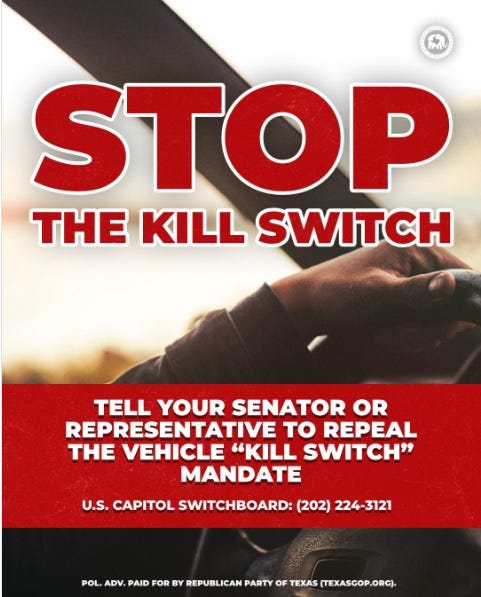
Your representatives most probably assume their constituents have no clue that the HALT Act is set for implementation in all 2027 cars. You can disabuse them of this notion by simply contacting your 2 State Senators and you House representative. And you can complete this simple task by simply calling the following number. Tell each of them that if the HALT Act is not immediately defunded you will vote them out in the next election.
Whatever you think of Trump -- and I have my concerns -- we should all be happy that he ended the Biden policies for EV Tax Credits and insane fuel economy standards. Among other things the wide adoption of EV’s would have put incredible strain on the electrical grid. And had Biden’s fuel economy standards remained new cars would have had to become lighter and thus less safe to drive.
=====
President Donald Trump’s signature on his so-called big beautiful bill was a death blow for tax credits that lowered the cost of electric vehicles. Those tax credits — worth up to $7,500 and $4,000 for purchases of new and used EVs, respectively — won’t be available after Sept. 30, 2025. Another tax break that’s ending lets dealers pass along savings on EV leases. The credits were supposed to last for another seven years, through 2032. Analysts think the abrupt end to these federal subsidies will trigger a rush by consumers to buy or lease an EV in coming months. “This is going to be the summer of the EV,” Ingrid Malmgren, senior policy director at Plug In America, a nonprofit advocating for a quicker transition to electric cars, previously told CNBC.
As $7,500 tax credit ends, consumers may rush to cash in. Here’s how to get a good deal (07/10/2025)
https://www.cnbc.com/2025/07/10/trump-big-beautiful-bill-ends-7500-ev-tax-credit-time-to-buy-vehicle.html
=====
=====
President Donald Trump is close to erasing the entirety of a Biden-era plan to transition the country to electric vehicles. On Wednesday, the president personally unveiled a Department of Transportation proposal to weaken fuel economy standards for cars and trucks. The plan would scrap rules that require cars to get 50.4 mpg by model year 2031, replacing them with standards that only require a fleetwide average fuel economy of 34.5 mpg. The move caps a year of policy reversals aimed at eviscerating federal support for EVs. In June, Trump signed a joint resolution from Congress aimed at preventing California from implementing its rules to phase out gasoline-powered vehicles — though litigation continues over whether that is binding. In July, he signed a megalaw that scrapped incentives for EVs and eliminated long-standing fines for automakers that fail to comply with fuel economy standards.
Trump caps EV assault with fuel economy repeal (12/04/2025)
https://www.eenews.net/articles/trump-caps-ev-assault-with-fuel-economy-repeal/
=====
Because of this change of policy U.S. and European automakers have lost an estimated $114 billion on electric vehicles (EVs) and Detroit’s “Big Three,” alone, have taken a $52.1 billion hit due to write-downs, canceled models, and slower-than-expected demand. EV’s never made any sense to begin with. Their demise needed to happen for a host of reasons. The fact of the matter is that EV sales were decreasing even before Trump’s changes in policy.
=====
As of early 2026, U.S. and European automakers have lost an estimated $114 billion on electric vehicles (EVs), with legacy automakers losing roughly $83.6 billion between 2022 and late 2025, according to New York Post. Detroit’s “Big Three” alone have taken a $52.1 billion hit due to write-downs, canceled models, and slower-than-expected demand.
Key Industry Losses (as of early 2026):
Total Industry Losses: Nearly $114 billion in combined losses (including EV startups).
Stellantis: Reported over $26 billion in write-downs.
Ford: Suffered a $19.5 billion write-down and reported over $16 billion in losses since 2022.
General Motors (GM): Recorded a $7.6 billion write-down.
Average Loss: Automakers lost an estimated $20,887 per EV sold between 2022 and Q3 2025.
Startups: Rivian and Lucid burned through a combined $30.2 billion in cash.
These massive losses are largely driven by overestimating demand, high production costs, and a pivot away from aggressive EV strategies as Yahoo Finance reports $55 billion in write-offs. This has forced automakers to cut costs, delay, or cancel electric projects, as discussed on Autoblog.
Google AI [how much did the auto industry loose on ev cars]
=====
The truth of the matter is that EV’s were basically secondary cars for the wealthy. In the following essay they make the argument that Ford, and the other car manufacturers misread the market. Certainly there is truth in that analysis. But it is also true that the car manufacturers were envisioning a future where no one would own a car, with exception of the very wealthy. The manufacturers would own a huge fleet of autonomous EV’s that would transport those leasing them for shopping, traveling to work etc. All part of the WEF’s globalist Great Reset where you would ‘own nothing and be happy. Also one of the dumbest ideas in human history.
=====
The hard truth is that Ford, which makes its money by selling F-150s and other trucks, didn’t understand who its customers are. As I explained in testimony to the Senate Energy and Natural Resources Committee in January 2024, EVs have always been a niche-market product, not a mass-market one. And that niche market is dominated by wealthy, white, male, liberal voters who live in a handful of heavily Democratic cities and counties. I wrote:
Further, that niche market is primarily defined by class and ideology. Some 57% of EV owners earn more than $100,000 annually, 75% are male, and 87% are white. Last March, Gallup reported, “a substantial majority of Republicans, 71%, say they would not consider owning an electric vehicle.” Last October, researchers at the University of California, Berkeley, released a remarkable study that found “counties with affluent left-leaning cities” like Cambridge, San Francisco, and Seattle “play a disproportionately large role in driving the entire national increase in EV adoption.” The researchers found that over the past decade, about half of all the EVs sold in the U.S. were sold in the most heavily Democratic counties in the country. The summary of the study deserves quoting at length:
“The prospect for EVs as a climate change solution hinges on their widespread adoption across the political spectrum. In this paper, we use detailed county-level data on new vehicle registrations from 2012-2022 to measure the degree to which EV adoption is concentrated in the most left-leaning U.S. counties. The results point to a strong and enduring correlation between political ideology and U.S. EV adoption. During our time period about half of all EVs went to the 10% most Democratic counties, and about one-third went to the top 5%. There is relatively little evidence that this correlation has decreased over time, and even some specifications that point to increasing correlation. The results suggest that it may be harder than previously believed to reach high levels of U.S. EV adoption.” (Emphasis added.)
Ford is a historic company. It spends millions per year on market research. And yet, Farley and his colleagues didn’t understand their market, and that lack of understanding has cost the company $35 billion. Ford’s EV disaster will go down as one of the biggest fiascos in modern automobile history. I’ve asked before, and I’ll ask again: Why does Jim Farley still have a job?
Ford’s $35.1 Billion EV Fiasco (12/15/2025)
Felony stupidity in Dearborn.
=====
Let me just say that I predicted the demise of EV’s back in 2023.
=====
In this essay I addressed the insanity of pushing Electric Vehicle (EV) production in the United States and throughout the planet. Under the guise of Fake Climate Change Biden is pushing EVs which rely on Child Slave Labor, do nothing to better the environment and are reliant on resources and technology owned by the Chinese Communist Party. At a time that China is threatening a war on Taiwan this is tantamount to treason and I am actually concerned the China may soon declare a direct war on the United States. There is no good reason to transition to EV’s at this time as the United States has enough fossil fuels for the next 200 years. Meanwhile Biden is doing everything he can to make fossil fuels more expensive which is responsible for the 10% inflation we have endured since he took office in 2021. Frankly I’d like to knock that shit eating smile off his face as he continues to destroy our republic. It will be up to the American People to rise up and demand an immediate end to EV production.
In this essay I also explain how Ford Motor and the WEF see a future where autonomous electric vehicles will transport citizens and most will no longer own a car. Even with the demise of the EV market cars, in general, are quickly becoming unaffordable.
=====
So today I will make another prediction.
I think those pushing for the HALT Act thought the public would just follow along like dumb sheep to the slaughter: unaware that their 2027 car would become a surveillance trap. But once the public understands the scope of surveillance and the increased cost of buying and maintaining these vehicles, they simply won’t buy them. The Big 3 lost over 50 billion by pushing EV’s that the public didn’t want in the first place. But EV’s were not even 5% of the overall car market. This will effect every single car produced beginning with 2027 models. It could literally bankrupt the entire car manufacturing industry.
So I both hope and predict that these “Kill Switch Cars” will stop being produced. And that could happen in a number of ways. The best way it could happen is Massie’s Bill will eventually pass, defunding the entire program. In that case the technology will not be implemented at all. The second way it could happen is people will simply refuse to buy this crap -- instead buying used cars that don’t have the technology. This will hopefully force the auto makers to disable the devices and stop including them in future cars.
But my readers can also help stop these “Kill Switch Cars” by sharing this essay and urging them to at least watch the two video I’ve recommended. After watching the videos no one is going to want to buy this crap.
There is little doubt that cars are becoming less affordable, along with everything else. Both the cost of buying and maintaining a car have far exceeded the annual rate of inflation. It is also difficult to figure out just how much the true cost has risen, since 1950, because of long term inflation and other factors. But basically it required 1000 hours of labor to purchase a car in 1950. Today an average new car requires at least 50% more labor to purchase: about 1580 hours of labor. And on top of that maintaining a car today is far more expensive due to all the electric devices and computer modules that simply did not exist in 1950.
=====
The number of average work hours required to purchase a new car has increased significantly since 1950, despite advancements in manufacturing efficiency. While a new car in the mid-1950s cost roughly $1,700–$1,900, a new vehicle in 2026 often costs over $50,000.
Average Work Hours to Buy a Car
* 1950s: A new car typically required roughly 900 to 1,000 hours of labor to purchase. In 1954, a Ford factory worker making roughly $1.89 an hour could afford a new car (≈$1,700) with less than a year’s wages.
* Today (2025–2026): Based on an average wage of ≈$31.80 per hour, a base-model vehicle (like a Ford Maverick) requires nearly 940 hours, while the average new car price (over $50,300) requires over 1,580 hours of labor.
Key Factors Influencing Cost
* Increased Features: Modern cars are more complex, requiring more manufacturing time for safety, electronic, and convenience features compared to the 1950s.
* Vehicle Cost vs. Income: While average incomes have increased, the price of new vehicles has outpaced wage growth, increasing the total work hours required for the average worker.
* Financing: Many modern consumers finance their purchases, with total costs, including interest, often exceeding 1,200 labor hours.
Historical Data Points
* 1950s: Average annual family income was ≈$3,300.
* 1954: Factory worker made ≈$1.89/hour or ≈$75/week.
* 2025: Estimated per capita personal income is ≈$63,620, or ≈$31.80/hour.
According to the American Enterprise Institute - AEI , there are alternative perspectives indicating that considering the increased longevity, safety, and features of modern cars, it may be a better time for car ownership than in the past.
Google AI [average work hous to buy a car since 1950]
=====
=====
The Model T brought mobility within reach of ordinary workers. Despite huge improvements, affordability has eroded as real costs climb.
How Many Work-Hours Does a Car Cost? The Model T to Today (01/29/2026)
https://thedailyeconomy.org/article/how-many-work-hours-does-a-car-cost/
=====
Whether you are using your iPhone, your computer, your social media, or driving your car, we are all increasingly facing what I would call Algorithmic Tyranny. Just a few years ago, for example, if you got suspended from Facebook it would be because of human intervention. But today, with the expansion of AI, it is much more likely you will get censored by an AI Agent. These AI Agents can do the work of thousands of humans and don’t sleep, take vacations or require things like health insurance. And their capabilities are expanding exponentially as they move toward what is called Artificial General Intelligence. They give plausible deniability to the corporations that control and program it. “It wasn’t us that caused your driverless car to run over that civilian, it was AI.”
One of the scary things about these AI Agents is there is no opportunity to challenge their actions. They become judge, jury and executioner. As a journalist I’ve certainly witnessed this on the Social Media platforms. When I was permanently banned from Facebook (January 2026) they didn’t even cite the post that got me suspended. And when you try to appeal their decision there is really no recourse and also no human interaction. That is bad enough. But just imagine driving your friends to a club in a questionable part of Detroit. You’re not drinking because you’re the designated driver. But when you leave the club at 1:30 AM all of your passengers are drunk. Once you start the car the “kill switch” smells alcohol and completely disables the car. You’re all screwed and there is no opportunity to appeal its decision. And this is but one of thousands of situations where this “kill switch” technology could put you in danger. The videos list dozens of problems with this technology. One of the creepiest aspects of this technology is the biometric scanning. If the biometric scanning determines you to be in the criminal database it won’t just disable the car. It will also call the police.
Is this really the future you want for current and future generations. Because you just know it is going to get worse in the future. Enough is enough. Please call you federal representatives and demand an end to these “Kill Switch” technologies.
=====
=====
6 Stats That Show How Unaffordable Car Ownership Has Become (08/19/2025)
https://money.com/unaffordable-new-car-ownership-costs/
=====
Ford’s New Patent Turns Your Truck Into a Rolling Surveillance State (04/27/2026)
=====
Ford Pro Telematics Solutions
https://www.fordpro.com/en-us/telematics/?
=====
Kill Switch Law: Who’s profiting from trapping you in your own car? (06/13/2025)
https://www.cbtnews.com/kill-switch-law-whos-profiting-from-trapping-you-in-your-own-car/
=====
Automakers Ruined New Cars — And They Did It On Purpose! (04/04/2026)
No posts
Comments
Nothing yet. Say the first thing.
Sign in to join the conversation.